
Evolution Against Entropy: Why the Universe Builds Instead of Breaking
Part 19 of the Elucidation series. Previously: Is History Going Somewhere?

• • •
Here is a paradox that sits at the heart of modern physics, and it is one that most people have never noticed.
The second law of thermodynamics tells us that in an isolated system, entropy tends to increase. Entropy increases. Engines wear down. Bodies age. Stars burn out. Organized structures do not last forever. This is one of the most firmly established laws in all of science.
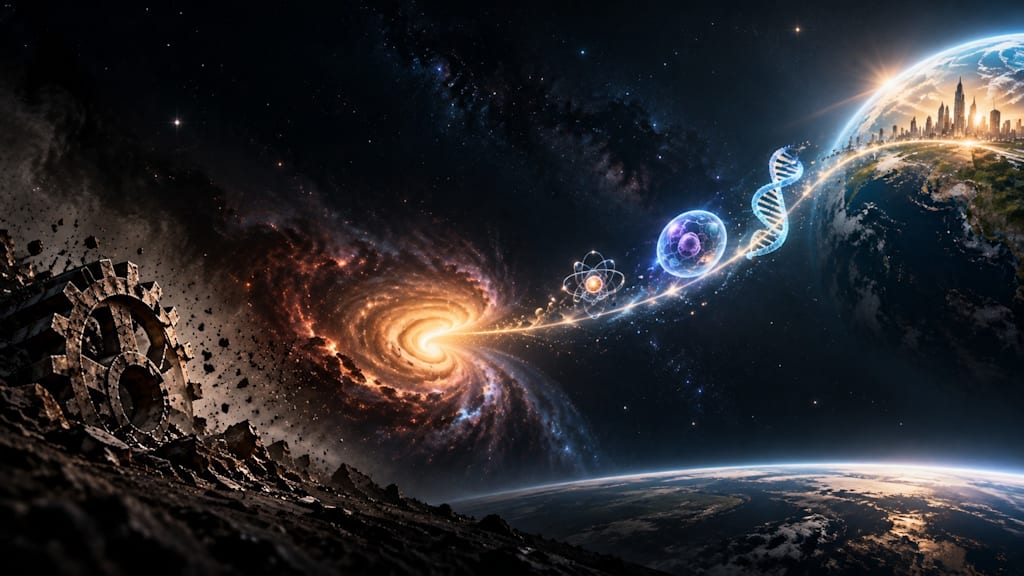
And yet, within this universe of increasing entropy, another remarkable pattern has appeared: matter has repeatedly formed structures of greater complexity.
The Car Engine and the Cosmos
Think of a car engine. As it operates, it gradually wears down. Friction erodes metal. Heat degrades components. Efficiency drops. Eventually, the engine fails. This gives us a simple picture of how organized systems gradually break down.
Now think of the universe. The same tendency toward decay can be seen throughout nature. Every star burns out. Every organism dies. Every mountain erodes. Every organized structure is subject to change and eventual breakdown.
But the total trajectory of the universe is upward. From the simple matter of the early universe to the staggering complexity of human civilization, the overall movement has been relentlessly toward greater order, greater structure, greater organization.
How is this possible? How can a universe governed by entropy produce such a remarkable growth of complexity?
The Anti-Entropic Nature of Development
We can identify this as one of the most profound features of evolutionary development: its anti-entropic character. Here, anti-entropic does not mean that evolutionary development violates the second law. It means that within a universe of increasing entropy, systems can still develop greater organization and complexity.
While each individual phenomenon grows old and passes away, the process as a whole can continue beyond it. A star dies, but from its scattered elements, new and more complex systems form. An organism dies, but life continues across generations, changing and diversifying. A civilization falls, but what it learned is carried forward into the next stage of human development.
It is as though the process of evolutionary development operates at a higher level than the individual phenomena within it. The parts decay. The larger process continues.
This is not a violation of entropy. It is something more subtle and, in some ways, more astonishing. Within the overall entropic tendency of the universe, there exists a counter-current, a force or pattern or tendency that works against dissolution, that pushes toward ever greater complexity and organization.
This does not give us a complete physical explanation for why complexity has emerged as it has. But the pattern itself deserves attention. Across billions of years of cosmic, chemical, biological, and human development, new levels of organization have repeatedly appeared: from simpler matter to complex structures, from non-living chemistry to life, and eventually from life to consciousness. Whatever is driving this process, it is real, it is powerful, and it has never been permanently stopped.
What This Means
The anti-entropic nature has profound philosophical implications.
First, it provides an objective basis for distinguishing between progress and decline. If the direction of existence is toward greater complexity and consciousness, then anything that moves in that direction is genuinely progressive, and anything that opposes it is genuinely regressive. This is not a matter of opinion. It is a feature of reality itself.
Second, it gives content to the concepts of truth and falsehood, right and wrong. The summit exists. The direction is real. And therefore each step, each action, each choice, each social system, can be evaluated against it. Not by personal preference, but by its alignment with the objective course of existence.
Third, it reveals what the obstacles to evolutionary development really are. Whether they take the form of ignorance of natural laws, uncontrolled instinct within the individual, or exploitation and oppression within society, all are barriers to further human development. In the human and social sphere, they can be understood as forces that restrict, damage, or obstruct that development. And they must be recognized and struggled against.
The Advance
This outlook can be summed up in a striking formulation:
A great advance is underway, and from this perspective we begin to see more clearly what truth and falsehood mean, and what direction the main path follows.
The main path. Not invented. Not imposed. Discovered, in the actual history of the universe, written in the evidence of 13.8 billion years.
In the next article, we transition from the history of evolutionary development to the search for its governing rules. The story has been told. Now we ask: what laws does it follow?
• • •
Next: Three Laws of Evolutionary Development**
Elucidation is a series of articles inspired by philosophical lectures given around 50 years ago. New articles are published weekly.
About the Creator
Han Elucidation
Why do we exist? A searcher. Exploring existence, meaning, and what it means to be human through the Elucidation series.
Enjoyed the story? Support the Creator.
Subscribe for free to receive all their stories in your feed.
Comments
There are no comments for this story
Be the first to respond and start the conversation.