
Endobronchial Ultrasound Biopsy Market Set for Strong Growth as Minimally Invasive Lung Cancer Diagnostics Gain Global Momentum
Advanced Pulmonary Diagnostic Technologies Are Reshaping Cancer Detection and Respiratory Care Worldwide

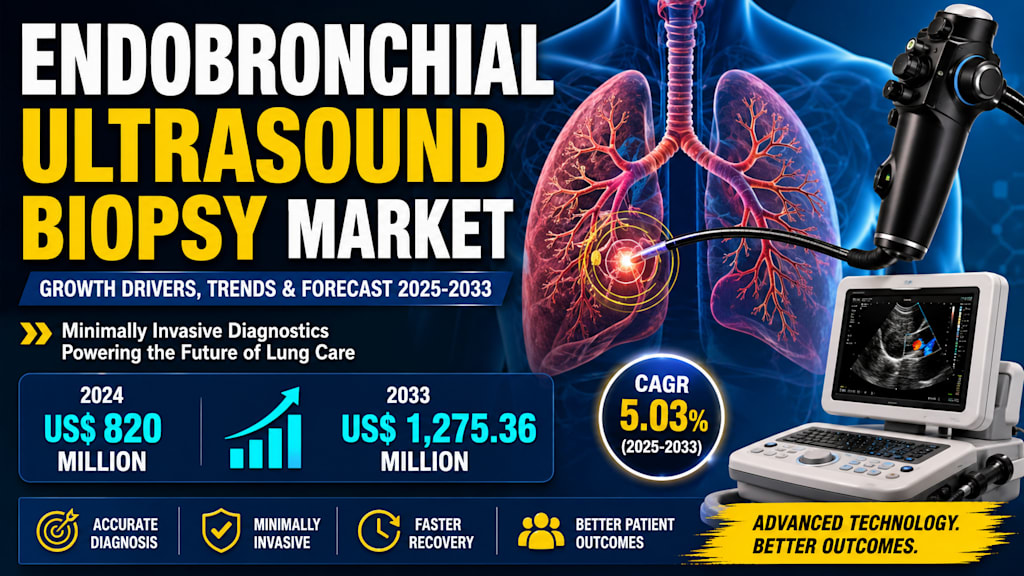
The global healthcare industry is witnessing a major transformation in diagnostic technologies, especially in the field of respiratory disease detection and lung cancer diagnosis. Among the technologies gaining rapid attention is Endobronchial Ultrasound Biopsy (EBUS), a minimally invasive diagnostic procedure that is revolutionizing pulmonary medicine.
According to recent market insights, the Endobronchial Ultrasound Biopsy Market is projected to grow from US$ 820 million in 2024 to nearly US$ 1,275.36 million by 2033, expanding at a CAGR of 5.03% during the forecast period from 2025 to 2033.
The increasing prevalence of lung cancer, rising respiratory illnesses, advancements in ultrasound-guided biopsy systems, and the global shift toward minimally invasive procedures are among the primary factors accelerating market growth worldwide.
Rising Burden of Lung Cancer Driving Demand for EBUS Procedures
Lung cancer remains one of the leading causes of cancer-related deaths globally. The increasing number of cases linked to smoking, environmental pollution, industrial exposure, and aging populations has intensified the need for accurate and early-stage diagnostic solutions.
Traditional surgical biopsies often involve longer recovery periods, higher risks, and increased hospitalization. EBUS-guided biopsy procedures provide a safer and less invasive alternative by enabling physicians to obtain tissue samples from lymph nodes and lung lesions through ultrasound-guided bronchoscopy.
Healthcare professionals increasingly prefer EBUS because it allows:
Real-time imaging guidance
Precise tissue sampling
Faster recovery
Reduced complications
Better patient comfort
Improved cancer staging accuracy
The technology has become especially critical in diagnosing and staging non-small cell lung cancer (NSCLC), one of the most common forms of lung cancer worldwide.
According to estimates from the American Cancer Society, approximately 226,650 new lung cancer cases are expected in the United States in 2025. This growing disease burden is significantly boosting the adoption of EBUS biopsy procedures across hospitals and specialty clinics.
Minimally Invasive Diagnostics Becoming the Future of Healthcare
One of the strongest trends shaping the medical industry today is the shift toward minimally invasive procedures. Patients and healthcare providers alike are prioritizing technologies that reduce surgical trauma, shorten recovery times, and minimize hospital stays.
Endobronchial ultrasound biopsy fits perfectly within this evolving healthcare model.
Unlike traditional surgical lung biopsies, EBUS procedures are performed under moderate sedation and local anesthesia. This significantly lowers procedural risks while improving operational efficiency in healthcare facilities.
The demand for minimally invasive pulmonary diagnostic tools is also growing due to:
Increasing healthcare costs
Rising awareness among patients
Expanding outpatient treatment models
Greater focus on early cancer detection
Improvements in imaging technologies
As hospitals continue investing in advanced diagnostic infrastructure, EBUS systems are expected to become standard equipment in modern pulmonary care centers.
Technological Advancements Accelerating Market Expansion
Continuous innovation in imaging technologies and biopsy instruments is playing a crucial role in expanding the Endobronchial Ultrasound Biopsy Market.
Leading medical device manufacturers are investing heavily in:
Enhanced ultrasound imaging systems
Real-time needle guidance technologies
High-definition visualization tools
Improved bronchoscope flexibility
AI-assisted imaging solutions
Advanced biopsy accessories
These innovations are improving diagnostic precision while reducing operator dependency.
Modern EBUS systems now offer superior image clarity and deeper lesion access, enabling pulmonologists to diagnose complex thoracic conditions with greater confidence.
The integration of advanced imaging processors is also helping clinicians identify difficult-to-reach lesions that were previously challenging to access using conventional methods.
As technological barriers continue to decline, adoption rates are expected to accelerate across both developed and emerging healthcare markets.
Respiratory Diseases Beyond Cancer Fueling Market Demand
Although lung cancer remains the primary application area, EBUS biopsy procedures are increasingly being used to diagnose several other respiratory conditions.
Growing incidences of diseases such as:
Tuberculosis (TB)
Chronic Obstructive Pulmonary Disease (COPD)
Pulmonary infections
Sarcoidosis
Mediastinal disorders
are creating additional demand for accurate and minimally invasive diagnostic procedures.
Air pollution, urbanization, tobacco consumption, and aging populations are contributing to the rise in chronic respiratory disorders worldwide.
Healthcare providers are increasingly utilizing EBUS-guided procedures to obtain tissue samples and evaluate suspicious lymph nodes without subjecting patients to invasive surgeries.
This broader application spectrum is helping expand the market far beyond oncology alone.
Aging Global Population Creating Long-Term Market Opportunities
The global population is aging rapidly, creating a significant long-term opportunity for pulmonary diagnostic technologies.
Older adults are more susceptible to:
Lung cancer
Respiratory infections
Chronic pulmonary diseases
Immune-related complications
According to global demographic estimates, the population aged 60 years and above is expected to surpass 1.4 billion by 2030.
This demographic shift is expected to place enormous pressure on healthcare systems to provide early, efficient, and minimally invasive diagnostic solutions.
EBUS procedures are particularly beneficial for elderly patients because they involve lower procedural risks compared to surgical alternatives.
As healthcare systems prioritize geriatric care and chronic disease management, the role of EBUS technologies is expected to expand substantially over the next decade.
Emerging Markets Becoming Major Growth Engines
Developing countries across Asia-Pacific, Latin America, and the Middle East are emerging as important contributors to the growth of the EBUS biopsy industry.
Countries such as India, China, Saudi Arabia, and Brazil are witnessing:
Rapid healthcare infrastructure expansion
Growing investments in medical technologies
Increased awareness of lung diseases
Higher cancer screening rates
Government support for healthcare modernization
Hospitals and specialty clinics in these regions are increasingly adopting advanced bronchoscopy and ultrasound systems to improve diagnostic capabilities.
India, in particular, is experiencing rising adoption of EBUS procedures due to expanding healthcare access and increasing awareness regarding early-stage cancer diagnosis.
As emerging economies continue strengthening healthcare systems, demand for modern pulmonary diagnostic tools is expected to rise sharply.
High Equipment Costs Remain a Significant Challenge
Despite strong market potential, several challenges continue to limit widespread adoption of EBUS technologies.
One of the biggest barriers is the high cost associated with:
EBUS scopes
Ultrasound processors
Imaging systems
Specialized biopsy needles
Equipment maintenance
Staff training
Smaller hospitals and clinics often struggle to justify the large upfront investments required for implementing EBUS systems.
In many low-resource settings, healthcare providers continue relying on conventional diagnostic approaches due to financial constraints.
Additionally, maintenance expenses and ongoing operational costs further increase the burden on healthcare institutions.
Manufacturers are therefore focusing on developing cost-efficient solutions to improve affordability and expand market penetration.
Shortage of Skilled Professionals Slowing Adoption
Another major challenge facing the market is the limited availability of trained pulmonologists and technicians capable of performing EBUS procedures effectively.
Successful EBUS-guided biopsies require:
Advanced bronchoscopy skills
Expertise in ultrasound interpretation
Experience in tissue sampling techniques
Specialized clinical training
Unfortunately, many emerging regions continue facing shortages of highly trained healthcare professionals.
This skills gap affects procedural quality, diagnostic accuracy, and patient outcomes.
To address this issue, healthcare organizations and medical device companies are increasingly investing in:
Training workshops
Simulation-based learning
Clinical education programs
Physician certification initiatives
Strengthening professional training infrastructure will be critical for unlocking the full potential of the EBUS market globally.
United States Leading Global Market Expansion
The United States currently represents one of the largest markets for Endobronchial Ultrasound Biopsy technologies.
Several factors contribute to the country’s market dominance, including:
High lung cancer incidence
Advanced healthcare infrastructure
Strong reimbursement systems
Early adoption of medical technologies
Presence of major medical device manufacturers
American hospitals are increasingly integrating EBUS procedures into standard lung cancer diagnostic pathways.
The country's strong emphasis on early detection and minimally invasive treatment approaches continues driving technological adoption across healthcare institutions.
Research initiatives and continuous product innovation are also strengthening the United States’ position as a global leader in pulmonary diagnostic technologies.
Competitive Landscape Intensifying Among Major Industry Players
The Endobronchial Ultrasound Biopsy Market is becoming increasingly competitive as leading medical technology companies continue investing in innovation and strategic expansion.
Major companies operating in the industry include:
GE Healthcare
Siemens Healthcare
Koninklijke Philips N.V.
Boston Scientific Corporation
Olympus Corporation
Cook Group Incorporated
FUJIFILM Holdings Corporation
Medi-Globe Technologies GmbH
These companies are actively focusing on:
Product launches
FDA approvals
Strategic collaborations
Imaging technology advancements
AI-enabled diagnostics
Expansion into emerging markets
Competition is expected to intensify further as demand for minimally invasive pulmonary diagnostic solutions continues rising globally.
10 Recent Developments in the Endobronchial Ultrasound Biopsy Industry
1. GE Healthcare Expands Imaging Equipment Production
In October 2024, GE Healthcare announced the expansion of its medical imaging equipment manufacturing operations in Wisconsin to meet growing global demand.
2. FUJIFILM Launches Advanced ARIETTA 750 FF ENDO System
FUJIFILM Healthcare Europe introduced enhanced compatibility features for its ARIETTA 750 FF ENDO ultrasound platform in September 2024.
3. Praxis Receives FDA Approval for EndoCore EBUS-TBNA Device
Praxis secured FDA approval for its advanced biopsy solution aimed at improving tissue sampling efficiency during EBUS procedures.
4. Olympus Continues Expanding Bronchoscopy Portfolio
Olympus Corporation strengthened its pulmonary diagnostics division through continued innovation in bronchoscopy imaging technologies.
5. Boston Scientific Focuses on Minimally Invasive Pulmonary Solutions
Boston Scientific expanded research activities targeting advanced respiratory diagnostic technologies.
6. Philips Accelerates AI-Driven Imaging Innovation
Philips invested heavily in AI-assisted ultrasound imaging systems to improve diagnostic accuracy.
7. Siemens Healthineers Strengthens Diagnostic Imaging Capabilities
Siemens continued enhancing imaging integration technologies supporting pulmonary diagnostic procedures.
8. Cook Medical Enhances Biopsy Needle Technologies
Cook Medical advanced specialized needle systems designed for improved tissue collection efficiency.
9. Increased Investment in Physician Training Programs
Several manufacturers expanded physician education initiatives to address shortages of skilled EBUS specialists.
10. Growing Adoption of Real-Time Imaging Guidance Systems
Healthcare institutions worldwide accelerated deployment of real-time ultrasound-guided bronchoscopy technologies.
Final Thoughts
The global Endobronchial Ultrasound Biopsy Market is entering a transformative growth phase fueled by rising lung cancer cases, technological innovation, and the healthcare industry’s growing preference for minimally invasive diagnostic procedures.
As hospitals continue prioritizing precision medicine and early-stage disease detection, EBUS-guided biopsy technologies are becoming indispensable tools in modern pulmonary care.
Although challenges such as high equipment costs and limited skilled personnel remain significant, continuous innovation and expanding healthcare infrastructure across emerging markets are expected to create substantial long-term opportunities.
With strong investments from leading medical technology companies and increasing global awareness regarding advanced respiratory diagnostics, the future of the Endobronchial Ultrasound Biopsy industry appears highly promising through 2033.
About the Creator
Enjoyed the story? Support the Creator.
Subscribe for free to receive all their stories in your feed.
Comments
There are no comments for this story
Be the first to respond and start the conversation.