
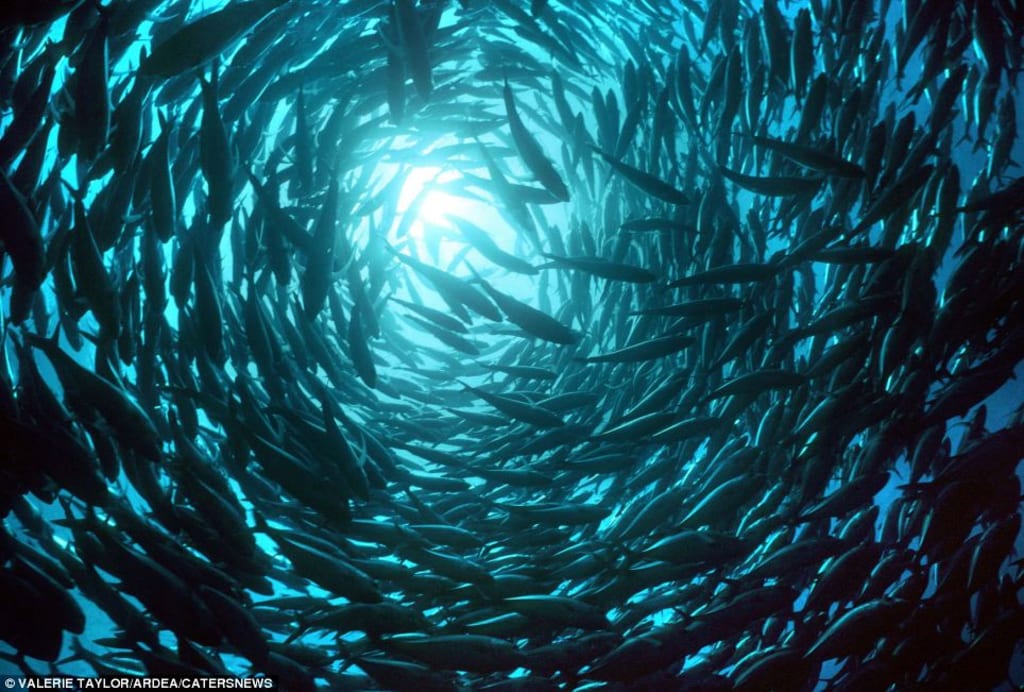
Indeed, Earth's largest animal migrations often take place underwater, and they are quite different from the more commonly known terrestrial migrations. One of the most remarkable examples of this is the vertical migration of marine organisms, which occurs daily in the world's oceans.
Every night, countless marine creatures, including zooplankton, fish, and invertebrates, undertake a synchronized journey from the deeper, darker layers of the ocean to the surface waters. This mass migration is driven by a variety of factors, with one of the primary ones being the search for food. Many of these creatures feed on phytoplankton, which photosynthesize near the surface during daylight hours. By ascending to the surface at night, they can feed on this abundant food source.
This phenomenon is often referred to as the "diel vertical migration" (DVM) and is a crucial part of the ocean's food web. It has a profound impact on the distribution of nutrients and energy throughout marine ecosystems. Additionally, it serves as a critical survival strategy for many species, allowing them to avoid predators that may lurk in deeper waters during the day.
The scale of this daily migration is staggering, with billions or even trillions of individual organisms participating each night. It's a reminder of the incredible diversity and complexity of life beneath the ocean's surface, which is often hidden from our view but plays a vital role in maintaining the health of our planet.
During World War II, the development and use of sonar technology played a significant role in naval warfare. Sonar, which stands for "Sound Navigation and Ranging," is a technology that uses sound waves to detect objects underwater. While sonar was primarily developed for military purposes, it had some unexpected discoveries during the war, including the detection of strange signals rising from the deep ocean.
These signals were initially perplexing because they seemed to indicate that parts of the ocean floor were moving up and down dramatically, by as much as 3,000 feet. However, it was soon realized that the sonar was not detecting geological movements but rather the presence of vast numbers of tiny marine organisms, particularly marine life that was part of the deep scattering layer.
The deep scattering layer is a region of the ocean where various marine creatures, such as zooplankton and small fish, migrate daily in response to changes in light levels. During the day, they stay at deeper depths to avoid predators, and at night, they rise closer to the surface to feed on phytoplankton, which undergoes photosynthesis during daylight hours.
When these dense aggregations of marine life ascended toward the surface, they reflected sonar signals, creating the illusion of the ocean floor rising and falling. This phenomenon was an intriguing discovery during World War II and helped researchers understand more about the behavior and distribution of marine organisms in the ocean's depths.
It's an example of how scientific advancements sometimes arise unexpectedly during times of conflict, leading to a better understanding of the natural world.
The daily migration of zooplankton from the depths of the ocean to the surface and back down again is indeed a fascinating and mysterious phenomenon. Scientists have been studying this behavior for many years, and while the exact reasons for this migration are not fully understood, several factors have been proposed to explain it.
1. Feeding: One of the primary reasons for zooplankton's daily vertical migration is feeding. Zooplankton, which includes tiny animals like copepods and krill, primarily feed on phytoplankton, which are microscopic plant-like organisms that perform photosynthesis near the surface of the ocean during daylight hours. By ascending to the surface at night, zooplankton can take advantage of this rich food source.
2. Predation Avoidance: During the day, zooplankton are vulnerable to visual predators, such as fish and other marine creatures, that hunt near the surface. By descending to deeper, darker waters during daylight hours, zooplankton can avoid these predators and reduce their risk of being eaten.
3. Temperature and Light: Temperature and light levels in the ocean change with depth. Some species of zooplankton are sensitive to temperature and light, and they may migrate to find conditions that are most suitable for their survival and reproduction. For example, they may seek warmer waters near the surface at night.
4. Biological Clocks: Many marine organisms, including zooplankton, have internal biological clocks that help regulate their daily activities. These clocks are synchronized with the natural day-night cycle and play a role in governing the timing of their migrations.
5. Ocean Circulation and Tides: Ocean currents and tides can also influence the vertical movements of zooplankton. Some researchers believe that these factors might help transport zooplankton to different areas of the ocean, where they can find new sources of food or avoid unfavorable conditions.
6. Climate Change: Recent research suggests that climate change may be affecting the timing and patterns of zooplankton migrations. Changes in ocean temperature and chemistry can influence the distribution and abundance of phytoplankton, which, in turn, can impact the behavior of zooplankton.
The daily migration of zooplankton is a complex and intricate phenomenon that likely involves a combination of these factors and more. Scientists continue to study this mysterious migration to gain a better understanding of its ecological significance and the broader implications it may have on marine ecosystems and climate-related processes.
This highlights the incredible distances covered by tiny zooplankton during their daily journeys and the important ecological roles these migrations play:
1. Tiny Zooplankton: Zooplankton are incredibly small organisms, often smaller than the tip of a crayon. Despite their small size, they undertake immense journeys in the ocean.
2. Enormous Scale: If you were to scale these migrations to a human, it would be like running a 10K race twice a day, at twice the speed of an Olympic marathon runner.
3. Diel Vertical Migration (DVM): DVM refers to the daily migration of marine organisms, such as zooplankton and some fish, from the deeper, darker layers of the ocean to the surface and back again. This migration involves navigating through varying light and temperature conditions.
4. Reasons for Migration: Zooplankton migrate to the surface at night to feed on phytoplankton, which photosynthesize during the day. This allows them to take advantage of the rich food source while avoiding daytime predators. They return to deeper waters during the day to avoid visual predators.
5. Light and Circadian Rhythms: Zooplankton are highly photosensitive, and their migrations are influenced by changes in light. Researchers have discovered that they might have circadian rhythms, similar to those found in land organisms, which regulate their behaviors.
6. Role in Carbon Sequestration: Vertical migration plays a vital role in the biological carbon pump. Organisms that photosynthesize at the surface capture carbon dioxide from the atmosphere. When they sink to the deep sea after being consumed by predators or when they die, they transport this carbon to the deep ocean, sequestering it from the atmosphere and helping mitigate climate change.
7. Importance for Ocean Health: DVM is crucial for ocean ecosystems. It transfers nutrients and energy throughout the marine food web, supporting the health of the planet and providing a key source of food for larger organisms, including fish.
8. Human Impact: Disrupting vertical aquatic migrations could have severe consequences for ocean food webs and climate regulation. Understanding and protecting these migrations are critical for maintaining the health of our planet.
About the Creator
Enjoyed the story? Support the Creator.
Subscribe for free to receive all their stories in your feed.
Comments
There are no comments for this story
Be the first to respond and start the conversation.