
Earth Isn’t Late to the Universe. It Arrived Right on Time.
A 13.8-billion-year timeline shows why earlier civilizations are possible, why they probably didn’t move Earth, and why the evidence still points to us evolving here.
1. The Time Gap Is Not 3.7 Billion Years
The universe is about 13.8 billion years old. Earth is about 4.54 billion years old. The Solar System formed about 4.6 billion years ago.
When Earth was born, the universe had already been around for about 9.2 billion years. The arithmetic is not 8 billion minus 4.6 billion. If we use the marker “8 billion years after the Big Bang,” Earth came about 1.2 billion years later.
The universe did not have a switch that suddenly flipped to “stable” 8 billion years ago. About 100 to 200 million years after the Big Bang, the first stars began to shine. They were massive and short-lived, and they soon ended in supernova explosions, scattering the first heavy elements into interstellar space. After that, galaxies gradually assembled, cosmic reionization was completed, and the star formation rate slowly rose. About 10 billion years ago, the star formation rate reached its peak, often called “cosmic noon.” After that, the star formation rate declined, and the universe became quieter. There was no single moment that said: from today on, the universe is stable.
When Earth formed, the universe was not young. It was also not a stage that had long been prepared and was waiting for civilization to appear.
2. Rocky Planets Need Materials
The Big Bang directly produced only hydrogen, helium, and a small amount of lithium. The iron, silicon, oxygen, magnesium, calcium, aluminum, and other elements needed for rocky planets had to be slowly produced by nuclear fusion inside stars, supernova explosions, neutron star mergers, and similar processes. The first generation of stars were almost all metal-poor. Around them, it was hard for enough rocky material to form Earth-like planets.
The early universe was also more violent. Supernova explosions, gamma-ray bursts, and strong cosmic radiation were more frequent. Galaxy collisions were more intense. Even if a rocky planet happened to form, its surface environment could be repeatedly destroyed. Life needs relatively long-term stable conditions. The early universe may not have been able to provide them.
Earth appeared about 4.6 billion years ago, when heavy elements were abundant enough and the environment was relatively suitable. It was not the first planet in the universe. It was also not squeezed out during a period of material shortage and fierce radiation.
3. Earth’s Place in Planet Formation History
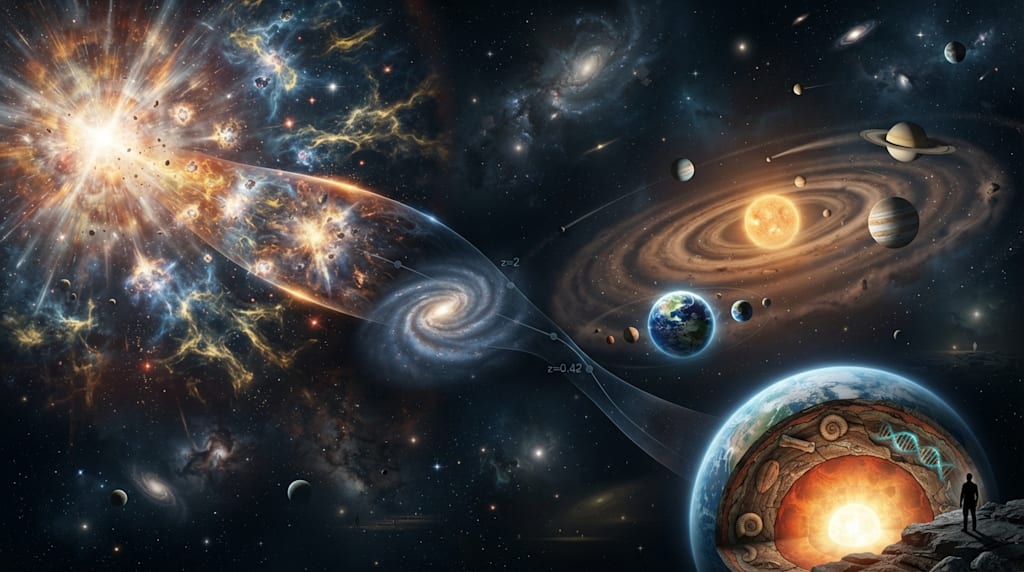
If we look only at the star formation rate, Earth came later than cosmic noon. Cosmic noon was around redshift z ≈ 1.5 to 2. Earth formed around redshift z ≈ 0.42. Earth did not form when the universe was at its busiest.
If we look at the formation rate of rocky planets in habitable zones, the situation is different. In recent years, some semi-empirical models have estimated that Earth appeared near the peak of the formation rate of habitable-zone rocky planets. From the perspective of forming rocky planets suitable for long-term life, Earth is not too late.
Some models have given rough estimates. In the currently observable universe, there may be about 10^20 rocky planets. About 10^18 may be in habitable zones. Among these habitable-zone rocky planets, about 10^17 may have formed earlier than Earth. About 9 × 10^17 may be the same age as Earth or younger.
These numbers come from models, not direct observational counts. The “habitable zone” itself has no unified standard. Even so, these numbers show one thing. Earth is not the earliest planet in the universe, and it is probably not the latest. It is in a middle-to-late position, but still within the active period of planet formation history.
4. Earlier Civilizations: Possible, but Not Proof of a Creator
If some civilizations appeared billions of years earlier than humanity, statistically they cannot be ruled out. The observable universe has a huge number of planets. Some of them may have formed billions of years earlier than Earth. If life and civilization are not rare in the universe, some civilizations may be billions of years ahead of us.
“Possible” does not mean “they came.”
First, the probability of the origin of life is unknown. We only know that life appeared on Earth. We do not know how likely it is for life to arise from nonliving matter. It may be common. It may be extremely rare.
Second, from single-celled life to multicellular life, to complex intelligence, to technological civilization, each step requires a series of conditions. Earth took about 4 billion years to reach technological civilization. This process may not be inevitable.
Third, a civilization lasting billions of years is not guaranteed. Technological civilizations are especially fragile. Nuclear war, climate change, resource depletion, runaway artificial intelligence, viruses, asteroid impacts, and gamma-ray bursts could each interrupt a civilization. A civilization that is 1 billion years ahead of us has not necessarily progressed continuously for 1 billion years. It may have long been extinct. It may have restarted many times. It may have stagnated for a long time.
Fourth, the cost of interstellar travel is extremely high. The speed of light is the limit. Interstellar distances are measured in light-years. Even if a civilization could build enormous spacecraft, colonizing the entire galaxy would require immense time and energy. They may not be interested. They may not be able to sustain it for billions of years.
The Fermi paradox asks why we have not seen a single civilization if the universe should contain many. There are many possible explanations. We are the first batch. They are very rare. They are short-lived. They do not communicate. They came but left no traces. We have not searched enough. None of these explanations directly leads to “they dragged Earth here and created humanity.”
5. Earth Was Dragged Here: The Evidence Does Not Support It
“The Earth was originally not in the habitable zone, and a super civilization dragged it here” is cool in science fiction. It is very difficult to establish scientifically.
Earth formed near its current orbit. Geological records, meteorite isotopes, models of the Moon’s formation, and Solar System dynamics simulations all point to Earth having formed naturally in the inner region of the Solar System. The early Solar System did indeed experience giant planet migration. For example, the “Nice model” suggests that the orbits of Jupiter, Saturn, Uranus, and Neptune once changed. This does not mean Earth was dragged into the habitable zone from somewhere far away.
If a super civilization wanted to move Earth, it would need to change Earth’s enormous orbital energy. This is not as simple as giving it a push. It would leave obvious dynamical disturbances on other bodies in the Solar System. It would also leave traces in Earth’s internal structure, isotope ratios, and geological record. No such traces have been observed.
The “habitable zone” is also not a narrow strip that only one planet can occupy. The Solar System’s generalized habitable zone can be drawn from about 0.725 to 3 astronomical units from the Sun. Mars is within it in the broad sense. Venus was once in the habitable zone under some definitions. The definition of the habitable zone varies with factors such as atmosphere, greenhouse effect, clouds, oceans, and tidal heating. Earth’s position is good. It is not the only possible position.
Earth does not need to be dragged here by anyone. It was already in a good position. That position was roughly determined when the Solar System formed.
6. Humans Were Created: Biology Does Not Support It
If some super civilization created us, they either directly designed life, modified existing organisms, or seeded life on Earth. In any case, they should have left identifiable traces.
Modern biology gives a very consistent picture. All life on Earth shares the same genetic code, the same types of nucleic acids, and the same types of protein synthesis mechanisms. Humans share common ancestors with chimpanzees, gorillas, orangutans, and monkeys. The fossil record and molecular clocks corroborate each other. Homo sapiens appeared in Africa about 300,000 years ago and then gradually spread across the globe. Our genome is full of endogenous retroviruses, pseudogenes, redundant sequences, and evolutionary patches such as the appendix, wisdom teeth, and the birth canal dilemma.
If humans were carefully designed, there would be less imperfect historical leftovers. Our DNA would not be so similar to that of other primates. The fossil record would not show a continuous evolutionary chain. These observations are explainable by natural evolution. External design requires additional assumptions.
There is no evidence that humans are the product of an external civilization. We are more like a branch on the tree of life on Earth than a product in some laboratory.
7. The Habitable Zone Is Not a Life Switch
When discussing extraterrestrial life and prehistoric civilizations, people often treat the “habitable zone” as a hard standard. Only planets in the habitable zone can have life, according to this view. That view is incomplete.
The habitable zone usually considers only the possibility of stellar radiation and liquid water. Its definition is not unified. For the Solar System, the generalized habitable zone can be very wide. The narrow habitable zone depends on atmospheric models. Venus may once have been in the habitable zone. Mars is also within it in the broad sense. Europa and Enceladus are icy on the surface, but their subsurface oceans may be suitable for some microorganisms because of tidal heating and radioactive decay heat.
There are many extremophile microorganisms on Earth that can use chemical energy and radiation energy to survive. They can live in deep-sea hydrothermal vents, underground rock layers, acidic lakes, and high-salinity environments. If we define “habitable” according to the environmental tolerance of these organisms, the number of potentially habitable bodies in the universe would increase greatly.
This expands the range of “life may exist.” It is not evidence that a super civilization created humans. Life may be very tenacious and may be widespread in the universe. This still does not mean that some advanced civilization once came to Earth and manipulated our origins.
8. If You Want to Write Science Fiction
Although the scientific evidence is lacking, this question is suitable for science fiction. You can start from several directions.
Seeding scenario. An ancient civilization seeded microorganisms on habitable planets in the galaxy. Earth was just one of them. Humans were not created. They were seeded. The conflict lies in this: we have found traces of the seeding, but we cannot confirm whether the seeders still exist.
Earth relocation scenario. A civilization moved Earth from a less habitable position to its current orbit. This scenario needs to explain the enormous energy source, why the traces of relocation have not been discovered, and why they did it.
Human experiment scenario. Humans are the product of a genetic experiment by a civilization. This scenario needs to explain the fossil record, endogenous retroviruses, and genetic similarities with other primates. Otherwise, it easily becomes inconsistent.
Non-interference observation scenario. A super civilization discovered Earth long ago but chose not to interfere. They may have left hidden observation points. Some of our unsolved mysteries may be their traces. This scenario is easier to keep suspenseful.
We are their descendants. They did not create us. They once lived on Earth, then left or went extinct. We are merely their distant relatives. This scenario can avoid the problem of design traces.
When writing, the setting does not have to be absolutely scientific. It has to be internally consistent. The conflict should come from the process of discovering evidence. Readers care less about how powerful they are and more about who we are.
9. Facts That Can Currently Be Confirmed
Earth formed about 4.54 billion years ago. The Solar System formed about 4.6 billion years ago. The universe is about 13.8 billion years old. Homo sapiens appeared about 300,000 years ago.
Earlier civilizations cannot be statistically ruled out. In the observable universe, there are enormous numbers of planets. Some of them may have formed billions of years earlier than Earth. There is no evidence that they moved Earth or created humans. Geological records, isotopes, fossils, and molecular clocks all point to Earth having formed naturally near its current orbit in the Solar System. Life originated and evolved naturally on Earth.
Earth did not arrive early or late. It is a natural product of the universe’s chemical evolution at a certain stage.
About the Creator
Jin
Writer of reamstories
https://reamstories.com/jin
Enjoyed the story? Support the Creator.
Subscribe for free to receive all their stories in your feed. You could also become a paid subscriber, letting them know you appreciate their work.
Comments
There are no comments for this story
Be the first to respond and start the conversation.