
Earth Already Has Immortal Creatures. Evolution Still Chose Death.
From 101-million-year-old deep-sea bacteria to 80,000-year-old aspen clones, nature built near-immortals. Here is why it never built one that cannot be killed.
“Immortality” splits into two meanings. Biology has one. Physics has the other.
Biological immortality means no built-in expiry date. If nothing eats it, crushes it, infects it, or drops a catastrophe on it, it will not die of old age. Physical immortality means nothing can kill it at all. No knife. No fire. No radiation. No black hole.
The first kind exists on Earth. The second kind cannot exist in ordinary matter.
Evolution did not choose the second. We keep missing the first.
I. Earth already has ageless residents
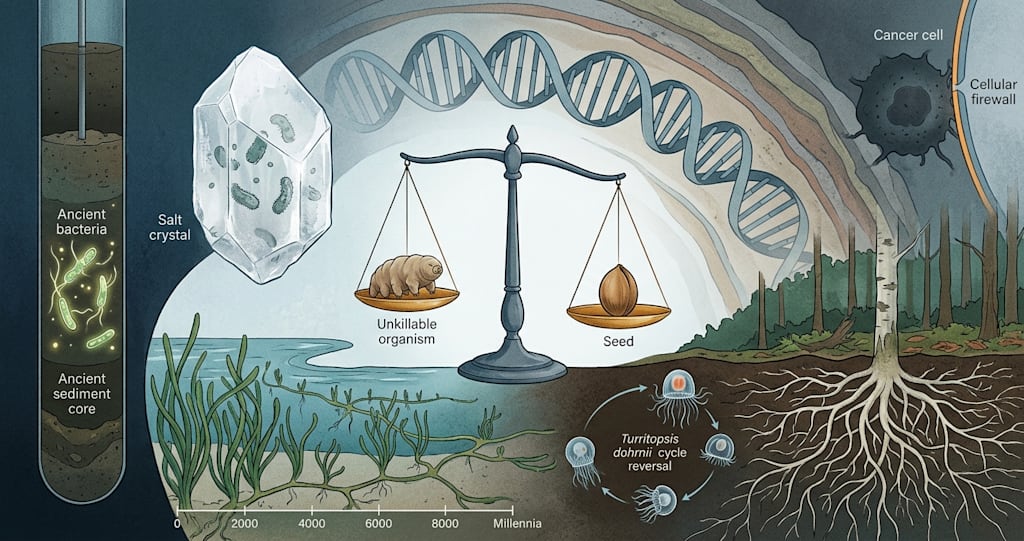
In deep-sea sediment, some microbes slow their metabolism until it is barely measurable. Bacteria in the South Pacific Gyre stopped dividing long ago. They use a tiny energy flow for self-repair. In 2019, Japanese researchers found aerobic bacteria in deep-sea sediment that had survived on extremely low energy for about 101.5 million years.
In 2000, researchers at West Chester University found dormant bacteria inside salt crystals from a nuclear waste site in New Mexico. The crystals formed 250 million years ago. Sterilization cut the odds of modern contamination to less than one in a billion. In 2006, the same team revived Cretaceous halophilic archaea from salt crystals.
Eocene bacteria from the Yunying salt mine in Hubei, China, are polyploid. Extra copies of their genome help them withstand time. In coal and sediment 2,000 meters below the Pacific seafloor, 5 to 30 million years old, each cubic centimeter holds 50 to 2,000 live bacteria. In rich nutrients, these bacteria may need tens of days to 100 years to complete a generation.
Eukaryotes have their own long-lived cases. Some clonal seagrass meadows of Posidonia oceanica and Posidonia australis are estimated at 4,000 to 100,000 years old. The underground clone of the quaking aspen called Pando may be 8,000 to more than 80,000 years old. Turritopsis dohrnii, the jellyfish, can reverse its life cycle under certain conditions. Hydra and other animals show negligible senescence.
These organisms have not beaten death. They have pressed life into a low flame. They do not reproduce quickly, move much, or expand far. They repair themselves at a crawl. They have no internal lifespan limit, but they still face external death. Seagrass can be wiped out by sea-level change, pollution, or disease. Aspen can be weakened by herbivores, pathogens, and climate change. Jellyfish can be eaten, infected, or injured.
They are not unkillable. They may simply live on if nothing kills them.
II. Evolution does not aim for individual immortality
We often picture evolution as a ladder toward stronger, faster, longer-lived bodies. Evolution has no direction and no goal. It filters for solutions that leave more offspring in the current environment.
Natural selection does not care how long an individual lives. It cares whether genes pass on. Once an organism reaches reproductive age and raises offspring, it has done its evolutionary job. Whether it then lives ten years, a hundred years, or slowly ages and dies exerts weak pressure. Aging often happens after reproduction. The post-reproductive body matters less to selection.
This is the disposable soma theory. The body is a gene’s vehicle, a machine built to be discarded. Energy and resources are limited. Spend them on endless repair, and there is less for reproduction. Build a body that lasts until reproduction is done, then send resources to the next generation.
Immortality would require endless maintenance of DNA, proteins, cells, and tissues. Reproduction only requires passing on genetic information. For evolution, the second option is usually cheaper and more effective.
There is also antagonistic pleiotropy. Some genes boost growth and reproduction early in life, then cause aging, cancer, and degeneration later. Selection favors them when they help the young. Their late-life damage is harder to remove. Genes that drive cell division can mature an animal faster, but they also raise cancer risk later. Natural selection is not a precision engineer. It is a repairman working with limited time and parts. If a trait works when young, its late-life cost can survive.
Evolution did not aim for immortality. Immortality was never the default answer.
III. Immortality and cancer cannot coexist easily
For multicellular life, immortality has a fatal conflict. Immortalized cells are cancer cells.
A multicellular body must limit infinite cell division to keep order. Every cell can divide. If one cell divides without limit, refuses death, and expands without end, it becomes a tumor. To suppress cancer, multicellular organisms evolved telomere shortening, p53, Rb, and other brakes. These brakes make cells senesce or die after a certain number of divisions. They protect the whole body. They also drive aging.
To get both individual immortality and cancer defense, a body would need extreme regulation. Every cell would need to repair itself for centuries while never dividing out of control. It would need to replace damage without crossing boundaries. Theoretically, this is not impossible. In evolutionary practice, it is brutally difficult. Cancer comes from inside the body, from a broken internal rule. Immortality requires loosening limits on cell death. Loosening those limits opens a door for cancer.
Aging in multicellular life is part of the price for suppressing cancer. Death is a cost the system pays for order.
IV. A changing world punishes the unchanged
The immortal has a hidden weakness. It does not change.
Climate changes. Food changes. Predators change. Pathogens change. Parasites and pathogens reproduce fast and mutate fast. They run a Red Queen race with their hosts. The host must keep running to stay in place. Sexual reproduction and generational turnover create genetic diversity. That diversity gives populations a chance at new resistance. If every individual were immortal, turnover would slow. Genetic diversity might fall. The population would be more fragile against new pathogens.
Asexual clones can also suffer from Muller’s ratchet. Harmful mutations pile up, and recombination cannot clear them. Immortality does not mean no wear. Over long stretches, damage and mutations can accumulate. An immortal clone may look long-lived while sliding toward genetic decay.
Death and reproduction are tools. Life uses them to handle change. Death clears old vehicles and makes room for new variation. Generational turnover keeps populations flexible.
V. Absolute immortality leaves biology behind
If immortality means nothing can kill it, ordinary matter cannot do it. Every body is made of finite particles. It faces thermodynamics, radiation, mechanical destruction, pathogens, and mutation. Keeping low entropy takes energy. Repair takes information. Energy and information are finite. Absolute indestructibility would take infinite maintenance. That is physically out of reach.
If an absolutely unkillable organism could also self-replicate and expand, it would not stay quietly in Earth’s ecology. It would reshape the environment by its physical properties. It could destroy Earth. Then no human would be here to ask the question. Survivorship bias and the anthropic principle apply. We can ask why there are no immortal organisms because Earth has not been taken over by one.
Earth did not evolve absolute immortals. Materials do not allow it. Time was not enough. And if such a thing had appeared, we might not be here to discuss it.
VI. What death does
Death has a job in evolution.
It renews populations. It redistributes resources. It recombines genes. It frees ecological niches and gives new species room. It turns individual life into a river instead of stagnant water. If immortal individuals held a niche too long, the whole system could become rigid. Death is like a forest fire. It is cruel, and it gives new shoots a chance.
Evolution selected another kind of continuation: genes, populations, and ecological processes. Your body will die. Your genes may continue through offspring. Your atoms will return to nature and enter new cycles. Life continues through generations. One body is temporary.
VII. Back to the sediment
In coal beds 2,000 meters beneath the Pacific seafloor, each cubic centimeter holds 50 to 2,000 live bacteria. They do not answer the immortality question. They simply live, very slowly.
Archaea in salt crystals are still there. Seagrass clones are still there. The underground aspen is still there. They did not win immortality. They stretched time beyond human imagination.
Humans ask why there are no immortal organisms. The sediment offers a plain reply. Evolution did not make individuals live forever. It made death part of reproduction.
About the Creator
Jin
Writer of reamstories
https://reamstories.com/jin
Enjoyed the story? Support the Creator.
Subscribe for free to receive all their stories in your feed. You could also become a paid subscriber, letting them know you appreciate their work.
Comments
There are no comments for this story
Be the first to respond and start the conversation.