
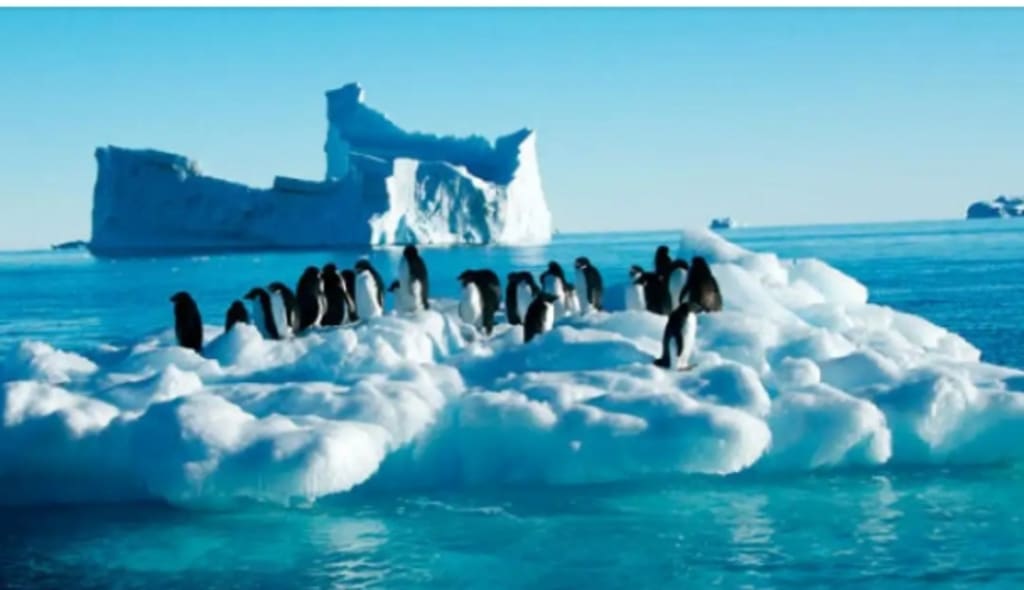
We've all envisioned going by the Cold and seeing the common ponders of polar bears skipping on ice floes or the Aurora Borealis moving over the sky. Well, too bad to break it to you, but you won't discover any sightseers running to Antarctica anytime soon. Why would you inquire? Let's plunge into it to begin with. it's found within the southern side of the equator particularly at the South Post the southern sea encompasses it and most of the landmass is covered by Ice making it one of the foremost farther and bone chilling places on Soil presently have you ever met somebody who's gone by Antarctica likely not it's one of the slightest gone by places on the planet and as it were a modest bunch of Fortunate pioneers have seen its insides which is for the most part made up of icy masses and Ice Areas but believe me when I say the natural life and view are out of this world why shouldn't you travel to Antarctica well for starters the environment is fantastically delicate and can be effortlessly harmed also there are no local human populaces on the landmass so your voyages would basically be like going by an uninhabited Island and let's not disregard that it's too one of the foremost costly destinations to travel to in spite of all that Antarctica isn't precisely protected like a fortification but there's an worldwide understanding called the Antarctic arrangement this arrangement was arranged to avoid any undesirable action on the landmass and boycott some forms of testing done there by part states but the essential reason we can't fair Waltz into Antarctica is that it includes a fragile biological system that needs security The arrangement states that Antarctica ought to be utilised for tranquil purposes, as it were, and ought to be free from any human movement that may hurt the environment. Researchers are still learning about the continent's unique biological system, and our actions and machines could disrupt the sensitive adjustment that exists there. In case you're still tingling to go to Antarctica, Getting consent isn't exactly a walk in the park for U.S. citizens. You have to complete an extraordinary form and send it to the Office of Sea and Polar Issues, and once you're there, you'll have to follow a few strict rules to ensure the environment, like not exasperating any Natural life or taking gifts like rocks, plants, or creatures. Currently, you can live in Antarctica, but there are no laws Prohibiting individuals from living there forever. It's a really aloof environment that is unacceptable for human residence. Temperatures can reach negative 76 degrees Fahrenheit and below, making it nearly incomprehensible for anyone to outlive without the correct hardware and involvement; furthermore, the closest piece of land is over one thousand miles away, making any occupants totally cut off from the rest of the world. Who knows, perhaps one day we'll get the chance to visit this interesting and captivating landmass, but until then, let's respect it from afar. Let's presently converse a bit, almost like the discovery of Antarctica, not at all like other places that were as of now possessed. Antarctica never had a local human population. Antiquated Greek rationalists had a thought approximately the landmass and called it antarctos, meaning inverse the bear. The Bears it alludes to are not the polar ones, in spite of that, but maybe the extraordinary and small bear star groupings that are, as it were, discernible within the northern side of the equator. As a result, the term implies the inverse of the arrival of the bear moaning and ceiling voyages within the late 1700s and early 1800s, which would wander and advance south. When adjusting Cape Horn at the tip of South America, it was known that going south regularly implied more grounded winds but also the risk of hitting coasting ice of all sizes in winds and seas that seemed unsafe to the transport and group. Captain James Cook was the primary to cross the Antarctic Circle on January 17, 1773, within the Ross Ocean locale. He came to a point encouraging north a year afterward, and in spite of the fact that he didn't cite arriving, he came within 50 miles and saw stores of shake held in chunks of ice, showing that a more southerly arrival existed. The primary location of Antarctica is broadly recognised to have taken place in January of 1820 amid The Voyage of two shifts under the command of Captain Fabian Gottlieb Von Belling's house was a portion of a two-year exploratory Undertaking around the world to find unused lands. The captain's ships were the primary to have crossed the Antarctic Circle since Cook was the primary The undisputed landing on Antarctica didn't happen until much later, on January 24, 1895, at Cape Adare, amid the whaling Voyage of the dispatch Antarctic driven by Henrik Bull, a little vessel with six or conceivably seven men on board rode aground amid calm conditions. You might not accept it, but Antarctica is really a forsake with all that ice. You think it'd be like a winter wonderland with snowball battles and hot cocoa? All day long, when we think of deserts, we picture camels and cacti and people battling to discover water, but in Antarctica, it's an entirely distinctive story. The Battle isn't to discover water; it's to discover anything that's not secured in ice, and the normal precipitation has been over 0.4 inches within the past 30 years. That's like some drops of rain compared to what we're used to, so actually, it's not the hills or sizzling heat that produce a forsake. Keith's lack of precipitation, but do not stress. In the event that you ever discover yourself misplaced in Antarctica, you won't need to stress about almost getting parched. Make sure beyond any doubt you bring a coat and a few gloves since it's cold enough to form you into a popsicle, as it were. Antarctica is one of the driest places on earth, but it's also the coldest, windiest, and most elevated, almost overachieving. The Penguins and researchers down in Antarctica have at times found themselves in a bit of a pickle when it comes to timing. You see, not at all like the rest of us on this enormous blue planet, there's no Antarctica time zone. All the lines of longitude meet at a single point at the South Pole, making it a bit of a head scratcher when attempting to figure out what time it is presently. You can be considering, but how do the researchers and analysts keep track of time down there? They regularly stick to the time zone of the nation they are withdrawing from, in any case, with stations from all over the world on the Antarctic. Promotional things can get a little wacky. Imagine attempting to coordinate with your neighbouring nations without inadvertently waking them up in the middle of the night. You might think that not much might survive in a place where the temperature is amazingly cold, the sun scarcely appears, and the wind seems to blow you away quicker than a tumbleweed. Well, as in numerous places on Earth, soil life found a way in Antarctica. Whether you accept it or not, this solidified landmass is buzzing with movement. It's home to billions of krill, which in turn draw in parts of seals and more penguins than you'll be able to shake a penguin. Penguins are the extreme swimmers with streamlined bodies that would make Olympic decoration victors desirous; they come aground to breed and chill, but their genuine ability is taking Stones from each other and shaping numerically exact clusters to remain warm. Antarctica is additionally home to the biggest species of penguin on earth; it's called the sovereign penguin beyond any doubt. These animals are flightless fowls, but that doesn't mean they can't bounce; in truth, a few of them can jump up to 120 inches, and let's not disregard almost all the seals with their textured bodies and extraordinary melodies. These marine warm-blooded animals are ensured by the Antarctic settlement, and they're flourishing within the Cool Waters of the Southern Sea as well, but the genuine stars of the show are the whales amid the Antarctic summer. These huge creatures appear up in droves to Chow Down on the Plenteous krill; it's undoubtedly like a whale Buffet down there. That's it.
About the Creator
Enjoyed the story? Support the Creator.
Subscribe for free to receive all their stories in your feed.
Comments
There are no comments for this story
Be the first to respond and start the conversation.