
Creatures of the Misfit Hours
“Where have you been all my life?!”
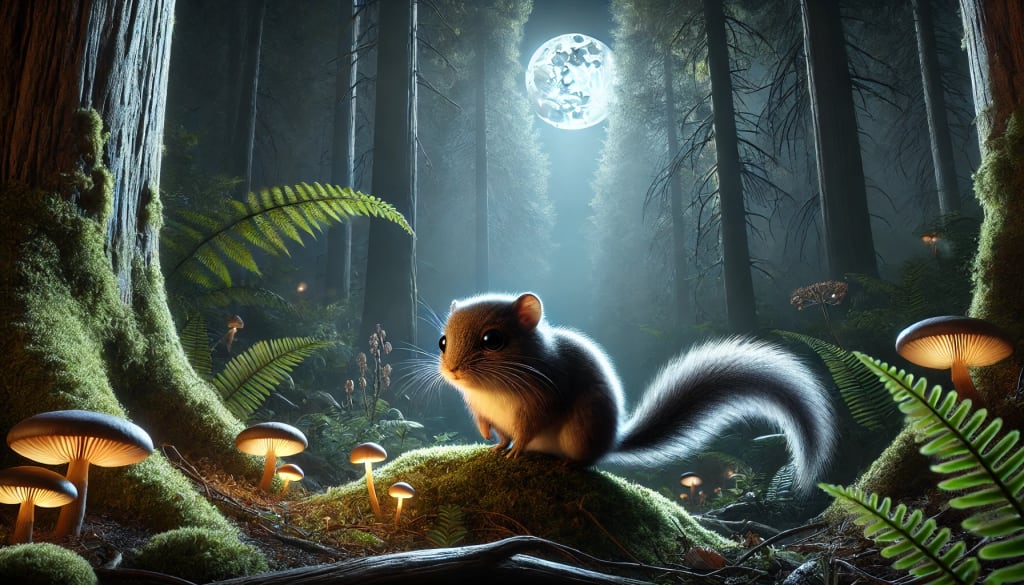
We used to emerge only under the protection of night. Stealth and tact, or, “staying out of the crosshairs”, if you will, was our tried and true method of survival and, dare I say, success. The forests, their steppes, and perhaps places even farther away were indeed the only safe havens affording us the freedom to roam, albeit periodically. In these days, our souls existed within the bodies of small, mole-like creatures equipped with night vision capabilities. We feasted at ground level and mostly on plant material and insects, focused intently on avoiding becoming prey ourselves.
Daylight spelled trouble for us, as the extra-ancient modern world was largely under reptilian rule. Dinosaurs and other creatures had been staking claim to Earth’s entire landscape for over one hundred million years. We were only welcomed by darkness and through darkness. We were creatures of the time neglected. The misfit hours.
This was the section of our then immeasurable 24-hour rotation where natural selection seemed to favor the majority, or more, the massive. In contrast, we were part of a select group of small, nocturnal species forced into solitude. Our greatest strength was our wit and intuition, helping us to avoid crossing paths with any of our sleeping, diurnal foes who were often afforded the upper hand.
Our emergence into the dominant light, playing to the tune of nature’s normalcy, was only possible through the dwindling of others, namely the dinosaurs (save the birds!) as well as the rest of the lengthy list of diverse land animals who met their demise, comprised in the all encompassing Cretaceous-Paleocene extinction event. This cataclysm directly targeted every kind of large animal weighing over 25 kilograms, or about 55 pounds. The downfall of Earth’s current state of authority was underway!
“The Asteroid that Killed the Dinosaurs”, in laymen’s terms, was a catastrophic occurrence that actually unfolded over the span of a few decades, although the environmental recovery would occur over the next twenty million years. An asteroid with mass greater than the the whole of the Manhattan borough in New York City slammed into the shores of what is now the Yucatán peninsula, near the southern tip of present-day Mexico, roughly 66 million years ago, decimating the immediate horizons and hurling rock, smoke, and other debris into the atmosphere that encapsulated the entire planet. The impending victims spared by direct impact were now sentenced to a slower death and decay brought on by the residual effects of pollutants and debris hurled into the atmosphere as well as smoke from wildfires triggered by rapid environmental unrest that almost completely blocked out sunlight across the globe for years. Perhaps this prolonged darkness and at least dimness that had made enemies with so many had in fact become our greatest ally and motivator.
Invited by the openness of Earth’s lengthy recovery, our ancestors willfully filled niches left agape by organisms missed. There was much work to be done. The shrews of old would find themselves becoming more adventurous with less impediments. From their struggle, the plethora of proto-primate species which we most familiarly associate ourselves with today were born. Our territory expanded from the veil of night on the forest floor to the assumption of dominance among the trees and wider reaches of the land, daring to feast on high-hanging fruits, nuts, leaves, and more with pride in broad daylight.
We were changing, and it was good. Over the following tens of millions of years, our physical and mental evolution would alter the world’s reality to an all but inconceivable degree, even to many researchers now, and especially to nonbelievers of actual divinity that is the procession of natural order. How could a species rooted in such vulnerability possibly usurp all odds to the point of an apex?
Alas, our ancestors were no longer misfits. In an ironic twist, we had been made entirely necessary “all of a sudden”, tasked with filling in gaps left behind in the aftermath of the K-Pg extinction event. Finally, we were making a name for ourselves in this world. The questions of our responsibilities were evolving as well. What was our evolutionary line not capable of achieving?
About the Creator
Dan Arnold
I’m a near-blind author from Tennessee fascinated by the lengthy road of evolution, the capabilities of many lives functioning as one universe, astronomy, and more! I’ll be posting short stories, poetry, and opinion-esque articles on here!
Enjoyed the story? Support the Creator.
Subscribe for free to receive all their stories in your feed.
Comments
There are no comments for this story
Be the first to respond and start the conversation.