
Continuous Pyrolysis Will Replace Traditional Batch Equipment
Future of Waste Recycling

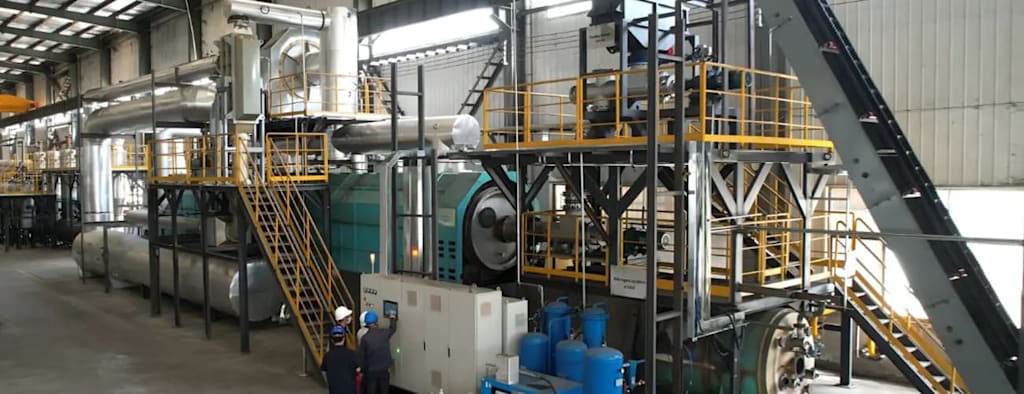
The global waste recycling industry is undergoing a pivotal upgrade driven by dual demands: stricter environmental regulations and the pursuit of higher economic returns. Waste tire and plastic pyrolysis, as a mature circular economy technology, has been widely adopted worldwide. For decades, traditional batch pyrolysis plants have dominated small and medium-sized recycling projects due to their low initial investment and simple operation. However, with industrial-scale recycling becoming the mainstream trend, fully continuous pyrolysis plant is emerging as the future leader, gradually replacing outdated batch equipment and reshaping the waste resource recovery landscape.
To understand the industry shift, it is essential to clarify the core differences between the two pyrolysis modes. Traditional batch pyrolysis works in repeated cycles: manual feeding, sealed heating, pyrolysis reaction, cooling, and residue discharging. Each production cycle requires system shutdown, temperature drop and material replacement, resulting in inevitable downtime and heat loss. Though flexible for small, mixed waste processing, this intermittent working mode has inherent flaws that limit long-term industrial development, including low productivity, unstable product quality and high labor dependence.
In sharp contrast, continuous pyrolysis systems realize 24-hour unmanned cyclic operation with automatic feeding, constant-temperature pyrolysis and synchronous residue discharging. This non-stop operation fundamentally solves the downtime defects of batch equipment. Industrial data shows that continuous pyrolysis boosts overall processing efficiency by over 30% compared with traditional batch plants, while cutting comprehensive energy consumption by 25%. The stable constant-temperature reaction environment also standardizes the quality of pyrolysis oil, carbon black and syngas, greatly improving commercial product value.
Cost and labor optimization is another decisive factor for the industry upgrade. Traditional batch plants rely heavily on manual operation, requiring frequent feeding, discharging and equipment inspection, which brings high labor costs and human error risks. In contrast, advanced continuous pyrolysis equipment adopts intelligent centralized control, requiring only 2 to 3 supervisors for daily operation. This reduces labor costs by more than 50% annually. Additionally, continuous systems reuse self-produced syngas for heating and recover residual heat through heat exchangers, forming a self-sustaining energy cycle that eliminates redundant fossil fuel consumption and further lowers operational costs.
Environmental compliance has become the key threshold for the survival of recycling enterprises in recent years. Batch pyrolysis equipment faces unavoidable environmental drawbacks. Frequent opening and closing of the reactor during feeding and discharging easily causes volatile oil gas leakage, leading to exhaust emission fluctuations and secondary pollution. Continuous pyrolysis operates in a fully sealed and stable state with zero gas leakage. Its matched integrated flue gas purification system ensures stable up-to-standard emissions all day long. Meanwhile, the optimized pyrolysis reaction improves carbon black yield from below 30% to 35%–40%, maximizing resource utilization and reducing solid waste residues.
Many investors may wonder whether batch equipment will be completely phased out in a short time. In fact, small-scale and scattered waste recycling scenarios still suit low-cost batch plants. Yet for large-scale, standardized and long-term recycling projects, continuous pyrolysis has absolute competitive advantages. As global environmental policies become stricter and the recycling industry moves toward large-scale industrialization, the low-efficiency, high-pollution and high-cost batch mode can no longer meet market demands.
Beyond efficiency and environmental performance, continuous pyrolysis also excels in product consistency and market competitiveness, a critical advantage often overlooked by new investors. Batch reactors suffer from fluctuating temperature and pressure across different batches, leading to inconsistent viscosity, purity and calorific value of pyrolysis oil. Such unstable products can only be sold at low prices for crude fuel use, limiting profit margins. In comparison, continuous pyrolysis maintains precise temperature and pressure control throughout the reaction process, producing high-purity pyrolysis oil that can be further refined into diesel and gasoline, while the upgraded carbon black can be used for rubber reinforcement and industrial pigment production. This diversified high-value product chain greatly improves the overall profit margin of recycling projects.
From the perspective of long-term investment and project lifecycle, continuous equipment also shows far better return on investment (ROI). Although batch pyrolysis machines have lower upfront purchase costs, their short service life, frequent maintenance and low output result in higher long-term comprehensive costs. Batch devices require regular shutdowns for cleaning, component replacement and safety checks, which greatly reduces effective production time. Modern continuous pyrolysis plants are designed with high-strength reactor materials and fully automatic anti-corrosion and ash-cleaning systems, extending equipment service life and minimizing downtime maintenance. For large factories running 365 days a year, the incremental output and saved maintenance costs can offset the initial equipment premium within one to two years.
Global market trends also strongly support the popularization of continuous pyrolysis technology. Developed regions in Europe and North America have gradually banned backward intermittent pyrolysis production lines due to carbon neutrality goals and industrial upgrading policies. Meanwhile, emerging markets in Southeast Asia, Africa and South America are no longer pursuing low-end small-scale batch equipment. Instead, they prefer standardized, intelligent and environmentally friendly continuous production lines to meet growing waste treatment demands and international export standards. This global policy and market shift is accelerating the elimination of traditional batch pyrolysis technology.
In conclusion, continuous pyrolysis technology represents the advanced productivity of the waste recycling industry. Its overwhelming advantages in production efficiency, energy conservation, environmental protection and long-term economic benefits determine its replacement of traditional batch equipment. In the future, with further technological iteration and cost reduction, fully continuous intelligent pyrolysis systems will become the standard configuration of the global waste tire and plastic recycling industry, driving the high-quality development of the circular economy.
About the Creator
Bestonpyrolysis
Engaged in waste plastic/tyre/rubber recycling, oil sludge treatment, biomass recycling, sewage sludge management and paper recycling…
https://bestonpyrolysisplant.com/
Enjoyed the story? Support the Creator.
Subscribe for free to receive all their stories in your feed.
Comments
There are no comments for this story
Be the first to respond and start the conversation.