
Complexity from Organisms to Civilizations
Part 23 of the Elucidation series. Previously From Atoms to Life: The Rise of Complexity

• • •
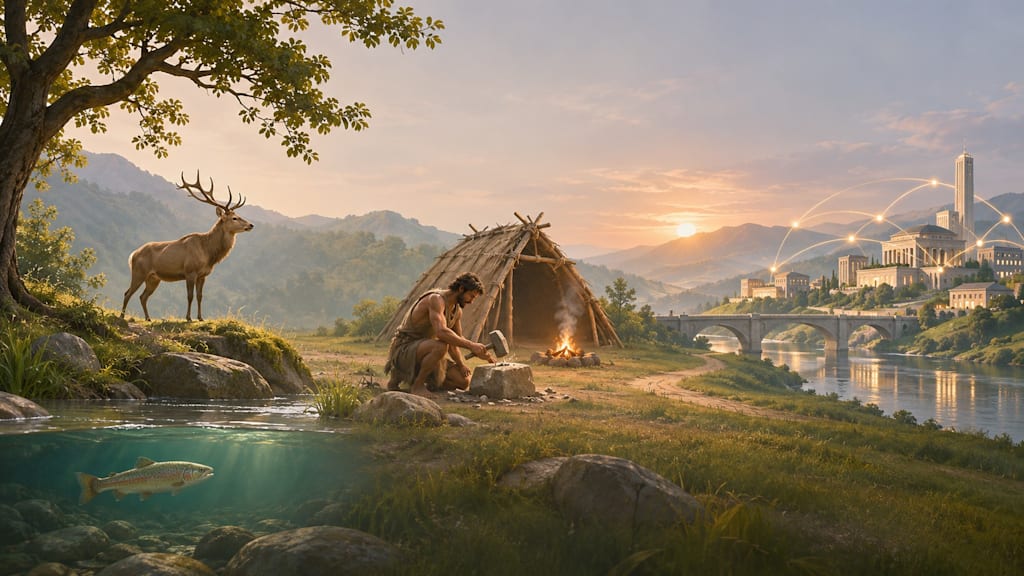
The law of complexity does not stop at the biological level. It extends with remarkable consistency into the social world of human organization, culture and history.
Biological Complexity
No one denies the idea of evolutionary adaptation in biology. Everyone recognizes that the human being is more developed than other animals, or that among animals, the mammal stands above the fish. But what matters here is the principle behind this development.
A greater capacity for adaptation represents a higher stage of evolutionary development. With human beings, however, adaptation takes on a new character. Humans do not simply adapt themselves to the environment. They increasingly change the environment to meet their own needs.
The familiar example of winter makes the distinction clear. Other organisms may migrate, hibernate, or depend on biological adaptations to survive the cold. Human beings build shelters, produce heat, and reshape the conditions around them. The important point is not the technology itself. It is the change in the relationship between the organism and its environment.
Human adaptation becomes increasingly active rather than passive. Instead of being limited entirely by existing conditions, human beings develop the capacity to alter those conditions.
This is the key point in the biological sphere of evolutionary development: a growing ability to overcome limiting conditions and gain greater control over the environment.
Social Complexity
Now bring the same principle into the social world.
Human societies also become more complex as they develop. This does not simply mean that there are more people. It means that the relationships between people become more numerous, more specialized, and more closely connected.
Think of a very early human community. Most relationships were direct and local. People lived in relatively small groups. The same person might hunt, build, protect the group, and help produce food. Social roles were limited, and most people depended mainly on those immediately around them.
As societies grew, these relationships changed. In tribal societies, there were larger networks of kinship, exchange, leadership, cooperation, and conflict. Different groups could trade with one another, form alliances, or compete over land and resources.
Feudal society became more complex still. A peasant was connected not only to a family or village, but also to a landowner, local authorities, markets, craftsmen, merchants, religious institutions, and systems of taxation and law. Society contained more specialized roles, and people became increasingly dependent on the work of others.
Now compare this with the modern world. A person buying a simple product may be connected, without ever seeing them, to factory workers in one country, designers in another, shipping companies, banks, software systems, retailers, governments, and global markets. A modern hospital depends on doctors, nurses, laboratories, pharmaceutical companies, universities, manufacturers, transport networks, electricity, communication systems, and many other institutions working together.
So the difference is not simply that modern society is larger. The structure of relationships itself has changed. Human beings are connected through forms of cooperation, production, communication, and organization that did not exist in earlier societies.
This is what we mean by increasing social complexity.
And just as in biological development, new social forms do not appear without a reason. They emerge when older forms can no longer meet the needs created by further human development.
For example, a social system designed around small-scale agriculture may work for a certain stage of history. But as trade expands, technology develops, knowledge grows, and production becomes more complex, that same system may begin to limit further development. What once helped organize society can eventually become an obstacle.
At that point, pressure for a new form of organization grows.
The basic principle is the same: as human capacities develop, society must also develop forms capable of containing and organizing those new capacities. When an old social structure can no longer do this, it begins to stand in the way of further development and is eventually replaced by a new one.
The Logic of Replacement
This is one of the most important consequences of the law of complexity: old forms are eventually replaced when they can no longer support further development.
According to the logic of evolutionary development, progress often requires breaking through structures that have become obstacles. Old and reactionary forms give way to new ones that are better able to meet the needs of a developing society. This does not happen simply because individuals decide that it should. It happens because the old structure can no longer contain the forces developing within it.
A social system that blocks the development of its people eventually becomes a barrier. If millions are kept struggling simply to survive while a small minority enjoys enormous wealth, the system is no longer allowing society as a whole to develop its capacities. It becomes like a damaged gear in a machine: instead of helping the movement, it begins to obstruct it.
When this point is reached, pressure for replacement grows.
This is the same general pattern we have followed throughout evolutionary development. Atoms combine into more complex molecules. Molecules form living systems. Cells become part of larger organisms. At each stage, new forms appear that can do what the earlier ones could not.
The same principle is being applied here to society. When an old form can no longer support further development, it eventually gives way to a new one. The obstacle is removed, and the process continues.
The Measure of Progress
How, then, do we judge whether a society, an institution, or an ideology is moving forward or backward? The key question is what it makes possible.
Does it expand human freedom or restrict it? Does it help people develop their abilities, knowledge, and awareness, or does it hold them back? Does it create the conditions for greater complexity, greater consciousness, and greater control over limiting conditions? Or does it preserve an old structure that has become an obstacle to further development?
From this perspective, progress is not simply a matter of opinion. It can be judged by whether a social form expands or restricts human capacities. The same long process that moved from simple matter to life and eventually to human civilization provides the broader framework for making that judgment.
In the next article, we will examine what happens when complexity reaches a point where gradual change is no longer enough. At certain stages, development requires something more: a leap into a new form.
• • •
Next: The Leap: When Gradual Change Is No Longer Enough**
Elucidation is a series of articles inspired by philosophical lectures given around 50 years ago. New articles are published weekly.
About the Creator
Han Elucidation
Why do we exist? A searcher. Exploring existence, meaning, and what it means to be human through the Elucidation series.
Enjoyed the story? Support the Creator.
Subscribe for free to receive all their stories in your feed.
Comments
There are no comments for this story
Be the first to respond and start the conversation.