
Changes in human nighttime activity are mapped using daily satellite photos collected over a ten-year period.
Earth's nighttime lights

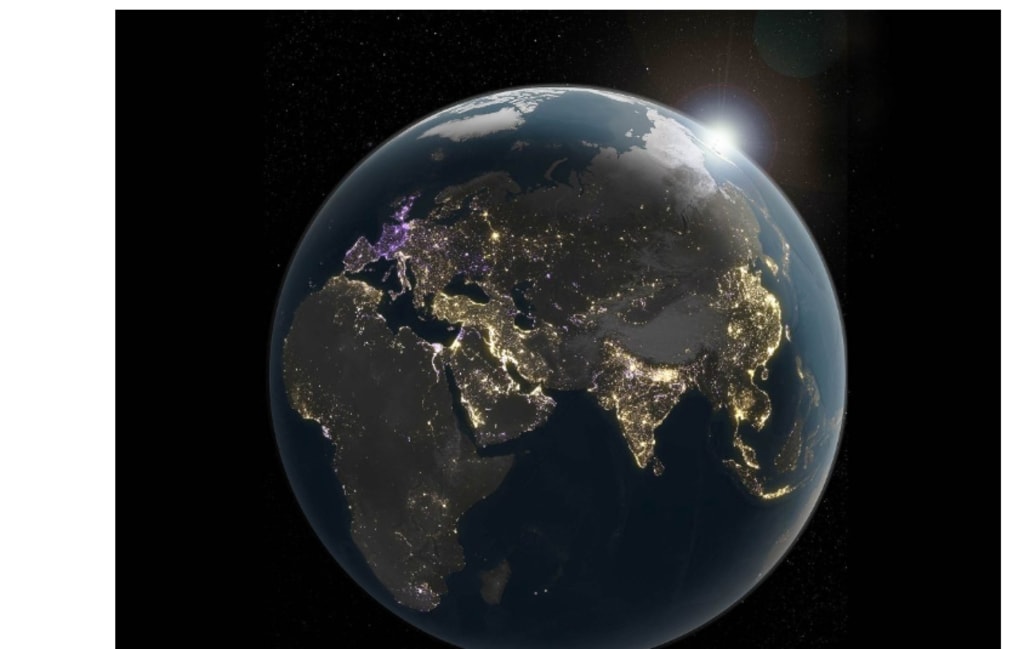
Researchers have discovered that, between 2014 and 2022, Earth's city lights, as observed from space at night, have become extremely erratic, with numerous locations frequently brightening and dimming over brief intervals. Because of this fragility, the glow of cities becomes a sensitive indicator of global disruption, policy changes, and unequal development.
Earth's nighttime lights
Rather of a consistent climb or fall, illuminated areas frequently reversed across over a million nightly satellite photos. Christopher Kyba, a physicist at Ruhr University Bochum, tracked such changes and recorded how small swings came together to form a global pattern of synchronous brightening and dimming.
Gains in certain areas were countered by losses in others because the same locations frequently changed several times during the nine-year period. Because of this back-and-forth, a single worldwide average obscures the true time and sources of change, necessitating a detailed analysis of how those shifts were recorded.
Daily photos across time
Short-lived decreases and increases frequently vanished into monthly or annual averages since older maps combined several nights together. Researchers watched city lights from orbit using daily satellite photos, adjusting for viewing angle to increase accuracy while capturing short-term changes.
While crowded city blocks frequently shine more intensely from directly overhead, neighbourhood streets typically appear brighter from the side. According to Kyba, "no worldwide analysis had been carried out using the full-resolution nighttime data until now."
After dark, growth
As cities grew and power reached more houses, night light extended throughout eastern China, India, and portions of Africa. The development of dependable electricity services and rapid electrification frequently forced formerly dark regions into the satellite record for the first time.
While northern India made progress earlier with public lighting and rural electrification initiatives, southern India continued to brighten for the most of the time.
A large portion of such growth was the result of normal development, although there were still areas of dimming in those same areas due to relocation, outages, or demolition.
The darker nights in Europe
The general signal shifted in the opposite direction throughout Europe, with measured night light decreasing 4% from 2014 levels. As towns pursued energy conservation and turned down more lamps after midnight, France stood out with a 33% decline.
Germany remained practically level due to the near-cancellation of brighter and darker pockets, in contrast to the gradual brightening observed elsewhere. Because LED illumination can appear brighter to humans than to a sensor, Europe's fall might likewise appear smaller from space.
Light-related shocks
The daily record abruptly dimmed in Asian industrial zones and other crowded regions when COVID-19 lockdowns spread in early 2020. Later, following Russia's invasion, Ukraine saw a severe darkening, and the energy crisis in Europe in 2022 caused still another notable decline over the continent.
Instead of seeing merely a hazy annual result, researchers were able to link changes to particular disturbances because the data were collected on a daily basis. Night lights evolved into a useful indicator of the strain on business, infrastructure, and daily mobility after dark.
Various causes of fading
Because some locations faded due to energy-saving regulations while others dimmed due to collapse, darker nights did not necessarily equate to success. Due to unstable power, deteriorating infrastructure, and economic degradation, Venezuela lost over 25% of its 2014 light.
Another example is South Africa, where rolling blackouts can continually darken neighbourhoods without any intentional conservation purpose. Regulations, curfews, and LED illumination can reduce satellite counts without correspondingly darkening the street, as seen in Europe.
What is captured by satellites
NASA's Black Marble uses three satellites in orbit to convert faint upward light into a daily record every night. Neighbourhoods, ports, highways, and oil fields can all be captured by each pixel, which has an area of roughly 0.2 square miles (0.5 square kilometres).
Fires and auroras are not included in the sensor's examination of radiance, the upward light signal it can detect. However, because satellites are unable to capture the changes in lighting earlier in the evening, the record is limited.
Earth's night light is important
Because artificial light at night might interfere with eating and migration patterns, brighter evenings have costs beyond energy use. A brighter street may also have an impact on neighbouring environment due to changes in plant growth, pollination, and reproduction.
"Light pollution damages ecosystems, and artificial light consumes a significant amount of electricity at night," Kyba stated. Therefore, improved maps could direct efforts to safeguard animals near cities as well as energy policies.
Europe wants more accurate data
For this type of record, researchers mostly rely on U.S. and Chinese platforms because Europe still lacks a dedicated night-light satellite. ESA's Night Watch project is currently testing potential additions for a future European mission.
While greater resolution would lessen today's confusion about what actually changed on the ground, higher sensitivity would capture fainter light. That information would make it simpler to understand dimming, whether it results from reconstruction, conservation, a crisis, or the replacement of LED lights.
Future Earth nights and city lights
Ultimately, city lights from orbit provide a potent but insufficient signal of the planet's transformation. The new map depicts lit land reacting continuously to expansion, pressure, and constraint rather than a planet that merely becomes brighter.
When used carefully, night light becomes a more complex and helpful signal that can track change swiftly but cannot explain motives on its own.
About the Creator
Enjoyed the story? Support the Creator.
Subscribe for free to receive all their stories in your feed.
Comments
There are no comments for this story
Be the first to respond and start the conversation.