
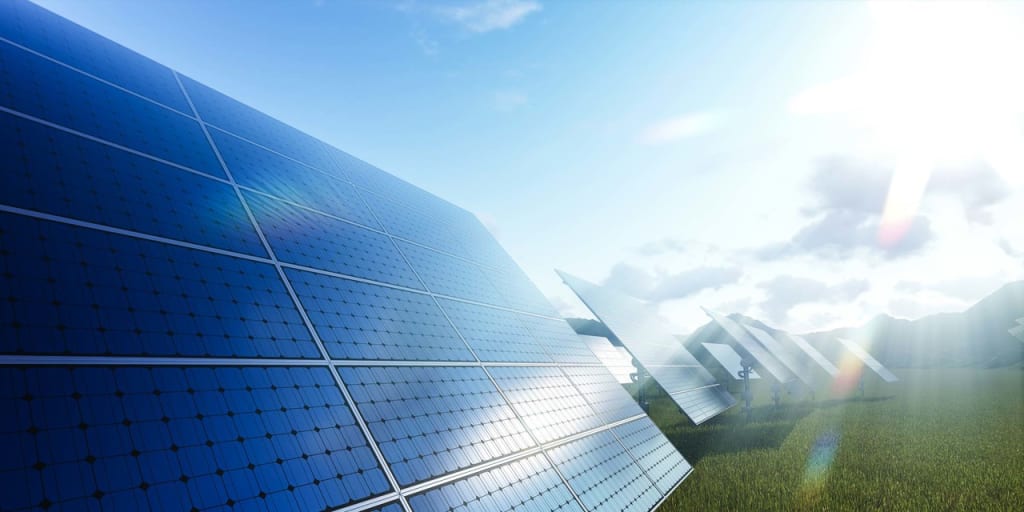
Back in December of 2015, gatherings to the Unified Countries Structure Show on Environmental Change agreed. One hundred and 95 countries, essentially every country on the planet, planned to authoritatively battle against the environment emergency. This is presently known as the Paris Arrangement. What's more, the principal objective of that arrangement is to restrict worldwide temperature climb to well under two degrees Celsius. In any case, to save the Earth from climbing temperatures, we want to eliminate billions of metric lots of carbon from our environment consistently. To assist with achieving this, nations have been putting resources into negative emanations and low-carbon advances, as well as adding framework to help them. Furthermore, sun oriented energy is now at the very front of this inexhaustible upheaval. Why? Since the sun is the most plentiful energy asset we have on our planet. In any case, what amount do you realize about sun powered chargers and how precisely do they function? Indeed, we should begin with photovoltaic cells. These cells convert daylight into power. A solitary photovoltaic cell, likewise called a sun powered cell, can be more modest than a postage stamp and more slender than a human hair. All alone, a sun based cell can produce about a portion of a volt. Thus, to expand this energy yield, you can join these sun based cells to make sun oriented modules and even somewhat greater sun powered chargers. Contingent upon their size and the materials they're made of, as well as how much daylight that is accessible, the power result of sunlight based chargers can change. This result, or how much energy a board produces, is estimated in kilowatt-hours. Thus, assuming that a board creates 100 watts in a single hour, that would be 100 watt-hours or 0.1 kilowatt-hours. Be that as it may, you can consolidate modules and boards much further to make sun based exhibits. These designs are utilized to drive homes and even space apparatus. Also, assuming that you assemble an adequate number of sunlight based clusters in a single spot, you could drive urban communities. You might take care of seen areas of land in sun based exhibits. These are much of the time called sunlight based ranches or sun powered parks. The biggest sun based park worked to date is the Pavagada Sun powered Park in India. It traverses north of 53 square kilometers and can create two gigawatts of power, which is sufficient to drive 700,000 families. Toward the finish of 2018, the world's introduced limit of sun powered cells came to north of 480 gigawatts, addressing the second biggest inexhaustible power source after wind. Presently, this might appear to be a great deal of energy as of now, however specialists are projecting that by 2050 the world's sunlight based cell limit could reach more than 8,500 gigawatts. This is the sort of extension we want to arrive at the carbon-cutting objectives of the Paris Understanding. The integral justification for why photovoltaic cells haven't assumed control over the world yet is on the grounds that the innovation is as yet restricted by three significant elements. Cost, productivity and unwavering quality. Productivity fundamentally implies how well a sun powered charger can change over daylight into power, and cost can be characterized by, all things considered, how much goes into making a sun based cell like materials, fabricating, circulation, establishment, comparative with how much wattage is created in kind for that speculation. What's more, in conclusion, we need to ensure a sunlight based cell can produce power on bright and shady days, which is harder than you could naturally suspect. Lately, advances to sunlight based energy innovation have assisted it with turning out to be more open to the typical individual like you and me, and to the groups participating On the planet Sun powered Challenge. Thus, essentially, the sun gives energy as photons. Also, when those photons will hit your sun powered beam when it hits your sun oriented cells, the photons invigorate electrons and those will hop across the band hole inside your sunlight based cell and they'll fundamentally move through your circuit. Thus, you get this progression of electrons. Today, the most well known semiconducting material utilized in sun powered cells is silicon. Making a plunge considerably more profound, we'll see that glasslike silicon cells are made of silicon particles associated with each other to frame a precious stone grid. Silicon bonds are made of electrons, the adversely charged particles in an iota. These electrons permit it to impeccably attach to its silicon neighbors, making this impeccably coordinated grid structure. In a sun oriented cell, there are two layers of silicon. One layer, n-type, has a negative charge, and the other layer, p-type, has a positive charge. Presently, each charge should be improved to make the energy we're searching for. Furthermore, to do that, specialists will dope or add different components to the silicon material, giving it additional electrons, or making void openings for electrons to fill. The negative charge is generally accomplished by blending the layer of silicon in with phosphorus. This includes additional electrons, permitting more electrons to meander openly in the grid. A positive charge for that p-layer is accomplished by doping that layer with boron, causing those spaces called openings. The limit between the two layers is known as the p-n intersection, while the area around it is known as the exhaustion locale. In this way, presently for the tomfoolery part. At the point when light from the sun hits those layers, the energy from the photons thumps electrons free. Since the layers are oppositely charged, the electrons need to go from the n-type layer to the p-type layer to fill its vacant openings. The electrons make a voltage contrast between one or the flip side of the cell. Thus, by adding an electric circuit to one end, the electrons can go through that circuit, fueling gadgets along their way and end up in the p-type layer. [EXHALES] Alright, we did it. We endured the sub-atomic clarification of how sun oriented cells convert daylight into power. However, common translucent silicon PV cells just proselyte 18 to 22% of daylight into power. What's more, that is plainly adequately not. We maintain that sunlight based cells should be pretty much as productive as could really be expected so they can drive whatever number things as would be prudent. What's more, the groups contending On the planet Sun powered Challenge are as of now utilizing a high level material to do as such. The common material to make sun powered cells out of is silicon, and this is a vehicle canvassed in silicon boards. They're permitted up to four square meters. Yet, as of late a ton of vehicles air exchanging over to an alternate material, gallium-arsenide cells, and they're fundamentally more effective. Gallium-arsenide is a semi-directing material produced using the components gallium and arsenic. Gallium-arsenide sun oriented cells currently hold the world effectiveness record for a solitary intersection sun powered cell, with a change pace of just around 28.8%. So what's preventing us from involving that in all things? Indeed, making a wafer of gallium-arsenide is significantly more costly than making a silicon wafer. The size of the gallium-arsenide cluster was 3.56 square meters, and to cover that size exhibit, you really want around 100 thousand, um, to cover a similar measure of region, truly to cover around four square meters. So even a bigger area of silicon, you'll require around 3 thousand, so there's a tremendous cost contrast. So specialists are as yet attempting to observe that ideal sun oriented cell that is both financially savvy and full productivity. Developments like those utilized On the planet Sun based Challenge will keep on pushing the limits of inexhaustible sun oriented innovation. What's more, since you have a strong handle on how sun powered chargers and photovoltaics work, we should investigate how we can apply all of this sun oriented tech to a race vehicle.
Comments
There are no comments for this story
Be the first to respond and start the conversation.