
Born To Be Wild: can the science of fertility control keep iconic wild horses free on their land?
Conservationists are turning to a humane and forward-looking solution to manage numbers

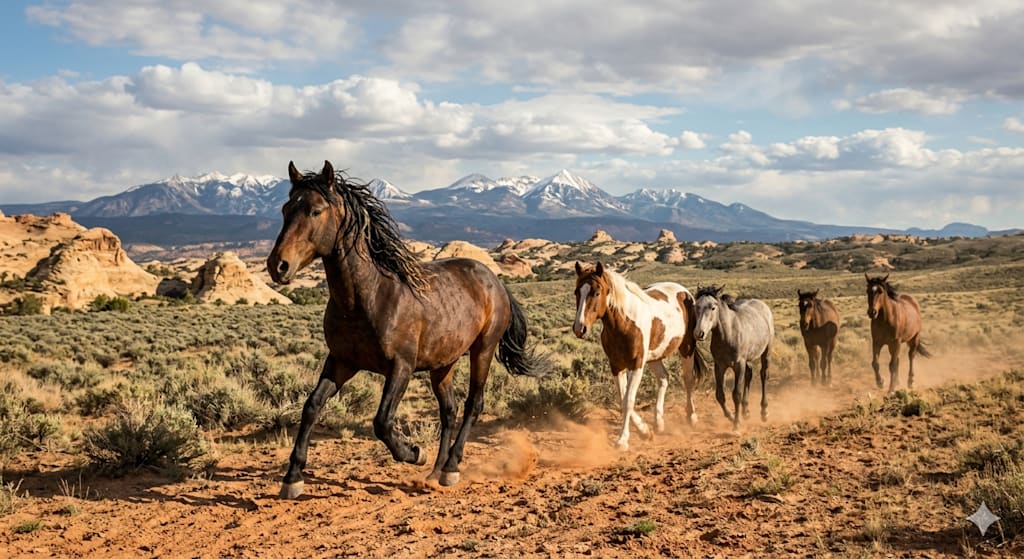
Few creatures capture the imagination like the wild horse. From the early days of Western settlement to the pages of literature, these untamed animals symbolise freedom, resilience, and the enduring spirit of the frontier. But today, the story of the wild horse has entered a new chapter - one that is no longer defined by wide open horizons but instead being shaped by complex coexistence balances and urgent ethical choices.
As wild horse populations increase across the American West, leading scientists, wildlife managers, and conservationists are turning to a humane and forward-looking solution: wildlife fertility control. This innovative field was at the heart of discussions at the 10th International Conference on Wildlife Fertility Control.
The event was organised by the Botstiber Institute for Wildlife Fertility Control (BIWFC) and was held in Barcelona, Spain, April 23rd to 24th. It brought together global experts to share the latest developments in non-lethal population management.
A living icon at a crossroads
Across the sweeping deserts, mountain valleys, and sagebrush plains of the American West, nearly 85,000 wild horses roam across around 30 million acres of land in ten states.
Although the numbers are small compared to the eight million cows, sheep & goats on the land, the rise of wild horse numbers presents a complex challenge for fragile ecosystems, local wildlife, and the horses themselves.
According to Stephanie Boyles Griffin, Senior Principal, Wildlife Protection U.S., Humane World for Animals, the time for innovation is now, as policymakers urgently explore new ways to maintain an ecological balance.
“Wild horses really are a living emblem of America’s identity. They helped settlers explore and survive the rugged landscapes of the West. Their power and endurance embodied the very ideals of individualism and freedom that shaped the nation. But unlike centuries ago, these horses now face a new reality in that they have no natural predators, ” said Boyles Griffin.
Without thoughtful, humane management, populationgrowth threatens not only the horses’ welfare but the delicate ecological balance that sustains so many species.”
Striking a balance
Boyles Griffin explained that unchecked populations of wild horses have the potential to overgraze the vegetation needed by desert bighorn sheep, sage grouse, kestrels, owls, and even many species of insects vital to the desert’s web of life. Other consequences from growing wild horse populations can include eroded soils to dwindling water resources.
“Although ecologists recognise these challenges, we don’t want to scapegoat wild horses - especially because there are relatively few of them compared to other domesticated grazers. However we do need to maintain a thriving ecological balance that allows all animals to flourish,” she explained.
“But removing horses through roundups and relocation is not an ethical answer. It causes immense stress and trauma, breaking family bands and displacing animals from their ancestral homelands. The ethical approach - and the truly sustainable one - is to keep wild horses wild, and that’s where fertility control comes in as a science-driven, humane solution that aligns compassion with conservation.”
Wildlife fertility control represents one of the most promising advancements in animal management in decades. Through methods such as immunocontraception, the use of safe, reversible vaccines that prevent pregnancy without altering natural behavior, scientists can stabilise horse populations while allowing family groups and natural structures to remain intact.
Reducing animal stress
Across several U.S. states, programs using immunocontraceptive agents like PZP-based vaccines have shown remarkable success, cutting birth rates and stabilising herds without the need for costly and controversial removals.
Advances in remote delivery systems now allow wildlife managers to vaccinate animals at a distance, reducing stress and minimizing human interference.
“The science has matured and I’m looking forward to learning what’s working best in a global sense in 2026 during the event in Barcelona," said Boyles Griffin. “Decades of field research show us that fertility control works - and with each year, it becomes more precise, more effective, and more scalable. What we need now is collaboration and commitment at every level: federal, state, scientific, and public.”
The upcoming 10th International Conference on Wildlife Fertility Control marks a pivotal moment for this discipline. More than 500 delegates from 35 countries are expected to attend, representing universities, wildlife agencies, NGOs, and governmental departments.
The program will feature more than 100 scientific presentations on the latest techniques, technologies, and case studies in fertility control, including work on wild horses, deer, elephants, macaques, and urban species.
Science and ethics coming together
Prof Giovanna Massei, Director of BIWFC Europe, based at the University of York in the UK, emphasised the significance of 2026's event.
“Our Barcelona conference showcased how science and ethics can move hand in hand,” she said.
“From developing new delivery systems for contraceptives to modeling the long-term ecological impact of fertility control, this is where cutting-edge ideas turn into real-world solutions. The conference was not only about science - it was about rethinking our relationship with wildlife in the 21st century.”
From control to coexistence
The U.S. wild horse issue remains one of the most visible tests of how society reconciles human interests, wildlife welfare, and ecological integrity. Historically, population management has relied on large-scale roundups by helicopter, followed by placement in holding facilities - an approach that many consider both inhumane and unsustainable.
“When we talk about fertility control, we’re not just talking about population numbers - we’re talking about coexistence,” added Boyles Griffin. “This is a tool that allows us to protect ecosystems and respect the animals who call those ecosystems home. We don’t have to choose between compassion and conservation, they are two sides of the same coin.”
With western landscapes under increasing environmental pressure - from prolonged droughts and changing vegetation patterns to competition for scarce water - wildlife fertility control provides a path forward that aligns with both science and public values.
The approach also addresses mounting economic concerns: large-scale removal programmes cost U.S. taxpayers tens of millions of dollars every year, while fertility control can stabilise herds at a fraction of that expense.
A global challenge
While American wild horses were high on the agenda for the conference discussions, their plight mirrors broader global challenges around the world, concerning species such as rodents, pigeons, elephants, wild boar and wild pigs and deer to mention a few.
For Boyles Griffin, the principles guiding this work transcend borders. She explained: “Every nation faces the same question: how can we live in balance with wildlife? The answers depend on compassion, innovation, and cooperation. What we’re seeing now is not just the evolution of a tool - it’s the emergence of a new philosophy of conservation.”
The 10th International Conference on Wildlife Fertility Control was open to scientists, policymakers, NGOs, media representatives, and members of the public interested in wildlife conservation, animal ethics, and environmental sustainability.
Further key themes from the event included:
● Advances in immunocontraceptive technologies and remote delivery
● Case studies on fertility control in wild horses, elephants, deer, and macaques
● Integrating fertility control into national wildlife policy
● Cross-sector partnerships for humane management
● Ethical frameworks for coexistence and animal welfare
About the Creator
Paul Drury-Bradey
impact storytelling.
working on sustainability, culture & social impact.
co-creation, community, campaigns.
___
@thisisjukebox (Instagram)
@pauldrurybradey (Twitter)
@pauldrurybradey (LinkedIn)
https://cultureandsocialimpact-stories.carrd.co/
___
Enjoyed the story? Support the Creator.
Subscribe for free to receive all their stories in your feed.
Comments
There are no comments for this story
Be the first to respond and start the conversation.