
Black Holes: Unveiling the Possibility of Supersonic Travel through Space
Black holes may be hurtling around at 10% of the speed of light

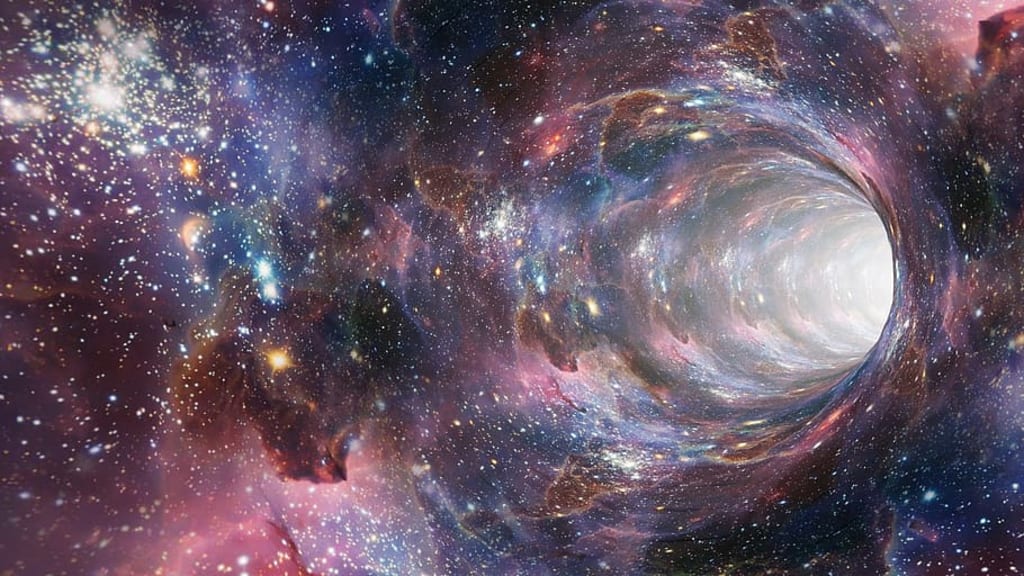
In the vast expanse of the cosmos, where galaxies twinkle like distant diamonds and nebulae paint the canvas of the universe, there exists a phenomenon that continues to captivate the imagination of scientists and enthusiasts alike – black holes. These enigmatic objects, with their incomprehensible gravitational pull, have long been objects of fascination, prompting inquiries into their behavior, formation, and even their movement.
In recent years, a tantalizing theory has emerged suggesting that black holes could be hurtling through the cosmos at speeds reaching up to 10% of the speed of light. This notion opens up a realm of possibilities, from redefining our understanding of galactic dynamics to even speculating about the potential for interstellar travel. Let's delve into the science behind this captivating hypothesis and explore the implications it holds for our understanding of the universe.
A Dance of Gravity: The Basics of Black Holes
Before diving into the thrilling prospect of traveling black holes, it's crucial to grasp the fundamental nature of these cosmic wonders. Black holes are regions in space where the gravitational force is so intense that nothing – not even light – can escape their grasp. This extreme phenomenon occurs when massive stars exhaust their nuclear fuel and collapse under their gravitational pressure, leading to an infinitely dense singularity surrounded by an event horizon, beyond which nothing can return.
The gravitational force of a black hole is directly related to its mass. The larger the mass, the stronger the gravitational pull. It's this incredible force that renders black holes one of the most potent agents in shaping the dynamics of galaxies, often residing at the centers of galaxies and influencing the motion of stars, planets, and even entire solar systems.
The Hypothesis: Black Holes in Motion
Traditionally, black holes were thought to be stationary objects, anchored to their respective galactic centers. However, recent research and observations have ignited a paradigm shift in this perspective. Scientists now propose the intriguing notion that black holes might not be confined to a sedentary existence but could indeed be on the move, racing through the cosmos at speeds that were once deemed implausible.
The crux of this hypothesis lies in the dynamic nature of galaxies. Galaxies are not static entities; they are in a state of perpetual motion. Stars within galaxies are in constant motion, orbiting their galactic centers due to the gravitational forces at play. Moreover, galaxies themselves are not isolated entities; they interact with one another, leading to gravitational interactions and even galactic collisions.
These interactions can result in the ejection of black holes from their galactic centers. When two galaxies collide, for instance, their black holes may also merge and be slung out in a process akin to gravitational slingshots. This cosmic ballet of interactions and mergers can propel black holes to velocities that were previously unimaginable.
The Need for Speed: Navigating the Universe at 10% of the Speed of Light
The notion that black holes could be moving at velocities close to 10% of the speed of light is staggering. To put this into perspective, the speed of light – often referred to as the cosmic speed limit – is approximately 299,792,458 meters per second. Traveling at 10% of this speed equates to a mind-boggling 29,979,245.8 meters per second. Such speeds would enable a black hole to traverse vast cosmic distances in relatively short periods, opening up intriguing possibilities for exploration and understanding.
But how could black holes achieve these velocities? As previously mentioned, gravitational interactions during galactic mergers could provide the necessary kinetic energy to propel black holes to such speeds. These interactions might involve gravitational slingshots or gravitational waves generated during cataclysmic events, such as black hole mergers.
Observational Evidence: Hunting for Galactic Fugitives
While the idea of supersonic black holes sounds captivating, empirical evidence to support this hypothesis is crucial. Scientists and astronomers have been diligently scanning the cosmos for signs of such high-velocity black holes, seeking out subtle clues that could confirm or refute this groundbreaking theory.
One promising avenue for discovery is through the observation of gravitational waves – ripples in spacetime caused by the acceleration of massive objects. The Laser Interferometer Gravitational-Wave Observatory (LIGO) and its European counterpart, Virgo, have been instrumental in detecting gravitational waves emitted during black hole mergers. By analyzing the properties of these waves, scientists can gain insights into the velocities and energies involved in such events, shedding light on the plausibility of high-speed black holes.
Another approach involves studying the motion of stars and other celestial bodies in the vicinity of suspected high-velocity black holes. The gravitational influence of a moving black hole would manifest as perturbations in the orbits of surrounding objects, offering a potential observational signature.
Implications for Galactic Dynamics and Beyond
If the hypothesis of high-speed black holes holds, it could revolutionize our understanding of galactic dynamics. The movement of black holes could play a significant role in shaping the structure of galaxies, influencing the distribution of matter, and even affecting star formation. This new dimension of galactic evolution would require a reevaluation of existing models and theories, propelling astrophysics into uncharted territory.
Moreover, the concept of high-speed black holes has implications for our broader understanding of the universe's evolution. As black holes traverse cosmic distances, they carry with them the history and gravitational imprints of their origin galaxies. By studying these wandering black holes, astronomers could glean insights into the history of galactic interactions and mergers, shedding light on the intricate dance of cosmic structures over billions of years.
The Unveiling of Cosmic Mysteries
The possibility of black holes hurtling through the universe at 10% of the speed of light invites us to peer into the heart of one of the universe's most enigmatic phenomena. This tantalizing hypothesis challenges our preconceptions and encourages us to explore the unknown with fresh eyes. As technology advances and observational methods improve, we inch closer to uncovering the truth behind the movement of black holes and their role in shaping the cosmos.
In the grand tapestry of space, where mystery and wonder abound, the journey to understand the true nature of black holes is a testament to human curiosity and scientific ingenuity. Whether these cosmic speed demons truly exist or remain a captivating theoretical possibility, the pursuit of knowledge continues to propel us forward, guiding us through the uncharted realms of the universe and unveiling the cosmic mysteries that await our discovery.
About the Creator
Jack Web
Science isn't just about facts; it's also about asking questions and embracing the unknown. It encourages skepticism and critical thinking, reminding us that knowledge is a journey, not a destination.
Enjoyed the story? Support the Creator.
Subscribe for free to receive all their stories in your feed.
Comments
There are no comments for this story
Be the first to respond and start the conversation.