
Black hole
"The Dark Abyss: Exploring the Mysteries of Black Holes"
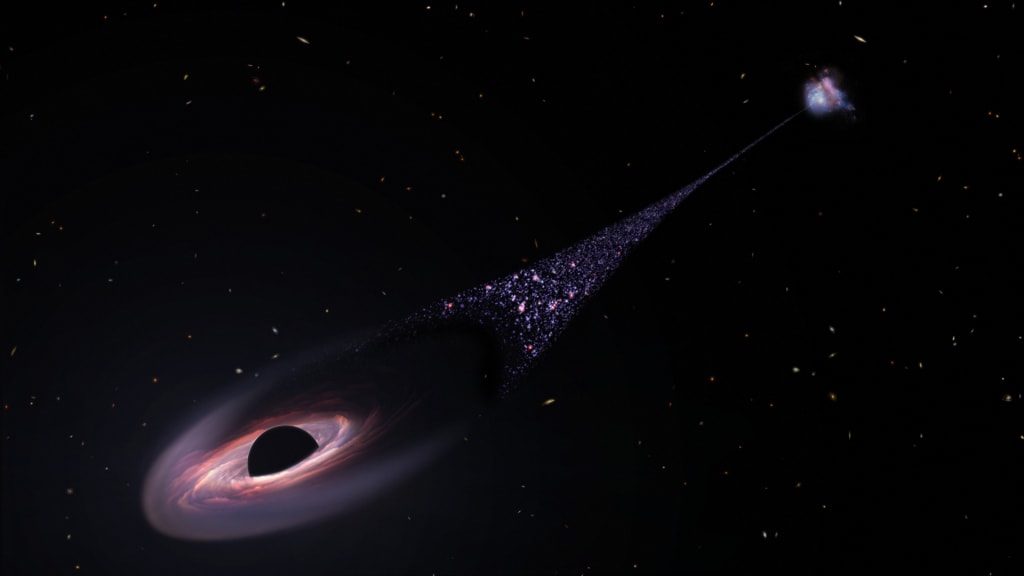
Black holes are some of the most fascinating objects in the universe. They are regions of space where gravity is so strong that nothing, not even light, can escape. Here's some information about black holes:
Formation: Black holes are formed from the remnants of massive stars that have died. When a massive star runs out of fuel, it undergoes a catastrophic collapse, creating a black hole.
Types: There are three types of black holes: stellar, intermediate, and supermassive. Stellar black holes are the most common and are created from the collapse of a single massive star. Intermediate black holes are believed to be formed from the merging of several smaller black holes, while supermassive black holes are found at the centers of most galaxies and are thought to be the result of the merging of multiple intermediate black holes.
Size and mass: Black holes come in a range of sizes and masses. Stellar black holes can have a mass between 5 and 100 times that of the sun, while supermassive black holes can have masses that are billions of times that of the sun.
Properties: Black holes have a number of unique properties. They are invisible, since no light can escape from them. They also have an event horizon, which is the point of no return beyond which nothing can escape the gravitational pull of the black hole.
Effects: Black holes have a number of effects on their surroundings. They can distort space and time around them, creating gravitational waves. They can also cause stars and other matter to orbit around them, creating accretion disks and emitting powerful radiation.
Discoveries: Black holes were first predicted by Albert Einstein's theory of general relativity. The first black hole was discovered in 1964 by astronomers studying a binary star system. Since then, scientists have used a variety of techniques to study black holes and learn more about their properties.
Despite their mysterious and somewhat scary reputation, black holes are an important part of the universe and play a key role in shaping the cosmos as we know it.
The size of a black hole is determined by its event horizon, which is the point of no return beyond which anything, including light, is inevitably drawn into the black hole's singularity. The size of the event horizon depends on the mass of the black hole, with larger black holes having larger event horizons.
The Schwarzschild radius is a formula used to calculate the size of the event horizon of a non-rotating black hole. It is given by:
R = 2GM/c^2
Where:
R = Schwarzschild radius
G = gravitational constant
M = mass of the black hole
c = speed of light
For example, a black hole with a mass of 10 times that of the sun would have a Schwarzschild radius of approximately 29.4 kilometers (18.2 miles).
It's important to note that the size of a black hole doesn't refer to the size of the singularity at its center, which is thought to be infinitely dense and small. Rather, it refers to the region around the black hole where the gravitational pull is so strong that nothing, not even light, can escape.
Black holes can be dangerous in some circumstances, but in general, they are not a threat to us.
If a black hole were to suddenly appear in our solar system, it could cause chaos in the orbits of the planets, but the chances of this happening are extremely remote.
Black holes can also be dangerous to objects that get too close to them, such as stars or planets. If a star were to get too close to a black hole, it could be torn apart by the immense gravitational forces, causing a phenomenon known as a "stellar tidal disruption event."
However, it's important to note that black holes are not "vacuum cleaners" that suck up everything in their vicinity. As long as an object remains outside the black hole's event horizon (the point of no return), it can orbit the black hole safely.
Overall, while black holes can be dangerous in certain situations, they pose no threat to us on Earth and are a fascinating area of study for astronomers and physicists.
About the Creator
Enjoyed the story? Support the Creator.
Subscribe for free to receive all their stories in your feed.
Comments
There are no comments for this story
Be the first to respond and start the conversation.