
Asia Pacific Non-Lethal Weapons Market Set to Surpass US$ 5.35 Billion by 2033 Amid Rising Security Modernization
Growing urban unrest, defense modernization, and demand for humane crowd-control technologies are reshaping the Asia Pacific non-lethal weapons industry

The Asia Pacific non-lethal weapons market is entering a phase of accelerated transformation as governments across the region prioritize public safety, defense modernization, and advanced crowd-control technologies. Increasing urbanization, rising civil unrest, large-scale demonstrations, and evolving security threats are encouraging law enforcement agencies and military organizations to adopt non-lethal alternatives that minimize casualties while maintaining operational effectiveness.
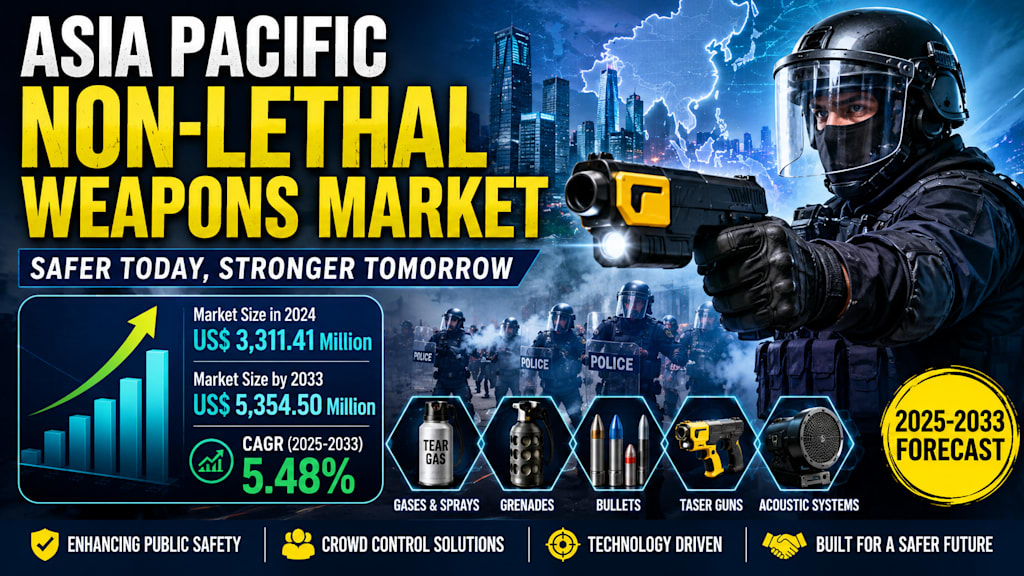
According to Renub Research, the Asia Pacific Non-Lethal Weapons Market is projected to grow from US$ 3,311.41 million in 2024 to US$ 5,354.50 million by 2033, expanding at a CAGR of 5.48% during the forecast period from 2025 to 2033.
The market’s rapid growth reflects changing attitudes toward public security and conflict management. Governments are increasingly looking for humane yet effective solutions that allow authorities to control riots, protests, and dangerous situations without resorting to lethal force. Technologies such as taser guns, tear gas, acoustic systems, directed energy weapons, and kinetic impact projectiles are becoming integral parts of modern law enforcement strategies.
Urbanization and Public Safety Concerns Fuel Market Expansion
One of the major growth catalysts for the Asia Pacific non-lethal weapons market is rapid urbanization. As metropolitan populations continue to rise across countries such as India, China, Indonesia, and Japan, governments face mounting pressure to maintain law and order in densely populated urban centers.
Mass protests, political demonstrations, sporting events, and social gatherings have become increasingly common throughout the region. Law enforcement agencies are therefore investing in crowd-control technologies capable of managing volatile situations while minimizing injuries and fatalities.
Non-lethal weapons such as rubber bullets, pepper sprays, flash grenades, and electroshock devices offer tactical advantages during riots and public disturbances. These tools help authorities de-escalate confrontations without causing permanent harm, making them preferred alternatives to conventional firearms.
The United Nations Economic and Social Commission for Asia and the Pacific (ESCAP) estimates that the region’s urban population could increase by nearly 50% by 2050. This demographic shift is expected to significantly increase the demand for modern crowd-control and public-security solutions.
Technological Advancements Revolutionizing Non-Lethal Weapons
Technology continues to reshape the capabilities of non-lethal weapon systems across the Asia Pacific region. Manufacturers are increasingly investing in research and development to improve precision, safety, portability, and tactical efficiency.
Directed energy weapons, smart ammunition systems, acoustic deterrent technologies, and AI-assisted targeting mechanisms are gaining attention among military and law enforcement agencies. These innovations provide more accurate force deployment while reducing collateral damage.
Advanced electroshock technologies, for example, allow authorities to neutralize threats temporarily without causing long-term injuries. Similarly, acoustic and light-based systems are increasingly used to disperse crowds during high-risk operations.
The adoption of integrated digital systems is also improving situational awareness for security personnel. Smart sensors and AI-enabled analytics now help authorities assess threat levels more accurately before deploying force.
As technological sophistication improves, non-lethal weapons are becoming more acceptable across democratic nations that prioritize human rights and controlled-force protocols.
Government Investments Driving Regional Market Growth
Government spending on defense and internal security modernization is another major factor accelerating market expansion. Countries throughout Asia Pacific are allocating higher budgets toward upgrading police forces and military infrastructure.
Several governments are implementing modernization programs focused on enhancing public safety capabilities while reducing civilian casualties during conflict situations. Non-lethal weapons are increasingly viewed as essential tools in balancing security requirements with humanitarian considerations.
India, China, Japan, Australia, and South Korea are among the countries actively investing in advanced riot-control equipment and tactical defense technologies.
According to the Australian Federal Police, the use of non-lethal weapons reduced injuries during crowd-control operations by nearly 45% compared to traditional force methods.
India has also witnessed a significant rise in investment toward crowd-control technologies. The Ministry of Home Affairs reportedly increased funding for state police crowd-control equipment by approximately 65% in 2023 compared to 2020.
Similarly, Japanese law enforcement agencies have expanded procurement budgets for advanced non-lethal technologies to strengthen operational preparedness amid rising urban-security challenges.
India Emerging as a Key Growth Market
India is becoming one of the most promising markets for non-lethal weapons in Asia Pacific. Increasing public demonstrations, political rallies, border-security concerns, and law-enforcement modernization programs are encouraging wider adoption of non-lethal technologies.
Indian security forces are increasingly relying on tasers, tear gas launchers, stun grenades, and rubber bullets to manage large gatherings and maintain public order. The government’s emphasis on modern policing and defense capability enhancement is expected to further accelerate market growth.
In addition, India’s large population and rapidly expanding urban centers continue to create demand for scalable and efficient crowd-management systems.
However, challenges related to training, operational integration, and budget constraints remain key obstacles for broader implementation across smaller police departments.
China Strengthening Non-Lethal Weapon Deployment
China represents another major contributor to the regional market’s growth trajectory. Rising social unrest, large-scale demonstrations, and internal-security requirements are encouraging investments in advanced non-lethal technologies.
Chinese authorities are actively deploying tear gas systems, acoustic deterrents, electromagnetic launchers, and kinetic-impact weapons during crowd-control operations. The country is also investing heavily in directed energy systems designed for tactical law-enforcement applications.
One notable innovation includes the CS/LW21 portable electromagnetic launcher unveiled in 2023 for riot-control purposes. The system uses electromagnetic force to launch projectiles with improved tactical precision.
China’s growing technological expertise and large defense manufacturing ecosystem position it as a significant player in the global non-lethal weapons landscape.
Japan Focusing on Public Safety Modernization
Japan’s non-lethal weapons market is also witnessing steady expansion as public-safety agencies prioritize advanced law-enforcement tools. Rising awareness regarding controlled-force strategies and human-rights compliance is supporting demand for modern crowd-management systems.
Japanese police and security agencies increasingly use electroshock devices, tear gas systems, and rubber projectiles to handle emergency situations while minimizing physical harm.
The country’s strong emphasis on technology and precision engineering is further encouraging the development of sophisticated non-lethal systems suitable for urban-security operations.
Key Challenges Facing the Industry
Despite strong growth prospects, the Asia Pacific non-lethal weapons market faces several challenges.
Regulatory and Legal Concerns
Many countries in the region maintain strict regulations regarding the use of force by police and military personnel. Although non-lethal weapons are designed to minimize fatalities, concerns surrounding misuse, excessive force, and human-rights violations continue to attract public scrutiny.
Governments must therefore establish comprehensive legal frameworks and operational guidelines to ensure responsible deployment.
Training and Integration Limitations
Another major challenge involves inadequate training and operational integration. Many police departments lack the resources and infrastructure required to train officers effectively in the use of advanced non-lethal systems.
Improper use of these technologies can escalate conflicts or result in unintended injuries. Consequently, governments and manufacturers must invest heavily in training programs, simulation exercises, and operational standardization.
Market Segmentation Overview
The Asia Pacific non-lethal weapons market is segmented by product type, technology, and end-use application.
By Product Type
Gases and sprays
Grenades
Bullets
Taser guns
Others
By Technology
Chemical
Electroshock
Mechanical and kinetic
Acoustic/light
Others
By End Use
Law enforcement
Military
Others
Among these segments, law enforcement applications currently dominate the market due to rising demand for riot-control and public-order management technologies.
Competitive Landscape Intensifying
The Asia Pacific non-lethal weapons market remains highly competitive, with leading global defense manufacturers expanding their product portfolios and regional partnerships.
Major companies operating in the industry include:
Byrna Technologies Inc.
General Dynamics Corporation
Moog Inc.
Raytheon Technologies Corporation
Rheinmetall AG
Textron Inc.
Combined Systems Inc.
Manufacturers are increasingly focusing on innovation, strategic acquisitions, and defense collaborations to strengthen their regional presence.
10 Recent Developments in the Non-Lethal Weapons Industry
Edge Group acquired a 51% stake in Condor Non-Lethal Technologies in April 2024 to strengthen its global non-lethal defense portfolio.
Edge Group signed a US$ 27 million ammunition agreement with Indonesia’s PT Pindad in May 2024 to support defense modernization initiatives.
China unveiled the CS/LW21 portable electromagnetic launcher for advanced riot-control operations in 2023.
Wrap Technologies expanded awareness of its BolaWrap remote restraint device for law-enforcement applications globally.
Byrna Technologies increased international expansion efforts for handheld kinetic launchers across Asia-Pacific markets.
Rheinmetall AG continued development of advanced crowd-control and tactical response systems for modern defense agencies.
Raytheon Technologies accelerated research into directed energy solutions suitable for non-lethal security operations.
Textron Inc. enhanced investment in tactical defense systems designed for military and homeland-security applications.
Combined Systems Inc. expanded production capabilities for smoke, flash-bang, and crowd-dispersal solutions.
Governments across India, Australia, and Japan increased procurement budgets for advanced riot-control equipment and electroshock technologies.
Future Outlook
The future of the Asia Pacific non-lethal weapons market appears highly promising as governments continue emphasizing public safety, military modernization, and responsible force deployment.
Rapid urbanization, technological innovation, geopolitical tensions, and growing civil-security concerns will continue driving demand for advanced non-lethal solutions across the region.
As manufacturers focus on AI-enabled systems, precision technologies, and integrated tactical platforms, the industry is expected to witness significant transformation over the next decade.
With increasing investments in research, operational training, and defense modernization, non-lethal weapons are likely to become essential components of modern law-enforcement and military strategies throughout Asia Pacific.
Final Thoughts
The Asia Pacific non-lethal weapons market is evolving into a strategically important sector within the broader defense and public-security industry. Governments are seeking balanced approaches that combine operational efficiency with humanitarian considerations, making non-lethal technologies increasingly indispensable.
As security threats continue to evolve and urban populations expand, the adoption of advanced crowd-control systems, electroshock devices, acoustic deterrents, and directed-energy solutions is expected to accelerate substantially.
Supported by technological advancements and rising government investments, the Asia Pacific non-lethal weapons industry is positioned for steady and long-term growth through 2033.
About the Creator
Enjoyed the story? Support the Creator.
Subscribe for free to receive all their stories in your feed.
Comments
There are no comments for this story
Be the first to respond and start the conversation.