
American roads are graveyards. China's streets are spotless.
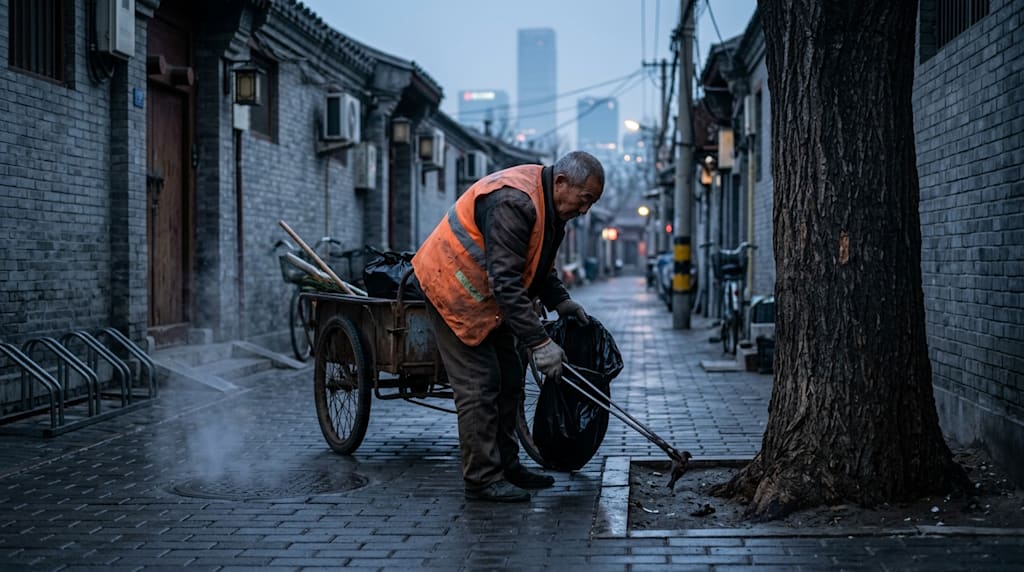
The difference isn't magic. It's a metal clamp, a black bag, and a man named Old Zhou working before dawn.
The Disappearing Dead
I drove across Arizona and ran over a raccoon.
The car jolted. In the rearview mirror, the animal was already flat—a dark reddish-brown smear on asphalt, mixed with grit and fur. Flies clustered over it. I cracked the window and the smell came through: iron and rot, like a bin left out in July.
Three days later, I drove the same stretch. It was still there. Flatter. The guts had been spread wider by more tires. The edges were dried and cracked. The center was still wet. New flies, same number. Nobody had moved it. Nobody had scraped it off. It was becoming part of the road.
That's normal out there. Squirrels, foxes, opossums, raccoons, rabbits—they get ground down until rain washes the remains into the ditch.
Now think about Beijing.
I lived in a hutong for three years. Locust trees at the mouth of the lane. Spring blossoms, summer caterpillars, autumn leaves. In all that time, I never saw a dead bird on the pavement. Not one. The ground was clean like it had been wiped every morning.
I wondered if the city just didn't have birds. Then I looked up. Power lines packed with sparrows. Chattering like they had nowhere to be. At dusk they rose in a black cloud that could cover half the alley's sky. China has billions of sparrows. They live two or three years. Tens of thousands die every day.
Where do they go?
I asked an old neighbor. He looked at me like I was slow. "They get swept up. Before you're even awake."
4:47 a.m. I waited at the hutong entrance and found Old Zhou, a street sweeper. Orange vest, white gloves, tricycle cart. Metal clamp in one hand, dustpan in the other. I stood in the dark for fifteen minutes. He swept four sections. Three cigarette butts. Two dead leaves. Then he stopped at the base of a locust tree.
The clamp reached into the hedge and pulled out a small grey lump. A sparrow. Feathers intact. Eyes closed. Claws curled against its belly. Old Zhou held it up for one second, then dropped it into the black bag on his cart. No pause. No face.
I walked over. He glanced at me. "Every day," he said. "Some mornings seven or eight. Some just one or two. Sparrows, pigeons, sometimes bats."
I started to ask if it bothered him. He cut me off: "It's dirty. But it's got to be done. People shouldn't have to see this when they walk out."
Then he said: "Yesterday one was still alive. Broken wing. Flopping in the flower bed. I put it under the hedge, thought it might rest. Came back this morning. Dead."
He bent over and swept again. The broom against concrete: shhh, shhh, shhh.
I left. The sky was lightening. By the time I came back after breakfast, the alley was spotless. Old Zhou's cart was gone. No feather. No grey lump. Nothing.
On that Arizona highway, the raccoon lay for three days. Because no one is paid to pick it up. Labor costs more than letting rot do the work.
In Chinese cities, before dawn, someone on a low wage takes it all away. Broken wings. Crushed ribs. Smell. All of it. Black bags. Transfer stations. Incinerators. Ash.
Morning comes. You step out. You see clean pavement.
You'll never know that Old Zhou paused a second longer before straightening up after he put that dying sparrow in the hedge. You'll only see the street—swept, empty, quiet.
His orange vest turns the corner. The sweeping sound keeps going.
About the Creator
Jin
Writer of reamstories
https://reamstories.com/jin
Enjoyed the story? Support the Creator.
Subscribe for free to receive all their stories in your feed. You could also become a paid subscriber, letting them know you appreciate their work.
Comments
There are no comments for this story
Be the first to respond and start the conversation.