
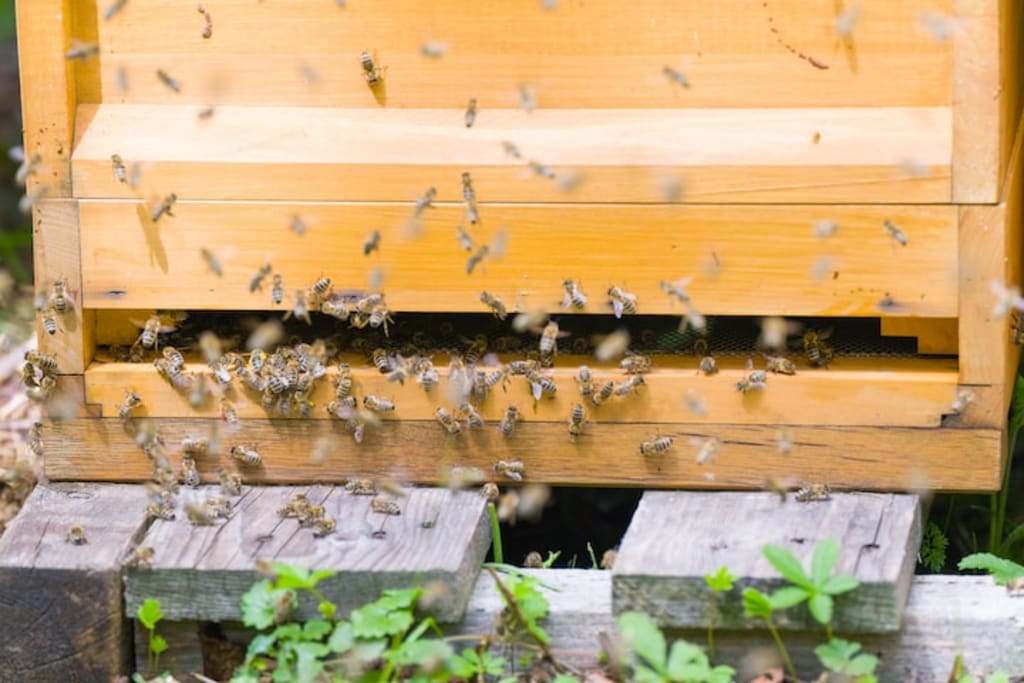
The history of bees traces back around 130 million years when they first appeared on Earth. The remarkable longevity of these creatures is owed to their intricate societal structure and collaborative behaviors. Each bee within the colony possesses a distinct role and duty; some construct and mend the hive, while others safeguard it, and a portion is dedicated to hive sanitation and food collection. Intriguingly, a glimpse into a bee hive reveals vigilant guard bees stationed at the entrance. Positioned on their hind legs, they raise their front legs, meticulously inspecting any incoming insects using their antennae. A distinctive hive odor aids these guards in identifying members of their colony. Solely bees laden with nectar are allowed entry by these guards, underscoring the unity and organization within the hive. Notably, the hive features a solitary entrance fortified by propolis—a bee-produced resin—applied to the surrounding walls, fostering resistance against infections and health issues.
A deeper exploration of the hive unveils the presence of densely packed hexagonal cells constructed from beeswax, known as honeycombs. These versatile structures serve as storage units for pollen, food, and honey. Honeycombs affixed to the hive's walls house eggs, larvae, and pupae, stretching vertically and horizontally to provide access. The comb edges create pathways for bee movement within the hive. Honey resides in the uppermost cells of the comb, beneath which pollen-filled cells are nestled. Moreover, cells for nurturing future worker bees and drone eggs are present, with drone eggs positioned at the comb's base.
The central aim of hive observation often revolves around locating the queen bee—an endeavor that proves challenging. The majority of bees within the hive are worker bees, forming the bulk of the population. Each worker bee undertakes specific tasks, primarily centered on foraging. The queen's presence may await, but the process of observing how bees source sustenance for the hive is equally captivating. A forager discovering an abundant nectar source performs a precise dance characterized by straight lines and figure eights. Wing vibrations accompany this dance, with the dance's duration indicating the distance of the nectar from the hive. Dance intensity correlates with nectar richness, while the dance angle reveals the nectar's direction in relation to the sun.
After studying the foragers, attention shifts to the cells where worker bees commence their lives as eggs. A 21-day transformation period sees an egg evolve into a mature worker, initially assuming the role of cell cleaner. This cleaned cell then transforms into a nursery for the next egg, tended by the bee, which feeds and maintains warmth during the egg's subsequent stages. Between 12 and 20 days old, the bee takes on various hive tasks: generating wax, storing nectar and pollen, constructing comb, guarding the entrance, and more. The transition to a forager occurs at around 20 days, involving the collection and delivery of pollen, nectar, and resin for propolis. Water collection for drinking and hive cooling is also part of the forager's duties.
Within the hive lies a "hospital" zone, where worker bees care for the unwell. Diverse types of honey are provided to ailing bees, tailored to specific infections. If necessary, sick bees are removed from the hive to avert colony-wide infection. Maintaining hive temperature around 95 degrees Fahrenheit falls to temperature control bees; a pivotal factor for successful egg hatching. Drones, the sole male bees in the hive, serve solely to mate with the queen and cater to her needs. Their existence is brief, and during times of scarcity or impending winter, worker bees expel drones from the hive, barring their reentry.
Undoubtedly, the queen bee commands paramount significance within the hive. While not a ruler in the conventional sense, she assumes a critical role as the sole egg-layer. Interestingly, her brain is smaller than that of a worker bee. Emitting specialized pheromones, she influences the hive's overall mood and bears responsibility for birthing every colony member. During her larval stage, the queen is fed royal jelly, a high-sugar substance, by worker bees. Enlarged cells and this nourishment contribute to her larger body and pheromone-producing capabilities. Mating with drones concludes, with the queen returning to the hive after three days.
In summary, delving into the nature of bees reveals a captivating world of intricate roles, cooperative behaviors, and a meticulously structured society that has endured millions of years.
About the Creator
Enjoyed the story? Support the Creator.
Subscribe for free to receive all their stories in your feed.
Comments
There are no comments for this story
Be the first to respond and start the conversation.