
Africa Fertilizer Market Expands as Food Security and Modern Farming Drive Agricultural Transformation
Renub Research highlights rising fertilizer demand across Africa as governments, agribusinesses, and farmers invest in productivity, soil health, and sustainable farming practices.

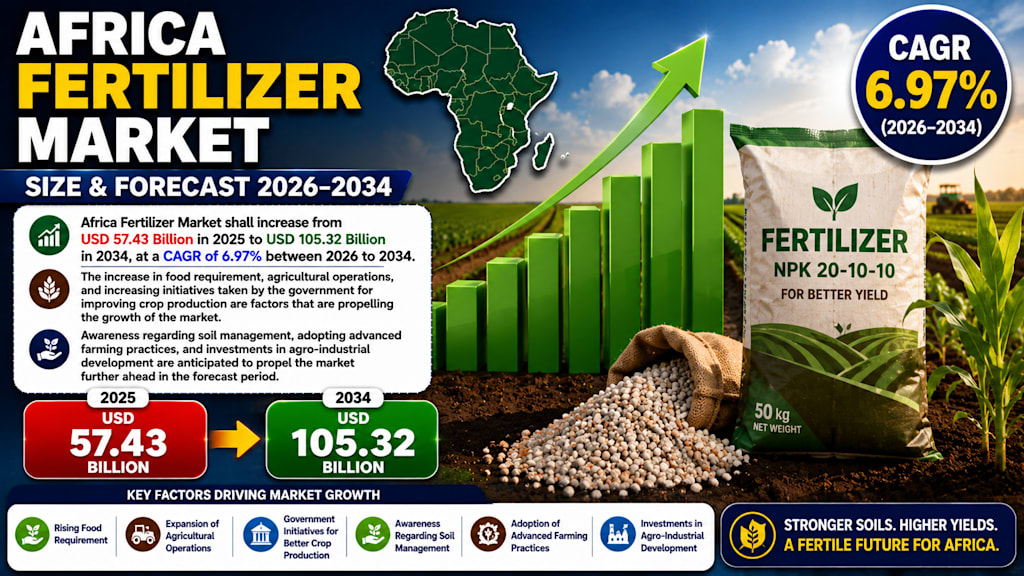
Africa Fertilizer Market Overview
The Africa fertilizer market is witnessing strong growth as countries across the continent focus on improving food security, agricultural productivity, and soil health. According to Renub Research, the Africa Fertilizer Market is expected to grow from USD 57.43 Billion in 2025 to USD 105.32 Billion by 2034, registering a CAGR of 6.97% between 2026 and 2034. Rising food demand, expanding agricultural activities, increasing government support, and greater awareness regarding modern farming practices are among the key factors driving market expansion across the continent.
Fertilizers play a crucial role in improving soil fertility, increasing crop productivity, and supporting sustainable agricultural development. These products provide essential nutrients such as nitrogen, phosphorus, and potassium, along with secondary nutrients and micronutrients like calcium, magnesium, and zinc. Fertilizers are generally categorized into organic and chemical fertilizers, both of which are increasingly being adopted across African agriculture.
Agriculture remains one of the most important sectors for economic growth and employment across Africa. However, declining soil fertility, intensive farming practices, and climate-related challenges are increasing the need for efficient fertilizer use. Governments, development agencies, and private-sector companies are therefore investing heavily in agricultural modernization programs to strengthen food production capabilities across the continent.
Population Growth and Rising Food Demand Drive Market Expansion
One of the most significant growth drivers for Africa’s fertilizer industry is the continent’s rapidly growing population. According to the report, Africa’s population currently stands at approximately 1.5 billion and is projected to nearly double by 2070, with estimates ranging between 2.7 billion and 3.7 billion people. This population growth is placing enormous pressure on agricultural systems to increase crop production and strengthen food security.
As food demand rises, farmers are increasingly adopting fertilizers to improve crop yields and soil quality. Urbanization is also changing dietary preferences and increasing demand for more diversified and nutritious food products. This shift is encouraging modernization within the agricultural sector and accelerating the adoption of fertilizers and advanced farming technologies.
Many African economies rely heavily on agriculture as a source of employment and economic stability. Improving agricultural productivity is therefore considered essential not only for food supply but also for broader economic development and poverty reduction. Fertilizers continue to play a critical role in achieving these goals.
Government Support and Agricultural Subsidy Programs
Government initiatives and subsidy programs are becoming increasingly important in supporting fertilizer adoption across Africa. Several governments are offering financial support, fertilizer subsidies, farmer training programs, and distribution assistance to improve accessibility and affordability for smallholder farmers.
Collaboration between African governments, international development agencies, and agricultural organizations is also helping increase awareness regarding efficient fertilizer application and soil management techniques. These programs aim to improve crop yields, enhance food security, and reduce poverty across rural communities.
In May 2024, African Heads of State and Government supported the Nairobi Declaration during the Africa Fertilizer and Soil Health Summit held in Nairobi, Kenya. The declaration emphasized agricultural sustainability, improved soil health, and stronger support for smallholder farmers across the continent.
Expansion of Modern Farming and Commercial Agriculture
Africa’s agricultural sector is gradually shifting from traditional subsistence farming toward more commercial and technology-driven agricultural systems. This transformation is creating strong demand for fertilizers and advanced farming inputs. Precision farming, irrigation systems, improved soil management practices, and mechanized agriculture are increasingly being adopted in various regions.
Commercial farming activities involving crops such as cocoa, coffee, maize, cotton, rice, and wheat are expanding rapidly. Since these crops require higher nutrient efficiency and improved yields, fertilizer usage continues to increase steadily. Investments from both private companies and foreign organizations are also helping modernize agricultural infrastructure and increase fertilizer consumption.
In March 2026, the Government of Ghana announced the establishment of the Timbuktoo AgriTech Hub to promote technological innovation within the agricultural sector. The initiative focuses on using advanced technologies to improve agricultural productivity and strengthen food systems across Africa.
Challenges Facing the Africa Fertilizer Market
Despite strong growth potential, the African fertilizer industry continues to face several operational and structural challenges. One of the most significant barriers is the high cost of fertilizers. Prices are heavily influenced by global raw material costs, transportation expenses, import dependency, and currency fluctuations. Many smallholder farmers struggle to afford fertilizers because of limited financial resources and restricted access to agricultural credit.
Although subsidies are available in some countries, they are often insufficient to fully address affordability issues. Price volatility in international fertilizer markets also creates uncertainty for both suppliers and farmers. As a result, fertilizer usage rates remain relatively low in several African regions compared to global averages.
Supply chain inefficiencies present another major challenge. Many rural areas lack adequate transportation networks, storage facilities, and distribution infrastructure. Since many African countries depend heavily on fertilizer imports, delays at ports and logistical bottlenecks can increase delivery times and raise overall costs. Poor storage conditions can also reduce product quality and effectiveness.
Africa Nitrogen Fertilizers Market
Nitrogen fertilizers represent one of the most important segments within the African fertilizer market because of their essential role in improving crop productivity and soil fertility. Nitrogen-based fertilizers help support leaf growth, plant development, and overall crop yields, making them critical for staple food production.
The demand for nitrogen fertilizers continues to rise due to increasing food security concerns and the widespread nutrient deficiencies found in African soils. Governments and agricultural organizations are promoting nitrogen fertilizer usage through subsidy programs and farmer education initiatives. Crops such as maize, wheat, and rice remain major contributors to demand growth in this segment.
Africa Ammonium Nitrate Fertilizers Market
The ammonium nitrate fertilizer segment is also experiencing steady expansion across Africa due to rising agricultural activities and the growing need for efficient nitrogen sources. Ammonium nitrate is highly valued for its rapid nutrient release capabilities and its ability to improve cereal and high-demand crop yields.
Government support programs, commercial farming growth, and increasing investment in agricultural productivity are helping drive demand for ammonium nitrate fertilizers. Although safety regulations in some countries may limit usage in certain areas, ammonium nitrate remains an essential component within modern fertilizer formulations across the continent.
Africa Organic Fertilizers Market
Organic fertilizers are gaining popularity across Africa as awareness regarding sustainable farming and soil health continues to increase. Products such as compost, manure, and plant-based fertilizers are widely used to improve soil quality while reducing dependence on synthetic chemicals.
Small-scale farmers particularly favor organic fertilizers because of their relatively lower costs and local availability. Governments and non-governmental organizations are actively encouraging organic farming practices to support environmental sustainability and safer food production systems. Consumer demand for organically grown food products is also encouraging more farmers to adopt organic farming methods.
Agriculture Fertilizers Continue Dominating Demand
Agricultural applications continue to dominate fertilizer consumption across Africa. Fertilizers are essential for improving soil fertility, increasing crop yields, and supporting sustainable farming practices throughout the continent. Population growth, food security concerns, and agricultural modernization programs are all contributing to the expansion of fertilizer use in farming activities.
Governments across Africa are increasingly implementing agricultural reforms aimed at improving fertilizer accessibility and affordability. At the same time, farmers are adopting more advanced cultivation practices that rely heavily on balanced nutrient management and fertilizer application.
Fertilizer Market in South Africa
South Africa remains one of the most advanced fertilizer markets in Africa due to its well-developed commercial farming sector and sophisticated agricultural value chain. Fertilizers are widely used for crops such as maize, wheat, sugarcane, and fruits. Precision farming practices and increasing emphasis on soil health management are supporting balanced fertilizer usage across the country.
Although challenges such as volatile input costs and environmental concerns remain, South Africa continues to be the largest fertilizer consumer in Sub-Saharan Africa. In August 2025, the Southern African Development Community launched the SADC Soil Health and Fertilizer Hub in Johannesburg to support sustainable agriculture and food security initiatives across Southern Africa.
Fertilizer Market in Nigeria
Nigeria represents one of Africa’s fastest-growing fertilizer markets because of its large agricultural sector and rapidly expanding population. Fertilizers are critical for increasing productivity in crops such as maize, rice, cassava, and yam. Government subsidy programs and private-sector participation have significantly improved fertilizer accessibility in recent years.
The country’s large arable land resources and increasing agro-industrial investments continue to support long-term demand growth. However, logistical challenges, infrastructure limitations, and price fluctuations still affect market efficiency. Efforts to increase local fertilizer production are helping reduce dependence on imports and improve affordability.
Fertilizer Market in Ghana
Ghana’s fertilizer market is experiencing steady growth due to strong government support for agricultural development and food security initiatives. Fertilizers are widely used in the cultivation of cocoa, maize, rice, and vegetables, all of which are important components of Ghana’s agricultural economy.
Government subsidy programs and international cooperation initiatives are helping improve fertilizer accessibility and farmer education. Agricultural expansion and agro-processing investments are also contributing to market growth.
In August 2025, Ghana officially commissioned a US$ 3.5 million fertilizer production facility developed by Invess Agriculture Ltd in partnership with Nitron Group. The facility has the capacity to produce approximately 385,000 metric tonnes of granulated fertilizers annually along with multiple fertilizer formulations for COCOBOD.
Recent Developments from Key Companies
Yara International ASA continued expanding its sustainable fertilizer solutions and digital farming support initiatives across African agricultural markets.
UPL Limited strengthened its agricultural solutions portfolio by promoting integrated crop nutrition and sustainable farming technologies in Africa.
ICL Group Ltd expanded its specialty fertilizer offerings focused on improving crop yields and nutrient efficiency.
Haifa Group continued supporting precision agriculture through advanced plant nutrition technologies and water-soluble fertilizer solutions.
K+S Aktiengesellschaft strengthened its fertilizer distribution and crop nutrition programs targeting commercial farming operations across Africa.
Kynoch Fertilizer continued expanding its presence within Southern Africa by supporting precision farming and balanced nutrient management solutions.
Foskor maintained its role as one of South Africa’s major phosphate fertilizer producers supporting regional agricultural production.
Gavilon South Africa (MacroSource LLC) continued strengthening fertilizer supply chain operations and agricultural commodity distribution across Southern Africa.
The Southern African Development Community launched the SADC Soil Health and Fertilizer Hub in Johannesburg in August 2025 to support sustainable agriculture and food security initiatives.
The Government of Ghana commissioned a US$ 3.5 million fertilizer production facility through Invess Agriculture Ltd and Nitron Group to improve domestic fertilizer availability and agricultural productivity.
Final Thoughts
Africa’s fertilizer market is entering a period of significant transformation as governments, agribusinesses, and farmers intensify efforts to improve food security and agricultural productivity. Population growth, modernization of farming practices, and expanding government support programs are creating strong long-term demand for fertilizers across the continent. While affordability challenges and supply chain inefficiencies remain important obstacles, continued investments in agricultural infrastructure, sustainable farming practices, and fertilizer production are expected to strengthen the industry’s future outlook. As Africa’s agricultural sector modernizes further, fertilizers will continue playing a central role in supporting crop productivity, economic growth, and food sustainability across the region.
About the Creator
Enjoyed the story? Support the Creator.
Subscribe for free to receive all their stories in your feed.
Comments
There are no comments for this story
Be the first to respond and start the conversation.