
Adventures in Trail Running
And musings on life on Earth

“The very basic core of a man’s living spirit is his passion for adventure. The joy of life comes from our encounters with new experiences, and hence there is no greater joy than to have an endlessly changing horizon, for each day to have a new and different sun.”
- Christopher McCandless from “Into the Wild”
I head down a path I’ve never been on before. It’s not part of the trail but an old jeep road, so there’s enough room that it’s runnable. No vehicle has been this way in a while, though, and weeds are taking over. Up ahead, there’s a gate I have to go around, and I trip on the barbed wire while the thick brush tears at my skin. A younger me would’ve jumped the gate; however, the splendor of youth has long since passed. Despite the obstacles, it’s a path worth following.
Further up, I come upon an old stone building, its stairs flanked by the mighty saguaro cactus on both sides. The front door and windows are boarded up, but it’s in good shape. It was possibly a residence at one time, although I’m not familiar with this type of building’s use. But with a few upgrades, it would make for a neat tiny house.
Going up the steps, I walk to the right, careful of my footing. After all, rattlesnakes are prevalent in the desert and blend in well with the ground. There’s a small entrance on the side, blocked off years ago to discourage wanderers like me. I hear the buzzing of bees and look to see a couple dozen swarming a hole in the stone. It’s a sign that maybe I should get back on the path.
About 1/4 of a mile from the residence, I find a brick wall surrounding a small, open structure similar to a back porch on many homes. It’s out of place here. I go around to the front and enter through the sliding wrought-iron gate. Under the structure, there’s a sink, fireplace, and the remnants of an outdoor kitchen. I wonder how many gatherings took place here — I can see kids climbing the walls, their mothers telling them to get down while their fathers stand watch near the kitchen. I’m its first visitor in a while, but the structure and wall have been here for quite some time.
Another building up the road looks more like an outhouse or storage. Like the first structure, it’s also boarded up, so its use remains a mystery.
I am overjoyed by my findings. I’m a kid again, exploring and enjoying the moment and I catch myself in a genuine smile, something I so often fake.
Hoping my adventure is not over, I go further up the path and find a washed-out section full of metal debris. It looks like it might have been a car at one time, but it’s so torn apart and scattered that it’s unrecognizable in its current form.
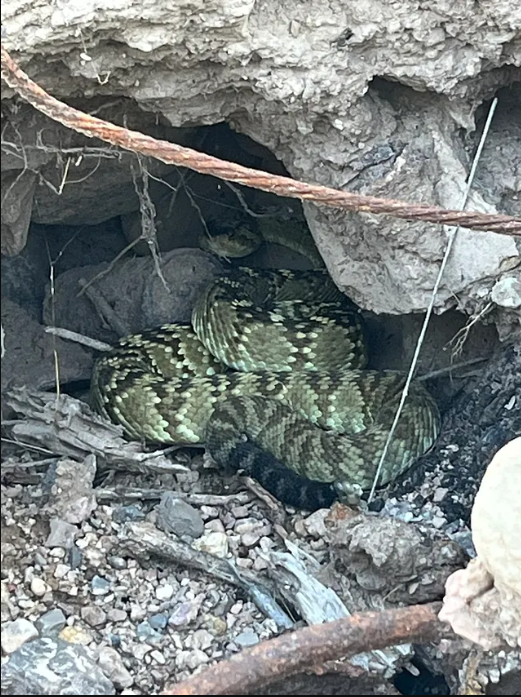
Being fascinated by the sight, for several minutes I fail to notice the black-tailed rattlesnake sitting in a hole to my right. Surprisingly, it’s the first time I’ve seen this species of rattlesnake despite the frequency of encounters with snakes on my trail runs. But it lives up to its name with the banded tail an apt black color not seen on other rattlesnakes. It’s gorgeous, and I’m instantly in awe of its rugged elegance.
I bend down to get a couple pictures before it moves deeper into the hole while shaking its tail — one of nature’s most effective warning systems telling me I shouldn’t get any closer. I heed the warning.
I stay there for a few minutes, basking in my luck and appreciating the solitude and surrounding nature. I’m detached from everything but the moment itself, a feeling so increasingly difficult to find. I’m part of nature, not separate from it.
The run back toward the trailhead is fluid and full of joy and I feel like I’m running faster, although the opposite is most likely true. It doesn’t matter. It’s been a successful run despite what my watch ends up saying. Stats can only tell you so much.
I come to a fork in the trail — one way leads to the trailhead and the other up the mountain. Climbing a mountain is always my preference, not only because I love the grind but also because I get to run back down.
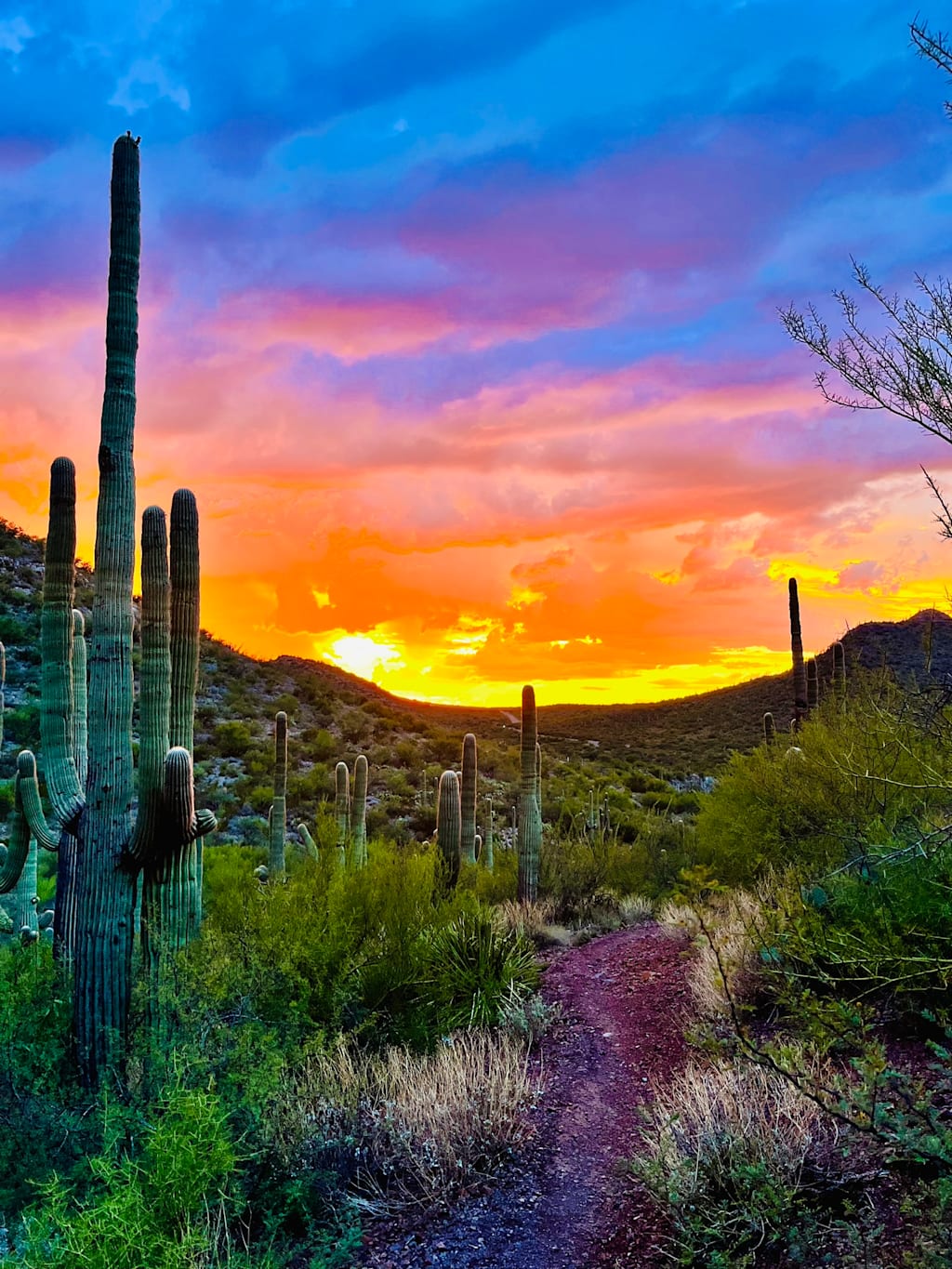
As I get to the top, the sun is slowly making its way behind the distant mountains, and I capture one of the most beautiful sunsets I’ve ever had the pleasure of seeing.
In this moment, I achieve everything I want and need — to be surrounded by beauty.
But my next trail run turns out to be quite a different experience.
I’m writing this from a campground bathroom while a windy, violent monsoon storm slowly lumbers by. Luckily, it’s a bigger bathroom with an entrance and I’m protected from the wind and rain by sturdy brick and a bolted-on wooden roof. It’s as safe as I can get in the middle of the desert.
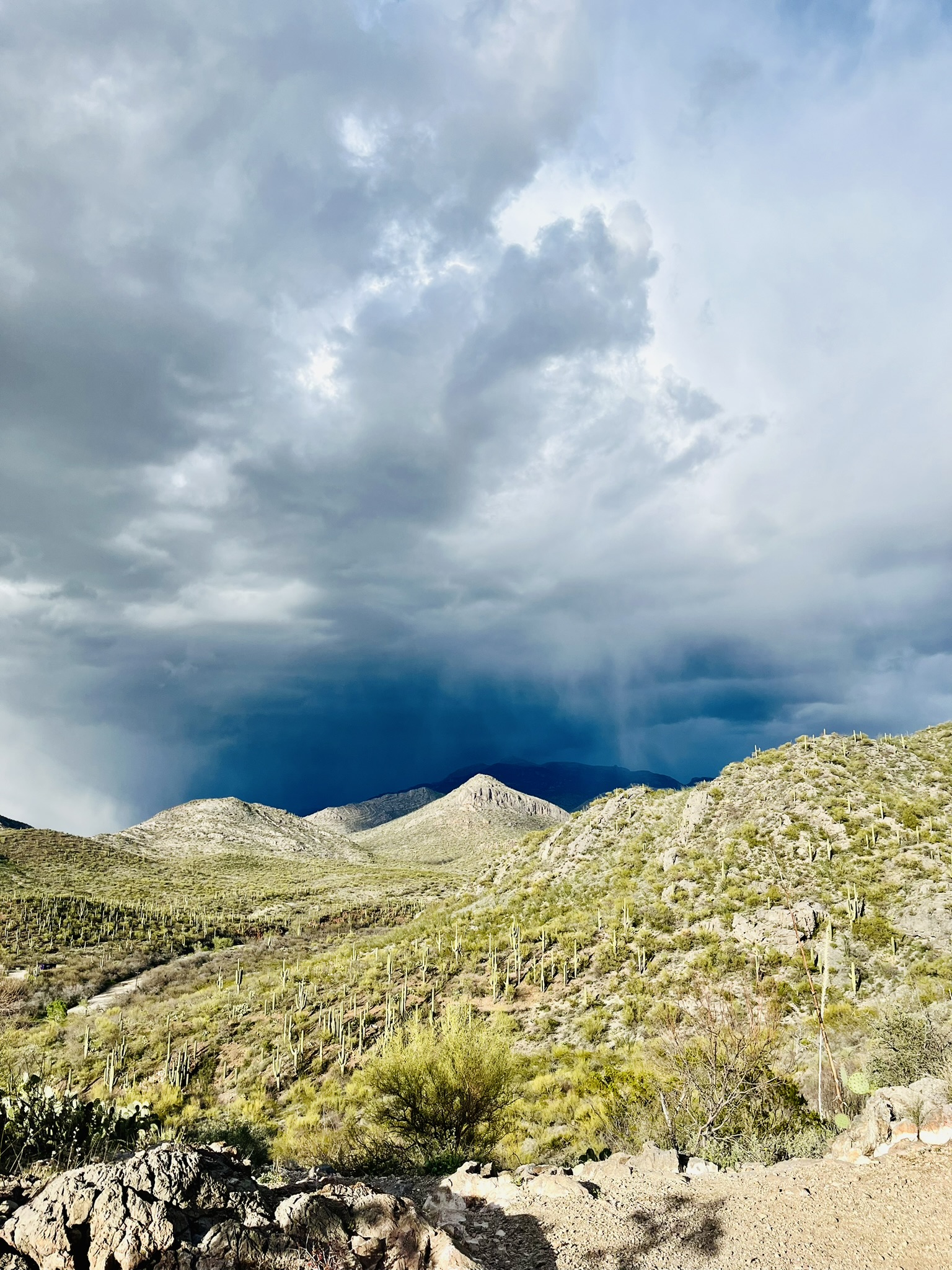
I’m no stranger to running in the rain and enjoy it. But getting caught in a monsoon storm is different. And this particular one was what National Weather Service meteorologist Glenn Lader called “the strongest (monsoon) event for Tucson I’ve seen in my almost 20 years.”
Monsoon winds are often violent and can include microbursts, which can produce winds of up to 100 mph. Hail, flash floods, dust storms, and even tornadoes can also happen.
I run a lot during monsoon season despite the dangers. Many storms are localized and you can watch them from afar while on the trail. It’s a beautiful, yet unnerving sight because I know how unpredictable they can be. The trails I run always have shelter within a reasonable distance; I’m dumb, but not stupid. I always turn around when I sense I need to also — my intuition finally good for something. Sometimes the decision to turn around comes a bit too late, though. This is one of those times.
With the storm at my back, I make it to the campground about five minutes before it hits. Just given the intensity, I’m a little worried, and it doesn’t appear it will let up anytime soon. It’s 6:10 pm, so I’ve got time to wait it out; it’s about an hour and a half before sunset and I always bring lights in case I end up on the trail after dark. I don’t have cell service — more curse than blessing in this situation.
I wonder if other animals seek shelter in storms such as this, and my mind, as it so often does, goes to strange scenarios. I imagine a pack of javelina traipsing into the bathroom followed by other desert animals — roadrunners, Gila monsters, rattlesnakes, deer, and coyotes round the corner and enter this perfectly placed shelter. We coexist in the campground bathroom until the storm lets up enough that we can go back to our normal activities. Kind of like a smaller version of Noah’s Ark and with only one toilet. Not a lot of privacy, although I’m sure I’d be more embarrassed than them. But, other than the frog popping out of the ground, no other animals join me. I’m a bit disappointed.
I sit in the bathroom and enjoy the rain, wind, and peacefulness, my worry slowly dissipating as the storm does too.
About an hour in, the monsoon finally gives me a reprieve — at least with the rain. Lightning and thunder still dominate the skies, and the sun has long since disappeared behind the dark clouds. I’m glad I brought my headlamp since I still have around two miles to get back to my car.
The run back is again fluid, but this time, I pick up the pace — after all, there’s no telling when the violent rain and wind will return. Running after a monsoon rain means you not only get to enjoy the rare, cooler temperatures of an Arizona summer, but you also get to splash in the puddles that have formed in the low spots. I forget about the looming threat of another storm and just enjoy the run.
I make it back to my car with orange-tinted lightning providing an intense light show and cracking thunder jolting me mid-stride.
Beauty still surrounds me, although it’s of a different and dangerous kind.
I trail run on land that was once home to the Hohokam, a southwestern Native American culture with ties to the cultures of Mesoamerica, especially Mexico. They roamed these same lands over 1,000 years ago and inhabited the area for almost 500 years. Some of the shelters they made still have their presence here. They farmed, hunted, and made tools, pottery, and jewelry. The Hohokam used what is now Colossal Cave for storage, to hold ceremonies, and for shelter. They focused on agriculture and growing crops, were called “masters of the desert,” and were known for their ability to build sophisticated irrigation systems.
It was a simple, yet harsh life. Disease often resulted in an early death as there was no medical treatment like today. They worked the land in often difficult conditions, and according to many scholars, their numbers declined drastically in a short period, most likely because of migration due to drought and other environmental factors.
“The Hohokam decline is part of a larger pattern of abandonment seen throughout the American Southwest. Recent studies suggest that people began migrating toward the south during a major drought in the Four Corners area in the 1200s. From AD 1200 to 1450 large portions of the prehistoric Southwest were largely abandoned.
Recent studies show a dramatic rise of population in the Salt River Valley from AD 1100 to 1300. At the beginning of this period, the Hohokam constructed their last large irrigation network on the river and used all of the available water to irrigate crops. This stressed their most critical resource, water. Major changes in Hohokam culture resulted, including the construction of the mounds. While these changes appear to be in response to a need to share water and feed an ever increasing population, their attempts fail. From 1350 to 1450 the population plunges and traces of the Hohokam disappear from the archaeological record.”
“It is thought that the Great Drought (1276–99), combined with a subsequent period of sparse and unpredictable rainfall that persisted until approximately 1450, contributed to this process. The later occupants of the area, the Pima and Tohono O’odham (Papago), are thought to be the direct descendants of the Hohokam people.”
Today, the Tohono O’odham Nation covers much of the area once inhabited by the Hohokam, and along with the Pascua Yaqui tribe, is prevalent in Tucson and the surrounding areas.
Like the Hohokam, the Tohono O’odham’s relationship to the landscape is paramount in their cultural and spiritual beliefs. Their Himdag (cultural values) includes respect for the land, respect for elders, and sharing with others. It also includes running and walking.
“Traditional people get up in the morning, run, and greet the sun. To a traditional person, running is a ‘part of fulfilling their spiritual needs.’ The focus is not on exercise, ‘It’s on spirituality — the health benefits just come along . . . In our himdag, there is no distinction between humans and animals and plants. You have a relationship there that was present since the world was created.’”
Running, for the O’odham, is a way to connect to the land. Marlinda Francisco, a Tohono O’odham Nation member, also believes loved ones who have passed protect her while she runs. “They come in the forms of butterflies, cardinals and feathers. I always pray and thank them for running with me and watching over me.”
These lands I run on are sacred. I don’t take that for granted.
The Hohokam not only had respect for each other, but also had a deep connection and respect for the land, nature, and the Earth. They protected and cherished it. They passed on these beliefs to their descendants, the Tohono O’odham. I feel that same connection and respect for the land and the Earth.
I see little of that today.
We live in a time full of genocides, war, ignorance, preventable diseases, and pollution. Rampant narcissism, corporate and government greed, and lack of empathy are increasing. Rights are being taken away and I fear for my daughters’ futures. There is famine, poverty, and abhorrent violence and discrimination. Abundance, it seems, is only for a select few.
We have failed to protect the very thing that gave us life. Our planet is slowly dying and we are to blame. We are killing ourselves and each other, and there is no end in sight. Every single part of that makes me incredibly sad.
It’s these adventures on the trail that help with that sadness.
About the Creator
Jeff Barton
Dad, trail and ultra runner, aspiring recluse, a bunch of other labels. Writing online since 2017; creator and editor of Runner's Life on Medium. I write about mental health and depression, running, life, and subjects that interest me.
Enjoyed the story? Support the Creator.
Subscribe for free to receive all their stories in your feed. You could also become a paid subscriber, letting them know you appreciate their work.
Comments
There are no comments for this story
Be the first to respond and start the conversation.