
Advantages of Continuous Pyrolysis for Waste Recycling
Why Continuous Pyrolysis Is Becoming the Preferred Technology for Industrial Waste Recycling

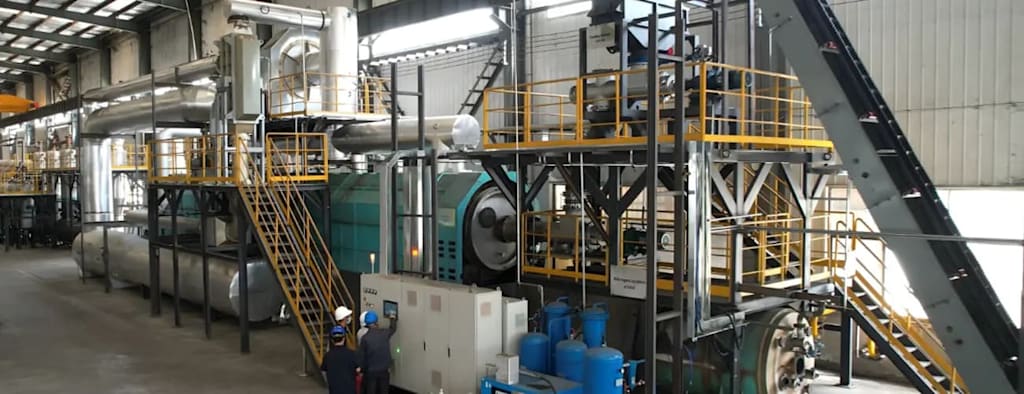
As governments and industries place greater emphasis on resource recovery and carbon reduction, pyrolysis has become one of the most promising technologies for recycling waste materials. It converts waste plastics, tires, oil sludge, and biomass into valuable products such as fuel oil, biochar, combustible gas, and recovered carbon black. While both batch and continuous systems are available, continuous pyrolysis has become the preferred choice for medium- and large-scale recycling projects due to its higher efficiency, automation, and lower operating costs.
Compared with traditional batch processing, continuous pyrolysis offers stable operation, consistent product quality, and greater profitability. These advantages make it an ideal solution for industrial waste recycling and circular economy initiatives.
What Is Continuous Pyrolysis?
Continuous pyrolysis is a production process in which raw materials are continuously fed into the reactor while solid products and gases are discharged simultaneously without stopping the operation.
Unlike batch systems that require repeated loading, heating, cooling, and unloading, a continuous pyrolysis production line can operate around the clock for extended periods. This uninterrupted process greatly improves equipment utilization and production efficiency.
Continuous systems are widely used for processing waste plastics, waste tires, biomass, oil sludge, and other organic solid wastes.
Higher Production Efficiency
One of the biggest advantages of continuous pyrolysis is significantly higher production efficiency.
Traditional batch equipment must stop after every production cycle for cooling and material discharge. These interruptions reduce the total daily output and increase energy consumption.
Continuous systems eliminate these downtime periods by maintaining stable operation. Fresh feedstock enters the reactor continuously while finished products are discharged automatically, allowing the equipment to maximize production capacity.
For commercial recycling plants, this means greater throughput and higher annual production.
Lower Energy Consumption
Energy efficiency is another major benefit of continuous pyrolysis.
Since the reactor remains at a stable operating temperature, less energy is required compared with repeatedly heating and cooling a batch reactor. Modern systems also recover and recycle non-condensable gases produced during pyrolysis as fuel for the burner.
This internal energy recycling reduces external fuel consumption and lowers operating costs.
Many advanced systems further improve efficiency through heat recovery technology, utilizing waste heat from the production process.
Stable Product Quality
Continuous operation provides more precise control of process conditions.
Automatic temperature control, stable feeding rates, and uniform residence time allow raw materials to undergo consistent thermal decomposition. As a result, the quality of pyrolysis oil, biochar, and recovered carbon black remains more uniform throughout production.
Consistent product quality improves market competitiveness and makes downstream processing more reliable.
High Level of Automation
Modern continuous pyrolysis plants are equipped with intelligent automation systems.
Automatic feeding systems transport raw materials into the reactor at a controlled rate, while continuous discharge systems remove solid products without interrupting production.
PLC control systems monitor temperature, pressure, burner performance, gas flow, and other key operating parameters in real time. Operators can supervise the entire production process through a centralized control panel, reducing manual intervention.
Automation not only improves production efficiency but also enhances workplace safety.
Reduced Labor Requirements
Because many production steps are automated, continuous pyrolysis requires fewer workers than traditional batch systems.
Manual loading and unloading are largely eliminated, allowing operators to focus on equipment monitoring, maintenance, and quality control.
Lower labor demand reduces operating expenses and minimizes the risk of human error during production.
For large industrial recycling facilities, labor savings can significantly improve long-term profitability.
Better Environmental Performance
Continuous pyrolysis systems are designed to meet increasingly strict environmental regulations.
Sealed reactors prevent oxygen from entering the reaction chamber, minimizing smoke generation and reducing the risk of uncontrolled combustion.
Gas recycling systems recover combustible gases instead of releasing them into the atmosphere, while modern emission control equipment removes dust and other pollutants before exhaust gases are discharged.
Compared with open burning or inefficient waste disposal methods, continuous pyrolysis provides a much cleaner recycling solution.
Lower Maintenance and Longer Equipment Life
Continuous systems are engineered for stable long-term operation.
Uniform heating reduces thermal stress on reactor components, while automated control minimizes sudden temperature fluctuations. Stable operating conditions reduce equipment wear and extend the service life of major components.
Preventive maintenance schedules are also easier to implement because production conditions remain predictable.
Over time, lower maintenance costs contribute to improved project economics.
Stronger Economic Returns
Although continuous pyrolysis plants generally require higher initial investment than batch systems, they often provide better long-term financial performance.
Higher production capacity increases product output, while lower energy consumption and reduced labor costs decrease operating expenses.
Consistent product quality improves sales opportunities, and the ability to operate continuously maximizes equipment utilization.
For investors planning commercial-scale waste recycling projects, these factors often result in faster return on investment and greater long-term profitability.
Supporting the Circular Economy
Continuous pyrolysis plays an important role in the transition toward a circular economy.
Instead of treating waste as a disposal problem, the technology converts discarded materials into reusable resources. Waste plastics become fuel oil, waste tires produce oil and recovered carbon black, biomass is transformed into biochar, and combustible gases are reused as process energy.
This resource recovery approach reduces dependence on virgin raw materials while lowering greenhouse gas emissions and conserving natural resources.
Conclusion
Continuous pyrolysis has become one of the most advanced and efficient technologies for modern waste recycling. Compared with traditional batch systems, it offers higher production efficiency, lower energy consumption, stable product quality, greater automation, reduced labor costs, and improved environmental performance.
As industries continue to pursue sustainable development and resource recovery, continuous pyrolysis will play an increasingly important role in recycling waste plastics, tires, biomass, and other organic wastes. Its ability to combine environmental protection with economic value makes it a key technology for building a cleaner, more resource-efficient future.
About the Creator
Bestonpyrolysis
Engaged in waste plastic/tyre/rubber recycling, oil sludge treatment, biomass recycling, sewage sludge management and paper recycling…
https://bestonpyrolysisplant.com/
Enjoyed the story? Support the Creator.
Subscribe for free to receive all their stories in your feed.
Comments
There are no comments for this story
Be the first to respond and start the conversation.