
“A World in Crisis: Voices from Global Challenges”
**“One planet, many struggles, shared responsibility.”**
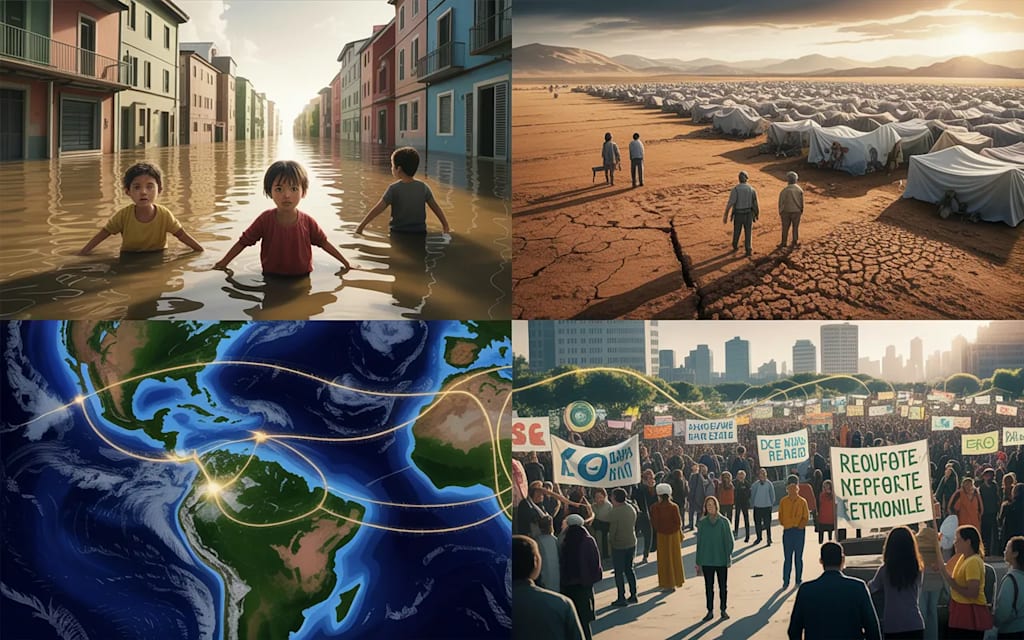
**A World in Crisis: Voices from Global Challenges**
The world had never felt smaller, yet it had never felt more divided.
From the crowded streets of megacities to the quietest corners of drought-stricken villages, humanity was speaking—but not always listening. It was a planet connected by technology, trade, and travel, yet strained by inequality, climate change, conflict, and uncertainty. In every time zone, there was a story unfolding. And together, they formed one global narrative: a world in crisis.
---
In the coastal city of Manila, the morning began with water.
Not the gentle kind that nourishes life, but the kind that swallowed homes whole during typhoon season. Maria, a schoolteacher, stood in ankle-deep floodwater outside her classroom. The building had survived another storm, but barely. Inside, the walls were stained with the marks of past floods—like memories the city could not erase.
She looked at her students, who arrived anyway, wading through streets that had turned into rivers. “We learn,” she told them, “because we must understand the world we are inheriting.”
For Maria, climate change was not an abstract debate. It was the smell of damp books, the cancelled lessons, the families rebuilding their homes again and again.
---
Thousands of miles away, in a refugee camp near the border of Sudan, twelve-year-old Yasin sat beneath a thin canvas shelter. The sun burned fiercely above him, and the wind carried dust that never seemed to settle.
Yasin once lived in a village with fields of sorghum and goats that followed him like shadows. But conflict had taken that life away. Now, his world was measured in aid rations and waiting lines.
Still, he clung to something no war could take from him—his education. A volunteer teacher came twice a week, and Yasin learned to read slowly, carefully, as if each word was a step toward a different future.
“What do you want to be?” the teacher once asked him.
Yasin hesitated, then answered, “I want to be someone who helps people stay in their homes.”
His voice carried both innocence and understanding beyond his years. He had already seen what displacement meant. He was already part of its story.
---
In a glass tower overlooking a European capital, Anika adjusted her laptop screen during yet another virtual conference. She worked for an environmental policy group, and her days were filled with data: rising carbon levels, deforestation rates, and projections that always seemed to lean toward alarm.
Yet what weighed on her most were not the numbers—it was the resistance. The slow pace of change. The arguments. The competing interests that turned urgent warnings into long debates.
“We have the science,” she said during a meeting, her voice steady but tired. “What we lack is time.”
After the call ended, she looked out the window at a city glowing with evening lights. She wondered how many of those lights would still shine for the next generation if nothing changed.
---
Meanwhile, in a small farming village in South America, Rafael walked through dry, cracked soil that once produced abundant crops. His family had farmed this land for generations, but the rains had become unreliable, the seasons unpredictable.
He knelt, letting the dust run through his fingers. “The land remembers,” his father used to say. But now Rafael wasn’t sure if that was true. Or maybe it remembered too much.
He had heard of new techniques, drought-resistant seeds, and global programs meant to help farmers like him. But help often arrived too late, or not at all.
Still, he planted. Because stopping would mean accepting defeat, and he was not ready to do that.
---
Across oceans, languages, and cultures, these lives were connected by invisible threads: climate shifts that crossed borders, economic systems that linked distant markets, conflicts that displaced millions, and technologies that carried both truth and misinformation at unimaginable speed.
In a university classroom in India, students debated solutions. In an island nation in the Pacific, families built homes on stilts as sea levels crept higher. In urban centers, activists marched with signs demanding justice, sustainability, and peace.
Each voice was different. Each struggle unique. Yet together, they formed a pattern that could not be ignored.
---
One evening, a global broadcast brought together voices from every corner of the world. Maria spoke about floods. Yasin spoke about displacement. Anika spoke about urgency. Rafael spoke about the land.
They did not speak as experts or politicians. They spoke as people living inside the consequences of global choices.
And for a moment, the world listened.
It was not a moment of instant solutions or miraculous change. But it was a moment of recognition—that behind every statistic was a human life, behind every crisis a story, and behind every story a shared responsibility.
---
The world was still in crisis. That truth had not changed.
But something else had begun to shift: awareness. Connection. A fragile but growing understanding that global challenges could no longer be treated as distant problems.
Because there was no “elsewhere” anymore.
Only here.
Only now.
Only one world.
About the Creator
Enjoyed the story? Support the Creator.
Subscribe for free to receive all their stories in your feed.
Comments
There are no comments for this story
Be the first to respond and start the conversation.