
A Third Way: How to Actually Investigate Reality
Part 12 of the Elucidation series. Previously: The Trap of Eclecticism

• • •
From our previous series of articles, we have seen three dead ends. Pure reason on its own, produces elegant systems disconnected from reality. Pure empiricism on its own, produces measurements drained of meaning. Eclecticism, mixing incompatible systems, produces chaos dressed as wisdom.
So what actually works?
The Elucidation lectures propose a method that is neither purely rational nor purely empirical, but a disciplined integration of both, and it follows a specific order.
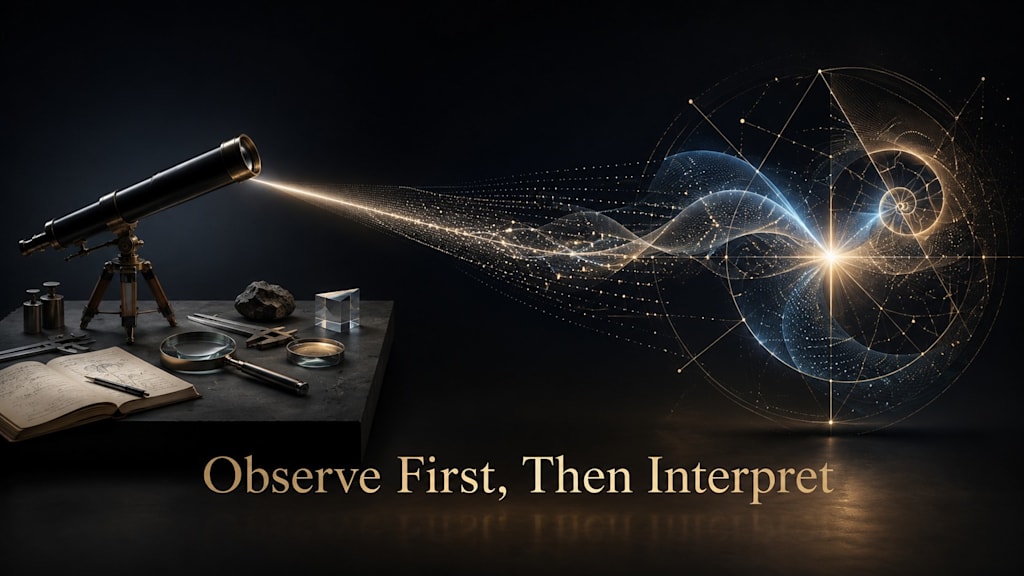
The Method: Observe First, Then Interpret
The principle is straightforward. First, study the world as it actually is, using the best scientific tools available. Observe. Gather evidence. Follow the data. Do this honestly, without forcing the evidence into a pre-existing framework.
Then, once the evidence is in hand, interpret it. Ask what it means. Draw philosophical conclusions from the patterns you have found. Use reason, not to replace observation, but to go beyond it, to ask the questions that observation alone cannot answer.
The order matters. Evidence first, interpretation second. Not the other way around.
This avoids the rationalist error (starting with a theory and looking for evidence to support it) and the positivist error (stopping at the evidence and refusing to ask what it means).
A Practical Example
Imagine you are trying to understand a vast landscape. You begin by climbing to a high point and looking out. You observe the terrain, the rivers, the mountains, the forests, the settlements. You note what is where. You map what you can see.
This is the scientific phase. It gives you data, but not meaning. You know what the landscape looks like, but not what it signifies.
Then you ask: Why are the settlements where they are? Why do the rivers flow in this direction? Is there a pattern? Does the landscape have a logic: a reason behind its arrangement?
This is the philosophical phase. It takes the observations seriously, but it goes further. It asks not just what but why.
A person who only observes has a map but no understanding. A person who only reasons has an understanding but no map. The method requires both, and in the right order.
The Plan of the Elucidation Lectures
This method is exactly what the remainder of this series will follow.
We begin with the scientific phase: a thorough study of the world's evolutionary development, from the first cloud of hydrogen to the emergence of life, consciousness, and civilization. This study draws on the best available science, cosmology, chemistry, biology, paleontology, anthropology.
From this study, patterns emerge. Three patterns, specifically, three laws that appear to govern the entire process of development, from the smallest particle to the largest civilization.
Then comes the philosophical phase: What do these patterns mean? If the universe has been moving in a consistent direction for fifteen billion years, what does that imply about the nature of existence? If the process accelerates, what does that say about the role of consciousness? If the process never reverses, what does that suggest about purpose?
The philosophical conclusions are not imposed on the data. They are drawn from it. But they go beyond what any purely scientific analysis could yield, because they ask questions that science, by its own rules, cannot ask.
Why This Method Produces Humility
One might expect that a method so ambitious, attempting to explain the meaning of existence, would produce arrogance. In fact, it produces the opposite.
Because the method begins with observation, it is always subject to correction. If new evidence contradicts an interpretation, the interpretation must change. The philosophical conclusions are not articles of faith. They are hypotheses tested against reality.
And because the method demands coherence, because every conclusion must fit with every other, it imposes a discipline that prevents the thinker from running away with a favorite idea at the expense of the whole.
This is the opposite of dogmatism. Dogmatism says: here is the truth; do not question it. This method says: here is what the evidence suggests; let us examine it further; let us demand that it fit together; and let us correct it when it fails.
The Road Ahead
With the method in place, the investigation can begin. Over the next several articles, we will follow the evidence from the beginning of the universe to the present day, tracing the story of evolutionary development in all its stages, mineral, organic, biological, social.
From that evidence, three laws will emerge. And from those laws, a picture of existence will take shape, a picture that answers the three fundamental questions of ideology more coherently than any alternative yet proposed.
• • •
Next: Why Knowledge Demands Action**
Elucidation is a series of articles inspired by philosophical lectures given around 50 years ago. New articles are published weekly.
This article is part of the Elucidation series. The articles have been written and reviewed by the author with the assistance of AI.
About the Creator
Han Elucidation
Why do we exist? A searcher. Exploring existence, meaning, and what it means to be human through the Elucidation series.
Enjoyed the story? Support the Creator.
Subscribe for free to receive all their stories in your feed.
Comments
There are no comments for this story
Be the first to respond and start the conversation.