
A significant climatic surprise may be concealed by Arctic woods.
When forests cease to be useful

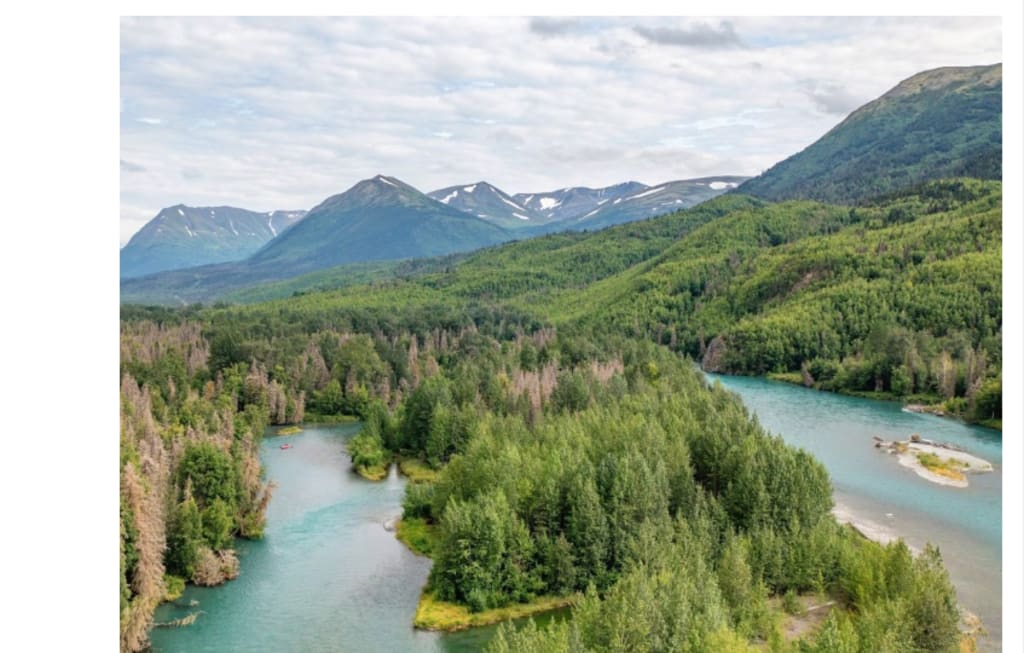
Climate change is no longer a far-off warning in the far north. The landscape is already changing as a result. Arctic and boreal regions in Alaska and Canada are warming up to four times faster than the world average.
Ecosystems that have long contributed to slowing climate change by removing carbon dioxide from the atmosphere and storing it in trees, bushes, and soil are severely strained by this.
When forests cease to be useful
The problem is that under stress, those ecosystems don't necessarily continue to be beneficial. Parts of the north may begin releasing carbon back into the atmosphere rather than storing it as wildfires intensify, droughts become more frequent, and other disturbances expand.
The entire climate system gets more difficult to stabilize after that. This is the reason biomass—the total amount of living plant material in these landscapes—is so important to biologists.
Calculating the amount of carbon stored in forests
One of the best indicators of how much carbon northern ecosystems are storing or losing is biomass. However, it's more difficult than it seems to get those measurements correct. Wanwan Liang and Jon Wang, researchers at the University of Utah, are now leading two new experiments that aim to clarify that image.
Examining the numerous satellite-based biomass datasets now in use reveals that they are not always consistent. The other presents a new map that shows biomass over almost 40 years in considerably greater detail over the Arctic and boreal regions of North America. When taken as a whole, the studies essentially pose the straightforward question: are we even accurately assessing the north's rapid change?
Too many maps, too many responses
A problem that many individuals outside the profession probably never consider is addressed in the first publication. Many remote-sensing datasets for Arctic and boreal forests are now accessible, but more does not always equate to better.
Liang stated, "There are a lot of datasets available now, but there's very little guidance for users on how to choose among them." "If you're not an expert, it's really hard to know which one to trust because two maps can give completely different estimates for the same region," Wang continued.
Nine biomass datasets from the Arctic and boreal regions of North America were therefore compared by the researchers. Rather than attempting to identify a single, all-encompassing winner, they sought to determine which datasets are better suited for specific uses.
For tracking wildfire damage, some might be more effective. For calculating large-scale carbon budgets, others might be more trustworthy. Wang remarked, "It's more like a guide." "Different maps work better for different purposes."
A considerably more crisp image
By creating a brand-new biomass dataset from scratch, the second study goes one step farther. Using Landsat satellite imagery, aerial LiDAR data, and forest inventory records from the US and Canadian Forest Services, Liang oversaw the creation of the map.
The outcome is a dataset that monitors aboveground biomass annually from 1984 to the present. With a resolution of 30 meters, it is roughly the size of a baseball pitch. Because of this level of information, researchers can now identify not just major disruptions like wildfires,
but also minor alterations like land conversion, logging, and larger regional vegetation changes. Liang stated, "We can detect anything happening at 30 meters or larger." Ecosystems in the north are changing in a variety of ways. Instead of flattening such changes into a single, wide average, a finer map enables scientists to observe those changes as they occur.
An optimistic notion with a catch
Warmer temperatures in the north may encourage trees to expand and absorb more carbon, partially balancing emissions from fossil fuels, according to a rather optimistic theory that has been circulating in climate science for years. Wang, however, asserts that the data is far from straightforward.
"There has been a theory that as temperatures rise, northern forests will simply continue to absorb more carbon." "However, we are unsure if that is true." Indeed, heat can occasionally speed up plant growth. However, it can also exacerbate drought stress, start bigger fires, and promote bug outbreaks that destroy trees.
These plants stop absorbing carbon after they die. Additionally, they emit carbon back into the atmosphere when they burn or degrade. Therefore, whether or not northern vegetation is growing is not the only question. The question is whether the north is becoming a greater carbon sink overall or if it is beginning to deteriorate.
Why improved stats are important
Carbon estimates are used by governments to report greenhouse gas inventories and formulate climate policy. These figures have an impact on the setting and evaluation of emissions objectives in nations like Canada.
Uncertainty does not remain in the lab if the underlying biomass datasets are inconsistent. It affects how policies are made. "It creates a lot of uncertainty when different datasets provide different answers," Wang stated. "And that makes it more difficult to make decisions."
Additionally, there are more direct applications. High-resolution biomass maps can enable improved land use planning, identify particularly sensitive locations, and estimate the amount of carbon that could be lost in a wildfire.
Maintaining public access to the data
Liang and Wang state that their objective is to make these tools clear and available at a time when some carbon-related data is becoming entangled in private sector systems. Wang declared, "This is taxpayer-funded science." "We want it to be usable by people."
The stakes are enormous as the Arctic and boreal north undergo rapid change. The world needs to know as soon as possible if these landscapes are changing from carbon sinks to carbon sources.
However, scientists must ensure that they are accurately measuring the trees before they can provide answers to the most important climatic problems. At a time when telling the narrative correctly is more important than ever, that is what our research is actually about: not just more data, but better data.
About the Creator
Enjoyed the story? Support the Creator.
Subscribe for free to receive all their stories in your feed.
Comments
There are no comments for this story
Be the first to respond and start the conversation.