



Making their home in the lowland rainforests of Borneo, Sumatra, and the Malay Peninsula, hornbills have an intimidating appearance with their most notable feature, the "casque," a helmet-shaped structure above the bil. After noticing their startling appearance, then imagine hearing their maniacal cackling. When fighting over territory or food, the males will joust and head-bang with other males. Hornbills have another surprising feature: their bald, red throat, which looks like the feathers have been plucked straight out. The rest is covered with black plumage, a white belly, and long legs.
These are monogamous birds with an unusual breeding habit. They work in pairs and seal the female up inside a tree cavity with mud, fruit pulp, and feces leaving a hole large enough for males to transfer regurgitated food to the female as she incubates up to six eggs. When the chicks are ready to fledge, the adults break open the seal.
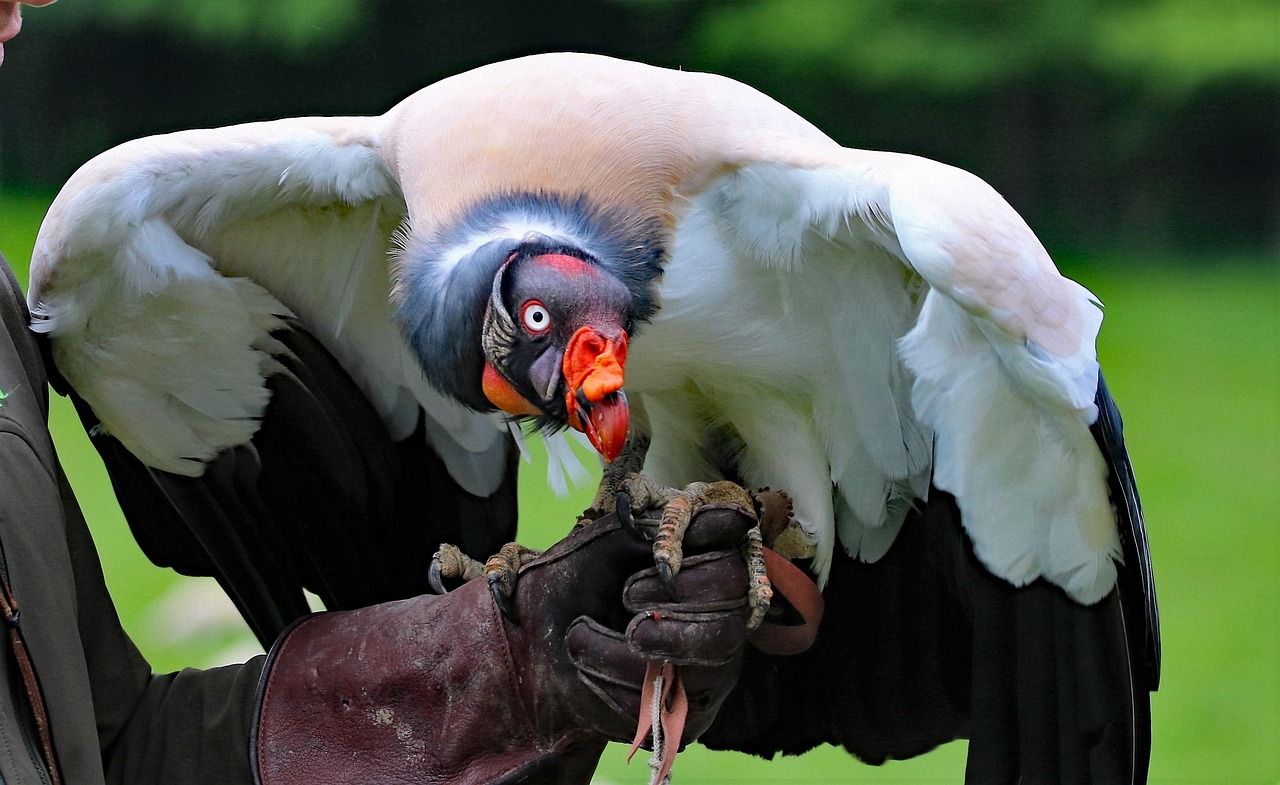
Striking-looking king vultures have bald crowns with short, bristle-like feathers; red-ringed white eyes; and the rest of the head and face vary in vibrant colors of red, orange, yellow, green, and bluish-purple. Their necks have collars of grayish-black feathers, and their bodies are white with a uniform band of black feathers that line the edge of their wings and tails. These birds are found in the dense tropics of Central and South America, from Mexico all the way down to southern Argentina; the king vulture goes way back to ancient Mayan times when it was believed to be a “king” that transported messages from the gods to humans.
King vultures are monogamous, with pairs mating for life. They make their nests on the ground in natural cavities such as hollow logs or tree stumps. Both parents share in the incubation of a solitary egg.
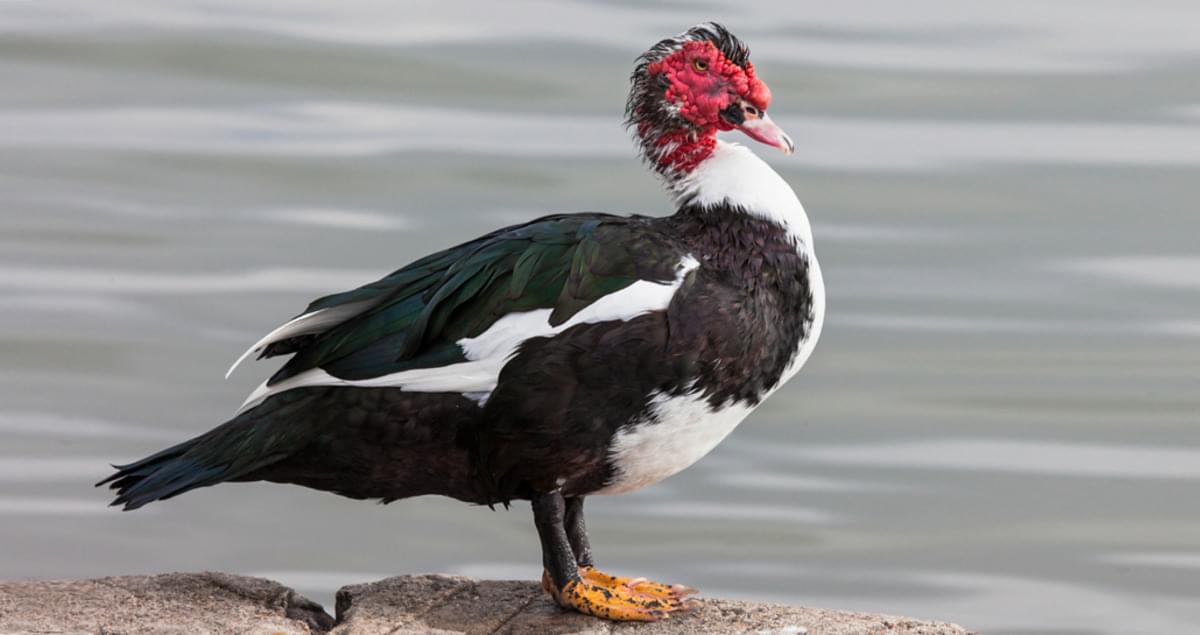
Muscovy ducks have warty faces. There are red, bumpy things all over the duck’s face called caruncles. The male also features a black or red knob near the bill. The bodies of both sexes are black and white and both have a short crest and black or yellow webbed feet. These ducks are native to South America and love congregating near water. Due to their oil glands not being as well developed as in other duck species, they are not good swimmers.
Muscovies breed up to three times a year, but they don’t form monogamous pairs. The males win a female over by fighting other males. Pairs can mate on land or in water. After mating, the female takes sole care of raising a clutch of 10 to 16 eggs.
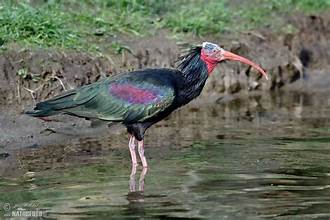
Northern bald ibises have red, featherless heads and long, curved beaks. These birds are found in small populations in Morocco and Syria. In addition to this large bird’s striking head and beak, the rest of its body is glossy black with iridescent green, violet, and bronze reflections. Long, wispy feathers stick out behind the bird’s head like a Mohawk. This species can be found in colonies on cliff tops or in dry deserts and fallow fields, foraging for the likes of scorpions, beetles, and lizards.
Northern bald ibises are socially monogamous, meaning they might mate with others but are dedicated to raising the chicks of a nest they have built. The males choose the nest site and prepare it, then wave a female over with their crest feathers and rumbling call. Once a male and female bond, they practice bowing and mutual preening before mating. After the female lays two to four eggs, both parents will incubate them and feed the chicks.
Potoos are nocturnal birds and rarely seen during the day. These birds sleep upright on tree branches. (pictured above) They mingle with their surroundings, having mottled green, gray, and brown plumage just like tree bark, and can stay hidden in daylight. They inhabit the rainforests of Central and South America. Seeing them can be a shock with their bulging yellow eyes, long necks, small beaks, and large gaping mouths. You'll know they're around by their eerie, haunting calls at night.
Potoos are monogamous breeders that share in the incubation and care of a single chick. Unlike many other birds, potoo pairs don’t actually build a nest but simply lay their egg in the crook of a branch or in the depression of a tree stump.
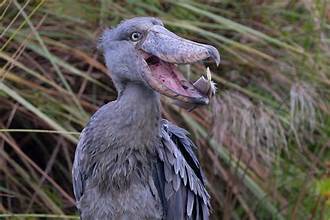
Shoebills are quite amazing, with giant bills that look like clogs. They are pretty popular birds for birdwatchers in Central and Eastern Africa. These are tall birds standing nearly five feet on long, spindly legs and looking like prehistoric storks with slate-gray plumage, big, round yellow eyes, and a tuft of feathers on the back of their heads. Their odd-shaped bills are pale yellow with slashes of gray markings and, at the end, a hook-shaped nail allowing the shoebills to decapitate prey. Their prey is usually lungfish but can also include water snakes, baby crocodiles, small waterfowl, lizards, and rodents. Occasionally these birds surprise others, letting loose with a clattering noise that sounds like a machine gun.
During breeding, shoebills form temporary monogamous pairs and become territorial. In pairs they build floating nests with grass and other vegetation.
About the Creator
Rasma Raisters
My passions are writing and creating poetry. I write for several sites online and have four themed blogs on Wordpress. Please follow me on Twitter.
Enjoyed the story? Support the Creator.
Subscribe for free to receive all their stories in your feed. You could also become a paid subscriber, letting them know you appreciate their work.
Comments
There are no comments for this story
Be the first to respond and start the conversation.