
A Look Through Animals Eyes
A Glimpse Through the Eyes of Animals
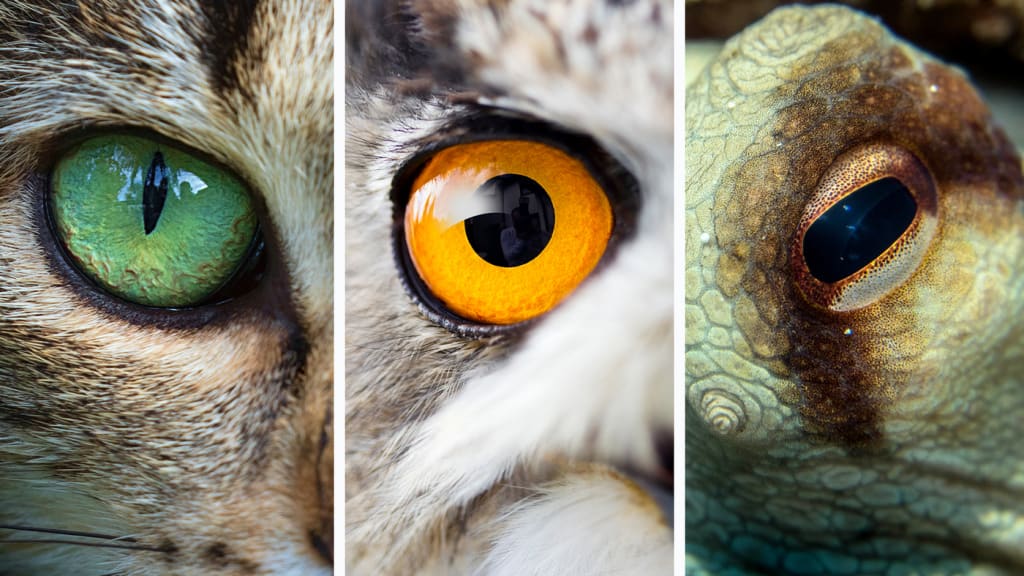
A Glimpse Through the Eyes of Animals
It is a well-known fact that animals perceive the world differently from humans. For instance, pigeons possess superior vision compared to humans, which is quite remarkable. Let us take a moment to view the world from the perspective of various animals. Snakes, for instance, have a unique way of seeing the world, as they possess infrared-sensitive receptors in their snouts, which enables them to detect the radiated heat of warm-blooded mammals. Cows, on the other hand, do not see colors as vividly as humans do, as they lack the necessary receptors in their retinas to perceive the color red. Their world is mostly composed of variations of blue and green. Additionally, cows have a near-panoramic vision, with the only blind spot being directly behind them. Therefore, it is advisable to alert them when approaching from behind.
Horses have a blind spot in front of their faces due to the placement of their eyes, which means they cannot see objects directly in front of them. Similarly, they do not perceive colors as vividly as humans do. Fish, on the other hand, have ultraviolet receptors and a more spherical lens than humans, which gives them an almost 360-degree vision. However, they have difficulty discerning red shades underwater. Deep-sea fish, on the other hand, can see in the dark, which is quite fascinating. Sharks, however, cannot distinguish colors, but their vision is clearer underwater than humans.
Birds have unique ways of seeing the world. They can see ultraviolet light, which helps them differentiate between males and females of their own species and navigate their surroundings better. Falcons and eagles can focus on small objects up to a distance of one mile, while pigeons can see tiny details and have a 340-degree field of vision. Insects, such as flies, have thousands of little eye receptors that work together to give them a comprehensive view of their surroundings. They see everything in slow motion and can perceive ultraviolet light. Bees, however, cannot perceive the color red, as it appears dark blue to them.
Rats cannot see red either, and their eyes move independently of each other, which means they see double all the time. Cats cannot see shades of red or green, but they can see brown, yellow, and blue hues. They have a wide-angle view, which enables them to observe more objects on the sides than humans. In pitch-black conditions, cats can see six times better than humans, as their pupils adjust to any lighting. Dogs cannot see red or orange, but they can differentiate 40 shades of gray and perceive blue and violet hues.
Frogs are picky eaters and will only consume moving prey. They are not very observant creatures and will not bother looking at things that are not important to them, such as shadows. Chameleons have eyes that can move independently of each other, which enables them to see everything around them without turning their heads. They can even see two images simultaneously, like a double feature movie, one in front and one behind.
In conclusion, animals perceive the world differently from humans, and it is fascinating to view the world from their perspective. If you suddenly had 360-degree vision like a chameleon, what would you do? Share your thoughts in the comments. If you found this information intriguing, please like and share this video with your friends. For more exciting content, click on the videos and stay on the bright side.
About the Creator
Enjoyed the story? Support the Creator.
Subscribe for free to receive all their stories in your feed.
Comments
There are no comments for this story
Be the first to respond and start the conversation.