
A long-standing puzzle regarding early animal existence is resolved by tiny fossils.
Animal life's missing branch

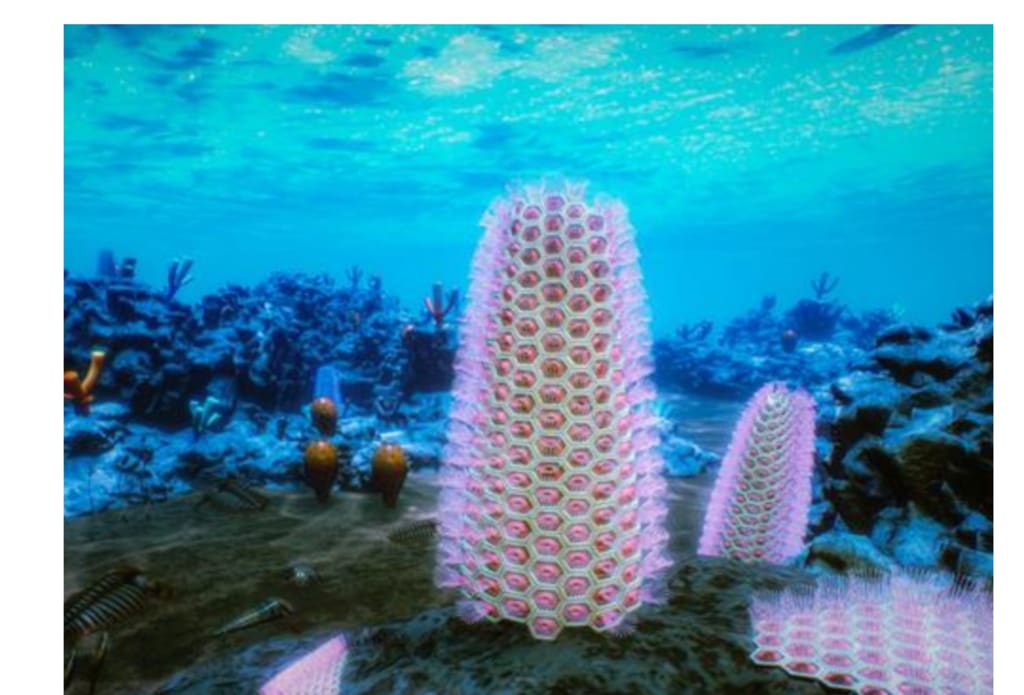
A single fossil that was only a tenth of an inch across was at the heart of an ongoing dispute for years. No one was able to determine if it was an early animal colony, a type of seaweed, or something else entirely when it was excavated from limestone in southern China.
There was a reason the argument had dragged on. From the beginning of animal life, one entire branch of the animal family tree seemed to be absent. The branch was missing from the earliest strata by about 50 million years, and the only solid evidence was the tiny, disputed fossil.
Animal life's missing branch
The animals are bryozoans, which are microscopic filter-feeding invertebrates that form colonies of nearly identical individuals that share a skeleton. They cover rocks, shells, and algae throughout all of the world's waters, making them difficult to notice unless you know to look.
Around 530 million years ago, during the Cambrian explosion, the majority of major animal body designs emerged. Bryozoans did not appear in the fossil record for another 50 million years, suggesting that they missed the event completely.
For a long time, research on the DNA of extant species had suggested that bryozoans also originated early. For decades, experts were troubled by the discrepancy, despite the rocks' claims to the contrary.
According to palaeontologist Dr. Timothy Topper of the Swedish Museum of Natural History, "Bryozoa has been the elephant in the room of Cambrian palaeontology for a long time."
Chinese fossils
The discovery comes from limestone in China's southern Shaanxi Province, where fossils dating back roughly 520 million years are found in rock formations known as the Xiannơong Formation.
Tiny, exquisitely preserved colonies were extracted from the stone by a multinational team under the direction of Baopeng Song of Northwest University (NWU). They included new specimens of Protomelission gatehousei, which was first identified as a Cambrian bryozoan in a 2021 research, as well as a completely new species that the scientists called
The presence of two distinct forms indicated that bryozoans were already branching into various types. As crucial as their age was their preservation. The colonies, which were only a tenth of an inch in diameter, retained their three-dimensional structure despite the soft tissue inside the original skeleton turning to stone in phosphate.
Soft tissue endures
The majority of bryozoan fossils from earlier times were naked skeletons. The animal's delicate body hardly ever turns into stone. Not in this place. These specimens preserved structures that had never been seen before.
A thin-walled sac, the soft lining of a single animal, rested inside each small chamber. The experts identified the fine fibres that ran and looped along it as fossilised muscle since they were sufficiently preserved. Each sac was divided from the next by a small, uniform space.
One specimen retained thin spines that protruded through the skeleton, known as styles. Each chamber held a distinct animal and was connected to the others in a typical honeycomb of six-sided compartments. There was only one solution when soft anatomy and skeleton were combined.
Resolving a long-standing dispute
Not everyone was persuaded by the 2021 fossil. In a 2023 publication, several experts contended that it was actually a green alga, a type of seaweed, rather than a mammal. Others thought it might be loose plates from an unrelated organism. The argument was resolved by the soft tissue.
Loose skeletal plates do not arrange themselves into neat budding chambers with shared walls, and algae lack muscular fibres and sac-like interior linings. All of it was clearly animal and kept in place in the new fossils.
Song explained, "These are complex, modular colonies, not just simple precursors." Both the internal anatomy and the skeleton supported bryozoans and disproved the opposing readings. There was no more room for a decades-old objection.
Further back in time
There was a surprise when the two fossils were positioned on the bryozoan family tree. As rudimentary first drafts, they did not sit at the base. They landed far up an advanced branch, the kind whose surviving relatives are still in the sea now.
An advanced branch this early suggests that the group's true origins are deeper still, prior to the official start of the Cambrian explosion. The Ediacaran epoch, the dark time immediately preceding the Cambrian, is also favoured by genetic research on extant bryozoans.
That is directly supported by the fossils. Side by side at 520 million years, two different colony types demonstrate the group's early experimentation with design. They were diversifying when the great radiation was still going strong, so they weren't latecomers.
Why the animals weren't there
Even after the identification, a true mystery persisted. These species' protracted silence in the fossil record required an explanation if they had always existed. The majority of Cambrian sites are well-known for their soft-bodied fossils that were created in quiet, deep water. These bryozoans inhabited shallow, sunny reefs—a type of habitat that rarely retains delicate tissue.
For fossil searchers to find them, they had chosen the wrong location. The fresh specimens sprang directly from that reef rock, liberated from limestone using acid. The missing animals started to appear once researchers understood which rocks to look for.
An antiquated lifestyle
Prior to this, there was a gap at the beginning of the bryozoan narrative that no one could complete. The hole has been sealed. As evidenced by animals preserved down to their muscular fibres and the cells that held them, their genesis is now firmly located inside the Cambrian explosion.
The finding gives palaeontologists a new area to explore by redrawing a portion of the early animal family tree. Globally, shallow Cambrian reefs that were previously overlooked in favour of soft-tissue fossils now seem to merit a far more thorough study.
Instead of being late to the Cambrian boom, bryozoans were already diversifying at the same time. The colonial way of life that characterises them now was a component of the first wave of animal development rather than a later invention.
About the Creator
Enjoyed the story? Support the Creator.
Subscribe for free to receive all their stories in your feed.
Comments
There are no comments for this story
Be the first to respond and start the conversation.