
25 Deep-Sea Creatures That Look More Like Aliens Than Animals
Hidden far beneath the waves, these astonishing deep-sea creatures challenge everything we think life on Earth should look like

Human curiosity has reached mountain peaks, frozen deserts, and even the Moon, yet one of the greatest frontiers lies beneath the waves. Deep below the surface lives an astonishing collection of animals that few people will ever see with their own eyes. Some glow like floating lanterns, others carry transparent skulls, and a few possess teeth that seem far too large for their own bodies. Every discovery reminds us that the ocean still guards countless secrets beyond imagination.
. . .
Darkness covers nearly every corner of the deep ocean, yet it remains one of the least explored places on Earth. Scientists estimate that much of the ocean floor is still unmapped, which means remarkable discoveries are waiting beneath the waves. Every research expedition brings fresh surprises, revealing extraordinary marine life that continues to challenge what we know about nature.
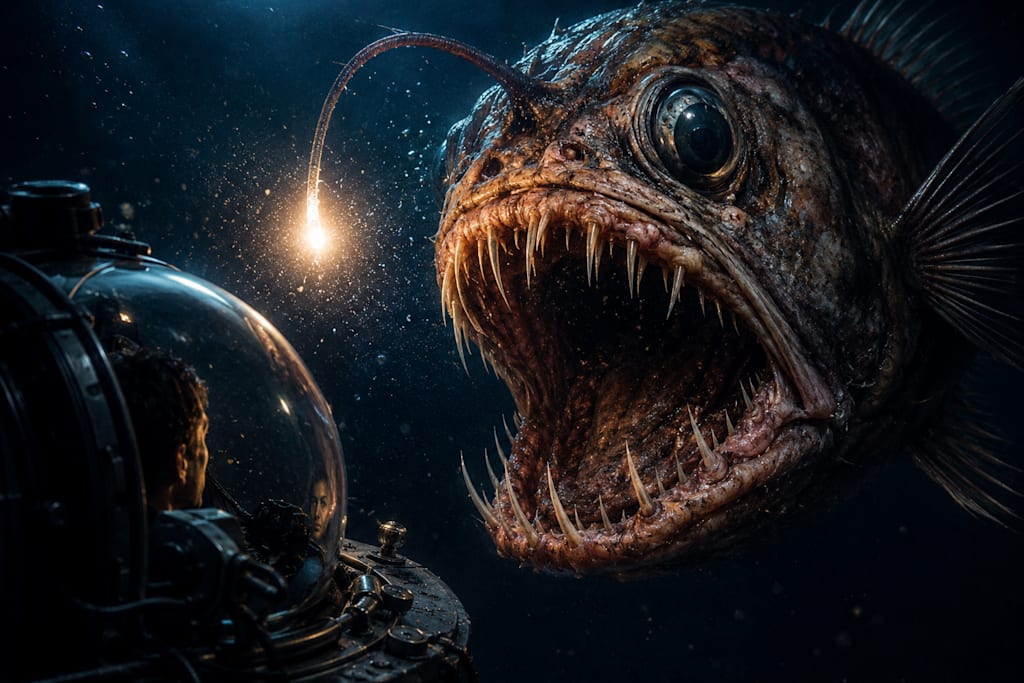
Among the most unforgettable is the Anglerfish. Its glowing lure hangs in front of its mouth like a living fishing rod, attracting curious prey before snapping shut with astonishing speed. This famous deep-sea predator has become a symbol of the mysterious ocean, yet seeing one still feels almost unbelievable.
The Goblin Shark deserves equal attention. Its long, flattened snout already looks unusual, yet its jaw creates the real surprise. It shoots forward in a split second to capture prey, giving this rare shark one of the most remarkable hunting techniques found beneath the sea.
The Vampire Squid carries a dramatic name, though it feeds mostly on drifting organic material rather than blood. Its dark red body, glowing eyes, and webbed arms create an unforgettable appearance that continues to fascinate marine researchers.
Another remarkable resident is the Barreleye Fish. Its transparent head reveals its eyes inside the skull, allowing scientists to observe one of nature's most unusual visual systems. Those eyes rotate upward to detect prey floating overhead.
The Giant Isopod resembles an enormous version of the tiny pill bugs found in gardens. Living thousands of feet below the surface, it can survive for years without food, a remarkable adaptation in an environment where meals are often difficult to find.
The Dumbo Octopus appears surprisingly charming with its ear-like fins extending from each side of its head. Those fins help it glide gracefully through deep water, making it one of the most recognizable deep-sea animals.
No collection of strange sea creatures feels complete without the Gulper Eel. Its enormous mouth stretches far beyond the size of its body, allowing it to swallow prey much larger than expected. Its thin tail even produces light, adding another extraordinary feature.
The Fangtooth Fish carries teeth so large they barely fit inside its mouth. Despite its frightening appearance, this predator grows only about six inches long, proving that size rarely tells the whole story.
The Black Swallower performs an astonishing feat by consuming fish much larger than itself. Its expandable stomach allows massive meals that help it survive long periods without another feeding opportunity.
The Leafy Seadragon offers an entirely different kind of wonder. Covered in leaf-like appendages, it blends beautifully with underwater vegetation. This remarkable camouflage helps protect it from predators.
Comb Jellies sparkle with rainbow colors as light bends across rows of tiny moving hairs. Many species also produce natural bioluminescence, creating glowing displays that brighten the deep ocean.
The Tripod Fish spends much of its life standing on long fin rays that resemble stilts. This unusual posture helps conserve energy while patiently waiting for drifting prey.
The Frilled Shark appears almost prehistoric. Its long body and rows of needle-like teeth have remained largely unchanged for millions of years, offering a fascinating glimpse into Earth's distant past.
The Cookiecutter Shark may seem small, yet it leaves perfectly round bite marks on whales, dolphins, and large fish. Those distinctive wounds reveal just how effective this tiny predator can be.
The Giant Squid has inspired legends for centuries. Rare encounters continue fueling fascination because observing one alive remains extraordinarily difficult, even with modern technology.
Glass Squid possess nearly transparent bodies that make them almost invisible in open water. Their delicate appearance hides remarkable adaptations that help them survive in complete darkness.
Sea Spiders stretch long, thin legs across the ocean floor. Several species grow much larger than their shallow-water relatives because of the unique conditions found in the deep sea.
The Dragonfish combines glowing organs with razor-sharp teeth. Many species even produce red bioluminescent light that remains invisible to most prey, giving these predators an impressive advantage while hunting.
The Blob Sculpin, often confused with the better-known blobfish, survives under immense pressure where its soft body functions perfectly. Its appearance changes dramatically only after reaching the surface.
The Siphonophore challenges the definition of a single animal. Each individual is actually a colony of specialized organisms working together as one. Some grow longer than a blue whale, making them among the longest living creatures on Earth.
The Sea Pig crawls slowly across the seafloor using tube-like legs. Although its name often makes people smile, it plays an important role by recycling nutrients from decaying organic matter.
Hatchetfish have paper-thin bodies and glowing undersides that help them disappear against the faint light filtering from above. This clever camouflage protects them from predators lurking below.
The Pelican Eel stretches its giant mouth into an enormous pouch capable of trapping prey with surprising efficiency. Its tiny eyes suggest that touch and movement matter more than vision in the deep ocean.
The Basket Star extends countless branching arms that resemble living tree roots. During feeding, those arms spread wide to capture tiny drifting organisms carried by ocean currents.
Closing the list is the Bloody Belly Comb Jelly. Its vivid red stomach conceals glowing prey inside its body, preventing larger predators from spotting the light and tracking it through the darkness.
These astonishing deep-sea animals remind us that Earth still holds extraordinary mysteries. Every research mission reveals another species with remarkable adaptations that challenge old assumptions about life. Beneath the waves lies a hidden world where survival depends on creativity, resilience, and constant adaptation. That lasting sense of discovery continues drawing scientists deeper into the ocean, while giving the rest of us another reason to marvel at one of the most mysterious places on our planet.
About the Creator
Ojo
🔍 I explore anything that matters—because the best discoveries don’t fit into a box...
Enjoyed the story? Support the Creator.
Subscribe for free to receive all their stories in your feed.
Comments
There are no comments for this story
Be the first to respond and start the conversation.