
12 Most Mysterious Places Scientists Still Can't Explain.
Unique discoveries
12 Most Mysterious Places Scientists Still Can't Explain.
When it comes to life on Earth and human history, scientists and historians possess some of the answers, although not all of them. They excel in their respective fields, drawing grand conclusions from minuscule clues and fragments of evidence. However, there are instances when they encounter perplexing phenomena that leave them completely puzzled. Today's video focuses on such enigmatic and marvelous places scattered across the world. These locations are breathtaking to behold, yet their true nature remains unfathomable, even to the scientific community.
One fascinating example can be found in Casourso, Italy, where the notion of "why have one tree when you can have two" seems to prevail. In a field, there exists a remarkable sight—a combination of two trees, each belonging to a distinct species. The lower tree is a mulberry tree, while a cherry tree grows atop it. This amalgamation forms a rare natural duplex hybrid. Although smaller trees occasionally grow on larger ones, witnessing two fully grown trees cohabiting and flourishing like this is exceptionally uncommon. Typically, the well-being of one tree comes at the expense of the other, often affecting the tree on top. However, in this peculiar case, the cherry tree's beautiful white flowers demonstrate that both trees thrive together harmoniously. The uniqueness of this tree has transformed it into a local tourist attraction, leading to its enclosure for protection, prohibiting people from getting too close. Climbing it is strictly prohibited.
Another mysterious location is the Heidentor in Austria, enveloped in enigma. Believed to have been constructed during the reign of the Roman Emperor Constantius II, who ruled between 351 and 361, the true origins of this structure remain shrouded in uncertainty. In ancient times, the Romans sometimes erected similar structures to commemorate significant military triumphs. This theory aligns with the fact that the ancient city of Carnuntum once occupied this spot, housing approximately 50,000 people within its fortified walls. While the settlement has long vanished, a solitary arch of this structure endures. For centuries, it was misinterpreted as the gateway to the old city. Due to the scarcity of its authentic history, numerous myths and legends have arisen around the Heidentor. It has become a popular gathering place for pagans, who refer to it as "heaven's gate" for unknown reasons. If it were a Roman tetrapylon, it would typically feature a statue of an emperor or deity in its center, yet no such remains exist today.
Envaitenet Island in Kenya reveals much about the local sentiment towards it through its name, which translates to "no return." Legends and myths surrounding this intriguing island suggest that anyone who enters will never return. In 1935, English explorer Vivian Fuchs tested this theory by visiting the island with colleagues Bill Dason and Martin Shelfields on a research mission. Unfortunately, they never returned, reinforcing the legends. Some conspiracy theorists speculate that the island harbors an alien base, housing extraterrestrial beings who abduct anyone who approaches too closely. The Kenyan belief is that those who descend into the enormous crater at the island's center will be struck by lightning and obliterated. Aerial photographs of the crater reveal remnants resembling ancient huts, but nobody has mustered the courage to investigate in person for a long time. Perhaps it's for the best.
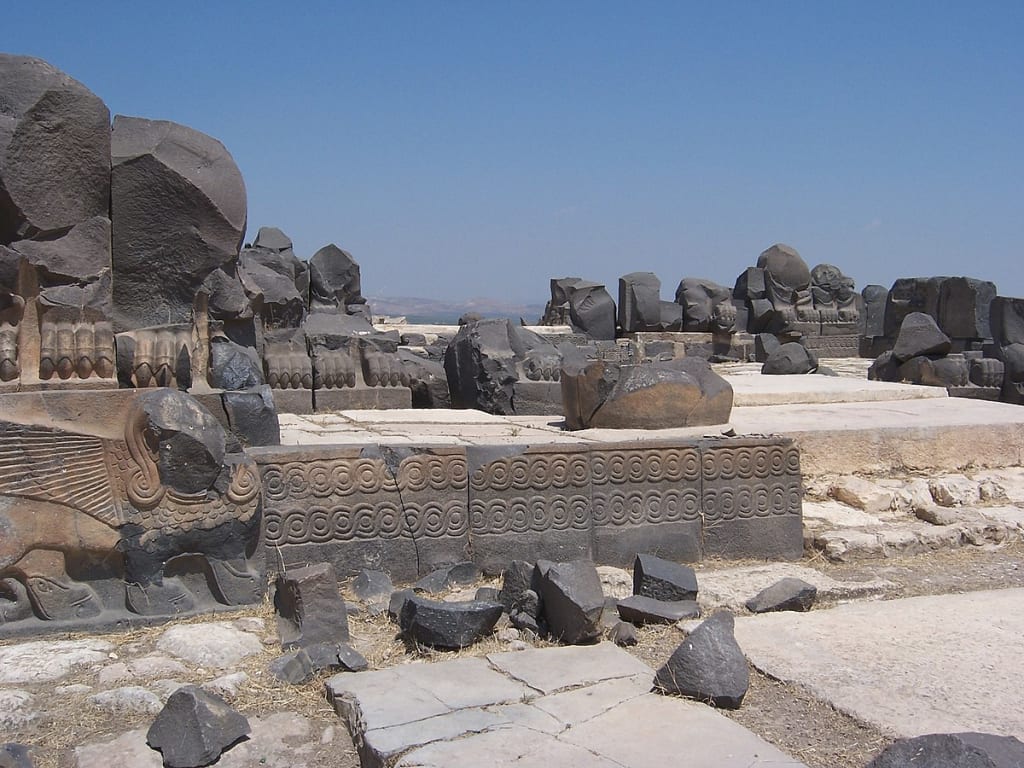
Among the many ancient temples in Syria, the Temple of Ain Dara stands out for its captivating story. What makes it particularly intriguing is the presence of huge human foot imprints at its entrance. These imprints have existed for at least 3,300 years, and their origin remains a subject of disagreement. Scientists and archaeologists argue that the same people who constructed the temple carved these imprints, intending to symbolize the procession of gods into the temple's inner chambers. However, local legends tell a different tale, claiming that the temple was visited by a great god with clawed feet who left the footprints himself. Another belief suggests that the temple builders were giants who left behind the footprints. Stories of giant humans inhabiting the region during ancient times add weight to these theories, with the footprints serving as evidence. Unfortunately, the temple suffered severe damage during a Turkish air raid in 2018, but the footprints miraculously survived.
While most visitors to Egypt marvel at the Great Pyramid of Giza, a lesser-known secret lies just 20 minutes away in Abu Ghraib. This old city houses a sun temple dedicated to the great god Ra, constructed approximately 2,400 years ago. Historical records indicate the existence of six sun temples in Abu Ghraib, but only two remain today. Among the ruins is a colossal stone obelisk that once marked the westernmost point of the city. Archaeologists puzzle over massive red granite blocks scattered throughout the area, meticulously engineered with polished surfaces and smooth holes that suggest advanced drilling techniques. Adding to the mystery are square alabaster dishes bearing markings resembling gears, evoking thoughts of an ancient engine. Did the inhabitants possess advanced technology? If so, what became of it and its wielders?
Once upon a time, Barsak was nearly an island in the RLC (exact location unknown). Presently, due to a slight decrease in water levels, it stands as a plateau in Kislorda, Kazakhstan. Similar to No Return Island in Kenya, Barsak is believed to be a place from which nobody returns. Its name, translated from its original Turkic language, signifies that whoever arrives there will never leave. In 1939, Barsak was declared a national reserve and remained off-limits to visitors for the entire 20th century. The Soviet activities on the island during those years remain undisclosed, fueling rumors of top-secret research. Even today, electronic devices malfunction as one approaches, and navigational equipment ceases to function. Reports exist of people's skin turning blue after prolonged exposure to or proximity with the plateau. A commonly recounted legend involves a group of nomads who believed they spent one year on the plateau, only to return to civilization and find three decades had passed. Barsak remains a mysterious and seemingly supernatural place.
Amid the ruins of Amman, Jordan, one encounters temples, palaces, and the remnants of a colossal stone hand, crafted from stone. This hand, known as the Hand of Hercules, despite being broken and displaying only three fingers, exudes a strangely intimidating aura. Part of the Temple of Hercules, built during the Roman occupation of Oman's citadel in the second century, it appears the temple was never completed for unknown historical reasons. The presence of a marble elbow indicates plans for constructing a colossal statue of Hercules, potentially making it the largest statue of that time. Earthquakes, common in the region, may have caused the Romans to abandon the project after enduring numerous tremors. Guides often jest about the impeccably trimmed nails and cuticles on the hand, jokingly implying Hercules enjoyed regular manicures. Although we know the Romans built the abandoned Temple of Hercules, its original builder remains a mystery.
In Mexico City, Mexico, the Pyramid of Ciacilco stands as a puzzling enigma. Little is known about the civilization that once occupied this site, as they left scarce evidence behind. Archaeological analysis of the land surrounding the pyramid indicates it was farmed between 3,200 years ago and the first century when the nearby Xitle volcano erupted. This eruption tragically affected the Mesoamerican population, who were believed to worship a fire god. Some historians argue that the entire population perished in the disaster, while others suggest survivors fled to different parts of Mexico, carrying fragments of their culture and eventually influencing the rise of Teotihuacan. Although humans no longer reside in the area, it is home to a thriving population of rattlesnakes and tarantulas, making it a hazardous place to visit.
The mystery surrounding the lost city of the Kalahari poses an existential question, as doubts persist about its actual existence. The story begins in 1885 when the Canadian magician and explorer William Leonard Hunt, also known as the Great Farini, claimed to have discovered an empty city of ancient ruins while traversing the Kalahari Desert on foot. In his report to the Royal Geographic Society, he described half-buried ruins, shattered temples, burial grounds, and partially collapsed walls. His account led to 25 expeditions over the following decades, yet none managed to find anything resembling Farini's description. In 1964, AJ Clement theorized that Farini may have taken an alternative route through the desert and proposed his own pathway, which led him to colossal stone monoliths made of dolerite. He concluded that what Farini had seen were natural rock formations dating back 180 million years. However, not everyone accepted this explanation, and some continue to search for the lost city of the Kalahari to this day.
During World War II, the Nazis constructed numerous enigmatic structures across Europe, many of which remain shrouded in mystery. One such example is the concrete rings erected on the coast of the Barren Sea. The fact that the Soviet military assumed control of these sites after the war, forbidding access for several decades, fueled wild theories and speculation. Some extremists believe that the Soviets' interest confirmed these locations as testing grounds for anti-gravity devices and weapons of mass destruction. There are even claims that this is where the Nazis developed a top-secret project known as Die Glocke (The Bell), although the true purpose of Die Glocke remains unknown. However, it is more plausible that these concrete bases served as mounts for rotating artillery pieces. Unfortunately, the precise nature of these structures remains uncertain.
Swinton in North Yorkshire, England, harbors a belief among its residents that an ancient temple resides in their midst. Swinton Druid's Temple, with its appearance of antiquity and the name "Druid's Temple," lends itself to such notions. However, the truth reveals that this temple was constructed a mere two centuries ago by the eccentric landowner William Danby. Concerned about rising unemployment, Danby hired locals to build the temple as an homage to Stonehenge. Furthermore, he offered a substantial reward to anyone capable of living as a hermit within the temple for seven years. Although one individual managed to stay for four and a half years, nobody completed the full term, and Danby's reward remained unclaimed. Despite its lack of ancient origins, New Age pagans and Druids visit the site each summer solstice.
Gunji Wamp in Groton, Connecticut, USA, has confounded archaeologists and historians for ages. The settlement has experienced a succession of settlers spanning at least 1,400 years, each leaving their mark on the landscape. Stone chambers, stone rings, enigmatic wall etchings unrelated to any known language, and Native American artifacts all intertwine in Gungywamp. Determining the boundaries of each era or identifying the initial settlers is impossible due to the abundance of human occupation traces. One theory posits that Celtic Christian monks fleeing Viking raids in Ireland built Gungywamp in the 6th century. However, this would rewrite the accepted pre-Columbian history of America, disregarding evidence suggesting an even older origin. Gungywamp occasionally exhibits spikes in electromagnetic activity attributed to the composition of magnetite, granite, and quartz rocks. While scientists consider this explanation valid, conspiracy theorists entertain ideas of alien bases or energy vortexes. A lithic stone tool discovered here dates back at least 3,500 years, undermining the Celtic monk theory. Unfortunately, we may never decipher if Gungywamp was built in stages or all at once, and its true origins remain frustratingly elusive.
The existence of the Lost City of the Kalahari presents an ongoing debate, with some questioning its very reality. In 1885, the Canadian magician and explorer William Leonard Hunt, known as the Great Farini, claimed to have stumbled upon an abandoned city of ancient ruins while traversing the Kalahari Desert. His vivid descriptions of half-buried ruins, shattered temples, burial grounds, and crumbling walls prompted numerous expeditions to find the fabled city. However, subsequent searches failed to locate anything resembling Farini's accounts. In 1964, A.J. Clement proposed an alternative theory, suggesting that Farini may have taken an unintended route through the desert. Clement discovered colossal stone monoliths made of dolorite, which, when eroded, could resemble walls composed of straight, square blocks. He concluded that Farini had simply encountered natural rock formations dating back 180 million years. Yet, this explanation fails to satisfy everyone, and the quest for the Lost City of the Kalahari persists.
The Nazis left behind numerous perplexing structures throughout Europe during World War II, with many shrouded in enigmatic tales. Among them are the concrete rings situated on the coast of the Barren Sea. Adding to the mystery, the Soviet military assumed control of these sites after the war, strictly prohibiting access for several decades. Consequently, wild and fantastical theories emerged, suggesting that these locations served as testing grounds for anti-gravity devices and weapons of mass destruction. Some even claim that these rings were associated with a secretive Nazi project called Die Glocke (The Bell). However, a more plausible explanation posits that the concrete rings served as foundations for rotating artillery pieces. Despite ongoing speculation, the true nature of these structures remains uncertain.
Swinton, a town in North Yorkshire, England, boasts a belief among its residents that an ancient temple stands within its vicinity. Swinton Druid's Temple, with its ancient appearance and the moniker "Druid's Temple," entices the imagination. However, the reality is that this temple was constructed just two centuries ago by the eccentric landowner William Danby. Concerned about rising unemployment, Danby employed locals to build the temple as an homage to Stonehenge. Additionally, he offered a substantial financial reward to anyone capable of living as a hermit within the temple for seven years. While one individual managed four and a half years, no one completed the full term, and Danby's reward remained unclaimed. Despite lacking ancient origins, the temple continues to attract New Age pagans and Druids who gather there during the summer solstice.
Gunji Wamp in Groton, Connecticut, USA, perplexes archaeologists and historians alike. The settlement has witnessed a succession of settlers spanning at least 1,400 years, leaving their distinctive marks on the landscape. Stone chambers, stone rings, cryptic wall etchings unrelated to any known language, and Native American artifacts intertwine in Gunji Wamp. Delineating the boundaries of each era or determining the initial settlers is impossible due to the abundance of human traces. One theory suggests that Celtic Christian monks fleeing Viking raids in Ireland constructed Gunji Wamp in the 6th century. However, this contradicts accepted pre-Columbian American history and disregards evidence suggesting an even older origin. Gunji Wamp occasionally exhibits spikes in electromagnetic activity attributed to the composition of magnetite, granite, and quartz rocks. While scientists consider this explanation plausible, conspiracy theorists entertain ideas of alien bases or energy vortexes. The discovery of a lithic stone tool dating back at least 3,500 years undermines the Celtic monk theory. Unfortunately, understanding whether Gunji Wamp was built in stages or all at once remains elusive, leaving its true origins a mystery.
About the Creator
Enjoyed the story? Support the Creator.
Subscribe for free to receive all their stories in your feed.
Comments
There are no comments for this story
Be the first to respond and start the conversation.