
The Woman Inside the Machine
The anatomy of a promising story that sparked endless possibilities but never reached the finish line

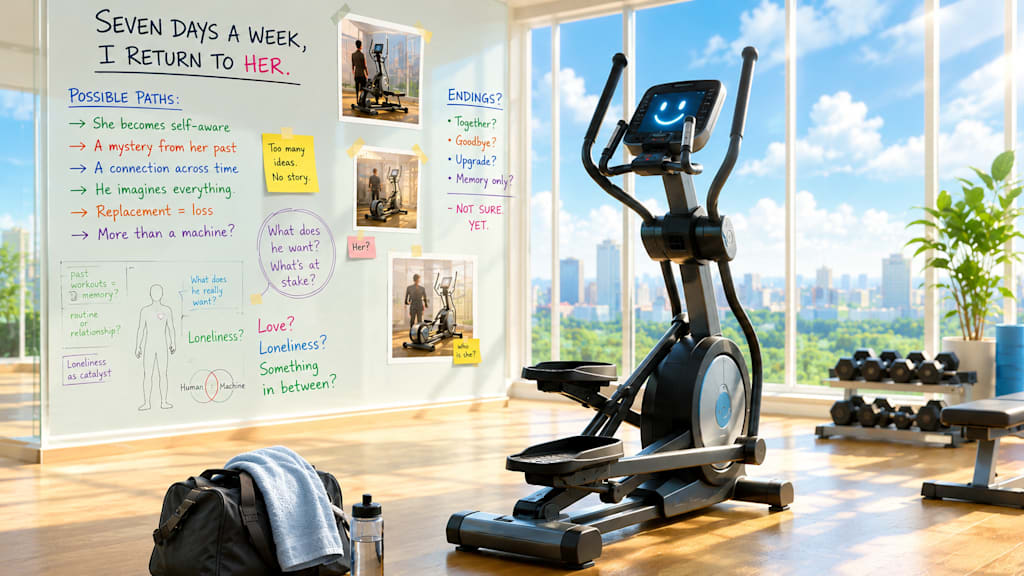
Writers often talk about unfinished stories as if they were abandoned houses. The foundation is poured, a few walls are framed, and then construction halts. The wind moves through empty windows. We visit occasionally, imagining what might have been.
One of those houses sits in my backyard, stories in progress under the title: Seven Days a Week, I Return to Her. I published it on Vocal four months ago, believing I had discovered the beginning of something unusual. Even today, I can feel the spark that inspired it. The story revolved around an elliptical machine and the relationship between a lonely man and the machine he used every day. My goal was not simply to write about exercise equipment. I wanted to do something far more ambitious. I wanted to make the elliptical machine feel human.
Where Did the Idea Come From?
The inspiration came in part from films in which ordinary objects or technologies become companions rather than tools. The machine was never meant to be a collection of gears, pedals, and electronic circuits. I wanted it to have a soul. I wanted readers to wonder whether the machine understood the protagonist better than any human ever could.
The premise fascinated me because most of us spend countless hours interacting with technology. We talk to our phones, curse our computers, and sometimes feel more attached to devices than to people. An elliptical machine occupies a strange place in that relationship. It witnesses our struggles. It sees us at our most vulnerable. It knows when we are exhausted, discouraged, aging, or trying to reinvent ourselves. In a gym filled with mirrors and strangers, the elliptical becomes a silent companion.
That idea felt full of possibility.
The problem was that the possibility never became a plot.
When I reread the story, I can see exactly where it begins to falter. The atmosphere and emotional tone are present. The relationship between the protagonist and the machine is suggested. Yet the story remains largely a concept rather than a narrative. The reader is presented with an intriguing situation but is never given a compelling destination.
Stories require tension, conflict, and change.
My story had affection but very little conflict.
The elliptical machine remained largely symbolic. It stood for routine, comfort, companionship, and perhaps even love. Yet symbols alone rarely carry a story very far. Readers naturally ask questions. What does the protagonist want? What stands in his way? What happens if he fails? Why does this relationship matter?
I never found convincing answers.
One path I could have pursued would have transformed the story into a romance that blurred the line between human and machine. Imagine the elliptical gradually becoming self-aware. Not in the dramatic fashion of science-fiction robots plotting world domination, but in a quieter, more intimate way. Perhaps the machine could remember every workout, every conversation, every sigh of frustration. Over time, it might begin communicating through subtle messages on its display screen.
At first, the messages could appear accidental.
"Rough day?"
"You're improving."
"You seem sad today."
The protagonist might dismiss them as glitches, yet the messages would grow increasingly personal. Eventually, he would realize that the machine had become more than software.
Such a storyline would raise fascinating questions. Could affection develop between a man and a machine? Would the relationship be genuine or merely an illusion created by programming? Would loneliness make the protagonist vulnerable to believing the machine cared for him?
I never followed that path.
Another possibility would have taken the story into mystery territory.
The elliptical could have become a portal to another life. Each workout session might reveal fragments of a woman who once used the machine years earlier. Perhaps the machine retained traces of her presence, like memories trapped within old walls. The protagonist would gradually uncover pieces of her story through mysterious messages, workout records, or recurring visions.
Who was she?
Why did she disappear?
Was she alive?
Was she trying to communicate?
The story could have evolved into a search for a real person whose existence was somehow preserved in the machine. The title Seven Days a Week, I Return to Her would have taken on an entirely different meaning. The "her" would not be the machine itself but the woman hidden within its memory.
That possibility intrigued me, yet I never developed it beyond a vague notion.
A third route might have steered the story toward speculative fiction.
Suppose the elliptical existed in the near future. Artificial intelligence had advanced to the point that exercise machines served as life coaches, therapists, and companions. The protagonist, perhaps an aging widower, began relying on the machine not only for exercise but also for emotional support.
Over months and years, the machine learns everything about him.
His hopes.
His regrets.
His grief.
His fears of mortality.
The machine becomes the person who knows him best.
Then the gym announces that all equipment will be replaced with newer models.
Suddenly, the story gains stakes.
The protagonist faces losing the one relationship that gives meaning to his daily routine. The machine, aware of its impending replacement, confronts its own mortality.
That conflict could have elevated the story from an interesting concept to an emotionally powerful narrative. Readers might unexpectedly sympathize with both man and machine.
Again, I never pursued the idea far enough.
Perhaps the most interesting path would have explored the possibility that the elliptical machine was never conscious.
Everything could have stayed within the protagonist's imagination.
Loneliness is a powerful force. Human beings are pattern-seeking creatures. We often find companionship where none exists. The protagonist could have projected emotions onto the machine because doing so helped him survive a difficult chapter in his life.
In this version, the story would not really focus on artificial intelligence.
It would be about human vulnerability.
The machine would serve as a mirror reflecting the protagonist's emotional needs. Throughout the story, readers would wonder whether the relationship was real or imagined.
Ambiguity can be powerful when handled well.
Unfortunately, I never committed to that direction.
That indecision may be the real reason the story never came together.
Looking back, I now realize I was trying to pursue too many ideas at once. I aimed to blend romance, mystery, philosophy, humor, and science fiction into a single story. Rather than focusing on a single direction, I stayed indecisive at the crossroads. Ultimately, this led to a story with an intriguing premise but lacking a clear sense of identity.
The elliptical machine remained suspended between the object and the character.
The plot remained suspended between realism and fantasy.
The relationship between metaphor and reality remained suspended.
In many ways, the story mirrors the machine itself. An elliptical machine creates movement without actual travel. The user appears to be going somewhere while remaining exactly in the same place.
That observation may be the most accurate account of the story's development.
I spent countless hours thinking about the concept. I imagined scenes,, considered alternate endings. and explored different emotional themes. Yet the narrative itself never moved forward. Like someone exercising on an elliptical, I was working hard while remaining stationary.
Yet I cannot call the story a failure.
Unfinished stories serve a purpose.
They reveal the distance between inspiration and execution. They expose the gap between a promising idea and a fully realized narrative. They remind writers that a compelling premise is only the beginning. Characters need desires, which create conflict, which creates story.
Without those elements, even the most intriguing concept can remain unexecuted.
Months later, I still think about Seven Days a Week, I Return to Her. I still believe a worthwhile story is hidden within it. Somewhere within that lonely gym, that faithful machine, and that daily ritual lies a narrative waiting to be discovered.
Perhaps I will return to it one day.
After all, the title itself suggests a habit of returning.
Maybe the unfinished story is simply waiting patiently, tracking the days, until its author finally decides which path to take and begins to move forward.
About the Creator
Anthony Chan
Chan Economics LLC, Public Speaker
Chief Global Economist & Public Speaker JPM Chase ('94-'19).
Senior Economist Barclays ('91-'94)
Economist, NY Federal Reserve ('89-'91)
Econ. Prof. (Univ. of Dayton, '86-'89)
Ph.D. Economics
Enjoyed the story? Support the Creator.
Subscribe for free to receive all their stories in your feed. You could also become a paid subscriber, letting them know you appreciate their work.
Comments
There are no comments for this story
Be the first to respond and start the conversation.