
The Structure That Speaks
From Lévi-Strauss to the Bodies of Meaning

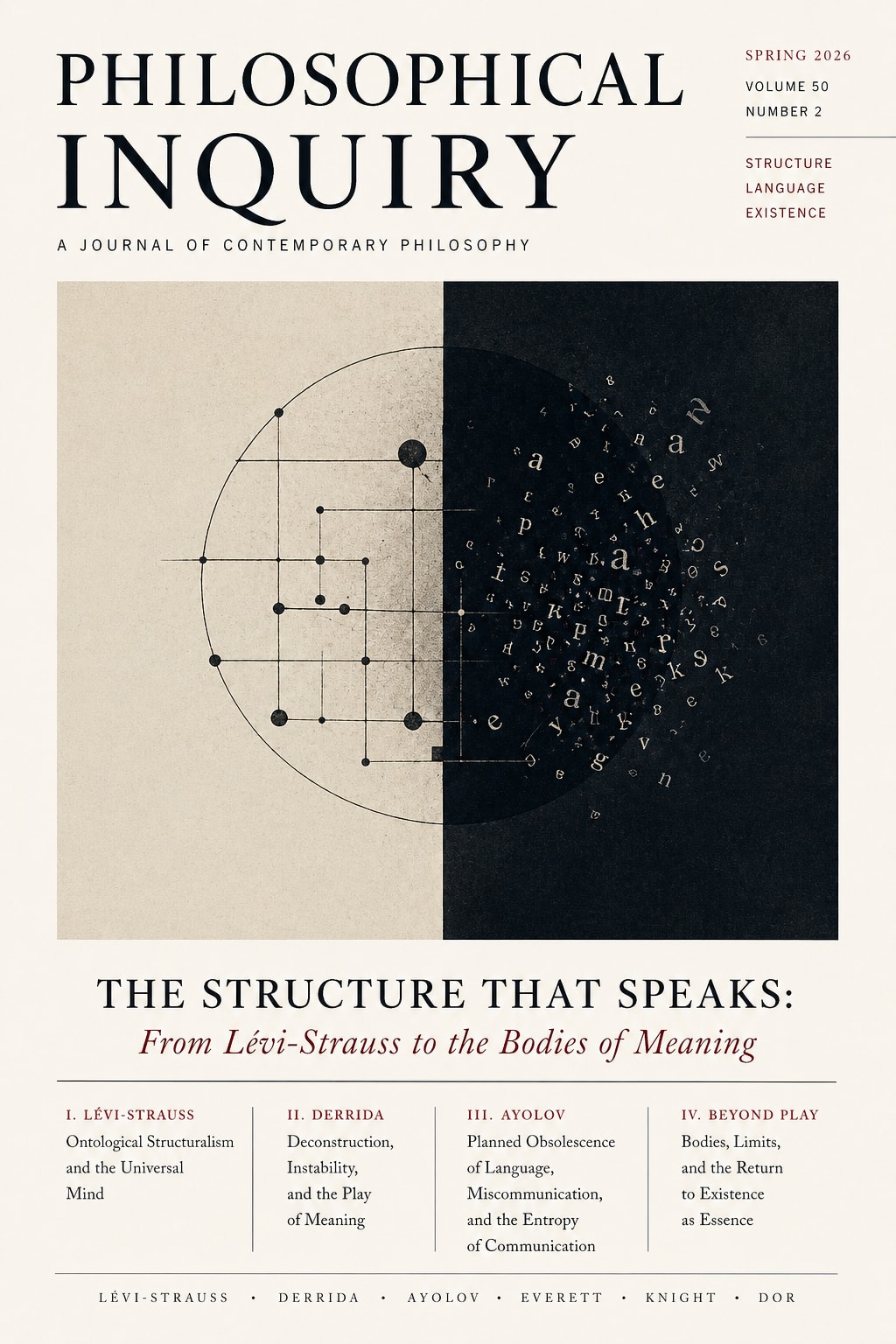
The Structure That Speaks: From Lévi-Strauss to the Bodies of Meaning
Introduction: Ontology, Structure, and the Fate of Language
Claude Lévi-Strauss is a central figure in structuralism, and although he framed his work primarily as scientific and epistemological, it carries deep ontological consequences for understanding human nature and culture. His approach suggests that reality at the human level is not grounded in isolated actions, intentions, or conscious meanings, but in underlying structures that organize and determine them. What appears as diversity in cultural forms is in fact the manifestation of a deeper unity.
The first pillar of this structural ontology is the universality of the human mind. Lévi-Strauss postulates that human intellect has the same logical structure everywhere in the world, from so-called “primitive” societies to modern civilizations. Ontologically, this implies a single, stable foundation of human existence. There is no fragmentation at the level of being. There is variation only at the level of expression.
The second pillar is the primacy of structure over the element. Meaning does not reside in individual objects such as myths, kinship relations, or rituals. Meaning arises from the relations between them. Structure is therefore the true reality that organizes the visible diversity of culture. The world of human meaning is not made of things, but of differences.
The third pillar is the centrality of binary oppositions. Thought and world are constituted through pairs of opposites such as nature and culture, raw and cooked, self and other. These oppositions are the fundamental mechanism by which the human mind organizes the chaos of existence.
The fourth pillar is the existence of unconscious structures. Human beings follow structural rules, whether in language or in social organization, without conscious awareness. Structure operates behind the back of the subject. The individual is not the origin of meaning, but the point through which structure expresses itself.
Yet this ontological structuralism did not remain unchallenged. Thinkers such as Jacques Derrida criticized it for its search for fixed centers and universal truths. They argued that meaning is unstable, that structures are not fixed but shifting, and that language is a field of endless play. This critique transformed the intellectual landscape, but it also produced a new opposition: structure versus anti-structure.
Today, this opposition has evolved into a more radical condition. The crisis is no longer simply whether structures are stable or unstable. The crisis is that language itself has become exhausted. It is here that the theory of Peter Ayolov must be introduced. His concept of the planned obsolescence of language describes a condition in which meaning is not only unstable but systematically degraded. Language expands, but meaning decays. Communication increases, but understanding collapses.
Thus emerges a new ontological field defined by a sequence of tensions: Sartre’s free subject, Lévi-Strauss’s structured subject, Derrida’s play of meaning, and Ayolov’s entropy of communication. What appears as freedom becomes saturation. What appears as multiplicity becomes noise. What appears as liberation becomes inertia.
I. Lévi-Strauss: Universal Structure and the Logic of Relations
The structuralism of Lévi-Strauss rests on the idea that the human mind operates according to universal principles. The difference between societies is not a difference in rationality, but a difference in the materials through which rationality is expressed. This leads to a fundamental ontological claim: human existence is grounded in a shared structure of thought.
Meaning, in this framework, is relational. A myth has no meaning in isolation. Its significance emerges from its position within a system of relations. Lévi-Strauss analyzes myths by breaking them into minimal units and arranging them into patterns that reveal underlying contradictions. Myths function as logical systems that mediate tensions that cannot be resolved in lived reality.
Binary oppositions are central to this process. The example of raw and cooked demonstrates how human thought transforms nature into culture. The raw represents the natural state, while the cooked represents human transformation. Fire acts as a mediator. This structure appears across cultures, indicating that it is rooted in the universal organization of the human mind.
Another crucial element is the unconscious nature of these structures. People follow rules of kinship, language, and culture without understanding the system behind them. Structure operates independently of intention. The subject becomes secondary to the system. Meaning is not created by individuals but passes through them.
This leads to a decentering of the subject. The individual is no longer the origin of meaning. Instead, the individual is a position within a system governed by rules that precede and exceed them. Human freedom is therefore limited. It exists only within the constraints imposed by structure.
II. Derrida: Instability, Deconstruction, and the Illusion of Escape
Derrida’s critique of structuralism focuses on the instability of structures. He argues that every structure depends on a center that cannot be fully justified. This center is both inside and outside the system, creating a paradox that undermines the idea of stability.
From this follows the concept of the play of meaning. Words do not have fixed meanings. They derive their significance from their differences from other words, and these differences are constantly shifting. Meaning is never fully present. It is always deferred.
Derrida also challenges binary oppositions, showing that they are hierarchical rather than neutral. One term is privileged over the other, and deconstruction seeks to expose and reverse these hierarchies.
However, this critique does not escape structure. By defining itself in opposition to structuralism, post-structuralism becomes part of a new binary opposition. The attempt to dissolve structure reproduces it. Derrida cannot create a theory out of nothing. His thought depends on what it opposes.
This reveals a fundamental limit of the post-structuralist project. The play of meaning does not lead to complete freedom. It leads to instability. Without structure, meaning becomes uncertain. Communication becomes fragile. The promise of liberation turns into the risk of fragmentation.
III. Ayolov: Planned Obsolescence, Kayfabe Civilization, and the Return to Physical Reality
The contemporary condition extends beyond the debate between structure and play. It introduces a new problem: the systematic degradation of language. Peter Ayolov’s theory of the planned obsolescence of language describes a situation in which communication systems are structured to produce entropy. Language becomes abundant but empty. Words circulate without anchoring meaning.
In this condition, the play of meaning becomes a mechanism of control. If words can mean anything, they eventually mean nothing. Communication no longer serves understanding. It serves repetition, distraction, and inertia. This is the essence of what can be described as a kayfabe civilization, a system in which social life operates as a staged performance. Conflicts appear real, but they are structured narratives within a closed system.
The binary oppositions of good and bad, freedom and oppression, progress and decline repeat endlessly without producing real change. This repetition reveals the persistence of structure even within apparent instability. Derrida’s play becomes absorbed into a larger system that neutralizes its effects.
Against this condition, the return to physical reality becomes decisive. The body imposes limits that language cannot erase. Biological consequences, social constraints, and material conditions act as boundaries on the play of meaning. The example of the incest taboo illustrates this clearly. It is both a cultural rule and a biological necessity. Violating it produces measurable consequences. Structure is therefore anchored in physical reality.
This perspective aligns with approaches that emphasize the physical origins of language and thought. Language is not an abstract system detached from the body. It is rooted in social interaction, biological constraints, and shared experience. Meaning cannot be separated from the conditions of its production.
The idea that existence is essence emerges from this framework. Human beings are not defined by abstract meanings or linguistic constructions. They are defined by their physical existence, their place in the world, and their participation in concrete social structures. The body becomes the ultimate ground of meaning.
Conclusion: The Structure That Remains
The trajectory from Lévi-Strauss to Derrida and to Ayolov reveals a progressive transformation in the understanding of human existence. Structuralism establishes the primacy of underlying systems. Post-structuralism reveals their instability. The contemporary critique exposes the exhaustion of language itself.
What remains is not the infinite freedom of meaning, but the persistence of structure. Even when language dissolves into play, even when meaning becomes unstable, the body, the environment, and the social system impose limits. These limits are not optional. They define the conditions of existence.
In this sense, the final position is neither the sovereignty of the subject nor the infinite play of language. It is the recognition that existence itself imposes structure. Human life unfolds within constraints that cannot be transcended. The attempt to escape them leads not to freedom, but to disorientation.
The most radical response is therefore not to construct new meanings or to deconstruct existing ones, but to recognize the structure that remains. Beyond the noise of communication, beyond the instability of language, there is the simple fact of being.
Existence is essence. Structure speaks, but it speaks through bodies, through limits, and through consequences that no theory can erase.
Footnotes
Lévi-Strauss, C. (1963) Structural Anthropology. New York: Basic Books.
Lévi-Strauss, C. (1966) The Savage Mind. Chicago: University of Chicago Press.
Lévi-Strauss, C. (1969) The Elementary Structures of Kinship. Boston: Beacon Press.
Lévi-Strauss, C. (1970) The Raw and the Cooked. New York: Harper & Row.
Derrida, J. (1976) Of Grammatology. Baltimore: Johns Hopkins University Press.
Derrida, J. (1978) Writing and Difference. Chicago: University of Chicago Press.
Ayolov, P. (2026) The Planned Obsolescence of Language: Miscommunication as a System. SAMIZDAT.
Ayolov, P. (2026) The Entropy of Communication, Vol. II. SAMIZDAT.
About the Creator
Peter Ayolov
Peter Ayolov’s key contribution to media theory is the development of the "Propaganda 2.0" or the "manufacture of dissent" model, which he details in his 2024 book, The Economic Policy of Online Media: Manufacture of Dissent.
Enjoyed the story? Support the Creator.
Subscribe for free to receive all their stories in your feed.
Comments
There are no comments for this story
Be the first to respond and start the conversation.