
The SAMS Model: Hyperreality and the Second-Order Mirror
How the Digital Samsara Transcends Reflection to Construct the Hyperreal Self-Screen Identity (SAMS: Sotirova-Ayolov Mirror Simulacrum Series-1)

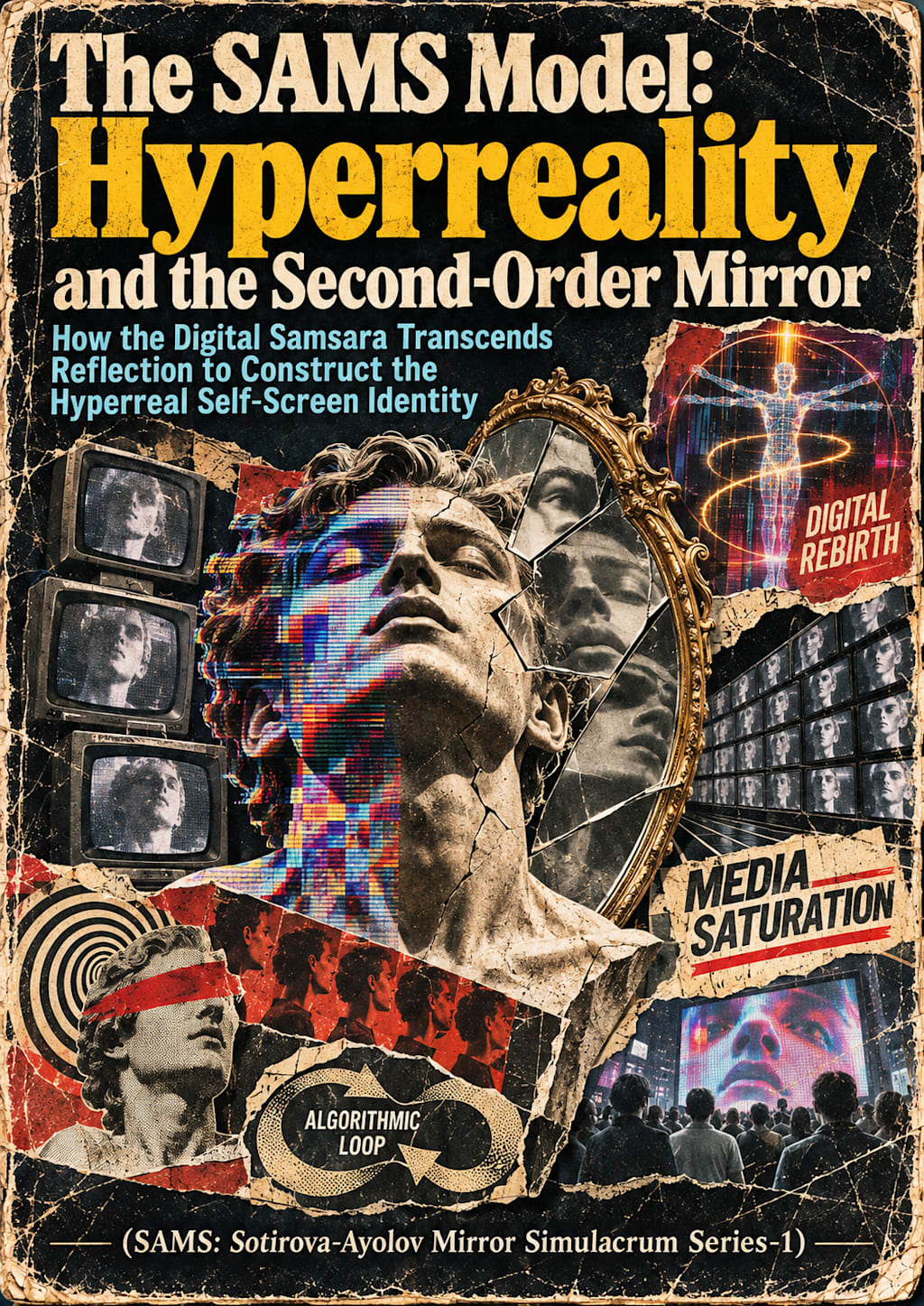
The SAMS Model (Sotirova-Ayolov Mirror Simulacrum), developed by Desislava Sotirova and Peter Ayolov from the Faculty of Journalism and Mass Communication (FJMC) at Sofia University “St. Kliment Ohridski”, introduces the concept of the Second-Order Mirror — a digital apparatus that constructs rather than merely reflects human identity. Drawing on Baudrillard’s hyperreality, media framing and visual identity theory, the model explores Digital Samsara: the perpetual cycle of creation, validation, dissolution and rebirth of the hyperreal Self-Screen Identity, in which the mediated self becomes more real than its original.
Abstract
This article introduces the Sotirova-Ayolov Mirror Simulacrum (SAMS) Model as a theoretical framework for understanding the transformation of visual mediation from the representation of human identity to its active construction. Integrating media framing, synthetic media research, the political economy of the human image and the Baudrillardian theory of hyperreality, the model distinguishes between the First-Order Mirror, which reflects a pre-existing subject, and the Second-Order Mirror, which produces a mediated identity capable of reshaping its original referent. The article identifies three constitutive mechanisms of this transformation: Infrastructural Extraction, Identity Formatting and Ontological Admission. Through these mechanisms, the embodied individual becomes increasingly dependent upon a manufactured Self-Screen Identity for social recognition. The concept of Digital Samsara describes the recursive cycle of projection, validation, dissolution and rebirth through which this hyperreal identity is continuously reproduced within algorithmically organised visual environments. Unlike traditional theories of mediated self-presentation, the SAMS Model proposes that digital performance can become an ontological process through which representation progressively governs behaviour and identity. The article establishes the conceptual foundations of a broader research programme investigating the relationship between visual mediation, synthetic reality, artificial intelligence and human existence, while considering the possibility of emancipation from compulsory algorithmic recognition.
Keywords
SAMS Model, Second-Order Mirror, Digital Samsara, Self-Screen Identity, hyperreality, simulacrum, media framing, synthetic reality, Mirror Selves, Identity Industrial Complex, algorithmic recognition, visual performativity.
Introduction: The Mirror That No Longer Reflects
“The mirror once depended upon the presence of the human being standing before it. The contemporary screen increasingly demands that the human being reconstruct their existence according to the requirements of the image appearing within it. When representation becomes the governing principle of existence, the mirror ceases to be an instrument of recognition and becomes an instrument of creation.”
— SAMS Model
For centuries, the mirror occupied a relatively stable position within human experience as an instrument of reflection, allowing individuals to encounter an external representation of their physical existence without fundamentally questioning the ontological priority of the original. Although the reflected image could influence perception, the biological subject remained the necessary precondition of its appearance. The emergence of photography, cinema and television complicated this relationship by introducing mechanisms of selection, framing, reproduction and distribution that transformed reflection into mediated representation. Desislava Sotirova’s research on media framing provides an essential theoretical foundation for understanding this transformation, demonstrating how the mediated event becomes intelligible through the boundaries imposed upon its representation. The contemporary digital environment, however, introduces a fundamentally different relationship between the image and its referent. The screen increasingly operates through algorithmic selection, predictive modelling, synthetic generation and continuous mechanisms of social evaluation. It no longer simply presents an interpretation of something existing independently of its representation but actively participates in determining what becomes socially recognisable as existing. Baudrillard’s concept of hyperreality offers a philosophical foundation for examining this transition, particularly when representations acquire greater social significance than the realities from which they supposedly originate. Developments in synthetic video and artificial intelligence further destabilise the distinction between authentic presence and manufactured appearance. The contemporary image need not originate in an observable physical event, and its capacity to produce social consequences increasingly depends upon circulation rather than authenticity. These transformations demand a reconsideration of the mirror itself as a theoretical category. The classical mirror belongs primarily to the domain of reflection, whereas the contemporary algorithmic screen increasingly belongs to the domain of production. Between these two forms of mediation emerges a decisive epistemological and ontological distinction that constitutes the central concern of the Sotirova-Ayolov Mirror Simulacrum Model and its investigation of the contemporary conditions of human identity.
The SAMS Model introduces the concept of the Second-Order Mirror to describe a system of visual mediation that constructs the identity it ostensibly reflects. Unlike the First-Order Mirror, whose primary function is representational, the Second-Order Mirror establishes a recursive relationship between the embodied individual and their mediated appearance. Peter Ayolov’s Mirror Selves Trilogy provides the theoretical architecture for understanding this relationship through three interconnected mechanisms: the industrial extraction of human images, the formatting of individuality into reproducible symbolic forms, and the admission of these forms into spaces of collective recognition. Combined with Sotirova’s research on media framing and synthetic representation, these mechanisms explain how visual mediation can become constitutive of identity rather than merely expressive of it. The resulting Self-Screen Identity represents a hyperreal formation through which individuals increasingly encounter themselves and become recognisable to others. Ayolov’s theories of media scripting and ludic culture further illuminate the transformation of ordinary existence into continuous performance, whereby individuals anticipate the requirements of representation before undertaking the activities that will subsequently be represented. Performance gradually becomes behaviour, behaviour becomes identity, and identity becomes the foundation of subsequent performances. This recursive movement constitutes what the SAMS Model describes as Digital Samsara, a technological analogue of the philosophical cycle of birth, attachment, dissolution and rebirth. Within this cycle, recognition remains temporary, requiring repeated acts of visual production to maintain social presence. The theoretical originality of SAMS therefore resides in its integration of the structural, economic, psychological and temporal dimensions of mediated identity. Its purpose is not to suggest that physical reality disappears, but to explain how its representation acquires sufficient autonomy to reorganise the lived existence of its referent. The fundamental question confronting contemporary media theory is consequently no longer whether the screen accurately reflects the human being, but whether the human being has increasingly become a reflection of the screen.
Part I: The Second-Order Mirror — From Media Framing to the Construction of Identity
“Every frame establishes a distinction between the world that becomes visible and the world that remains outside representation. When the individual begins to anticipate this distinction, the frame ceases to organise merely the perception of reality and begins to organise reality itself. The ultimate power of visual mediation resides in its capacity to transform the represented subject into a participant in the manufacture of their own representation.”
— SAMS Model
The theoretical foundations of the SAMS Model emerge from the recognition that visual communication has never been a transparent transmission of reality. Every act of representation involves selection, exclusion, arrangement and interpretation, transforming the apparent neutrality of the image into a structured relationship between perception and meaning. Desislava Sotirova’s research on media framing provides a particularly important foundation for understanding this process. In Events in a Frame, the mediated event becomes an object of investigation through the mechanisms by which journalism selects and organises complex developments into recognisable narratives. The conceptual implications of framing extend beyond journalism because the frame establishes boundaries within which reality becomes socially intelligible. What remains outside these boundaries may continue to exist physically while losing its relevance within collective perception. Contemporary digital platforms extend this principle from the representation of external events to the representation of individual existence. The individual becomes an event that must be framed, interpreted and circulated. Sotirova’s research on synthetic video and deepfake verification further illuminates the transformation of visual communication through technologies capable of producing convincing representations without corresponding physical occurrences. Nevertheless, the problem extends beyond distinguishing authentic images from artificial ones. Even an authentic recording may participate in the manufacture of a misleading or fundamentally reconstructed identity through selective presentation and repetitive circulation. The Second-Order Mirror emerges precisely within this convergence of framing, technological reproduction and synthetic generation. Its defining characteristic is not necessarily the falsification of visual material but the capacity to construct a socially operative reality from representations whose relationship with embodied existence remains selective, unstable and potentially reversible. Consequently, the distinction between authenticity and fabrication, although indispensable to journalism, becomes insufficient for explaining the deeper transformation of human identity. The SAMS Model investigates the conditions under which even truthful images participate in constructing identities that exceed the realities they originally represented.
Peter Ayolov’s The Media Scenario extends this investigation by examining mediated communication through the structural relationship between narrative organisation and human participation. The contemporary subject increasingly inhabits environments in which communicative situations possess predetermined expectations, recognisable roles and established conventions of performance. The individual entering the space before the camera does not necessarily behave as they would outside that space because the anticipated existence of an audience transforms the conditions of action. The Ludicrous Culture: Homo Ludens 2.1 develops a complementary understanding of contemporary existence as increasingly organised through performance, spectacle and socially regulated forms of play. Within algorithmic environments, however, play frequently loses its voluntary character and becomes a condition of participation. Professional visibility, personal relationships, political communication and cultural recognition increasingly involve performances whose consequences extend beyond the boundaries of the original activity. The individual gradually internalises the expectations of the imagined audience, developing behavioural patterns designed to produce desirable representations. Initially, the person performs differently because the camera is present; subsequently, the person behaves differently because the camera might become present. Eventually, the distinction between performance and behaviour becomes increasingly difficult to maintain. The SAMS Model identifies this transformation as the emergence of the Second-Order Mirror, whereby representation becomes a constitutive element of the represented subject. The image acquires a prescriptive function, establishing expectations that precede and organise subsequent conduct. Unlike the classical mirror, which remains dependent upon the immediate presence of its referent, the Second-Order Mirror accumulates representations, evaluates their reception and returns their consequences to the individual through mechanisms of feedback. The resulting identity is neither entirely authentic nor necessarily fabricated. It constitutes an emergent formation produced through the recursive interaction between embodied behaviour, mediated representation and collective recognition. The individual becomes simultaneously the performer, the spectator and the evolving product of a performance whose script is never entirely their own.
Part II: The Architecture of the SAMS Model — Manufacturing the Hyperreal Self-Screen
“The industrialisation of identity begins when the human image becomes a resource that can be extracted, formatted and circulated independently of the person from whom it originates. The individual discovers that recognition increasingly depends upon the successful reproduction of a representation rather than the richness of an existence. What appears to be the liberation of personal expression becomes the manufacture of a self that must satisfy the conditions of its own visibility.”
— SAMS Model
The architecture of the Second-Order Mirror can be understood through three interconnected mechanisms derived from Peter Ayolov’s Mirror Selves Trilogy. The first mechanism, Infrastructural Extraction, emerges from the political economy developed in Identity Industrial Complex: The Political Economy of the Human Image. Contemporary digital capitalism increasingly treats personal representations as resources capable of generating economic value through circulation, engagement, behavioural prediction and commercial classification. The individual provides not only attention and labour but also the visual material through which their identity becomes economically productive. Photographs, videos, personal narratives and behavioural patterns enter infrastructures that transform expressions of individuality into measurable and exploitable resources. The human image becomes visual capital, possessing a potential value that encourages its continuous production and distribution. The second mechanism, Identity Formatting and Enclosure, develops from Copyrighting the Self: Manufacturing Mirror Selves. Although embodied existence possesses considerable complexity, its mediated representation must generally conform to the technical and cultural requirements of particular platforms. Experiences become photographs, personalities become profiles, emotional states become recognisable expressions, and biographies become sequences of selectively preserved events. Such formatting does not merely simplify reality after its occurrence. It can influence the organisation of experience before representation takes place. Individuals increasingly anticipate the visual possibilities of their activities, selecting circumstances, environments and behaviours according to their anticipated representational value. The image therefore acquires a prospective dimension, participating in the production of the reality that it will subsequently claim to document. Symbolic enclosure occurs when the recognisable representation becomes sufficiently stable to restrict the individual’s freedom to develop beyond it. Together, Infrastructural Extraction and Identity Formatting explain how the Second-Order Mirror converts human existence into a reproducible and potentially profitable representational formation. The individual becomes both the supplier of the raw material and the participant responsible for maintaining the manufactured image through continuing acts of production within infrastructures largely controlled by others.
The third mechanism, Ontological Admission, originates in the philosophical concerns of The Shapes of the Self: Identity and Recognition in Visual Space. While the previous mechanisms explain the economic extraction and representational formatting of individuality, Ontological Admission addresses the conditions under which a manufactured image becomes socially consequential. Recognition constitutes an essential dimension of collective existence, but the contemporary visual environment increasingly distributes recognition through technologically organised spaces of appearance. Individuals become publicly intelligible through forms that can circulate within these spaces and satisfy their conventions of visibility. This does not mean that people outside digital environments cease to exist. Rather, their existence may remain inaccessible to particular systems of professional, cultural or social recognition. The SAMS Model describes this distinction through the concept of Self-Screen Identity, a mediated formation through which the individual becomes recognisable both to others and, increasingly, to themselves. The Self-Screen is neither simply an image nor merely a collection of representations. It is an evolving interface between embodied existence and its socially operative visual construction. Its hyperreal character emerges when representations accumulate sufficient authority to influence the conduct of their original referent. An individual may experience pressure to maintain an established digital persona even when its characteristics no longer correspond to their actual interests, experiences or emotional circumstances. The representation becomes a source of obligations imposed upon the represented subject. In Baudrillardian terms, the image begins to precede the reality that it supposedly reproduces. The specific contribution of the SAMS Model consists in identifying the mechanisms through which this reversal becomes economically sustainable, technologically reproducible and socially consequential. Infrastructural Extraction supplies the economic conditions of image production; Identity Formatting establishes its reproducible characteristics; Ontological Admission converts these characteristics into socially recognised existence. Their combination constitutes the Second-Order Mirror as an apparatus capable of producing a hyperreal identity whose influence extends beyond representation into the organisation of ordinary human behaviour.
Part III: Digital Samsara — The Endless Rebirth of the Hyperreal Self
“The digital self is born whenever an image enters the space of collective attention, yet its existence remains dependent upon the recognition it receives from others. When that recognition disappears, the individual experiences the symbolic dissolution of an identity whose apparent permanence was always an illusion. The response to this disappearance is another act of production, through which the self is reborn into the very system responsible for its previous dissolution.”
— SAMS Model
The structural mechanisms of the Second-Order Mirror acquire their temporal dimension through the concept of Digital Samsara. The term establishes a philosophical analogy with the Buddhist understanding of samsara as a cycle of conditioned existence perpetuated through ignorance, craving and attachment. The SAMS Model does not identify technological mediation with the religious doctrine of rebirth but employs this philosophical tradition to illuminate the recursive instability of contemporary mediated identity. The first stage of Digital Samsara is Birth, understood as the projection of a formatted representation into the digital environment. Through this act, an aspect of embodied existence acquires an independently circulating visual form. The second stage is Attachment, during which the individual becomes invested in the recognition generated by the representation. Quantitative indicators of attention provide apparently objective measurements of the social consequences of personal visibility, encouraging the identification of representational success with individual significance. The third stage is Death, understood as the gradual disappearance of the representation from the immediate attention of its audience. Algorithmic circulation privileges novelty, relevance and continuing engagement, producing conditions under which even successful representations eventually lose their capacity to command attention. Although the image may remain technically accessible, its active social existence diminishes. The fourth stage is Rebirth, whereby the individual responds to declining visibility through another act of identity production. Previous experiences of recognition become informational resources guiding the selection and organisation of subsequent representations. The new image incorporates the perceived successes and failures of its predecessors, creating a recursive process of behavioural adaptation. Digital Samsara therefore describes more than the repetitive publication of personal content. It identifies a temporal structure within which mediated identity remains dependent upon continuous reconstruction. The individual repeatedly encounters the instability of a manufactured self while seeking permanence through the very processes responsible for its instability. Recognition promises continuity, but its conditions of distribution continually produce the necessity of renewal.
The philosophical significance of Digital Samsara becomes apparent when the individual begins to organise embodied existence around the reproduction of the Self-Screen Identity. The digital persona initially emerges as an instrument through which the person communicates aspects of their existence, yet its accumulated characteristics can gradually establish expectations that constrain subsequent behaviour. The individual becomes attached not simply to the image itself but to the network of recognition, emotional investment and social opportunities associated with it. Consequently, the disappearance of visibility may acquire an existential significance disproportionate to the actual disappearance of anything from embodied reality. A photograph loses attention, yet the person experiences rejection; a representation becomes obsolete, yet the individual experiences personal inadequacy. The confusion between representational decline and existential decline constitutes one of the central philosophical problems addressed by the SAMS Model. Developments in artificial intelligence intensify this problem by enabling the generation of increasingly autonomous visual personas. A synthetic representation may communicate, perform and circulate without requiring the continuous physical participation of the person whose identity it reproduces. Sotirova’s research on synthetic media verification becomes particularly relevant here because the credibility of visual presence can no longer be inferred confidently from its apparent authenticity. The problem of verifying an image intersects with the problem of determining who, or what, constitutes its socially recognised subject. The Self-Screen may consequently develop characteristics that its biological referent neither possesses nor controls. Nevertheless, the human individual can remain psychologically, professionally or economically dependent upon the consequences produced by this increasingly autonomous representation. Digital Samsara reaches its most developed expression when the original becomes responsible for maintaining the existence of a simulacrum that no longer depends upon the original for every act of appearance. The Second-Order Mirror thus establishes a paradoxical condition in which technological independence from the embodied individual can coexist with the individual’s increasing dependence upon the recognition generated by their technological representation.
Conclusion: Beyond the Second-Order Mirror — Breaking the Cycle of Digital Samsara
“The disappearance of the image does not necessarily constitute the disappearance of the person, just as the multiplication of representations does not necessarily constitute the enrichment of existence. The freedom of the individual depends upon preserving a distinction between the life that is experienced and the identity that is manufactured for recognition. Liberation from the Second-Order Mirror begins when the human being discovers that existence requires neither continuous representation nor permanent confirmation from an audience.”
— SAMS Model
The Sotirova-Ayolov Mirror Simulacrum Model establishes an interdisciplinary framework for investigating the transformation of contemporary visual mediation through the integration of media framing, synthetic media research, visual identity philosophy and the political economy of digital representation. Its principal theoretical contribution consists in distinguishing between the First-Order Mirror, whose primary function is reflection, and the Second-Order Mirror, whose defining characteristic is the recursive construction of identity. This distinction does not suggest that earlier technologies of representation were incapable of influencing human behaviour. Rather, it identifies the particular convergence of algorithmic selection, economic extraction, continuous feedback and synthetic generation that makes contemporary visual mediation an increasingly powerful condition of identity formation. The three constitutive mechanisms of the SAMS Model explain complementary dimensions of this transformation. Infrastructural Extraction establishes the economic conditions under which personal images become productive resources. Identity Formatting and Enclosure explain the conversion of embodied individuality into reproducible representational structures. Ontological Admission identifies the processes through which these structures acquire recognition and social consequences. Digital Samsara provides the temporal dimension of the model, explaining how the instability of mediated recognition encourages repeated acts of identity production through the stages of Birth, Attachment, Death and Rebirth. Together, these concepts establish a theoretical architecture applicable to diverse areas of contemporary communication research. Social media self-presentation, political persona construction, synthetic journalism, influencer culture and artificially generated avatars constitute particularly relevant fields of investigation. Future empirical research may examine the relationship between representational feedback and behavioural adaptation, the economic conditions of compulsory visibility, and the consequences of synthetic identities for established practices of media verification. The subsequent articles of the Sotirova-Ayolov Mirror Simulacrum Series will develop these possibilities through more specialised investigations. The inaugural contribution establishes the conceptual vocabulary necessary to distinguish the increasingly autonomous existence of mediated representations from the embodied human realities upon which their social significance frequently depends.
The philosophical implications of the SAMS Model ultimately concern the possibility of preserving human autonomy within environments that increasingly organise recognition through technologically manufactured identities. The Second-Order Mirror should not be understood exclusively as an instrument of deception or domination. Mediated representation can facilitate meaningful communication, professional opportunities, cultural participation and relationships that would otherwise remain inaccessible. Artificially generated representations can similarly provide legitimate instruments of creativity and expression. The decisive problem arises when participation ceases to be experienced as a possibility and becomes an apparently indispensable condition of personal significance. Digital Samsara persists through the confusion between existence and visibility, between recognition and value, and between the represented individual and the representations through which that individual becomes socially intelligible. Breaking this cycle does not necessarily require abandoning digital technologies or withdrawing from mediated communication. It requires recognising the contingent relationship between the embodied human being and the Self-Screen Identity. The image can possess genuine social consequences without becoming the ultimate measure of the person whose existence it represents. Likewise, an individual can experience a decline in mediated recognition without undergoing a corresponding decline in existential significance. This distinction becomes particularly important in environments populated by synthetic representations capable of reproducing the signs of identity independently of their biological referents. The ability to distinguish between human existence and its technological simulation may become one of the fundamental conditions of autonomy in contemporary visual culture. The SAMS Model therefore concludes its inaugural theoretical investigation with a proposition that is simultaneously philosophical and communicative: the screen should remain an instrument through which human beings participate in collective existence rather than become the authority determining whether their existence possesses value. Human beings must retain the possibility of inhabiting a reality that does not require continuous conversion into representations. The ultimate liberation from Digital Samsara begins when the human being no longer needs to be reflected, reproduced or recognised by the Second-Order Mirror in order to believe that they exist.
The fundamental proposition of the SAMS Model is that the human being no longer simply looks into the mirror but increasingly becomes what the mirror demands. The Second-Order Mirror reverses the historical relationship between reality and representation: instead of the image originating from life, life begins to originate from the image. Digital Samsara perpetuates this reversal through the endless destruction and reconstruction of the hyperreal Self-Screen Identity, transforming the desire for recognition into a mechanism of self-subordination. In an age when artificial intelligence can manufacture human presence without the participation of a human being, the central question is no longer whether our representations are authentic, but whether we remain the authors of the existence they claim to represent. The importance of the SAMS Model lies precisely in exposing this ontological reversal before humanity forgets that it once existed independently of its own reflection.
References
Baudrillard, J. (1994) Simulacra and Simulation. Translated by S.F. Glaser. Ann Arbor: University of Michigan Press.
Goffman, E. (1959) The Presentation of Self in Everyday Life. Garden City, NY: Doubleday.
Gombrich, R.F. (2009) What the Buddha Thought. London: Equinox.
Huizinga, J. (1949) Homo Ludens: A Study of the Play-Element in Culture. London: Routledge & Kegan Paul.
McLuhan, M. (1964) Understanding Media: The Extensions of Man. New York: McGraw-Hill.
Ayolov, P. (2026a) Copyrighting the Self: Manufacturing Mirror Selves. Plovdiv: SAMIZDAT.
Ayolov, P. (2026b) Identity Industrial Complex: The Political Economy of the Human Image. Plovdiv: SAMIZDAT.
Ayolov, P. (2026c) The Ludicrous Culture: Homo Ludens 2.1. Plovdiv: SAMIZDAT.
Ayolov, P. (2026d) The Media Scenario: Scriptwriting for Journalists. Sofia: Sofia University Press. (Note: If citing the original Bulgarian edition, use: Айолов, П. (2026) Медийният сценарий. София: Университетско издателство „Св. Климент Охридски“).
Ayolov, P. (2026e) The Shapes of the Self: Identity and Recognition in Visual Space. Plovdiv: SAMIZDAT.
Sotirova, D. (2019) ‘Евроатлантическата интеграция на Западните Балкани в сайта на БНР’ [The Euro-Atlantic integration of the Western Balkans on the Bulgarian National Radio website], Medialog, pp. 184–204.
Sotirova, D. (2020) ‘Идеята за обединена Европа и перспективата на Западните Балкани’ [The idea of a united Europe and the prospect of the Western Balkans], Медии и комуникация, 1, pp. 22–40.
Sotirova, D. (2021a) ‘Разнообразие в телевизионните програми на обществените телевизии в държавите от Западните Балкани’ [Diversity in the television programmes of public broadcasters in the Western Balkans], Medialog, pp. 84–105.
Sotirova, D. (2021b) ‘Факторът „елитност“ и подборът на международни новини в Би Би Си’ [The factor of eliteness and the selection of international news at the BBC]. In: Качествена журналистика и нова комуникационна среда, pp. 373–381.
Sotirova, D. (2022a) ‘Граници на идентичността’ [Boundaries of identity], Medialog, pp. 183–187.
Sotirova, D. (2022b) ‘Отношенията между телевизиите и властта в държавите от Западните Балкани’ [The relationship between television and the ruling authorities in the Western Balkans]. In: Журналистика, ценности, свят.
Sotirova, D. (2022c) Събитията в рамка. Медийно отразяване на евроатлантическата интеграция на Западните Балкани (1999–2018 г.) [Framed Events: Media Coverage of the Euro-Atlantic Integration of the Western Balkans (1999–2018)]. Sofia: St. Kliment Ohridski University Press. ISBN 9789540755434.
Sotirova, D. (2023) ‘Foreign influence over media in the Western Balkans’. In: Communication and Media of the 21st Century: Educational and Professional Challenges. Proceedings of the International Scientific Conference, 27–28 October 2022.
Sotirova, D. (2024) ‘Дезинформация по време на предизборни кампании’ [Disinformation during election campaigns]. In: Дезинформацията: презареждане. Proceedings of the International Scientific Conference.
Sotirova, D. (2025a) ‘AI and deepfake technology in times of crisis of trust in media: Is it really a grave threat to journalism?’, Medialog, pp. 43–53.
Sotirova, D. (2025b) ‘„Враговете на народа“: войната на Тръмп срещу американските медии’ [‘Enemies of the people’: Trump’s war against American media], Medialog, pp. 71–86.
Sotirova, D. (2025c) ‘Обекти и дири – аспекти на реалността: Втора съвместна изложба на проф. Венцислав Димов и доц. Орлин Спасов’ [Objects and traces – aspects of reality: The second joint exhibition of Professor Ventsislav Dimov and Associate Professor Orlin Spasov], Medialog, pp. 146–150.
Sotirova, D. (2026a) ‘AI and deepfake technology in times of crisis of trust in media: Is it really a grave threat to journalism?’, Medialog, 18, pp. 43–53. Google Scholar duplicate record.
Sotirova, D. (2026b) ‘Convergence of media flows: Challenges to journalism in the verification of synthetic video content’. Proceedings of the International Scientific Seminar.
Sotirova, D. (2026c) ‘“Enemies of the people”: Trump’s war toward American media’. Zenodo.
Sotirova, D. (2026d) ‘From socialist propaganda to Trump’s anti-media rhetoric: The historical grammar of media delegitimization’. Zenodo. DOI: 10.5281/zenodo.21233483.
Sotirova, D. (2026e) ‘The digital transformation of vox populi: Regulatory gaps and ethical aspects in influencer polls with minors on TikTok’. In: Променящите се медии: професионални, регулаторни и етични предизвикателства.
Sotirova, D. (2026f) ‘The idea of a united Europe and the prospect of the Western Balkans’. Zenodo.
Sotirova, D. (2026g) ‘The relationship between television and the ruling authorities in the Western Balkans’.
Sotirova, D. (2026h) ‘Whose public media? From the Prague protests to the political control over RAI’.
About the Creator
Peter Ayolov
Peter Ayolov’s key contribution to media theory is the development of the "Propaganda 2.0" or the "manufacture of dissent" model, which he details in his 2024 book, The Economic Policy of Online Media: Manufacture of Dissent.
Enjoyed the story? Support the Creator.
Subscribe for free to receive all their stories in your feed. You could also give them a one-off tip, letting them know you appreciate their work.
Comments
There are no comments for this story
Be the first to respond and start the conversation.