
The "Rollerball" Trajectory: Possibility, Scarcity, Necessity
Epistemological Cycles of Cognitive Overload, Institutional Gatekeeping, and the Inevitable Future of Synthesized Truth (Online Media Ecology Series)

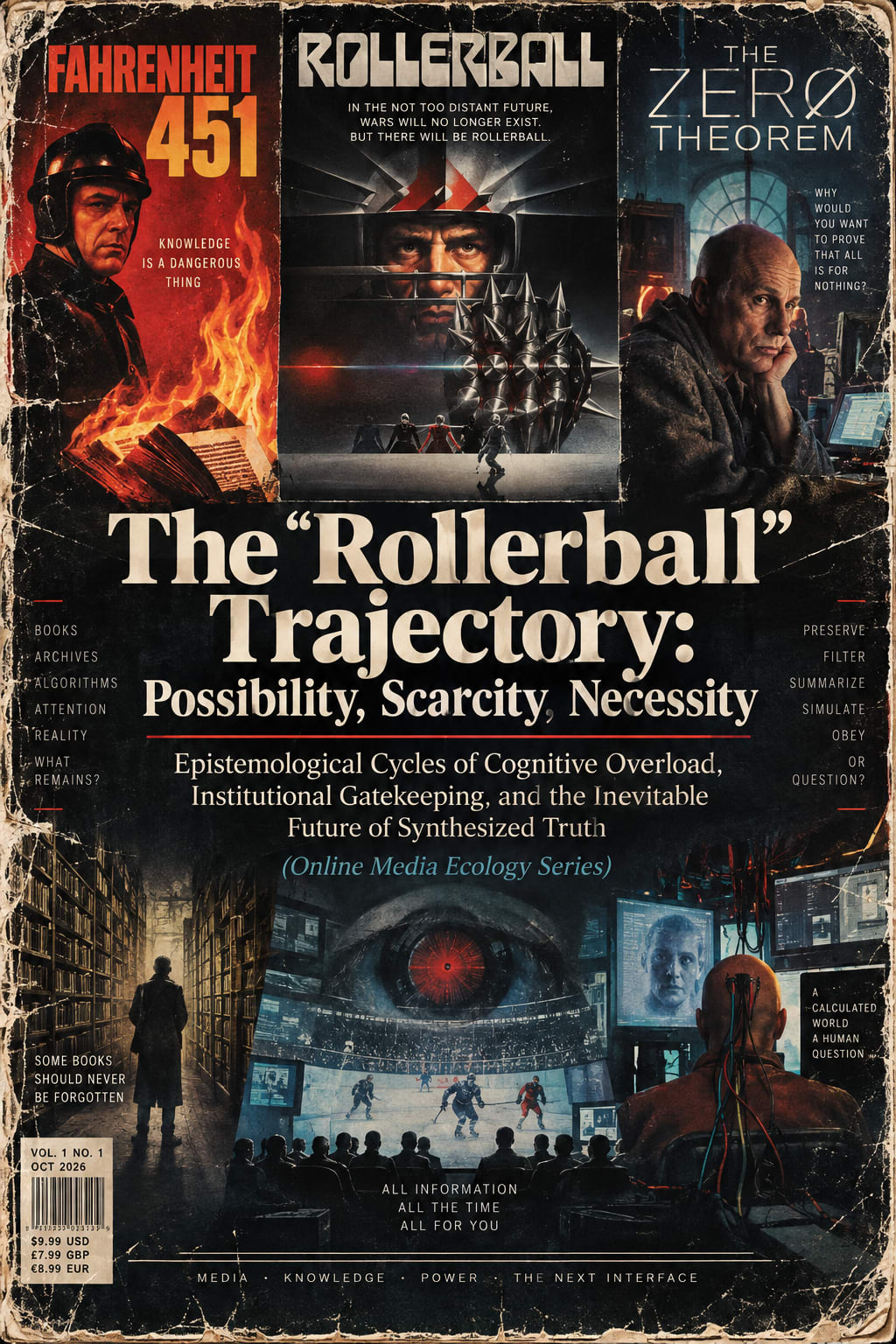
Abstract
Norman Jewison’s Rollerball (1975), adapted by William Harrison from his 1973 short story “Roller Ball Murder,” is conventionally interpreted as a dystopian warning against corporatism, technological control and the suppression of individuality. Yet behind the spectacle of the arena lies an equally consequential epistemological problem: what happens when a civilisation accumulates more information than its members can meaningfully retrieve, verify or comprehend? Jonathan E.’s encounter with computerised libraries and the central information system Zero suggests a future in which the scarcity of knowledge has been replaced by the scarcity of access, orientation and cognitive capacity. This article proposes the concept of the Rollerball Trajectory to describe a recurrent movement from informational possibility through cognitive scarcity towards the increasing necessity of synthesized knowledge. It rejects both technological determinism and nostalgic assumptions that physical books constitute inherently freer or more reliable repositories of truth. Print culture has always depended upon editors, publishers, institutions, commercial interests and systems of selection; digital synthesis transforms rather than invents the problem of epistemological gatekeeping. Bringing Rollerball into dialogue with Ray Bradbury’s Fahrenheit 451, Terry Gilliam’s The Zero Theorem, Max Weber’s theory of rationalisation, Marshall McLuhan’s Media Ecology and Jean Baudrillard’s account of simulation, the article argues that contemporary artificial intelligence and Large Language Models can be understood as the latest stage in a much longer history of cognitive externalisation: from archive to database, from search to ranking, and from retrieval to synthesis. As informational abundance increasingly exceeds biological attention, summarisation may cease to be merely convenient and become infrastructural. The resulting danger lies not in synthesized truth itself but in irreversible synthesized truth: an epistemological environment in which the interface becomes indistinguishable from the archive and compression becomes deletion. Against both informational anarchy and the fantasy of an infallible Zero, the article proposes the principle of revisable synthesis: publicly accessible summarized knowledge sustained by provenance, uncertainty, preserved primary archives, competing hypotheses and mechanisms of correction. The ultimate Rollerball question is therefore no longer whether humanity will surrender knowledge to machines, but whether a civilisation that can no longer read its entire archive can construct systems capable of summarising it without forgetting how to doubt their own summaries.
Keywords: Rollerball; William Harrison; Norman Jewison; synthesized truth; cognitive overload; information scarcity; epistemological gatekeeping; artificial intelligence; Large Language Models; Media Ecology; Marshall McLuhan; Max Weber; Jean Baudrillard; Fahrenheit 451; The Zero Theorem; digital archives; path dependence; epistemic authority; revisable synthesis
Introduction: The Inevitable Track: When Too Much Knowledge Becomes Ignorance
“All information is here. Nothing is lost… Except, the whole of the 13th century. Misplaced the computers, several conventional computers. We can’t find them.”
— Librarian, Rollerball (1975)
Norman Jewison’s Rollerball (1975) is remembered primarily for its arena: a circular track on which speed, violence, corporate power and individual survival are compressed into a spectacular ritual. Yet the film’s most prescient environment may not be the arena at all. It may be the library. William Harrison, who adapted the screenplay from his own short story “Roller Ball Murder,” first published in Esquire in September 1973, constructed a future in which the political question of who governs cannot be separated from the epistemological question of who knows. Jonathan E., the celebrated Houston player whose refusal to retire gradually turns him from corporate asset into systemic anomaly, begins searching for an explanation of the society that has produced him. His search leads away from the stadium and towards the institutional organisation of memory. The local library cannot simply provide the books he requests: they have been classified, transcribed and summarized, and the clerk directs him towards the computer infrastructure where knowledge has migrated. Eventually Jonathan reaches Geneva and encounters Zero, described by its eccentric custodian as the “central brain, the world’s brain”. Zero is supposed to locate information and indicate what it might mean, yet the system has become strangely ambiguous. Some conventional computers containing the thirteenth century have been misplaced; questions have become complicated; and when Jonathan asks the apparently straightforward question of how corporate decisions are made and who makes them, the immense apparatus of accumulated knowledge produces tautology, slogans and evasion. The scene is usually legible as satire of technological centralisation, bureaucratic secrecy and historical amnesia. Yet another interpretation is possible. Zero may represent not merely the dystopian corruption of knowledge but the endpoint of a genuine epistemological problem that modern civilisation has spent centuries creating for itself. Humanity has been extraordinarily successful at defeating the scarcity of information. Printing multiplied texts; industrial publishing multiplied printing; libraries organised multiplication; photography, recording and broadcasting expanded what could be preserved; computation transformed documents into searchable data; networks dissolved many of the geographical restrictions governing access; and digital storage made preservation and reproduction possible on a scale that earlier archival cultures could scarcely have imagined. The result is an extraordinary historical inversion. The problem is increasingly not that knowledge does not exist, but that no biological individual can adequately encounter the quantity that does. The successful accumulation of information therefore produces its own counter-scarcity: scarcity of attention, time, verification, contextualisation and orientation. Zero begins to look less like an arbitrary invention than like an epistemological attractor.
This inversion is the beginning of what will be called here the Rollerball Trajectory: possibility, scarcity and necessity. Possibility describes the expanding technological capacity to record, reproduce and preserve information; scarcity names the paradoxical condition produced when this abundance exceeds the processing capacities of its human users; necessity describes the resulting pressure to construct mechanisms capable not merely of storing knowledge but of selecting, comparing, ranking, compressing and eventually synthesising it. The trajectory does not require a conspiracy, nor does it presume that a centralised computer such as Zero constitutes the inevitable technological form of the future. It identifies instead a recurrent pressure within information systems: every successful expansion of the archive increases the importance of whatever stands between the archive and the person attempting to understand it. The librarian, editor, publisher, index, catalogue, encyclopaedia, canon, search engine, recommendation algorithm and Large Language Model belong to radically different technological and institutional histories, yet each responds in some measure to the disparity between what can potentially be known and what an individual can actually process. This is why the conventional opposition between the trustworthy physical book and the dangerous digital summary is inadequate. Printed knowledge has never arrived without mediation. Books are selected, edited, financed, printed, distributed, reviewed, classified, translated, abridged, canonised and sometimes suppressed. Digital systems do not invent gatekeeping; they transform its scale, speed, visibility and reversibility. The deeper question raised by Rollerball is consequently not whether mediation can be abolished but what happens when mediation becomes indispensable. Marshall McLuhan provides one axis for understanding this transformation because changes in media environments alter the conditions under which perception, memory and social organisation operate. Max Weber provides another because expanding institutional complexity generates pressures towards rationalisation, classification, calculability and administratively manageable knowledge. Jean Baudrillard introduces a third problem: the possibility that representations may become more accessible, operational and socially consequential than the realities or primary materials they supposedly represent. Read together, these traditions permit Zero to be approached not simply as a malfunctioning fictional computer but as a thought experiment concerning the point at which accumulated knowledge requires an interface powerful enough to become an epistemological institution in its own right. The decisive power of such an institution would not necessarily consist in destroying the archive. It could arise from something far simpler: becoming easier to consult than the archive.
The importance of this distinction becomes clearer when Rollerball is placed beside Ray Bradbury’s Fahrenheit 451 and, later, Terry Gilliam’s The Zero Theorem. Bradbury imagined a society in which the relationship between people and difficult texts had already been transformed by acceleration, condensation, entertainment, conformity and institutional coercion. The destruction of books is spectacular, but the cultural process preceding destruction is equally important: complexity becomes burdensome, sustained attention becomes increasingly anomalous, and the difficult encounter with competing ideas loses ground to faster and less demanding forms of communication. Rollerball advances the problem into a different informational condition. Its books need not simply burn; they can be transcribed. Their information can survive while the reader’s relationship with that information changes fundamentally. Jonathan’s difficulty is therefore distinct from Montag’s. Montag must rescue texts from disappearance. Jonathan must recover intelligibility from an apparatus that ostensibly possesses the information he requires. One confronts destruction; the other confronts mediation. This distinction becomes still more significant in an age of digital abundance. A text does not need to be prohibited, erased or burned to become socially invisible. It can remain perfectly preserved while being buried beneath quantities of competing material that almost nobody possesses the time to navigate. Conversely, a summary need not falsify a source to become more culturally influential than it. It needs only to become the version that most people actually encounter. This is the emergence of interface power: the capacity of the intermediary to determine the practical surface of knowledge without necessarily eliminating what lies beneath it. The contemporary significance of Zero therefore rests less in the fantasy of a single omniscient machine than in the increasingly familiar movement from archive to database, database to search, search to ranking, ranking to recommendation, and recommendation to synthesis. At each stage information becomes easier to approach, while another layer of selection is inserted between the individual and the accumulated archive. The apparent liberation from informational friction consequently creates a new dependency upon those systems capable of performing the liberation.
The Rollerball Trajectory nevertheless cannot terminate in a simple warning against synthesis, because synthesis itself is among civilisation’s oldest intellectual technologies. To understand is already to discriminate; to explain is to compress; to remember is to select. The relevant distinction is therefore not between an impossible state of completely unmediated knowledge and a corrupted state of mediation, but between forms of mediation that remain contestable and those that acquire the authority of finality. Here lies the central paradox of Zero. A civilisation overwhelmed by its own informational productivity may genuinely require increasingly powerful systems of synthesis, while the concentration of synthesis simultaneously creates unprecedented possibilities for epistemological closure. Terry Gilliam’s The Zero Theorem extends this problem from institutional architecture towards existential experience: once calculation becomes an environment rather than merely a tool, the question of what can be processed begins to collide with questions—meaning, purpose, individuality, love, uncertainty—that resist reduction to administrative or computational resolution. Jonathan E. and Qohen Leth can therefore be read as inhabitants of different dimensions of a related problem: the former confronting an institutional system whose explanations have become inaccessible, the latter inhabiting a world in which data processing threatens to consume the very question of what processing is for. Neither film needs to have predicted contemporary artificial intelligence for this comparison to matter. Their significance lies in exposing a structural tension that becomes more urgent as computational systems increasingly mediate access to accumulated culture. The argument that follows therefore rejects both informational nostalgia and technological fatalism. It asks instead whether the movement towards synthesized knowledge can remain compatible with epistemic plurality, recoverable sources, uncertainty, dissent and correction. The future problem is not simply whether there will be a Zero. Something functionally resembling Zero may become increasingly attractive precisely because the alternative is an archive too large for any person to comprehend. The decisive question is what kind of Zero will be constructed: opaque or auditable, singular or plural, doctrinal or revisable. A civilisation capable of preserving almost everything may discover that preservation was the easier problem. The harder problem begins when it must decide how to know what it has preserved.
Part I: From Gutenberg to Zero: The Catastrophic Success of Information
“The books you’ve ordered are classified and have been transcribed and summarized.”
— Rollerball (1975)
The history of information can be read as a history of successful rebellion against scarcity. For most of human existence, the principal epistemological problem was brutally material: knowledge disappeared because its carriers died, manuscripts deteriorated, libraries burned, distances obstructed transmission, copying demanded enormous labour and access depended upon physical proximity to scarce objects. Printing did not abolish these constraints, but it altered their scale sufficiently to transform the relationship between civilisation and memory. Reproducibility made survival less dependent upon the fate of a particular manuscript; expanding publishing markets multiplied authors, readers and genres; libraries increasingly became institutions for organising abundance rather than merely protecting rarity. What Marshall McLuhan described through the cultural consequences of typography was therefore more than the arrival of a convenient container for words. Print constituted an environment that reorganised relations among memory, authority, individuality and distance. Yet celebrating print as the natural habitat of autonomous thought risks converting one historical medium into an epistemological morality. The book was never an unmediated encounter between sovereign writer and sovereign reader. Before a volume reached its audience, numerous acts of selection had already occurred: somebody financed, edited, printed, distributed, stocked and catalogued it. Governments could prohibit it; religious institutions condemn it; publishers reject it; markets make it unavailable; libraries decline to acquire it; educational systems exclude it from curricula. The printed archive was simultaneously decentralising and gatekeeping. Its great achievement was not the elimination of mediation but the multiplication of copies and, eventually, mediators. This distinction matters because the nostalgic opposition between physical books and digital databases obscures the continuity underlying the Rollerball Trajectory. Humanity has never possessed an archive without selection. What changes historically is the architecture through which selection occurs. Print distributes many acts of mediation among material institutions; computation can concentrate, accelerate and partially automate them. The transition is momentous, but it is not a transition from innocence to corruption. It is a transformation in the scale, speed and reversibility of an ancient epistemological function.
The spectacular achievement of print also contained the germ of a new problem. Every reduction in the cost of reproduction increased the quantity competing for human attention. Industrial printing, newspapers, magazines, inexpensive books, mass literacy, photography, broadcasting, photocopying and eventually digital networks successively weakened older material constraints upon communication. Here McLuhan’s proposition that “the medium is the message” becomes useful only when rescued from its most mechanical interpretation. Content does not become irrelevant; rather, the consequences of a medium cannot be understood merely by examining the statements transmitted through it. A printing system capable of producing ten thousand books establishes different cultural conditions from a manuscript culture circulating ten. A searchable digital archive containing millions of documents creates another environment again, even when those documents reproduce material originally printed on paper. Once reproduction and storage become relatively inexpensive, a different scarcity emerges. Human beings retain finite lives, finite attention and limited capacities for comparison. The quantity of potentially accessible information can therefore expand much faster than the biological capacity to encounter it. This is the catastrophic success announced in the title of this Part: information technology solves one problem so effectively that it generates its opposite. Scarcity does not disappear; it migrates. The rare commodity becomes the time required to locate a document, read it, compare it with rival accounts, establish its provenance, recognise its errors and position it within an intelligible structure. A library containing one thousand books confronts its reader with choice. A network containing billions of documents confronts its reader with an information-retrieval problem. The greater the archive becomes, the greater the practical authority of catalogues, indexes, librarians, reviewers, search systems and eventually automated synthesizers. Abundance therefore does not abolish the gatekeeper. Paradoxically, it increases the demand for one.
Rollerball compresses this transformation into one understated encounter. Jonathan enters what appears to be a library because he wants to “study up on some things”. His desire is elementary: he suspects that something is happening around him and wants information with which to interpret it. Yet the institution no longer operates according to the epistemological expectations associated with the traditional library. The clerk explains that the books he requested have been “classified and have been transcribed and summarized”; edited versions exist in the catalogue while the original informational material has migrated towards computer banks. Jonathan immediately recognises that alteration of the object has altered the institution itself: “This is not a library, and you are really not a librarian.” The exchange can easily be interpreted as the film’s nostalgic defence of books against computers, but it becomes more interesting through Media Ecology. The decisive change is not simply the replacement of paper by electronic storage. The relationship between question, source, reader and intermediary has been reorganised. Jonathan requests books; the system offers edited versions. He seeks primary objects; the institution assumes that mediated access should suffice. Most importantly, the librarian does not experience this substitution as extraordinary. It is simply how information now works. McLuhan’s concept of technological extension becomes useful here. Writing externalises memory; printing amplifies reproduction; databases extend storage and retrieval; computational synthesis can externalise parts of comparison and interpretation. Yet every extension modifies the activity being extended. A person navigating a catalogue performs a different cognitive operation from someone receiving an edited digest; a person searching a database performs another; a person asking a generative system for a synthesized answer performs another again. The relevant question is consequently not only whether the underlying information technically survives. It is which habits of knowing become normal once a particular interface becomes the ordinary route towards it.
This is why the defence of paper as intrinsically decentralised cannot sustain the argument. A warehouse of books can belong to one corporation; publishing industries can become concentrated; states can determine which printed works circulate legally; commercial owners can determine which manuscripts reach mass audiences. Conversely, digital objects can be replicated across machines and jurisdictions, preserved in multiple versions and compared almost instantaneously. Material substrate alone therefore cannot determine epistemological freedom. More useful variables are concentration, redundancy, provenance, access and recoverability. Print possesses a particular strength because widely distributed physical copies make simultaneous retroactive alteration difficult: changing a later edition does not transform every earlier copy already resting on private shelves. Digital systems possess different strengths, including extraordinary reproducibility, searchability and geographical accessibility, but these advantages can reverse when access depends upon a small number of mutable platforms. The relevant opposition is consequently not paper versus silicon but distributed memory versus epistemological bottleneck. Rollerball’s world has produced precisely such a bottleneck. When Jonathan reaches Geneva, the supposedly efficient migration of knowledge becomes almost comic. Some conventional computers containing information concerning the thirteenth century have been misplaced, while Zero is presented as the system in which the accumulated informational order has been concentrated—the “central brain, the world’s brain”. The irony is exact. The more comprehensive an archive becomes, the more consequential failures of its organisation become. Losing a manuscript means losing a manuscript; losing access within a sufficiently centralised information infrastructure can make an entire domain of knowledge practically disappear. Rollerball therefore imagines something more significant than digitisation. It imagines the concentration of retrieval.
Zero should not be retroactively converted into a primitive Large Language Model. The film presents a fictional central computer and memory system, and its behaviour cannot simply be redescribed through contemporary concepts such as hallucination or model collapse. Its conceptual importance lies elsewhere. Zero represents the aspiration to create an informational point through which accumulated knowledge becomes administratively manageable. Storage begins to approach interpretation. Once an information system is expected not merely to preserve material but to determine where relevant knowledge is and what it means, it crosses the boundary between warehouse and epistemological intermediary. Weber’s rationalisation provides the institutional counterpart to McLuhan’s media transformation. Large organisations cannot repeatedly return every decision to the totality of available evidence. They classify, standardise, summarise and proceduralise because complexity must be reduced before coordinated action becomes possible. Bureaucratic rationality therefore possesses a genuine informational advantage: it makes enormous systems operable. Yet the same process establishes categories determining what counts as relevant information, which routes constitute legitimate access and which conclusions become administratively actionable. Rollerball radicalises this logic by imagining preservation, classification, retrieval and interpretation converging within an increasingly central infrastructure. Zero becomes the fantasy of perfect institutional memory while simultaneously exposing the vulnerability of that fantasy. Human archives have always forgotten. The difference is that a system created to overcome fragmented memory can itself become the privileged gateway through which memory must pass.
The movement towards such gateways requires no conspiracy. It can emerge from convenience. Every person confronting a large library understands the attraction of the catalogue; every researcher understands the index; every internet user understands search. The decisive threshold arrives when the intermediary becomes sufficiently effective that direct navigation of the underlying abundance begins to appear irrational. Why inspect ten thousand documents if a reliable system can identify the twenty that matter? Why read twenty conflicting reports if an accurate mechanism can compare them? Why perform that comparison personally if a trustworthy synthesizer can identify agreements, contradictions and evidential weaknesses in seconds? Each step appears reasonable because each conserves the resource that abundance renders scarce: human attention. This is the deeper movement from Gutenberg to Zero. It is not adequately described as a decline from intellectual freedom into technological enslavement. It is a succession of solutions to genuine problems, each solution transforming the environment in which the next problem emerges. Printing solves scarcity by multiplying texts. Libraries organise multiplication. Catalogues make organised collections navigable. Search systems rank enormous catalogues. Synthesis promises to convert ranked results into intelligible answers. At every stage informational friction decreases while the authority of the interface increases. The possibility of knowing more consequently creates dependence upon systems capable of determining where knowledge is. The historical question “Where can knowledge be found?” gradually mutates into the more consequential question “Which knowledge deserves to be found?” At that point civilisation enters the second movement of the Rollerball Trajectory. Information remains abundant, perhaps unimaginably so, but meaningful orientation within it has become scarce. The librarian has not disappeared. The librarian has become the architecture.
Part II: The Librarian’s Gate: Scarcity in an Age of Infinite Information
“Books cut shorter. Condensations. Digests. Tabloids.”
— Fahrenheit 451 (1966)
If the first movement of the Rollerball Trajectory is the catastrophic success of accumulation, its second begins when accumulation ceases to guarantee intelligibility. Ray Bradbury’s Fahrenheit 451, published in 1953 and adapted to film by François Truffaut in 1966, provides an essential precursor to this transformation because its most enduring image—the burning book—can obscure the subtler informational process described by Captain Beatty. The destruction of books represents the spectacular endpoint of a longer cultural movement towards acceleration, simplification and diminished tolerance for complexity. Bradbury’s society does not merely prohibit difficult knowledge from above; it inhabits an environment in which difficult knowledge has progressively lost its ecological advantage. Condensation precedes incineration. Long works become shorter, arguments become digests, attention migrates towards immediately consumable forms, and immersive electronic entertainment occupies spaces once available for sustained reading. McLuhan’s Media Ecology makes this progression more significant than a conventional censorship allegory. A society does not need explicitly to decide that complexity is evil for a media environment to make complexity increasingly inconvenient. Once communication accelerates, slowness acquires a cost; once information becomes continuous, concentration requires withdrawal; once instantaneous stimulation becomes ordinary, the long interval demanded by difficult reading begins to feel anomalous. Fahrenheit 451 therefore anticipates a crucial distinction for understanding contemporary informational scarcity. A civilisation may possess enormous quantities of technically available information while simultaneously weakening the practical conditions required to engage with it. This is why Bradbury’s world and Rollerball’s world should not be collapsed into the same dystopia. Montag inhabits a culture in which books have become dangerous objects whose continued existence must be protected through extraordinary acts of preservation. Jonathan inhabits a culture in which books have been transcribed, classified, edited and summarized. Montag confronts disappearance; Jonathan confronts substitution. One must save the archive from fire, while the other must find a route through an archive that claims already to have processed itself. The difference marks an epistemological transition from censorship through destruction towards governance through mediation. The latter can be less visible precisely because it need not prohibit the source. It needs only to make the intermediary more useful than the source itself.
This is the paradoxical scarcity created by informational abundance. When the quantity of available material exceeds the amount any individual can examine, scarcity migrates from objects to cognitive resources. Attention becomes scarce; verification becomes scarce; expertise becomes scarce; contextual understanding becomes scarce; and perhaps most importantly, confidence about where to direct those scarce resources becomes scarce. The individual confronted by ten documents may compare them. Confronted by ten million, the individual must first accept some mechanism for deciding which documents merit comparison. Every sufficiently large archive therefore generates a secondary architecture of orientation. The traditional librarian performs this function without necessarily claiming to determine truth: collections are classified, catalogues organise location, bibliographies establish relationships and specialists guide readers towards relevant materials. Yet as the archive expands and the available time for navigating it contracts, orientation itself acquires increasing epistemological authority. Search engines rank. Recommendation systems select. Academic indexes define searchable corpora. News aggregators determine prominence. Automated systems can increasingly extract, classify and summarize. None of these functions is identical, and none should automatically be equated with censorship. Their shared structural significance lies in the fact that abundance makes unfiltered access progressively less usable. A search engine returning every possible result without ordering would technically maximise availability while practically destroying retrieval. The filter therefore becomes indispensable precisely because the archive is open. This produces one of the central inversions of the Rollerball Trajectory: the gatekeeper no longer necessarily stands before a locked door. The gatekeeper may instead stand before an open door through which so much material is pouring that passage becomes impossible without guidance. The power to exclude consequently develops alongside the power to orient. What makes the modern gate epistemologically consequential is not simply that it can prevent access, but that it can determine the route through abundance.
Weber’s rationalisation clarifies why this transformation cannot be explained adequately through malicious intention. Bureaucratic systems exist partly because large organisations cannot operate through perpetual reconsideration of everything. Rules, classifications, procedures, records and specialised offices reduce uncertainty by converting unique situations into administratively recognisable categories. The same principle operates within informational institutions. A library without classification is a warehouse; a database without structure is an accumulation of files; an internet without retrieval mechanisms approaches practical unintelligibility. Rationalisation is therefore not merely an instrument of domination. It is one of the techniques through which complexity becomes usable. Yet its efficiency creates an unavoidable epistemological consequence: whatever cannot be classified according to the operative system becomes more difficult to see. The category illuminates by excluding. The index reveals by reducing. The summary clarifies by omitting. Rollerball’s Zero represents the extreme fictional concentration of this logic because the system is expected simultaneously to remember, locate and explain. Jonathan’s journey to Geneva is therefore significant not because he discovers that the corporations have destroyed knowledge, but because he discovers that the architecture designed to make knowledge manageable has become incapable of providing the particular orientation he requires. The absurd disappearance of the thirteenth century makes this visible through comedy. The information may once have been collected; the institutional promise of total memory may remain; yet practical access has failed. More revealing still is Jonathan’s attempt to understand corporate decision-making. The question is political, but the failure he encounters is epistemological. An immense apparatus capable of retaining information cannot necessarily explain the structure that gives that information significance. Zero exposes the difference between possessing data and producing understanding.
The comparison with Fahrenheit 451 becomes particularly useful at this point because Bradbury supplies an alternative model of preservation. At the end of the story, the exiles preserve books by memorising them, transforming individual human beings into distributed biological copies of threatened texts. Their method is technologically primitive but structurally sophisticated: no single central archive contains everything, and the destruction of one person does not automatically destroy the entire cultural memory. The Book People embody redundancy. Rollerball’s Zero embodies concentration. Yet neither model can simply be declared superior outside its informational environment. Human memorisation cannot scale to preserve the enormous informational production of a contemporary civilisation, while centralised computation introduces vulnerabilities precisely because so much retrieval can depend upon shared infrastructure. The opposition therefore reveals a fundamental design problem rather than a sentimental choice between humanity and machinery. Knowledge systems require both preservation and navigation, both redundancy and coordination. Too little organisation produces chaos; too much concentration produces bottlenecks. Too little filtering makes abundance cognitively unusable; too much filtering can make the filter indistinguishable from reality. The epistemological problem of the twenty-first-century archive is consequently not solved by demanding “all information” without mediation. Such a demand becomes increasingly meaningless as the quantity of information approaches scales no person can inspect. What matters is whether mediation remains visible as mediation: whether the reader can know why something has been selected, recover what has been omitted, inspect the evidence beneath a summary and discover competing interpretations that the dominant interface did not privilege. The danger begins when the map does not merely simplify the territory but becomes the only territory most users ever encounter.
Baudrillard becomes indispensable precisely at this boundary. His theory of simulation need not be reduced to the crude proposition that representations are false and reality is true. The more disturbing possibility is that representations become operationally more important than whatever they represent. A database record can become more consequential than the event from which the record originated; a ranked search result more visible than an unranked source; a profile more actionable than the person described by it; a summary more widely encountered than the document it compresses. Under these conditions, informational mediation does not have to eliminate reality to reorganise social experience around representations of it. The archive remains somewhere beneath the interface, but practical knowledge increasingly occurs at the interface. This is interface power. It differs from classical censorship because it can operate without forbidding anything. A document may remain accessible to anyone sufficiently motivated to search for it while nevertheless becoming practically absent from collective consciousness. Conversely, a particular interpretation can achieve enormous authority without becoming legally compulsory simply because it occupies the most convenient point of access. The logic is already latent in Rollerball’s library. Jonathan does not initially demand that information be liberated from prohibition; he asks for particular books and discovers that the system has already decided how he should encounter them. The edited version becomes the practical object. The summary stands where the book once stood. The epistemological significance of this arrangement lies less in whether the summary is accurate than in whether the user retains a meaningful route back to what was summarized.
Scarcity therefore acquires a meaning almost opposite to its premodern form. The problem is no longer necessarily insufficient information but insufficient capacity to orient oneself within information. This explains why contemporary arguments that simply celebrate unrestricted abundance fail to address the structural problem. Adding another million documents to an archive may increase theoretical knowledge while decreasing the probability that any particular document will ever be encountered. Producing more commentary can increase expressive plurality while making verification more difficult. Preserving every version can strengthen historical memory while overwhelming anyone attempting to determine which version is authoritative. The answer cannot be to reverse informational possibility and artificially recreate scarcity by destroying the archive. The pressure instead moves towards systems capable of reducing abundance into navigable forms. This is where the second phase begins to generate the third. The more severe the scarcity of attention becomes, the more valuable reliable synthesis becomes. The exhausted reader does not necessarily demand censorship; the reader demands orientation. The citizen confronted by thousands of contradictory claims does not necessarily ask that disagreement disappear; the citizen asks which claims are supported. The researcher facing millions of documents does not necessarily want fewer documents to exist; the researcher wants a mechanism capable of identifying relationships among them. The attraction of Zero can therefore arise democratically from below as much as administratively from above. People may demand the very compression that later acquires power over them. The crucial transformation occurs when a convenience becomes infrastructure and infrastructure becomes difficult to bypass. At that point, informational scarcity has generated its own solution and its own danger. The gatekeeper has become indispensable not because the gate is closed but because the archive behind it has become too vast to cross unaided. The historical scarcity of information has ended only to reveal another scarcity beneath it: the scarcity of human orientation. The next stage of the Rollerball Trajectory begins when civilisation attempts to solve that scarcity by asking the intermediary not merely to find knowledge, but to understand it on humanity’s behalf.
Part III: The Coronation of the Summary: When Zero Becomes Necessary
“Zero is the world’s brain.”
— Rollerball (1975)
The disturbing possibility raised by Rollerball is not that Zero has failed, but that civilisation may eventually require something like Zero to succeed. Once informational abundance exceeds biological capacities of attention, memory and comparison, the historical function of the intermediary changes. The librarian once helped the reader locate a source; the catalogue helped the librarian organise sources; the search engine ranked sources that no human catalogue could comprehensively navigate. The next logical pressure is towards systems capable of comparing those results and converting them into provisional intelligibility. The movement can be expressed as archive → database → search → ranking → recommendation → summarisation → synthesis. None of these stages abolishes its predecessor, yet each changes the practical location at which ordinary users encounter knowledge. This is where the proposition that a possibility once created can become a necessity must be treated not as a metaphysical law of history but as a problem of path dependence. Technologies that successfully remove persistent constraints generate expectations, infrastructures and dependencies around the capacities they provide. Electrified societies do not lose the physical capacity to live without electricity, but institutions organised around continuous electrical provision make abandonment extraordinarily costly. Networked communication follows a similar pattern. Once administration, commerce, education, research and everyday coordination are reorganised around rapid information exchange, returning to slower infrastructures ceases to represent a simple preference for an earlier medium. Information synthesis may follow the same trajectory. If increasingly sophisticated systems can compare thousands of documents, expose contradictions, translate specialised terminology and produce comprehensible accounts in seconds, refusing synthesis altogether may eventually become as impractical as refusing catalogues in a large library. The significant question is therefore not whether humanity should preserve an imaginary condition of completely unmediated reading. Such a condition never existed. The question is what institutional arrangements emerge when cognitive delegation becomes normal. Zero becomes politically important at precisely the moment it becomes genuinely useful. A useless central computer can be ignored. A highly competent one becomes infrastructure.
This allows a more difficult reading of Rollerball than the conventional opposition between Jonathan’s humanity and corporate technological domination. Imagine, as a counterfactual rather than as dialogue contained in Harrison’s screenplay or Jewison’s film, that Zero answered Jonathan successfully. Jonathan asks how corporate decisions are made. A competent Zero might reply that decisions emerge from aggregated information, projections, models, resource constraints and plans intended to coordinate a global system too complex to be governed through individual intuition. Such an answer would not prove that corporate authority is legitimate, but it would transform the philosophical problem. The corporations could no longer be dismissed merely as irrational tyrants concealing arbitrary power beneath technology. They would represent the possibility that governance itself increasingly becomes information processing. Modern societies already require vast quantities of abstraction simply to function: populations become demographic distributions; economies become indicators; transport becomes flows; energy becomes demand curves; disease becomes epidemiological data; institutions become budgets, projections and performance measures. No administrator encounters the whole society directly. Administration proceeds through representations of society. Weber’s rationalisation thus meets the information problem at exactly this point. Formal systems promise calculability, predictability and coordination because individual perception cannot encompass the complexity being administered. Zero would be the radical completion of this tendency: not merely another bureaucratic office but an informational environment capable of combining what specialised offices know. The danger would then cease to be reducible to the existence of calculation. It would concern the relationship between calculation and authority. Who determines the objectives being optimised? Which phenomena become measurable? Which values disappear when qualitative realities are converted into comparable variables? What happens when the model encounters Jonathan E.—an individual whose persistence contradicts the assumptions built into the institutional prediction? A rational system should revise its model when reality contradicts it. A self-protecting system may instead attempt to remove the contradiction.
This distinction is crucial for understanding contemporary artificial intelligence without turning Rollerball into technological prophecy. Large Language Models are not Zero, and Zero is not an anticipatory representation of an LLM. Yet generative systems reveal why the fictional aspiration represented by Zero has become increasingly comprehensible. Search traditionally places the burden of synthesis upon the user. A query produces sources or ranked destinations, after which the user must inspect, compare and interpret them. Generative interfaces alter that relationship by producing an answer directly. The interface therefore begins to occupy a position formerly distributed among search engine, librarian, encyclopaedia, editor and reader. This does not mean that the system possesses final truth, nor that contemporary models should be trusted as autonomous epistemic authorities. It means that the technological direction of travel increasingly concerns cognitive operations rather than storage alone. McLuhan’s concept of extension becomes unusually powerful here. Writing extends memory beyond the nervous system; print extends reproducibility; telecommunications extend presence; databases extend storage and retrieval. Systems capable of summarisation, translation, comparison and inferential recombination begin to extend aspects of cognitive processing itself. Every extension simultaneously alters the practice being extended. When remembering becomes external, memory practices change; when navigation becomes automated, spatial habits change; when retrieval becomes instantaneous, research habits change. If synthesis becomes routinely externalised, the relationship between reading and knowing may change accordingly. The decisive media-ecological question is therefore not whether AI can “think like a human”, but what happens to human cognition when increasing amounts of intellectual friction are transferred to an environment capable of processing them on demand. The medium becomes consequential before it becomes infallible.
The attraction is obvious. Informational friction is expensive. Searching consumes time; comparison requires expertise; specialist vocabularies obstruct outsiders; contradictory sources generate uncertainty; verification can demand access to materials unavailable to ordinary readers. A sufficiently reliable synthesis system could reduce these inequalities. It could allow a student without access to an elite library to navigate difficult scholarship, enable a reader to compare arguments across languages, help specialists discover connections beyond their disciplinary boundaries and expose evidential disagreement that would otherwise require days of investigation. Cognitive externalisation should therefore not be treated simply as intellectual decline. Calculators did not abolish mathematics; databases did not abolish history; search engines did not abolish research. Technologies can remove low-value friction while enabling more sophisticated inquiry. The Rollerball Trajectory becomes dangerous only when reduced friction is confused with eliminated uncertainty. The answer that arrives immediately can acquire an authority disproportionate to its epistemological status because the labour that once made uncertainty visible has disappeared from the user’s experience. A researcher manually comparing ten contradictory documents cannot easily forget that disagreement exists. A reader receiving one fluent synthesis may never encounter the disagreement unless the interface deliberately preserves it. Convenience thus creates a peculiar form of opacity: not necessarily secrecy about information, but invisibility of the decisions through which information became an answer. This is interface power in its mature form. The interface does not need to forbid alternative interpretations. It can simply make one synthesis effortless and every alternative comparatively expensive.
At this point Baudrillard’s theory of simulation intersects with McLuhan’s media ecology and Weber’s rationalisation. The danger is not simply that a synthetic representation might be false. Human beings have always relied upon representations, abstractions, maps, histories and summaries. The more radical possibility is that the representation becomes operationally sufficient. If most practical encounters with a subject occur through synthesized interfaces, the underlying archive may remain intact while becoming culturally secondary. Zero does not have to burn the library. Zero only has to become easier to consult than the library. The resulting transformation resembles Baudrillard’s problem of simulation because the representational layer increasingly acquires autonomy from the realities it organises. A summary may be derived from primary materials, but later summaries can draw upon earlier summaries; rankings influence what receives attention; visibility generates citation; repeated formulations become apparently canonical because they are repeatedly encountered. The informational environment can therefore become reflexive. Representations help determine which representations will be produced next. This does not mean that reality disappears, but that access to reality is increasingly organised through layers of previous mediation. McLuhan explains how this interface becomes an environment; Weber explains why institutions favour its efficiency; Baudrillard explains why the resulting representation may become more socially operative than the dispersed materials beneath it. The three perspectives converge at Zero without requiring any of them to have predicted it.
Yet a perfect Zero would create a paradox more serious than the malfunctioning machine encountered by Jonathan. If the system genuinely became exceptionally reliable, comprehensive and efficient, the incentive to bypass it would diminish. The better the synthesis, the greater the dependency upon synthesis. This reverses the usual dystopian scenario. A society need not be forced to surrender primary reading through censorship. It may voluntarily abandon much of it because direct retrieval becomes comparatively inefficient. Citizens overwhelmed by contradictory claims may demand a mechanism capable of telling them what happened, what is known, what remains disputed and which evidence is unreliable. Researchers may demand instant literature synthesis because no individual can follow every publication. Administrators may demand predictive models because decisions must be made faster than humans can manually process the evidence. The movement towards Zero could therefore emerge not despite democratic demand but partly because of it. People exhausted by informational chaos may ask to be relieved of the burden of continuous epistemological arbitration. The intermediary then acquires authority through usefulness rather than coercion. This is the point at which possibility approaches necessity: a technology becomes embedded because the environment reorganises itself around the problem that technology solves.
The critical distinction must consequently be drawn not between synthesis and freedom, but between revisable and irreversible synthesis. Every act of understanding already compresses. Every history omits events; every map excludes detail; every scientific model simplifies; every memory selects. A civilisation incapable of synthesis would drown in its own archive. But synthesis becomes epistemologically dangerous when the compressed representation can no longer be reopened. The ideal information system would therefore not eliminate the layers beneath its answer. It would preserve provenance, primary sources, uncertainty, conflicting evidence, historical versions and alternative interpretations while providing an intelligible surface for those who cannot inspect everything. Such a system would not claim to end disagreement; it would organise disagreement without erasing its existence. Zero’s real failure is therefore not that it attempts to synthesize. Its failure is that its authority is greater than its recoverability. When the thirteenth century disappears, there is apparently no meaningful alternative route around the bottleneck. When Jonathan asks who makes corporate decisions, the informational architecture does not permit him to descend through its answer towards the evidence and institutional mechanisms beneath it. The lesson is not that civilisation must reject Zero. It is that civilisation may eventually need a Zero capable of doubting itself. The problem is not synthesized truth but irreversible synthesized truth. Once synthesis becomes necessary, the political question of the archive changes permanently: not whether there will be a librarian, but whether the final librarian can ever be corrected.
Part IV: The Revisable Zero: Who Governs the Final Librarian?
“Why would you want to prove that all is for nothing?”
— The Zero Theorem (2013)
If the third movement of the Rollerball Trajectory makes synthesis increasingly necessary, the fourth must ask what kind of synthesis a civilisation can safely inhabit. The question cannot be answered by demanding the abolition of filters, because every archive of sufficient size requires selection, classification and orientation. Nor can it be answered by constructing an infallible Zero, because infallibility is precisely the quality no epistemological institution should be permitted to claim. The problem lies in the asymmetry between the necessity of reduction and the uncertainty of the criteria through which reduction occurs. Every summary excludes. Every classification creates an outside. Every model distinguishes signal from noise. Yet history repeatedly demonstrates that phenomena initially dismissed as irrelevant, anomalous, mistaken or incomprehensible can later acquire significance when evidence, conceptual frameworks or historical circumstances change. This produces the Summariser’s Paradox: the better a system becomes at removing informational noise, the greater the possibility that it will also remove the anomaly through which its own assumptions might eventually be corrected. The goal cannot therefore be the elimination of what contemporary digital culture dismisses as “slop”. Propaganda, commercial manipulation, fabricated evidence and repetitive low-value material certainly impose cognitive costs, but informational disorder is not composed exclusively of worthless material. It also contains failed experiments, unpopular interpretations, speculative hypotheses, minority positions and observations for which the dominant explanatory system has not yet found a category. A mature Zero would consequently require something apparently contrary to its purpose: a protected domain of epistemological disorder. This chaos incubator would preserve material excluded from the current synthesis without forcing every user to confront the entire archive whenever asking an ordinary question. The architecture could be imagined as three interacting layers: the raw archive, containing preserved sources and historical versions; an experimental layer in which unresolved claims, contradictory evidence and speculative interpretations remain available for investigation; and a synthesized public layer presenting the most strongly supported current understanding. Information would not be permanently imprisoned within any layer. A marginal hypothesis could move upwards when evidence accumulated; an established synthesis could move downwards when contradicted. The essential property of such a system would therefore not be perfect knowledge but institutionalised corrigibility. Zero would cease to be the final answer and become the most efficient provisional answer available.
This principle transforms the meaning of informational preservation. Conventional discussions often assume that censorship begins when a document is destroyed, prohibited or physically removed. Under conditions of synthesized knowledge, however, epistemological disappearance can occur without material destruction. A source may continue to exist while becoming effectively absent from the interface through which almost everyone encounters its subject. Conversely, preservation without provenance can become nearly meaningless when users cannot reconstruct why a synthesis says what it says. A revisable Zero must therefore preserve not only documents but the paths connecting conclusions to documents. Provenance becomes part of knowledge itself. The user should be able to descend from synthesis to evidence, identify uncertainty, inspect conflicting sources and recover previous versions of the answer. This does not require every citizen to perform exhaustive primary research before accepting that water boils or that the Earth orbits the Sun. The purpose of auditability is not compulsory scepticism towards every established proposition. It is to prevent convenience from becoming irreversibility. The difference resembles that between a map that simplifies a territory and a map that destroys every road it omits. Synthesis is unavoidable because cognition itself is selective; deletion is not. The fundamental design principle can therefore be expressed simply: a civilisation that summarises everything must preserve what it excludes from the summary. Otherwise synthesis ceases to be compression and becomes deletion. This also resolves the false opposition between epistemic authority and epistemic plurality. Institutions can legitimately distinguish stronger from weaker evidence without pretending that their classifications are metaphysically final. Scientific knowledge already depends upon such revisability: propositions can be strongly established without becoming immune to correction. The future informational infrastructure should extend that principle into the architecture of retrieval itself. Zero must be authoritative enough to orient but transparent enough to be challenged.
Terry Gilliam’s The Zero Theorem (2013) provides an unexpectedly powerful companion to this problem because it shifts attention from the architecture of the archive to the person inhabiting an environment dominated by calculation. No direct genealogy between Gilliam’s Zero and Rollerball’s Zero need be asserted for the resonance to matter. Jewison’s film imagines the macrostructure: corporate organisation, informational concentration and a centralised apparatus intended to make a complex world intelligible. Gilliam moves towards the micropsychology of a world in which computational processing has become an everyday existential environment. Qohen Leth, played by Christoph Waltz, works for the vast Mancom corporation as a data processor and is assigned the task of solving the Zero Theorem, a proposition whose implications concern whether existence ultimately amounts to nothing. The important connection is not the shared word “Zero” as evidence of deliberate influence, but the shared attempt to translate problems exceeding ordinary human comprehension into systems of calculation. Qohen’s predicament makes visible the boundary that a competent Zero cannot simply calculate away. Information systems can classify evidence concerning meaning; they can compare philosophical traditions, analyse reported experience, identify linguistic patterns and summarize arguments concerning purpose. None of those capacities necessarily converts meaning itself into a computable output. The danger of total rationalisation arises when the success of calculation within one domain encourages the assumption that everything important must be expressible in calculable form. Weber’s rationalisation reaches an existential boundary here. The problem is no longer merely that bureaucracy constrains individual freedom. It is that the categories through which the system successfully administers reality may begin to define what reality is permitted to contain.
Gilliam’s hypermediated environment also sharpens the Media Ecology argument. Qohen is surrounded by screens, advertisements, corporate communications, gamified labour and virtual experiences. Technology is not merely an instrument he occasionally employs; it constitutes the environment through which work, intimacy, authority and escape are mediated. McLuhan’s Narcissus metaphor becomes especially relevant. Technological extensions fascinate because they return amplified capacities to their users while simultaneously encouraging numbness towards what has been displaced. Externalised memory can make forgetting less consequential; automated navigation can weaken the necessity of spatial orientation; instantaneous retrieval can diminish the practical value of remembering where knowledge came from. Artificial intelligence potentially extends this sequence towards interpretation itself. If systems increasingly perform searching, comparison, summarisation and preliminary judgement, the ultimate amputation would not be the disappearance of intelligence but a changed relationship to intellectual effort. This possibility should not be romanticised into a cult of difficulty. Cognitive friction is not inherently virtuous. Hours wasted locating an obscure document, translating terminology or manually comparing repetitive information do not automatically make knowledge deeper. Yet some forms of friction perform epistemological work because they expose contradiction, uncertainty and the provisional character of conclusions. The danger begins when removing the labour also removes awareness that interpretation occurred. A frictionless answer can conceal the contested path through which the answer was produced. The Media Ecology of synthesis must therefore ask not only what AI allows humans to know, but what habits of knowing become unnecessary when the environment knows on demand.
Baudrillard intensifies the problem because a sufficiently convenient synthetic layer can become the reality with which users practically interact. The purest form of interface power does not falsify the archive; it renders continuous descent into the archive unnecessary. Once summaries are accurate enough for ordinary purposes, summaries begin feeding subsequent discourse. Journalists consult syntheses, students consult explanations, administrators consult dashboards, researchers use automated reviews, and future computational systems may encounter texts already shaped by earlier computational systems. Representation becomes increasingly recursive. This does not mean that the world vanishes or that every synthesis becomes a copy without an original. It means that the operational distance between source and representation can grow while the representation becomes more socially immediate. Here the Weberian iron cage and the Baudrillardian simulacrum converge with McLuhan’s environment. Rationalisation produces the demand for efficient informational reduction; mediation transforms reduction into an ordinary cognitive environment; simulation warns that the resulting representations may become more actionable than the dispersed realities from which they originated. The Iron Cage has automated the Simulacrum. Yet this convergence should not be treated as an inevitable dystopian terminus. Precisely because the problem is architectural, alternative architectures remain possible. Multiple synthesizers can coexist. Sources can remain inspectable. Models can disclose uncertainty. Version histories can prevent silent rewriting. Distributed archives can protect against single points of failure. Minority hypotheses can remain searchable without receiving equal evidential status. The alternative to informational chaos is not necessarily epistemological monopoly.
This possibility returns the argument to Jonathan E. His survival at the end of Rollerball is powerful because he demonstrates that the model governing the game has failed to predict the individual placed inside it. The rules are progressively altered around him, yet he persists. His significance for the Rollerball Trajectory lies not simply in heroic individualism but in anomaly. Jonathan is the datum that refuses to behave as expected. A genuinely rational system should learn from such a datum. An institution concerned primarily with preserving its existing structure may instead redefine the anomaly as a threat. This distinction suggests a further speculative trajectory beyond the film. If eliminating Jonathan proves impossible, the corporation could absorb him. Player could become adviser, executive, commissioner or eventually guardian of the very institution he challenged. Such an outcome is not Harrison’s or Jewison’s canonical ending; it is a thought experiment about institutional adaptation. Systems frequently survive successful criticism by incorporating the critic, transforming an external anomaly into an internal source of legitimacy. Jonathan’s most consequential reform in such a hypothetical future would not necessarily be the destruction of Rollerball or Zero. It could be the alteration of their rules: making the informational system auditable, ensuring that no summary permanently replaces its sources, and preserving the possibility that an unexpected Jonathan can emerge from the archive itself. The rebel would then cease merely to oppose the system and become responsible for keeping the system capable of encountering what it does not already know.
This is where The Zero Theorem and Rollerball can finally be brought together without collapsing their differences. Jonathan confronts a macrostructure that seeks to demonstrate the futility of individual action; Qohen inhabits a computational environment in which the question of individual meaning itself has become entangled with corporate calculation. Both can be interpreted as achieving intensely local forms of resistance without clearly abolishing the larger environment surrounding them. Jonathan may survive the arena, but the arena, cameras and corporations remain. Qohen’s retreat into an altered relationship with his mediated world does not straightforwardly dismantle Mancom. Their victories therefore expose the limits of imagining emancipation merely as escape. In a sufficiently comprehensive media environment, there may be no geographical outside to which the individual can simply retreat. The more consequential freedom concerns whether the environment can be changed from within: whether its rules can be inspected, whether its representations can be challenged, whether anomalies can survive long enough to become knowledge, and whether the system can recognise its own mistakes. The final librarian must therefore possess a quality absent from fantasies of omniscience: the institutional capacity for doubt. Zero becomes tolerable only when zero is never final. The trajectory from possibility through scarcity to necessity consequently does not have to terminate in epistemological closure. Its fourth movement can be revisability—the deliberate preservation of the conditions under which tomorrow’s evidence can overturn today’s synthesis. The most advanced archive would then be distinguished not by remembering everything or answering everything, but by never making correction impossible.
Conclusion: After the Final Goal: A Civilisation That Can No Longer Read Itself
“Jonathan! Jonathan! Jonathan!”
— Rollerball (1975)
The final chant in Rollerball is profoundly ambiguous. Jonathan E. has survived a contest progressively stripped of the rules that once separated sport from organised killing. He circles the track alone while his name, rather than the corporate lesson the game was designed to communicate, fills the arena. On the most immediate level, the ending constitutes a victory of the individual over an institution that attempted to demonstrate the insignificance of individuality. Yet Jonathan has not destroyed the arena. He has not dismantled the corporations, abolished Rollerball or reconstructed the lost archive. The cameras remain; the spectators remain; the communications infrastructure remains; and his rebellion itself has become the most compelling content the system has produced. The medium survives the defeat of its intended message. McLuhan therefore supplies a final complication to the apparent triumph: an individual can reverse the meaning of a spectacle without necessarily escaping the environment that makes spectacle possible. The same ambiguity governs the epistemological trajectory traced throughout this article. Humanity’s historical struggle against informational scarcity has been extraordinarily successful. Civilisation has developed progressively more powerful techniques for externalising memory, reproducing texts, preserving images, storing data and distributing knowledge across distances that once made communication impossible. But success has transformed the problem rather than abolished it. When preservation becomes cheap and production approaches continuous abundance, the scarce resource becomes the human capacity to orient itself within what has been preserved. Possibility generates overload; overload generates a new scarcity; scarcity creates demand for selection; selection develops towards synthesis. The movement from Gutenberg to Zero therefore need not be understood as a conspiracy imposed upon an unwilling population. It can arise from the ordinary desire to know without drowning in everything that could possibly be known. The historical irony is that the civilisation that finally develops the capacity to preserve almost everything may simultaneously discover that no individual can read more than an infinitesimal portion of what has been saved.
This is why Fahrenheit 451 and Rollerball represent different moments within the same larger epistemological problem. Bradbury’s nightmare retains the spectacular image of destruction: books burn, memory becomes dangerous, and preservation requires the transformation of human beings into living archives. Rollerball imagines something colder and perhaps more relevant to informational abundance. The book does not necessarily have to burn. It can be transcribed, classified, edited and summarized. The archive can remain enormous while the routes through which people encounter it become increasingly narrow. A source does not need to disappear to become practically invisible; it needs only to fall outside the systems through which attention is allocated. Conversely, an interpretation does not need to be compulsory to acquire enormous authority; it can become the interpretation encountered first, most frequently and with the least effort. This is why nostalgia for paper cannot provide an adequate response. Print has always involved publishers, editors, markets, institutions, catalogues, curricula and hierarchies of legitimacy. The physical book is neither naturally truthful nor automatically decentralised. Digital systems can reproduce many of these older inequalities, intensify them through concentration, or counteract them through unprecedented accessibility and redundancy. The decisive distinction is not analogue against digital but recoverable against irreversible mediation. The danger appears when the intermediary ceases to function as a path towards knowledge and begins functioning as the practical terminus of knowledge. Zero does not have to destroy the library. Zero only has to become easier to consult than the library.
Weber, McLuhan and Baudrillard illuminate different dimensions of this transformation. Weber helps explain why expanding social complexity generates institutions organised around classification, calculability, standardisation and prediction. No global society can continuously administer itself through direct human acquaintance with every relevant fact. Abstraction is unavoidable. McLuhan makes visible the further consequence that media do not merely transport those abstractions but reorganise the cognitive and social environments in which they become meaningful. The transition from page to database, database to search interface and search interface to generative synthesis therefore alters more than speed. It modifies the relationship among source, intermediary and knower. Baudrillard introduces the final danger: the representation can become operationally more consequential than the dispersed reality it represents. When synthesized answers become the ordinary surface through which people encounter the archive, the interface acquires epistemological power even if every primary document technically survives somewhere underneath it. Artificial intelligence intensifies rather than invents this problem. Large Language Models should not be mistaken for Rollerball’s fictional Zero, nor should their existence be treated as proof that technological history has reached a predetermined destination. Their importance lies in demonstrating that computational mediation can move beyond locating documents towards comparing, translating, summarising and recombining them. The machine no longer merely tells the reader where the book is. Increasingly, it can tell the reader what the book says. The next temptation is obvious: to ask what the books collectively mean.
Terry Gilliam’s The Zero Theorem exposes the existential boundary of this development. Once calculation expands from particular technical problems towards the organisation of an entire informational environment, the temptation arises to assume that whatever matters can ultimately be rendered calculable. Yet meaning is not merely another informational shortage waiting for a sufficiently large database. Qohen Leth’s predicament dramatises the possibility that a system can become extraordinarily sophisticated at processing information while remaining unable to resolve why existence should matter to the person doing the processing. This is where the dream of Zero confronts its limit. A perfect archive could conceivably preserve every surviving document; a powerful synthesizer could compare interpretations at scales impossible for an individual reader; predictive systems could discover relationships invisible to unaided cognition. None of this establishes that the resulting system should possess final authority over questions of value, purpose or human significance. The danger of what might be called the disenchantment of the human intellect is therefore not that machines become intelligent while humans suddenly become stupid. It is that cognitive convenience gradually encourages the surrender of epistemological activities whose value was partly concealed by their difficulty: comparison, hesitation, disagreement, contextualisation and the recognition that an answer remains provisional. Removing pointless friction can liberate cognition. Removing every trace of the path by which an answer was produced can anesthetise it.
The appropriate response is consequently neither rejection nor surrender but revisability. A civilisation that requires synthesis must construct systems in which synthesis remains connected to what it compresses. The architecture of a mature Zero would preserve primary sources, provenance, uncertainty, contradictory evidence, historical versions and minority hypotheses while still providing an intelligible public layer capable of reducing overwhelming complexity. Such an architecture would distinguish evidential strength without confusing present consensus with permanent truth. It would preserve informational disorder without requiring every citizen to inhabit that disorder continuously. Above all, it would allow descent: from answer to evidence, from summary to source, from consensus to controversy. The chaos incubator becomes essential because the archive must retain what the current model cannot yet use. Today’s anomaly may remain an error; it may also become tomorrow’s correction. Jonathan E. is valuable precisely because he represents such an anomaly. The corporate system expects the game to demonstrate that no individual is greater than the structure, yet the individual refuses to produce the predicted result. The epistemological lesson is more important than the heroic one. A model confronted by Jonathan must either revise itself or attempt to eliminate Jonathan. The difference between those responses separates an information system from an ideology.
The Rollerball Trajectory therefore does not end with a verdict that synthesized truth is inherently dystopian. Under conditions of extreme informational abundance, synthesis may become one of the principal means by which knowledge remains usable at all. Possibility has produced abundance; abundance has produced scarcity of orientation; scarcity increasingly generates the necessity of synthesis. But necessity need not culminate in finality. The fourth movement is revisability. A system capable of saying what is presently known must remain equally capable of showing why it believes it, what it has excluded, where uncertainty remains and how its conclusions can be overturned. The problem is not synthesized truth but irreversible synthesized truth. Rollerball’s most prophetic image may therefore not be the violent arena or even the giant computer in Geneva. It may be the absurd coexistence of two propositions: that all information has been preserved and that an entire century has somehow been misplaced. Between those propositions lies the future politics of knowledge. The danger is not simply forgetting. Humanity has always forgotten. The unprecedented danger is constructing an apparatus so comprehensive that, when it forgets, society forgets with it. The unprecedented possibility is constructing an apparatus equally comprehensive but capable of exposing its own omissions. The final question is therefore not whether Zero will know everything. No archive, institution or intelligence can guarantee that. The question is whether Zero will know that it can be wrong. A civilisation that can no longer read its entire archive may have no alternative but to build systems that read on its behalf. Its freedom will depend upon ensuring that those systems never become the last readers.
References
Ayolov, P. (2026) The Conspiracy of Speech. Vol. I of The Planned Obsolescence of Language. Sofia: Peter Ayolov.
Ayolov, P. (2026) The Entropy of Communication. Vol. II of The Planned Obsolescence of Language. Sofia: Peter Ayolov.
Ayolov, P. (2026) Negentropic Culture: Against the Entropy of Words. Part 2 of The Entropy of Communication. Sofia: Peter Ayolov.
Ayolov, P. (2026) The Tower of Babble. Vol. III of The Planned Obsolescence of Language. Sofia: Peter Ayolov.
Ayolov, P. (2026) The Neo-Awakening of Information: The Illusion of Self, LLMs, and the Preservation of the Immortal Pattern. Sofia: Peter Ayolov.
Ayolov, P. (2026) Pattern Humanism: Calibrating the Biological PRM to Trace and Preserve Universal Patterns. Sofia: Peter Ayolov.
Ayolov, P. (2026) The Perverse Syntax of Empire: Planned Linguistic Obsolescence as the Software of Disgraceful Degradation. Sofia: Peter Ayolov.
Ayolov, P. (2026) From Snubbing to Znubbing: The Amputation of Attention. Sofia: Peter Ayolov.
Baudrillard, J. (1983) Simulations. Translated by P. Foss, P. Patton and P. Beitchman. New York: Semiotext(e).
Baudrillard, J. (1988) The Ecstasy of Communication. Translated by B. Schütze and C. Schütze. New York: Semiotext(e).
Baudrillard, J. (1994) Simulacra and Simulation. Translated by S.F. Glaser. Ann Arbor: University of Michigan Press.
Bradbury, R. (1953) Fahrenheit 451. New York: Ballantine Books.
Bush, V. (1945) ‘As We May Think’, The Atlantic Monthly, 176(1), pp. 101–108.
Carr, N. (2010) The Shallows: What the Internet Is Doing to Our Brains. New York: W.W. Norton & Company.
Eco, U. (1983) The Name of the Rose. Translated by W. Weaver. New York: Harcourt Brace Jovanovich.
Ellul, J. (1964) The Technological Society. Translated by J. Wilkinson. New York: Alfred A. Knopf.
Harrison, W. (1973) ‘Roller Ball Murder’, Esquire, September.
Harrison, W. (1975) Rollerball. Screenplay. Directed by Norman Jewison. United Artists.
Hayles, N.K. (1999) How We Became Posthuman: Virtual Bodies in Cybernetics, Literature, and Informatics. Chicago: University of Chicago Press.
McLuhan, M. (1962) The Gutenberg Galaxy: The Making of Typographic Man. Toronto: University of Toronto Press.
McLuhan, M. (1964) Understanding Media: The Extensions of Man. New York: McGraw-Hill.
McLuhan, M. and Fiore, Q. (1967) The Medium Is the Massage: An Inventory of Effects. New York: Bantam Books.
Merton, R.K. (1940) ‘Bureaucratic structure and personality’, Social Forces, 18(4), pp. 560–568.
Michels, R. (1915) Political Parties: A Sociological Study of the Oligarchical Tendencies of Modern Democracy. Translated by E. Paul and C. Paul. New York: Hearst’s International Library Co.
Postman, N. (1985) Amusing Ourselves to Death: Public Discourse in the Age of Show Business. New York: Viking.
Postman, N. (1992) Technopoly: The Surrender of Culture to Technology. New York: Alfred A. Knopf.
Shannon, C.E. (1948) ‘A mathematical theory of communication’, Bell System Technical Journal, 27(3), pp. 379–423; 27(4), pp. 623–656.
Simon, H.A. (1971) ‘Designing organizations for an information-rich world’, in Greenberger, M. (ed.) Computers, Communications, and the Public Interest. Baltimore: Johns Hopkins Press, pp. 37–72.
Weber, M. (1978) Economy and Society: An Outline of Interpretive Sociology. Edited by G. Roth and C. Wittich. Berkeley: University of California Press.
Weber, M. (2001) The Protestant Ethic and the Spirit of Capitalism. Translated by T. Parsons. London: Routledge.
Wiener, N. (1948) Cybernetics: Or Control and Communication in the Animal and the Machine. Cambridge, MA: MIT Press.
Winner, L. (1977) Autonomous Technology: Technics-out-of-Control as a Theme in Political Thought. Cambridge, MA: MIT Press.
Films
Fahrenheit 451 (1966) Directed by François Truffaut. Screenplay by François Truffaut and Jean-Louis Richard, based on the novel by Ray Bradbury. UK: Anglo Enterprises/Vineyard Film.
Rollerball (1975) Directed by Norman Jewison. Screenplay by William Harrison, based on his short story ‘Roller Ball Murder’. USA: United Artists.
Rollerball (2002) Directed by John McTiernan. Screenplay by Larry Ferguson and John Pogue, based on William Harrison’s short story ‘Roller Ball Murder’. USA/Germany/Japan: Metro-Goldwyn-Mayer.
The Zero Theorem (2013) Directed by Terry Gilliam. Screenplay by Pat Rushin. UK/Romania/France/USA: Voltage Pictures and Zanuck Independent.
About the Creator
Peter Ayolov
Peter Ayolov’s key contribution to media theory is the development of the "Propaganda 2.0" or the "manufacture of dissent" model, which he details in his 2024 book, The Economic Policy of Online Media: Manufacture of Dissent.
Enjoyed the story? Support the Creator.
Subscribe for free to receive all their stories in your feed.
Comments
There are no comments for this story
Be the first to respond and start the conversation.