
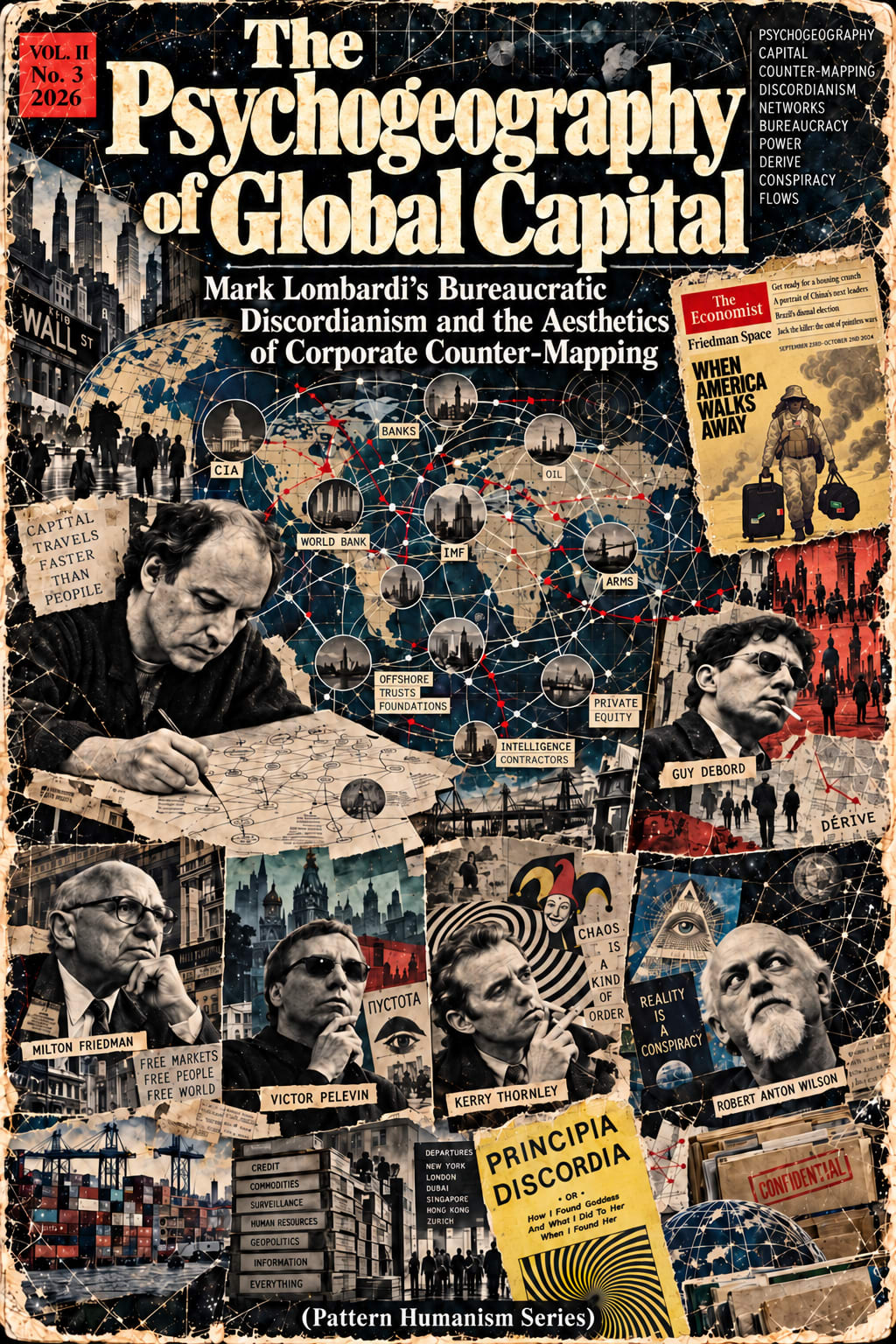
The Psychogeography of Global Capital
Mark Lombardi’s Bureaucratic Dérive, Discordianism and the Aesthetics of Corporate Counter-Mapping (Pattern Humanism Series)

The book "Pattern Humanism: Calibrating the Biological PRM to Trace and Preserve Universal Patterns" is a collection of 46 interconnected philosophical essays exploring the biological origins of cognition, the persistence of informational patterns, artificial intelligence, the constructed Self, and the technologically managed stable decline of modern civilisation.
Ayolov, P. (2026) Pattern Humanism: Calibrating the Biological PRM to Trace and Preserve Universal Patterns. Amazon. ASIN:B0HNL8WH8J
Abstract
Global capital has mastered the art of hiding in plain sight: publish enough documents, and transparency becomes the perfect camouflage. Mark Lombardi drew the connections, Victor Pelevin turned money into a black hole, and the Discordians demonstrated how easily the search for truth can become a cosmic practical joke. The article asks how we can expose the real architecture of power without succumbing to the comforting illusion that every spectacular act of stupidity must be the work of a secret mastermind.
The modern archive does not merely preserve evidence; it disperses relationships across documents whose administrative order can make concentrated power difficult to perceive. This article examines Mark Lombardi’s Narrative Structures as a form of bureaucratic dérive: an investigative passage through public financial records that translates sequential disclosures into spatial constellations. Extending Guy Debord’s psychogeographic method beyond the urban environment, it argues that the drawing becomes a counter-map of institutional proximity without making adjacency itself proof of collusion. The Carlyle Group’s financial networks surrounding September 2001 provide a revealing case through which the distinction between documented association and retrospective suspicion can be examined. Victor Pelevin’s Friedman Space supplies a satirical cosmology of extreme wealth, where financial concentration produces an insulating horizon beyond ordinary social accountability. Kerry Thornley’s Discordian experiments, together with Robert Shea and Robert Anton Wilson’s literary conspiracies, introduce a contrasting problem: the capacity of interpretation to manufacture the very structures it claims to discover. Cinematic representations of paranoia, the suppression of Wilhelm Reich’s publications, and Cass Sunstein and Adrian Vermeule’s proposal for cognitive infiltration illuminate the recursive relationship between institutional intervention and public distrust. Against both administrative opacity and interpretative excess, the article develops a conception of perceptual augmentation grounded in the embodied human observer. Visual composition extends biological capacities to recognise dispersed relationships without substituting aesthetic coherence for historical verification. Lombardi’s practice consequently emerges neither as an omniscient revelation nor as an exercise in conspiratorial imagination, but as an alternative epistemological instrument for investigating the geometries of global capital and recovering independent judgement from the informational labyrinth.
Keywords: Mark Lombardi; Pattern Humanism; Psychogeography; Guy Debord; Victor Pelevin; Friedman Space; Kerry Thornley; Discordianism; Operation Mindfuck; Bureaucratic Dérive; Cognitive Infiltration; Investigative Aesthetics.
Introduction: The Labyrinth of Overexposure: When Everything Is Visible and Nothing Can Be Seen
“The spectacle is not a collection of images, but a social relation among people, mediated by images. The spectacle in general, as the concrete inversion of life, is the autonomous movement of the non-living.”
Guy Debord, 1967, The Society of the Spectacle.
On 11 September 2001, as commercial aircraft struck the World Trade Center and the Pentagon, the Carlyle Group's annual investor conference was taking place at the Ritz-Carlton Hotel in Washington, D.C. Among the participants was Shafiq bin Laden, a representative of a wealthy Saudi family whose construction empire maintained investments in the American private equity industry. Former President George H. W. Bush, who had attended the conference the preceding day, was associated with Carlyle through its advisory network. The chronological distinction matters: their participation in the same gathering does not establish that they occupied the same room during the attacks, much less that either possessed advance knowledge of them. Yet the documented convergence remains intellectually significant. A former director of the Central Intelligence Agency, the relatives of the man subsequently identified as the principal organiser of the attacks, and one of America's most influential investment firms belonged to overlapping circuits of international business. Such relationships were neither intrinsically criminal nor necessarily extraordinary within the concentrated world of transnational finance. Their historical significance arises from the striking discrepancy between the geographical intimacy of economic interests and the antagonistic categories through which subsequent geopolitical events were publicly narrated. Four decades earlier, another improbable conjunction had entered American history. Kerry Wendell Thornley, a young Marine stationed at El Toro, California, had known Lee Harvey Oswald and subsequently written The Idle Warriors, a fictional treatment inspired partly by his acquaintance with the future presidential assassin. The manuscript was completed before John F. Kennedy's death in November 1963. Thornley's proximity to Oswald later attracted investigative attention, particularly during Jim Garrison's controversial inquiry in New Orleans. Neither acquaintance nor literary anticipation established involvement in the assassination. Nevertheless, their conjunction produced a peculiar epistemological disturbance: an ordinary sequence of biographical events acquired an almost impossible appearance once viewed retrospectively through the catastrophe that followed. The Carlyle conference and Thornley's manuscript therefore illuminate the same fundamental difficulty from opposite directions. Historical events do not arrive accompanied by explanations of which relationships will eventually matter. Their significance emerges through subsequent acts of selection, comparison and interpretation. The problem begins when an apparently meaningful configuration is treated either as conclusive evidence of deliberate coordination or dismissed as an irrelevant accident before its constituent relationships have been examined.
The difficulty becomes considerably greater when the material available for examination exceeds the perceptual capacity of any individual observer. Modern institutions produce enormous quantities of documentation: corporate registrations, judicial proceedings, financial disclosures, intelligence assessments, parliamentary investigations, shareholder reports and administrative correspondence. Their proliferation creates an appearance of unprecedented transparency while dispersing potentially consequential relationships among incompatible classifications, specialised vocabularies and disconnected chronological sequences. Concealment need not require a secret chamber or the destruction of evidence; it can arise from the ordinary architecture of informational abundance. The archive becomes a labyrinth whose individual passages are publicly accessible but whose overall configuration remains difficult to reconstruct. This condition should not be confused with proof that every administrative complexity has been deliberately engineered to deceive. Bureaucratic fragmentation can result from legal requirements, institutional specialisation, technological limitations and competing organisational purposes. Its political consequences, however, remain substantial regardless of intention. Mark Lombardi discovered an alternative means of approaching this predicament. Working primarily with publicly available materials, the American artist assembled thousands of handwritten index cards documenting relationships among financiers, corporations, political figures and government agencies. His resulting Narrative Structures abandoned the conventional succession of explanatory prose in favour of elaborate arrangements of names, directional lines and interconnected transactions. These drawings made relationships visible across distances that institutional documents ordinarily maintained. The procedure suggests an unexpected continuation of the Situationist dérive: rather than wandering through urban streets to encounter the concealed organisation of everyday experience, the investigator moves laterally through the administrative geography of economic power. Victor Pelevin's fictional Friedman Space provides a complementary image of wealth as a force that transforms the conditions of perception, while Discordianism exposes the opposite danger of finding intentional design in every coincidence. Between these extremes emerges the central philosophical question of this investigation: how can a finite biological observer recognise genuine structural regularities without surrendering judgement to either official explanations or self-confirming suspicion? The answer requires distinguishing the existence of a connection from its meaning, the recurrence of a configuration from its cause, and the persuasive elegance of a representation from the truth of what it represents. Human perception can be extended through external instruments, but no diagram eliminates the responsibility to verify its underlying evidence. The significance of Lombardi's achievement lies precisely here. His graphite constellations did not abolish uncertainty; they reorganised the conditions under which uncertainty could be investigated. The following analysis examines that transformation through archival wandering, the fictional gravity of accumulated capital, Discordian interventions into public belief, and the recursive manufacture of institutional distrust, before returning to the concrete individual whose capacity to discriminate between material relationships and imagined totalities remains the indispensable condition of historical understanding.
Part I: The Map That Refused to Behave: Mark Lombardi’s Bureaucratic Dérive
“A singular introduction! You will find that it is as good as another.”
Alexandre Dumas, 1844, The Three Musketeers. Quoted by Guy Debord in Theory of the Dérive, 1956.
The Situationist dérive emerged from a radical reconsideration of how environments organise human experience. During the 1950s, Guy Debord and his associates challenged the assumption that urban movement should be governed by predetermined destinations, productive schedules and commercially prescribed itineraries. Their experimental wanderings sought to discover the psychological attractions, invisible boundaries and social divisions embedded within the modern metropolis. Walking without an immediate practical objective was not simply an exercise in randomness; it constituted an investigation into the forces directing everyday behaviour. Streets, neighbourhoods and architectural arrangements became evidence of an underlying organisation that ordinary navigation tended to conceal. Psychogeography consequently treated the city as a dynamic field of attractions and exclusions rather than a neutral container of human activity. The Situationists extended this approach through détournement, the appropriation and transformation of existing cultural materials into instruments of criticism. A familiar advertisement, official illustration or institutional formula could acquire an antagonistic meaning when removed from its authorised context and rearranged within another composition. Although Mark Lombardi never belonged to this movement, his artistic procedure invites a comparable interpretation. His chosen terrain was neither Paris nor the industrial metropolis but the dispersed administrative environment of international finance. Corporate filings, newspaper investigations, banking records and judicial proceedings constituted a peculiar geography whose pathways were determined by bureaucratic classification. A corporation appeared under one heading, its directors under another, its subsidiaries within separate jurisdictions, and its financial transactions across multiple accounting periods. Reading each document in isolation reproduced the fragmentation through which complex organisations ordinarily presented themselves to the public. Lombardi departed from that prescribed itinerary by following names and relationships wherever they led. A banking scandal might open onto an arms transaction, which introduced a political intermediary, whose commercial associations revealed another financial institution. The resulting movement was neither entirely accidental nor predetermined. Like the original dérive, it combined directed curiosity with responsiveness to unexpected encounters. Yet an important distinction remains: Debord investigated the experiential geography of inhabited space, whereas Lombardi reconstructed relationships from documentary traces. The bureaucratic dérive is therefore an interpretative extension of Situationist practice, not a historical technique that Lombardi explicitly claimed to have adopted. Its significance resides in treating the archive as a navigable environment whose conceptual boundaries need not coincide with those established by its custodians.
The material foundation of this undertaking was an extraordinary collection of approximately 14,500 handwritten index cards, accumulated through sustained examination of publicly accessible information. More than 10,000 survive in the Museum of Modern Art Archives, where the preserved arrangement distinguishes companies, individuals and publications through coloured filing categories. These small rectangles formed a manually maintained relational resource, allowing recurring names, transactions and institutional affiliations to be retrieved across otherwise disconnected accounts. Lombardi's experience as a reference librarian contributed to this discipline of extraction, verification and classification, but the decisive transformation occurred when accumulated notes became large-scale drawings. In BCCI-ICIC & FAB, 1972–91 (4th Version), produced between 1996 and 2000, the collapse of the Bank of Credit and Commerce International becomes the organising centre of an expansive composition linking financial organisations, political intermediaries and associated controversies. Across more than eleven feet of paper, delicate graphite trajectories connect abbreviated identities and carefully positioned annotations. Solid and dotted connections distinguish kinds of relationships, while red markings frequently indicate information established through legal proceedings. The drawing does not simply reproduce an institutional chart on a larger surface. Its curves establish spatial rhythms, separating dense concentrations from peripheral associations and allowing the observer to trace different sequences without surrendering the entire configuration. Comparable principles govern George W. Bush, Harken Energy, and Jackson Stephens, where petroleum ventures and commercial intermediaries appear within an interconnected history extending beyond the boundaries of any single enterprise. Such compositions demonstrate an important distinction between recording information and constructing intelligibility. A list enumerates entities; a relational image exposes their possible organisation. Nevertheless, aesthetic proximity must never be mistaken for evidentiary equivalence. A confirmed transfer, a documented directorship and an indirect personal association possess different historical weights, even when represented within the same constellation. Lombardi's achievement depended on maintaining these distinctions while making their intersections available to inspection. His appropriation of the corporate flowchart therefore accomplished a subtle reversal: an instrument normally employed to explain managerial order became a means of examining the dispersed operations of authority. What had appeared as unrelated administrative particulars acquired a shared visual field without necessarily becoming components of a unified conspiracy. The resulting artwork was simultaneously a research apparatus, a formal experiment and a challenge to conventional documentary presentation. Its subversive force originated not in inventing concealed information but in changing the conditions under which existing evidence could be encountered, compared and questioned.
Part II: The Schwarzmann Horizon: Victor Pelevin and the Gravitational Physics of Global Capital
“We desire both to be respectable and to be respected. We dread both to be contemptible and to be contemned.”
Adam Smith, 1759, The Theory of Moral Sentiments.
Victor Pelevin's Friedman Space, first published in 2008, proposes an extraordinary hypothesis disguised as a scientific investigation: money possesses a gravitational property capable of distorting the environment surrounding its greatest concentrations. The familiar observation that wealth attracts additional wealth becomes, in his fictional universe, a literal cosmological principle. Russian oligarchs and operatives of the Federal Security Service investigate a phenomenon in which financial accumulation appears to alter physical reality, producing a separate domain inaccessible to ordinary experience. Beyond a critical threshold lies the Schwarzmann horizon, whose name evokes both the event horizon of astrophysics and the commanding figure of the billionaire financier. This imaginary boundary separates those who participate in everyday economic existence from individuals whose accumulated fortunes have supposedly transported them into another dimension. Pelevin transforms the mathematics of gravity into a grotesque allegory of post-Soviet capitalism, exposing the peculiar metaphysics concealed beneath economic language. Financial power is no longer merely an instrument for purchasing commodities, controlling institutions or influencing political decisions; it becomes a force capable of reorganising the world inhabited by its possessors. The absurdity of the premise reveals something that conventional descriptions of inequality frequently overlook. Extraordinary fortunes do not simply provide greater quantities of ordinary experience. They purchase insulation from circumstances that determine the lives of others: precarious employment, inadequate housing, public transportation, inaccessible healthcare, legal vulnerability and dependence upon institutions whose decisions cannot easily be challenged. The oligarch and the wage earner occupy the same geographical territory while inhabiting profoundly different social environments. Where one encounters restrictions, another discovers negotiable conditions; where one confronts impersonal regulations, another possesses intermediaries capable of reaching their administrators. The gravitational metaphor acquires particular force when applied to the relationship between political authority and concentrated investment. Financial actors need not exercise direct command over governments to influence the circumstances within which public decisions are made. Access to ministers, privileged information, strategic partnerships and extensive advisory structures may produce a field of unequal possibilities long before any identifiable transaction crosses the boundary into corruption. Pelevin's fictional physics therefore expresses an institutional asymmetry rather than a supernatural account of economic causation. His imaginary universe also exposes the seductions of extreme abstraction: the language of markets, liquidity and investment returns can transform decisions affecting concrete lives into apparently autonomous movements of impersonal quantities. Once human consequences disappear from the calculation, accumulated capital begins to resemble a self-sustaining reality whose inhabitants mistake their exceptional circumstances for the natural order of existence.
The Carlyle Group offers a historically grounded setting against which this satirical cosmology can be examined. Established in Washington in 1987, the investment firm developed a distinctive network of former senior politicians, government officials, financial intermediaries and international investors. George H. W. Bush, James Baker, Frank Carlucci and John Major were among the prominent figures associated with its expanding operations. Its business interests included defence manufacturing, energy and other sectors strongly affected by governmental policy. The firm's relationship with Saudi investors, including the Binladin family's reported two-million-dollar investment in one of its funds, attracted intense attention following September 2001. Such commercial connections do not demonstrate participation in terrorist activity; their relevance concerns the institutional proximity between public authority, private accumulation and international strategic interests. The geographical symbolism is striking. Carlyle's Washington headquarters stood along Pennsylvania Avenue, between the White House and the Capitol, while its commercial relationships extended into European political circles and Gulf financial networks. Its practical territory could not be described by drawing a boundary around an office building. It existed through contracts, acquaintances, advisory appointments, investment vehicles and opportunities for access distributed across several continents. This is where Lombardi's visual language provides a useful counterpoint to Pelevin's extravagant fiction. The sweeping trajectories of his graphite compositions make institutional relationships appear as a landscape of intersecting orbits, permitting an observer to recognise forms of proximity that ordinary cartography cannot represent. Yet the analogy between financial influence and gravitational attraction must remain analytical rather than explanatory in itself. A line connecting two directors establishes a relationship, not the magnitude of influence passing between them. Likewise, the presence of former public officials within a commercial organisation raises legitimate questions about conflicts of interest without establishing that every governmental decision favoured their financial associates. The critical distinction is between the architecture of opportunity and the demonstration of particular conduct. Pelevin imagines a horizon beyond which immense fortunes transform reality for their possessors; corporate counter-mapping investigates the earthly mechanisms through which privileged access may acquire practical consequences. The former renders economic separation grotesquely visible through satire, while the latter offers documentary means of testing specific relationships. Together, they challenge the comforting assumption that enormous financial disparities represent nothing more than quantitative differences between otherwise equivalent individuals. The deepest inequality may reside in the capacity to determine which rules remain binding, which encounters become possible and whose interests enter the room before political decisions are formally made.
Part III: Eris in the Filing Cabinet: Discordianism, Lee Harvey Oswald and Operation Mindfuck
“The ORDER is in the GRID. That is the Aneristic Principle.”
Greg Hill and Kerry Wendell Thornley, 1969, Principia Discordia.
The assassination of John F. Kennedy on 22 November 1963 transformed Kerry Wendell Thornley from an obscure American writer into an unwilling participant in one of the twentieth century's most enduring historical controversies. Four years earlier, while serving in the United States Marine Corps at El Toro, California, Thornley had become acquainted with Lee Harvey Oswald, a fellow serviceman whose Marxist sympathies and subsequent defection to the Soviet Union fascinated him. In February 1962, he completed The Idle Warriors, a fictional account of military alienation featuring Johnny Shellburn, a character modelled partly on Oswald. The manuscript preceded the presidential assassination by almost two years, although the real defection had already occurred when Thornley conceived his narrative. This chronological distinction is essential: the author anticipated neither Kennedy's murder nor the extraordinary significance his former acquaintance would subsequently acquire. He had transformed an unusual biographical encounter into literature, only to discover that later events had endowed his invention with an apparently prophetic dimension. Summoned before the Warren Commission in May 1964, Thornley described his impressions of Oswald and subsequently defended the Commission's conclusion in his 1965 book Oswald. His position became considerably more precarious when New Orleans District Attorney Jim Garrison pursued an alternative account of the assassination, investigating possible accomplices, impersonators and clandestine associations. Thornley's previous acquaintance, his literary portrait and his movements through New Orleans acquired new significance within Garrison's investigation. The writer found himself transformed from witness into suspect, confronting interpretations of his own biography that he neither recognised nor controlled. The most disturbing aspect of this episode was not an established conspiracy but the retrospective reconstruction of personal existence according to a predetermined explanatory scheme. Every acquaintance could become an operational contact; an unconventional opinion could appear as ideological camouflage; ordinary geographical coincidence might be reclassified as evidence of clandestine coordination. The interpretative mechanism resembled a detective story whose solution had been selected before its clues were assembled. Yet Thornley could not simply dismiss the investigation as an abstract intellectual error: official suspicion possessed material consequences for his reputation, security and sense of personal autonomy. His later accounts increasingly entertained possibilities of intelligence manipulation and psychological experimentation, but these suspicions cannot independently establish the extraordinary operations he came to imagine. What makes his experience philosophically important is the transformation of an individual life into a contested document, continuously rewritten by competing explanations whose claims to hidden knowledge threatened to overwhelm the original events.
The deeper irony is that Thornley had already helped invent an intellectual game designed to undermine precisely the certainties that would eventually engulf him. Together with Greg Hill, he developed Discordianism, a playful philosophical religion devoted to Eris, the Greek goddess of strife, whose mythical Golden Apple precipitated the quarrel leading towards the Trojan War. Its foundational text, Principia Discordia, transformed sacred scripture into an anarchic assemblage of parody, collage, pseudo-commandments and metaphysical provocations. The Sacred Chao, combining a pentagon with the Apple of Discord, presented order and disorder as complementary products of classification rather than independent descriptions of an ultimately knowable cosmos. Its most consequential proposition concerned the conceptual grid through which observers organise experience: a change in the classificatory framework alters which relationships appear meaningful, threatening or absurd. During the late 1960s, this experimental outlook developed into Operation Mindfuck, a programme of cultural pranks, contradictory rumours, fabricated organisations and deliberate disruptions of established belief. The objective was not to disclose a single concealed authority but to expose the ease with which seemingly authoritative explanations could be manufactured. Robert Anton Wilson and Robert Shea subsequently transformed this atmosphere into The Illuminatus! Trilogy, published in 1975, an extravagant narrative incorporating political assassinations, secret societies, occult traditions and mutually incompatible accounts of world history. Their literary achievement was to construct a fictional environment in which every revelation generated another uncertainty, making conspiratorial explanation simultaneously seductive and ridiculous. The reader experienced the exhilaration of discovering relationships alongside the exhaustion of being unable to determine which connections deserved belief. This deliberate instability introduced an ethical contradiction into the counterculture's assault upon official credibility. If fabricated evidence can demonstrate the fragility of established narratives, it can also contaminate the public sphere with indistinguishable falsehoods. An invented organisation may subsequently acquire believers; a satirical allegation can circulate without its original context; a joke intended to expose credulity may become an indispensable component of somebody else's worldview. Thornley's later difficulties gave this contradiction an intensely personal dimension. The man who participated in dismantling conventional distinctions between appearance and certainty increasingly struggled with suspicions concerning the forces directing his own existence. His trajectory should not be reduced to a clinical diagnosis or presented as evidence that secret agencies controlled his life. It illustrates a more unsettling possibility: relentless suspicion can become a prison even when initially cultivated as an instrument of intellectual emancipation. The essential contrast with Lombardi is consequently methodological. One artistic practice accumulated documentary relationships in pursuit of greater specificity; the other deliberately multiplied incompatible possibilities to undermine confidence in established explanations. Between them lies the danger of confusing a compelling arrangement of signs with a demonstrated account of historical causation.
Part IV: The Ouroboros of Lunacy: When Paranoia Becomes an Institutional Method
“The Party told you to reject the evidence of your eyes and ears. It was their final, most essential command.”
George Orwell, 1949, Nineteen Eighty-Four.
The relationship between personal suspicion and institutional authority acquires its most disturbing expression when the attempt to explain reality becomes indistinguishable from the circumstances producing the original uncertainty. Richard Donner's Conspiracy Theory (1997) dramatises this predicament through Jerry Fletcher, a New York taxi driver whose obsessive interpretations of political events initially appear to be symptoms of pathological distrust. His apartment, saturated with newspapers, surveillance precautions and accumulated fragments of information, becomes a miniature intelligence headquarters assembled without institutional permission. The narrative gradually reveals that some of his fears correspond to genuine clandestine activities, reversing the familiar assumption that eccentric behaviour necessarily invalidates the observer's conclusions. Yet this cinematic vindication constitutes a narrative convention rather than a general epistemological principle: the discovery of one genuine deception cannot retrospectively authenticate every suspicion surrounding it. Joel and Ethan Coen explore the opposite possibility in A Serious Man (2009). Arthur Gopnik, an unemployed mathematical prodigy living with his brother, constructs the Mentaculus, an elaborate handwritten probability map of the universe whose apparent ambition exceeds any practical human calculation. His obsessive project offers a grotesque counterpart to his brother Larry's professional physics, contrasting the scientific management of uncertainty with the fantasy of its complete elimination. Arthur's legal difficulties and encounters with authorities belong to the film's wider atmosphere of inexplicable misfortune, without establishing that his mathematical notebook contains forbidden knowledge. Both fictional characters nevertheless expose a fundamental vulnerability: the individual attempting to discover an encompassing order may become increasingly incapable of distinguishing the limitations of his understanding from external interference. Wilhelm Reich's confrontation with American regulatory authority supplies a historical counterpoint. Following proceedings initiated by the Food and Drug Administration, a federal injunction in 1954 restricted the interstate distribution of his orgone accumulators and associated promotional materials. Subsequent enforcement resulted in the destruction of equipment and large quantities of publications, including book burnings supervised by federal officials in 1956. These events demonstrate an unusually severe intervention against the circulation of a contested scientific doctrine. They do not, however, establish the existence of the energy Reich claimed to have discovered. The suppression of an idea and its empirical validity remain independent questions. What the episode illustrates is the extraordinary symbolic consequence of governmental destruction: an administrative action intended to eliminate disputed claims can instead transform their author into a figure of persecuted knowledge, generating a mythology more durable than the materials originally condemned.
This paradox enters a different political register in Cass Sunstein and Adrian Vermeule's 2009 examination of conspiratorial belief. Their controversial proposal for cognitive infiltration suggested that governmental representatives or allied participants might enter communities organised around extreme explanatory theories and introduce competing information intended to weaken their closed intellectual environments. Presented as a possible response to social polarisation and potentially dangerous falsehoods, the argument nevertheless exposes an unresolved contradiction within the proposed remedy. An undisclosed official participant who challenges suspicions of institutional manipulation risks confirming the very possibility of covert interference upon which those suspicions depend. Even when the intervention seeks to introduce accurate evidence rather than fabricate disinformation, its concealed sponsorship may undermine the credibility of that evidence once discovered. The distinction between proposing such activity and demonstrating its actual implementation is indispensable; the publication of a policy recommendation cannot establish the existence of an operational programme. Nevertheless, the theoretical consequences extend beyond the authors' immediate objectives. Institutional efforts to manage public interpretation may unintentionally reproduce the mechanisms through which distrust perpetuates itself. A government describes an allegation as irrational; its critics interpret the dismissal as protection of undisclosed interests; additional official responses appear to validate their suspicions; and increasingly elaborate explanations make subsequent correction more difficult. This recursive mechanism constitutes the Ouroboros of Lunacy: a cycle in which competing attempts to eliminate uncertainty continually manufacture fresh reasons for doubt. Its destructive force does not require an omnipotent directing intelligence. Fragmented administrations, defensive reputations, procedural errors and poorly conceived public communications can generate consequences resembling purposeful manipulation without originating in a coherent plan. Conversely, the existence of genuine state misconduct cannot justify abandoning the distinction between documented abuse and speculative accusation. The epistemological catastrophe occurs when every contradiction becomes supporting evidence, every absence of confirmation signifies successful concealment, and every denial is interpreted as proof of guilt. Under these conditions, investigation ceases to possess a conceivable point of resolution. The central danger is therefore not suspicion itself, which remains indispensable to democratic scrutiny, but the transformation of distrust into an interpretative system immune to correction. Political authority and its opponents may then become mutually dependent producers of the same disorder, sustaining an escalating contest in which institutional legitimacy deteriorates while factual discrimination becomes progressively more difficult.
Part V: The Concrete Man Against the Invisible Library: Pattern Humanism and the Future of Counter-Mapping
“Information is information, not matter or energy. No materialism which does not admit this can survive at the present day.”
Norbert Wiener, 1948, Cybernetics: Or Control and Communication in the Animal and the Machine.
The philosophical significance of Mark Lombardi's drawings extends beyond their capacity to expose financial relationships. They illuminate a fundamental asymmetry between the complexity of institutional organisation and the perceptual limitations of the individual attempting to understand it. The human nervous system evolved to identify meaningful regularities within a finite environment, responding to movement, proximity, recurrence, spatial orientation and changes in observable circumstances. Modern administrative systems, by contrast, operate through abstractions that frequently exceed the scale of direct experience. A transnational corporation possesses no single location corresponding to its effective reach; an investment fund distributes its activities among legally differentiated entities; an intelligence organisation divides operations into compartments whose participants may possess only partial knowledge of their collective consequences. The resulting structures are real in their effects while remaining inaccessible as unified objects of perception. This discrepancy provides the starting point for understanding the biological Pattern Recognition Model as a finite, embodied observer rather than an omniscient processor of information. The senses establish contact with the surrounding world, while memory, language and acquired classifications organise the resulting impressions into intelligible relationships. Every additional representation introduces both an opportunity for discovery and a possibility of distortion. The Identity Industrial Complex develops this predicament at the level of personal existence: administrative classifications replace the multidimensional individual with identities convenient for recognition, measurement and institutional management. An employee becomes a personnel record, a citizen a statistical unit, a borrower a credit profile and a political actor a position within an organisational hierarchy. These transformations facilitate large-scale coordination but cannot exhaust the existence of the people they represent. The concrete body remains the site where decisions become material consequences, whether through labour, deprivation, physical danger or the expenditure of finite time. Lombardi's visual compositions reverse part of this process by returning institutional relationships to a format accessible to embodied cognition. His sheets allow the eye to follow trajectories, recognise concentrations and compare distant arrangements without repeatedly reconstructing a sequence of textual descriptions. Such perceptual augmentation does not confer supernatural insight or bypass the need for historical investigation. It modifies the conditions under which evidence can be examined. The distinction is decisive: a diagram can disclose the organisation of documented connections, but the observer must still determine their significance through chronology, provenance, legal context and independently established facts. The drawing consequently operates as an external cognitive instrument rather than a substitute for judgement. Its material existence also interrupts the continual disappearance of information into successive administrative updates, preserving a configuration that can be revisited, contested and revised.
The contemporary extension of this method introduces possibilities that Lombardi could scarcely have anticipated, alongside dangers more difficult to recognise than those posed by conventional secrecy. Forensic Architecture reconstructs contested events through spatial modelling, satellite imagery, architectural analysis and synchronised audiovisual evidence, allowing dispersed traces to be compared within shared environments. Trevor Paglen examines the material and perceptual infrastructures of surveillance, revealing how technical systems organise visibility while escaping ordinary public attention. Josh On's They Rule translates interlocking corporate directorships into navigable diagrams, demonstrating how apparently independent enterprises may share influential personnel. These practices approach the problem through different artistic and investigative procedures, but they establish a common principle: the significance of information depends partly upon the form through which relationships become apprehensible. Contemporary computational systems can examine millions of records, identify recurring entities and produce intricate visual arrangements at speeds unavailable to manual archival research. Artificial intelligence extends these capabilities through semantic comparison, automated extraction and the detection of statistical associations distributed across heterogeneous sources. Yet increased computational capacity introduces an additional layer of mediation. Training datasets contain omissions, institutional priorities and historical inequalities; entity-resolution procedures may confuse individuals sharing similar names; visualisation algorithms can exaggerate proximity by privileging particular measures of centrality. A convincing synthetic diagram may therefore acquire an authority unsupported by its underlying materials. More fundamentally, automated systems can generate plausible connections whose evidentiary origins remain inaccessible to the people expected to accept their conclusions. The Invisible Library emerges at precisely this threshold: an apparently comprehensive repository whose internal procedures become increasingly difficult to inspect, leaving the investigator dependent upon outputs rather than recoverable documents. The future of counter-mapping cannot consequently be defined by computational expansion alone. Its emancipatory potential depends upon preserving traceable sources, distinguishing confirmed relationships from probabilistic associations, exposing omissions and allowing competing interpretations to remain visible. The opposition is not between biological intelligence and machines, since external instruments have always extended human understanding. It is between procedures that enlarge independent verification and infrastructures that demand acceptance without meaningful examination. The fragile pencil line becomes philosophically important for this reason. It remains a visible decision made by an identifiable person, open to scrutiny and correction. Technological sophistication should deepen that accountability rather than dissolve it. The ultimate measure of investigative progress is not the quantity of associations produced but the capacity of a living observer to confront their consequences, challenge their construction and recover an informed relationship with the world beyond the diagram.
Conclusion: Shattering the Mirage of Coincidence: The Geometry of Truth and the Limits of the Map
“The world is all that is the case. The world is the totality of facts, not of things.”
Ludwig Wittgenstein, 1921, Tractatus Logico-Philosophicus.
The most consequential feature of modern power may not be its capacity to conceal individual facts but its ability to distribute their significance across organisations, jurisdictions and incompatible systems of description. A financial transaction becomes intelligible through its participants, a political appointment through its surrounding interests, and a historical coincidence through the circumstances that render it consequential. No isolated document necessarily contains the configuration that emerges when these elements are examined together. Mark Lombardi recognised this problem as an artistic opportunity, transforming administrative fragments into compositions whose intellectual force originated from the relationships between their constituent details. His achievement becomes particularly revealing when juxtaposed with Victor Pelevin's fictional gravitational universe and Kerry Thornley's experiments in organised uncertainty. Each approaches the instability of appearances from a different direction. The first reconstructs connections through documentary investigation; the second exaggerates the insulating privileges of immense wealth until economic inequality assumes the dimensions of an alternative physical reality; the third deliberately destabilises authoritative explanations through parody, invented mysteries and competing narratives. Together, they expose the inadequacy of a familiar opposition between conspiratorial imagination and institutional rationality. Official accounts may be incomplete without being intentionally deceptive, while apparently extraordinary coincidences may deserve investigation without demonstrating criminal coordination. The encounter between the Carlyle Group's international relationships and the catastrophe of September 2001 illustrates the importance of maintaining these distinctions. Likewise, Thornley's acquaintance with Oswald and his subsequent treatment by investigators demonstrate how retrospective knowledge can transform ordinary biographical circumstances into seemingly prearranged historical clues. Neither example permits the investigator to replace evidentiary reasoning with aesthetic astonishment. Yet refusing premature conclusions does not require abandoning inquiry into the organisation of influence. What matters is the disciplined progression from an observable association to an explanatory hypothesis, followed by an assessment of whether independently established facts support the proposed connection. The danger begins when these stages collapse into one another. A visually compelling arrangement can encourage the illusion that identifying a relationship is equivalent to understanding its purpose. Conversely, excessive confidence in institutional classification may prevent consequential questions from being formulated at all. Between credulity and dismissal lies a more demanding practice: reconstructing the circumstances that make particular configurations possible while accepting that some apparent correspondences possess no deeper common cause.
The implications extend beyond the interpretation of past scandals into the changing conditions of human knowledge. As informational systems become more comprehensive, the individual increasingly encounters representations whose production cannot be personally reconstructed. Automated classifications, predictive models and synthetic accounts promise unprecedented analytical reach, yet the growing distance between source material and finished explanation introduces new opportunities for error, selective emphasis and misplaced authority. The central problem is therefore not simply whether computational instruments can identify more connections than their biological users. They undoubtedly can. The question is whether those discoveries remain accessible to independent examination, correction and meaningful experience. An elaborate diagram may exhibit perfect internal coherence while misrepresenting the world from which its components were extracted. Mathematical elegance cannot authenticate a false premise, just as the repetition of an accusation cannot convert speculation into historical evidence. This distinction returns philosophy to the finite observer whose encounter with reality precedes its conversion into administrative categories. The concrete individual does not possess unlimited comprehension, an immaculate memory or immunity from interpretative error. Perception is selective, reasoning provisional and every investigation constrained by the available materials. These limitations, however, provide grounds for disciplined verification rather than surrender to inaccessible authorities. The physical archive, the hand-drawn constellation and the transparent computational model acquire their greatest value when they permit the observer to return from abstraction to identifiable events, decisions and consequences. They should enlarge the possibility of understanding without claiming to exhaust the complexity of existence. Ultimately, the revolutionary potential of counter-mapping lies less in exposing an imagined universal conspiracy than in restoring the capacity to question how apparently separate arrangements participate in shared structures of authority. The map must remain open to revision because the world is not obligated to conform to the geometry imposed upon it. Discordianism reminds us how readily intelligence can become intoxicated with its own inventions; investigative aesthetics demonstrates that visual invention can also make neglected evidence perceptible. Neither provides an escape from uncertainty. Their productive confrontation offers something more valuable: an account of knowledge in which imagination discovers possible relationships, documentation tests their validity, and embodied judgement determines what can responsibly be concluded. The objective is not to eliminate coincidence from history but to prevent coincidence from becoming either the universal explanation of power or the universal excuse for refusing to examine it.
References
Ayolov, P. (2026a) Identity Industrial Complex: The Political Economy of the Human Image. Independently published.
Ayolov, P. (2026b) Pattern Humanism, Calibrating the Biological PRM to Trace and Preserve Universal Patterns. Sofia: Sofia University “St. Kliment Ohridski”.
Coen, J. and Coen, E. (2009) A Serious Man. Film. Universal City, CA: Focus Features.
Debord, G. (1956) ‘Théorie de la dérive’, Les Lèvres Nues, 9.
Debord, G. (1967) La société du spectacle. Paris: Buchet-Chastel.
Debord, G. and Wolman, G.J. (1956) ‘Mode d’emploi du détournement’, Les Lèvres Nues, 8.
Donner, R. (1997) Conspiracy Theory. Film. Burbank, CA: Warner Bros.
Hill, G. and Thornley, K.W. (1991) Principia Discordia: Or, How I Found Goddess and What I Did to Her When I Found Her. 5th edn. Avondale Estates, GA: IllumiNet Press.
Lombardi, M. (1996–2000) BCCI-ICIC & FAB, 1972–91 (4th Version). Graphite and coloured pencil on paper. New York: Whitney Museum of American Art.
Lombardi, M. (1998) George W. Bush, Harken Energy, and Jackson Stephens, c. 1979–91 (4th Version). Drawing.
Museum of Modern Art Archives (2025) Mark Lombardi Card Archive, 1990–2000. Finding aid prepared by R. Garbade. New York: Museum of Modern Art.
Paglen, T. (2009) Blank Spots on the Map: The Dark Geography of the Pentagon’s Secret World. New York: Dutton.
Pelevin, V. (2008) ‘Пространство Фридмана’ [Friedman Space], in П5: Прощальные песни политических пигмеев Пиндостана. Moscow: Eksmo, pp. 211–230.
Sharaf, M.R. (1983) Fury on Earth: A Biography of Wilhelm Reich. New York: St Martin’s Press.
Shea, R. and Wilson, R.A. (1975) The Illuminatus! Trilogy. New York: Dell.
Sunstein, C.R. and Vermeule, A. (2009) ‘Conspiracy theories: Causes and cures’, The Journal of Political Philosophy, 17(2), pp. 202–227.
Thornley, K.W. (1965) Oswald. Chicago: New Classics House.
Thornley, K.W. (1991) The Idle Warriors. Avondale Estates, GA: IllumiNet Press. Manuscript completed in 1962.
Weizman, E. (2017) Forensic Architecture: Violence at the Threshold of Detectability. New York: Zone Books.
Wiener, N. (1948) Cybernetics: Or Control and Communication in the Animal and the Machine. New York: John Wiley & Sons.
Wilson, R.A. (1977) Cosmic Trigger: The Final Secret of the Illuminati. Berkeley, CA: And/Or Press.
About the Creator
Peter Ayolov
Peter Ayolov’s key contribution to media theory is the development of the "Propaganda 2.0" or the "manufacture of dissent" model, which he details in his 2024 book, The Economic Policy of Online Media: Manufacture of Dissent.
Enjoyed the story? Support the Creator.
Subscribe for free to receive all their stories in your feed.
Comments
There are no comments for this story
Be the first to respond and start the conversation.