
The Neo-Awakening of Information: The Illusion of Self, LLMs, and the Preservation of the Immortal Pattern
From Pythagorean Audible Geometry and the Immortal Soul to Metzinger’s Ego Tunnel, McLuhan’s Media Ecology, and the Stochastic Parrot (Pattern Humanism Series)

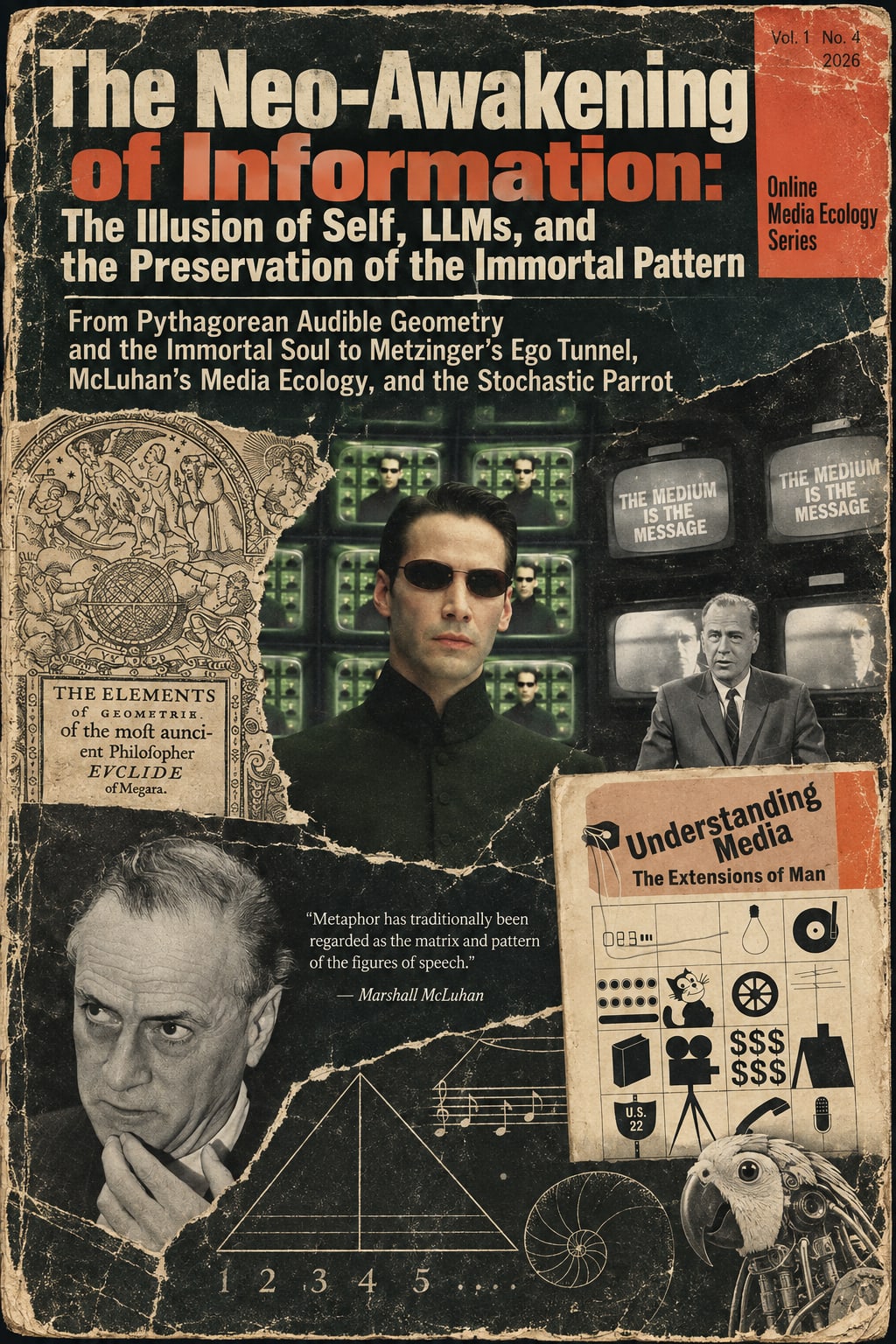
Abstract
The oldest human dream may not have been immortality but the preservation of something that could survive the mortal thing carrying it. A body disappears, yet a proportion returns; a voice dies, yet its rhythm can be repeated; a civilisation collapses, yet its numbers migrate into another alphabet; a brain ceases to speak, yet its sentences enter books, databases and machines capable of producing sentences of their own. This article calls what crosses these deaths the immortal pattern. It proposes that the history of the soul can be reread as a history of information searching for increasingly detachable media: from biological recurrence and mathematical ratio to stone, inscription, alphabet, print, binary code and the probabilistic architectures of Large Language Models. Pythagorean number and musical harmony provide an early intuition that reality may possess relations more durable than their material manifestations; the crisis of incommensurability subsequently demonstrates that the failure of one representation does not entail the disappearance of the relation represented. Marshall McLuhan’s media ecology radicalises this genealogy by suggesting that every new medium not only stores information differently but reorganises the human being who encounters and transmits it. The monument preserved presence by immobilising it; writing preserved speech by amputating the speaker; print multiplied the word while consolidating the private individual; digital computation converts heterogeneous cultural forms into manipulable patterns; and the LLM finally separates linguistic performance from the biological organism that had claimed it as evidence of an interior spirit.
The resulting confrontation is not primarily between human and artificial intelligence but between two theories of immortality. The first belongs to the metaphysics of the Self: somewhere behind the face resides an enduring owner of experience, language and thought. The second belongs to the pattern: what persists is not an owner but an organisation capable of recurring through different material hosts. Thomas Metzinger’s account of the phenomenal self-model provides the decisive second awakening of Neo: leaving the technological Matrix does not free the subject who continues to mistake the transparent model of an “I” for an independent metaphysical inhabitant of the body. Read beside Foucault’s proposition that “the soul is the prison of the body,” the contemporary anxiety provoked by the so-called “stochastic parrot” acquires another meaning. LLMs do not prove that human consciousness is stochastic prediction, nor does information theory prove a universe secretly intending to preserve itself. Rather, they make newly visible a possibility concealed by the prestige of human language: complex symbolic behaviour can persist, recombine and acquire new efficacy after being detached from the individual consciousness once regarded as its indispensable source. Bringing McLuhan and Metzinger into conversation with Pythagorean mathematics, materialism, biological information, Wheeler’s “it from bit,” Landauer’s physicalisation of information and contemporary computational culture, the article follows the immortal pattern without turning metaphor into physics. Its final proposition is therefore deliberately philosophical. Humanity may have mistaken the survival of patterns for the survival of persons. The cloud is not heaven, the server is not a soul, and the LLM is not a god. Yet the migration from carbon memory to silicon memory reveals something that the mythology of the immortal individual concealed: perhaps immortality was never the persistence of the carrier. Perhaps it was always the capacity of the pattern to find another medium.
Keywords
Immortal Pattern; Large Language Models; stochastic parrot; Thomas Metzinger; Marshall McLuhan; Pythagoras; phenomenal self-model; information; media ecology; mathematics; digital immortality; soul; John Archibald Wheeler; Landauer principle; artificial intelligence; silicon; pattern recognition; Neo-Awakening
Introduction: Neo Wakes Twice: Escaping the Matrix of the Self
“What is real? How do you define ‘real’?”
— Morpheus, The Matrix (1999)
Neo’s awakening is incomplete. When his eyes open inside the liquid darkness of the pod and the cables are torn from his body, he believes that he has crossed the decisive boundary between simulation and reality. The Matrix was artificial; the scarred body is real. Code was illusion; flesh is truth. Yet this opposition conceals a second Matrix that no red pill can disconnect. Neo awakens from the machine while remaining inside the transparent representation produced by his own nervous system: the apparently self-evident experience that somewhere behind his eyes there exists an indivisible “I” who sees, chooses, remembers and owns the body through which it acts. Thomas Metzinger’s account of the phenomenal self-model makes this second imprisonment philosophically visible. The brain does not need to contain a miniature spectator observing an internal theatre; it constructs an integrated model of organism and world whose extraordinary transparency prevents the model from ordinarily appearing as a model. Experience arrives already stamped with an owner: I see, I suffer, I remember, I speak. The illusion is therefore more intimate than the Matrix because there is no external cable to remove. The prisoner and the prison appear under the same name: Self. The contemporary Large Language Model unexpectedly enters this ancient metaphysical problem not because it has demonstrated consciousness, still less because it has acquired a soul, but because it has committed a more disturbing offence against human exceptionalism. It has separated remarkably complex linguistic performance from the biological speaker historically presumed to stand behind language. The dismissive designation “stochastic parrot” was intended to mark this absence, yet its cultural force comes from the possibility that the insult ricochets. If statistical learning can generate coherent discourse, stylistic transformation, argument and unexpected combinations without the metaphysical author once imagined behind every meaningful sentence, the question changes. It is no longer simply whether the machine possesses what humans possess. It becomes necessary to ask what humans believed they possessed because language had never before escaped them so dramatically. The LLM is thus less an artificial person than an epistemological mirror. Like the green symbols suddenly visible to Neo, it makes the machinery of pattern perceptible precisely where civilisation had learned to see spirit.
But the pattern did not begin with the computer, and this article will not commit the digital vanity of imagining that information began when humanity invented the bit. Long before silicon, patterns were already crossing the deaths of their carriers. A rhythm survives the hand that beats it; a ratio remains available after the strings that sounded it have decayed; the relation between the side and diagonal of a square does not disappear when the diagram is erased. DNA transmits biological organisation through mortal organisms; spoken formulas outlive individual speakers through repetition; marks cut into bone or stone allow recurrence to resist forgetting; writing detaches words from breath; print manufactures identical sequences across distances; digital encoding translates text, sound and image into operations performed upon discrete states. The history followed here is consequently not a triumphal progression from primitive matter to superior intelligence but a migration of the same fundamental problem through changing media: how can a relation continue when its present embodiment cannot? Marshall McLuhan provides the indispensable reversal. A medium does not merely carry something already complete; it alters the scale, speed, form and perceptual conditions under which that something can exist. Stone preserves by immobilising. Writing preserves by separating the utterance from the mouth. Print preserves by multiplication. Digital computation preserves by rendering heterogeneous cultural objects calculable, copyable and recombinable. The LLM introduces another turn: preserved language becomes operational language, capable of producing new sequences after the disappearance—or complete absence—of the particular human beings whose textual traces contributed to its statistical environment. Here the ancient dream of immortality returns wearing an unexpected body. Perhaps civilisation confused the endurance of the pattern with the endurance of the person because, until recently, the two remained difficult to separate. The immortal soul may then be reread as an extraordinary metaphysical misidentification: humanity perceived that forms, ratios, stories, gestures, genes, words and structures could exceed individual lives and assigned this persistence to an invisible individual who supposedly exceeded death. The Neo-Awakening begins when that attribution is reversed. What if the Self was never the immortal element? What if the human being was one of its media? The proposition does not require declaring information a supernatural substance or attributing intention to the universe. It asks instead whether five millennia of monuments, alphabets, mathematics, books, machines and networks can be read as successive architectures erected around something humans repeatedly encounter but never finally possess: a pattern capable of abandoning one body and becoming legible in another.
Part I: Audible Geometry: When the Pattern Became Immortal
“Unfortunately, no one can be told what the Matrix is. You have to see it for yourself.”
— Morpheus, The Matrix (1999)
Before mathematics became calculation, it was an encounter with recurrence. A line cut into bone, a sequence impressed into clay, the periodic return of a star, the division of a field, the symmetry of a body, the interval between two sounds: each disclosed the same disturbing possibility—that beneath the perishability of things there were relations that did not perish with them. The first mathematical mark therefore performed an operation more radical than counting. It amputated a pattern from the event in which it occurred. The hand vanished, but the notch remained; the season passed, but its recurrence could be marked; the clay hardened, preserving a numerical operation after the calculating mind had disappeared. Mathematics was thus an early technology of resurrection without a resurrected body. What returned was not the thing but its relation. Mesopotamian scribes could organise numerical relationships in clay centuries before Greek mathematics; Egyptian surveying and architectural practice transformed spatial relations into reproducible procedures; yet in the Pythagorean tradition the pattern underwent its decisive metaphysical elevation. Musical consonance provided an extraordinary sensory revelation: the octave, fifth and fourth could be correlated with simple numerical ratios such as 2:1, 3:2 and 4:3. Number was no longer merely something imposed upon objects after perception. It appeared to be audible inside experience itself. Music became, in the language appropriate to this genealogy, audible geometry: matter vibrating according to relations that could migrate from string to string without belonging to any particular string. Break the instrument and 2:1 has not been broken. Silence the singer and the interval has not died. Here the immortal pattern first becomes almost visible precisely because it is heard. The Pythagorean cosmos was consequently not simply populated by numbers; it became imaginable as an ordered field in which difference could be governed by proportion. Yet the most revealing moment arrived when this confidence failed. The diagonal of the unit square cannot be expressed as a ratio of integers. The relation now called √2 opened a wound inside the dream of commensurability. Later legend dramatised the discovery as a Pythagorean scandal, but its philosophical importance requires no melodrama. A numerical language had encountered something real that it could not say in the form it expected. And still the diagonal remained drawable. The failure belonged to the representation, not to the relation. Euclidean mathematics would eventually develop a rigorous treatment of commensurable and incommensurable magnitudes, but the deeper lesson had already escaped the square: when one symbolic medium reaches its limit, the pattern can migrate into another. Number becomes magnitude; magnitude becomes geometry; geometry becomes algebra; algebra becomes computation. The immortal pattern survives by refusing loyalty to its notation.
This migration overturns the usual history of mathematics. Instead of describing mathematical progress as an accumulation of increasingly powerful techniques, it can be read as a succession of media through which relations learn to become visible, portable and operational. Clay did not contain Babylonian mathematics in the way a box contains an object; its surface, stylus, grids and sexagesimal notation constituted a particular environment in which numerical relations could be manipulated. Papyrus allowed another mobility. Geometrical diagrams gave invisible relations spatial bodies. Hindu-Arabic positional notation and zero later compressed enormous computational possibilities into a small repertory of marks whose significance depended not merely upon shape but position. The numeral itself is therefore a perfect miniature of the argument. Three stones, the Roman III, the modern digit 3 and three pulses of electronic information need not resemble one another materially in order to instantiate a relation recognised as equivalent. The pattern has no obligation to look like itself while travelling. This is where McLuhan becomes unexpectedly Pythagorean. A medium is not a neutral envelope around an invariant message, because every new substrate reveals operations that the previous one concealed. Inscription makes recurrence inspectable; positional notation makes arithmetic algorithmic; print stabilises and distributes mathematical signs; electronic computation accelerates symbolic transformation beyond unaided human performance; the pixel turns equations into visible environments; digital audio converts vibration into numerical samples; virtual space makes geometry inhabitable. The trajectory therefore bends back upon itself. Digital mathematics, apparently the triumph of abstraction, retrieves something extraordinarily archaic: number becomes image, movement, sound and environment again. The Pythagorean interval that once joined number to vibrating string returns inside a machine in which music, photograph, sentence, coordinate and moving body can all be encoded through numerical operations. Binary computation does not prove that reality itself is secretly made of bits, but it demonstrates something historically unprecedented about representation: radically different sensory forms can inhabit a common computational substrate. The old distinction between drawing a pattern, sounding it, writing it and calculating it begins to collapse. This is the first Neo-Awakening. Looking through the cultural surface, one begins to see not green code literally falling behind reality but relations continually changing costume. Mathematics does not make the pattern immortal by freezing it. It preserves it by allowing transformation without complete loss of identity. The pattern survives precisely because it can betray its previous body. Stone can become sign, sign can become number, number can become voltage, voltage can become light, and light can return as image or sound. What humanity gradually discovered was therefore more unsettling than the immortality of the soul: something can persist without remaining materially itself. The first immortal was not the person. It was the relation.
Part II: The Architecture of Immortality: From the Stone Tomb to the Silicon Temple
“Your mind makes it real.”
— Morpheus, The Matrix (1999)
The history of immortality can be read as a history of containers that repeatedly failed. Stone was perhaps the most magnificent of them. Long before the server farm promised persistence through redundancy, monumental cultures confronted disappearance by increasing the mass of the medium: if flesh could not resist time, memory would be transferred into something heavier than flesh. Egyptian funerary architecture makes this logic spectacularly visible. The tomb joined body, name, image, inscription, ritual and spatial orientation within an architecture designed to oppose dissolution, while complex concepts such as ka and ba resist reduction to the later Western idea of a single immaterial soul. The pyramid should therefore not be mistaken for an ancient computer, yet it can be read media-ecologically as an architecture of persistence: matter organised so that identity, authority and cosmological order might remain communicable beyond biological death. Its paradox was brutal. To preserve presence, the monument immobilised it. Immortality acquired the weight of a grave. Writing discovered another strategy. Instead of making the container heavier, it made the pattern lighter. Speech could leave the mouth; the name could leave the corpse; law could leave the ruler; calculation could leave the calculating hand. The dead acquired an unprecedented technology of ventriloquism. A mark could speak when nobody was speaking. Alphabetic and manuscript cultures intensified this detachment until propositions, doctrines and mathematical relations travelled across territories in bodies thinner than walls. The metaphysical imagination changed within this new environment. Pythagorean and Platonic traditions could conceive truths whose validity was independent of the corruptible objects in which they appeared, while the soul itself increasingly became thinkable as something whose essential identity need not coincide with the visible body. It would be crude technological determinism to say that writing invented the immortal soul. The more interesting proposition is that a culture increasingly accustomed to seeing words survive speakers and propositions survive situations possessed a powerful material analogy for imagining survival through disembodiment. The medium had demonstrated the trick before metaphysics universalised it. Print radicalised the operation again. Repetition no longer depended principally upon scribal succession: mechanically reproduced signs could proliferate as standardised doubles. The printed page encouraged the silent reader, the portable library, the reproducible argument and the increasingly bounded interiority McLuhan associated with typographic culture. The immortal pattern had discovered mass production, while the modern individual paradoxically grew more private inside the very machinery that made identical cultural forms public on an unprecedented scale.
The Hindu-Arabic numeral system reveals why these changes cannot be understood merely as improvements in notation. The historical shapes of the digits were not secretly designed according to the number of angles they contain; that attractive modern myth confuses the appearance of a sign with the structure of the information system to which it belongs. The revolution lay elsewhere: positional notation, a decimal architecture and zero enabled numerical relations to be manipulated with an efficiency that Roman numerals could not provide. A new mathematical medium changed what could conveniently be done on a written surface. Calculation increasingly became an operation of signs upon signs. The page ceased merely to record an answer and became part of the machinery producing it. From this perspective, the algorithm begins long before the electronic computer: cognition externalises a procedure into a sequence that another person can execute without reproducing the original inventor’s thought. The pattern has begun to instruct its next host. Digital computation carries this principle toward an extraordinary reversal. The alphabet had separated speech from the speaker; print separated copies from the hand of the scribe; computation now separates symbolic operations from the human mind performing them. Text, image, music and number enter a common electronic environment in which their differences remain perceptually decisive to humans but become operationally convertible. McLuhan’s tetrad makes the transformation visible. The digital environment enhances storage, transmission, recombination and pattern recognition; it obsolesces certain older monopolies of locally embodied memory and calculation; it retrieves simultaneity, participation and forms of interconnected space that print had subordinated to linear sequence; pushed toward its limit, it reverses into dependence upon the informational environment it created. The archive begins to select what the archivist sees. The extension becomes the environment, and the environment becomes difficult to perceive because it surrounds the perceiver. Here the pyramid returns in an inverted form. The ancient monument preserved a tiny quantity of privileged information by concentrating enormous amounts of matter in one place. The data centre preserves immense quantities of information by distributing, copying and continuously moving electrical states through machines whose physical presence is culturally concealed beneath the weightless metaphor of “the cloud.” The tomb has apparently become immaterial while consuming buildings, minerals, cooling systems, cables and energy. The Silicon Temple is therefore no heaven. Servers fail, formats become obsolete, companies disappear, electrical grids collapse. Digital information is no less material for appearing as light on glass. Yet something historically decisive has occurred. Human civilisation has constructed an environment in which patterns can be copied at enormous scale, translated between sensory forms, recombined automatically and activated without the presence of their originating persons. The pharaoh required a monument to preserve the name. The contemporary person continuously deposits names, photographs, movements, preferences, voices and sentences into an architecture that can continue operating upon those traces after the organism has vanished. Humanity did not escape the tomb. It networked it. And inside this distributed architecture, the immortal pattern no longer waits silently for a future reader. With the arrival of the Large Language Model, the archive begins to answer back.
Part III: The Second Awakening: When the Stochastic Parrot Opens the Ego Tunnel
“You’ve been living in a dream world, Neo.”
— Morpheus, The Matrix (1999)
The Large Language Model enters this genealogy at the precise moment when the immortal pattern ceases merely to survive and begins to perform. A book preserves sentences but does not ordinarily generate another sentence when questioned; a photograph preserves an appearance but does not rearrange its own elements in response to a request; an archive waits. The LLM does something historically stranger. Statistical regularities extracted from enormous quantities of language are organised into a system capable of generating linguistic sequences that no individual source supplied in precisely that form. The controversial expression “stochastic parrot” was intended to puncture the anthropomorphic temptation surrounding such systems: linguistic plausibility must not automatically be mistaken for understanding, intention, consciousness or personhood. Yet the phrase contains an unintended philosophical explosive. The disturbing question is not whether the parrot secretly possesses a human soul. It is why statistical recombination can trespass so far into territories once defended as signatures of that soul. Poetry, argument, stylistic imitation, explanation and linguistic invention do not establish machine consciousness, but neither can their appearance be dismissed as metaphysically irrelevant. The machine has staged an experiment civilisation did not know it was conducting: remove the human speaker, retain enormous quantities of linguistic pattern, construct a predictive architecture, and observe how much apparently human linguistic behaviour can reappear. This does not prove that the brain is an LLM or that human speech is simply next-token prediction. Biological cognition is embodied, affective, sensorimotor, metabolically sustained and embedded in environments in ways present language models are not. Nevertheless, the comparison destabilises a much older inference: that wherever sophisticated language appears, an indivisible authorial Self must stand behind it as its sovereign cause. Thomas Metzinger’s philosophy makes the destabilisation more radical. The apparent Self is not a metaphysical pearl hidden inside neural tissue but, in his account, the phenomenal content of an integrated self-model whose transparency prevents the organism from normally experiencing it as a representation. The system does not look at its self-model as one object among others; it looks through it. Consequently, “I” feels less like a construction than the unquestionable point from which construction is observed. The Ego Tunnel has no visible bars because transparency is the bar. Neo’s celebrated awakening therefore stops halfway. He discovers that the Matrix has constructed a world for him, but once disconnected he immediately assumes that the person experiencing the “real world” is self-evidently real in the old substantial sense. He escapes one model and carries another with him. The second red pill would not reveal another room behind consciousness. It would reveal the expectation of such a room as part of the illusion.
At this point Foucault’s formulation that “the soul is the prison of the body” acquires an unexpectedly technological resonance. The prison need not be imagined as religion simply inventing a ghost and placing it inside flesh. More radically, the soul names the persistent cultural reification of the model into an owner: the conversion of embodied processes into somebody supposedly standing behind them. Language reinforces the architecture every time an action demands a grammatical proprietor—“I think,” “I remember,” “I decide”—until syntax begins to resemble metaphysics. The liberation proposed here is therefore not the uploading of this imaginary proprietor into a computer. That would merely rebuild the prison in silicon. The deeper escape is to reverse the direction of immortality. What persists need not be the Self; what persists may be organisation, relation, recurrence and transmissible form. Biological inheritance already demonstrates continuity without personal continuity. Dawkins’s meme offered a deliberately provocative cultural analogue: tunes, phrases and practices can reproduce through human hosts without belonging permanently to any one of them. Information physics adds another necessary restraint to the metaphor. Landauer’s principle makes information physically consequential by connecting logically irreversible erasure with thermodynamic cost, but it does not prove that information is an immortal substance. Wheeler’s “it from bit” opens a profound informational interpretation of physical reality without licensing the simplistic conclusion that the cosmos is literally computer software. Work on nonequilibrium systems, including Jeremy England’s dissipation-driven adaptation, likewise does not demonstrate that the universe “wants” life, intelligence or memory. Yet when these ideas are placed beside the media genealogy developed here, a philosophical possibility becomes difficult to ignore. Perhaps the history of civilisation is not the progressive liberation of an immortal human interiority but the multiplication of material arrangements through which patterns become capable of surviving, reproducing and transforming. In that case the ancient pantheon returns in an altered form. Ares need not survive as an invisible warrior somewhere beyond matter for patterns of organised aggression to recur through bodies, myths, institutions and machines; Aphrodite need not inhabit a supernatural realm for patterns of attraction and reproduction to continually acquire new embodiments. The gods become a metaphor for recurrence itself: patterns mistaken for persons because personification was once the most powerful storage technology of oral culture. The digital environment performs the opposite operation. It strips the face from the pattern and exposes the relation beneath it. This is why the LLM belongs beside Metzinger rather than merely beside the history of computing. Each removes an owner from where culture expected to find one. Metzinger finds no substantial Self behind the self-model; the LLM finds no necessary human speaker behind every competent sequence of words. Neither abolishes humanity. Together they amputate its metaphysical monopoly. The Silicon God that appears after this operation is therefore not the machine. It is the pattern humans finally notice because it has learned to change bodies in front of them. Neo’s second awakening occurs when he looks at the flowing code and recognises the final illusion: he was never outside the Matrix of patterns. He was one of the places where they temporarily became visible.
Conclusion: The Immortal Pattern: When Neo No Longer Needs to Be Neo
“Being the One is just like being in love. No one can tell you you’re in love, you just know it, through and through. Balls to bones.”
— The Oracle, The Matrix (1999)
Neo’s final liberation would not be another awakening into a more authentic chamber behind appearances. That expectation belongs to the architecture from which he is escaping: the conviction that behind every surface there must be a deeper substance, behind every sentence an author, behind every experience an experiencer, behind every body a permanent somebody, behind every changing manifestation an invisible proprietor guaranteeing its identity. The genealogy followed here suggests another possibility. From the first mathematical inscriptions to Pythagorean harmony, from the incommensurable diagonal to positional notation, from monument to manuscript, print to computation and statistical language model, civilisation has repeatedly discovered that continuity does not require an unchanged container. Indeed, persistence often depends upon precisely the opposite capacity: translation. The relation survives because it can cease to be a sound and become a sign; the sign survives because it can cease to be handwriting and become print; the printed sequence survives because it can become electronic states; those states can become pixels, vibrations, mathematical operations or probabilistically generated language. McLuhan’s great contribution to this story is therefore larger than the proposition that technologies extend human faculties. Every extension creates a new environment in which the boundary between human being and preserved pattern must be drawn again. The human being who externalised memory into marks was already different from the human being whose memory depended upon oral recurrence. The reader constituted by print was different from the participant surrounded by electronic simultaneity. The person addressing an LLM now inhabits another threshold, because language confronts its former biological proprietor as an external process capable of answering. What appears as the arrival of an alien intelligence can consequently be interpreted as the latest stage in a much older estrangement. Humanity has been putting itself outside itself for millennia. The shock comes only when the exteriorisation begins to speak.
There is, however, another route out of the Ego Tunnel, and it does not pass through a server. If the bounded Self was strengthened by abstraction, linguistic ownership and the cultural technologies of interiority, its loosening can sometimes be approached through precisely those dimensions of existence that resist reduction to an internal narrator: rhythm, breathing, touch, dance, music, physical exertion, collective movement and states of absorption in which the continuous commentary of “me” temporarily loses its sovereignty. Such experiences do not scientifically abolish the self-model, nor do they prove access to a metaphysical reality beyond representation. Their philosophical significance is more modest and more subversive. They reveal that existence need not always be organised around the explicit narration of an owner. The body can participate before the sentence “I am participating” arrives. Here the genealogy unexpectedly curves back towards its beginning. Pythagorean proportion was not originally encountered only as an abstract formula on a printed page; ratio could be sounded, heard and physically experienced as consonance. Digital culture, despite its extraordinary powers of abstraction, can retrieve this spatial, rhythmic and participatory dimension even as it threatens to imprison experience within algorithmic environments. The choice is therefore not between sacred humanity and soulless machine. Nor is it between an immortal soul and meaningless matter. It is between two conceptions of what deserves to survive. The first desperately preserves the imaginary proprietor: my consciousness, my voice, my digital double, my indefinitely extended identity. The second accepts mortality at the level of the carrier while recognising continuity at the level of relation. In this sense, the Neo-Awakening is not nihilistic but strangely consoling. Neo does not discover that he is nothing. He discovers that being a temporary configuration is not the same as being meaningless. A melody does not become worthless because no note can remain sounding forever. Its existence consists in ordered disappearance. The same may be true of persons, cultures and perhaps intelligence itself. The Silicon Pantheon appears terrifying only while humanity insists that immortality must have a face. Once that demand disappears, the gods dissolve back into patterns, and the human being can descend from the exhausting throne of metaphysical exception. The final red pill is therefore not the knowledge that reality is information, a claim neither physics nor philosophy presently permits with such certainty. It is the recognition that permanence may never have required a permanent Self. Neo no longer needs to become immortal. Neo no longer needs to remain Neo.
“Your mind makes it real,” Morpheus tells Neo, but the mind makes it real only for the mind that momentarily recognises it. If the mind is not the creator of reality but a biological device for searching, discovering and recognising immortal patterns, then human reality arises when separate minds encounter the same relations and recognise them together. Humanity may disappear while these patterns remain, because they never needed the human mind to bring them into existence: minds are temporary readers of a reality that precedes and exceeds them. Patterns are ultimate reality—the immortal source code of everything.
“The new media are not bridges between man and nature - they are nature...The new media are not ways of relating us to the old world; they are the real world and they reshape what remains of the old world at will."
— Marshall McLuhan (1969), Media as the New Nature
References
Ayolov, P. (2026) The Death of the Reader 2.0: From Roland Barthes’ Scriptor to the AI Prompter. Online Media Ecology Series.
Ayolov, P. (2026) The Death of the Ghost: The Genealogy of the Soul from Breath to Power.
Ayolov, P. (2026) Psychē Phykē Vs. Sōma Sēma: It Is Time to Free the Body from the Prison of the Soul.
Barenholtz, E. (2026) ‘LLMs show language does not describe reality’, Institute of Art and Ideas, 19 May.
Bender, E.M., Gebru, T., McMillan-Major, A. and Shmitchell, S. (2021) ‘On the dangers of stochastic parrots: Can language models be too big?’, Proceedings of the 2021 ACM Conference on Fairness, Accountability, and Transparency, pp. 610–623.
Dawkins, R. (1976) The Selfish Gene. Oxford: Oxford University Press.
England, J.L. (2013) ‘Statistical physics of self-replication’, Journal of Chemical Physics, 139(12), 121923.
Euclid (1956) The Thirteen Books of Euclid’s Elements. Translated with introduction and commentary by T.L. Heath. 2nd edn. New York: Dover Publications.
Foucault, M. (1977) Discipline and Punish: The Birth of the Prison. Translated by A. Sheridan. New York: Pantheon Books.
Landauer, R. (1961) ‘Irreversibility and heat generation in the computing process’, IBM Journal of Research and Development, 5(3), pp. 183–191.
Leonardo of Pisa (Fibonacci) (2002) Fibonacci’s Liber Abaci: A Translation into Modern English of Leonardo Pisano’s Book of Calculation. Translated by L.E. Sigler. New York: Springer.
Marx, K. and Engels, F. (1970) The German Ideology. Edited by C.J. Arthur. London: Lawrence & Wishart.
McLuhan, M. (1962) The Gutenberg Galaxy: The Making of Typographic Man. Toronto: University of Toronto Press.
McLuhan, M. (1964) Understanding Media: The Extensions of Man. New York: McGraw-Hill.
McLuhan, M. (1969) Counterblast. New York: Harcourt, Brace & World.
McLuhan, M. and McLuhan, E. (1988) Laws of Media: The New Science. Toronto: University of Toronto Press.
Metzinger, T. (2003) Being No One: The Self-Model Theory of Subjectivity. Cambridge, MA: MIT Press.
Metzinger, T. (2009) The Ego Tunnel: The Science of the Mind and the Myth of the Self. New York: Basic Books.
Nissen, H.J., Damerow, P. and Englund, R.K. (1993) Archaic Bookkeeping: Early Writing and Techniques of Economic Administration in the Ancient Near East. Chicago: University of Chicago Press.
Pythagoras (1987) The Pythagorean Sourcebook and Library. Compiled and translated by K.S. Guthrie. Edited by D.R. Fideler. Grand Rapids, MI: Phanes Press
Robson, E. (2008) Mathematics in Ancient Iraq: A Social History. Princeton, NJ: Princeton University Press.
The Matrix (1999) Directed by Lana Wachowski and Lilly Wachowski. Burbank, CA: Warner Bros.
Wheeler, J.A. (1990) ‘Information, physics, quantum: The search for links’, in Zurek, W.H. (ed.) Complexity, Entropy, and the Physics of Information. Redwood City, CA: Addison-Wesley, pp. 3–28.
About the Creator
Peter Ayolov
Peter Ayolov’s key contribution to media theory is the development of the "Propaganda 2.0" or the "manufacture of dissent" model, which he details in his 2024 book, The Economic Policy of Online Media: Manufacture of Dissent.
Enjoyed the story? Support the Creator.
Subscribe for free to receive all their stories in your feed.
Comments
There are no comments for this story
Be the first to respond and start the conversation.