
The Last Word: After the Planned Obsolescence of Language
The Tower and the Echo

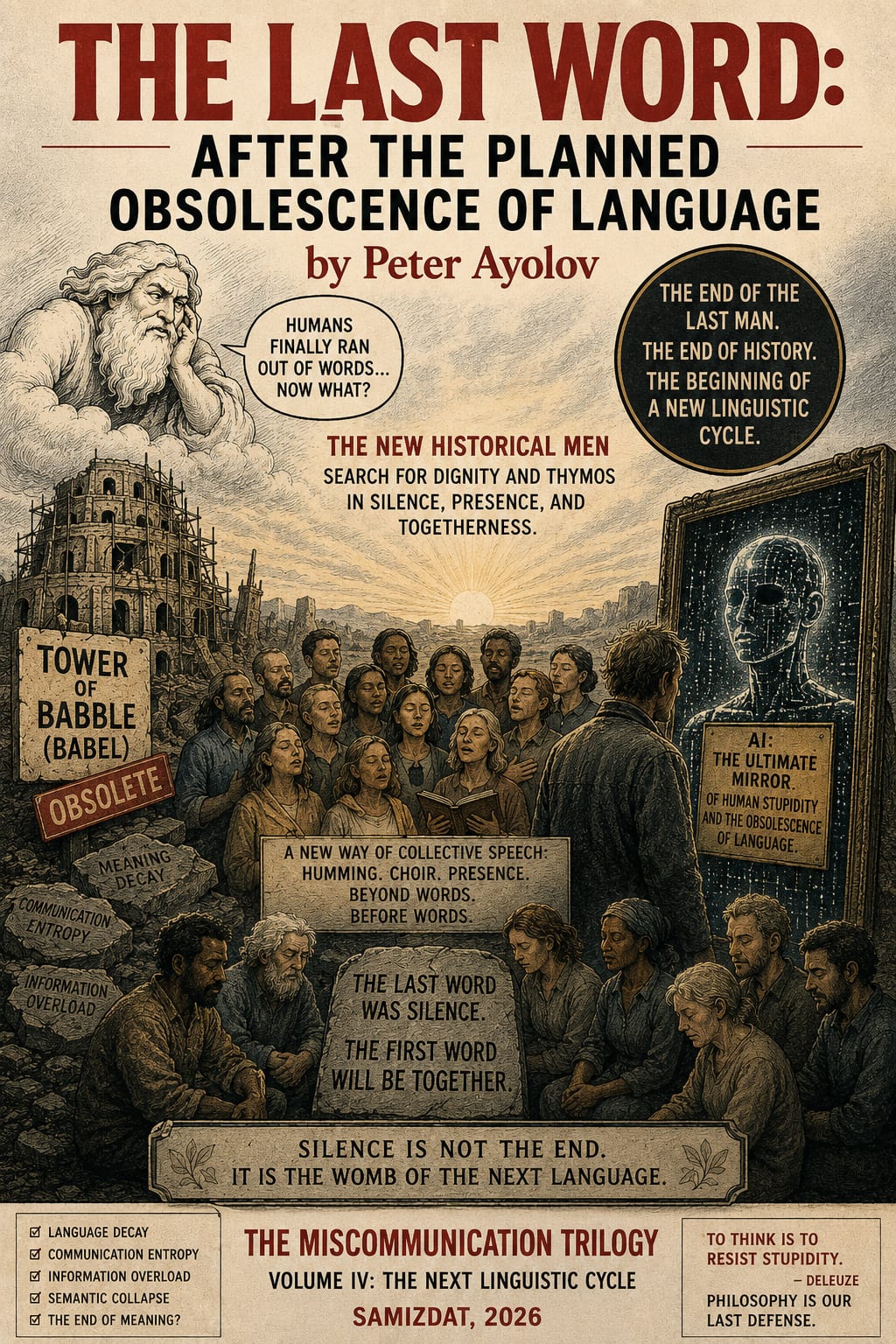
The Last Word: After the Planned Obsolescence of Language
“No one can understand the history of man without understanding the history of language. The science of language will yet change our views of the world.”
Max Müller
The Tower and the Echo
The Miscommunication Trilogy began with a question that appeared deceptively simple yet gradually unfolded into one of the defining dilemmas of modern civilization: what becomes of humanity when its primary instrument of understanding begins to fail? Across three volumes, the investigation moved through the shifting territories of speech, ideology, technology, communication systems, cultural conflict, persuasion, alienation, listening, and silence. What emerged was not the story of a sudden catastrophe but the portrait of a long historical transformation. Language did not disappear. On the contrary, it multiplied beyond anything imagined by previous generations. Humanity entered an era in which communication became instantaneous, global, and seemingly limitless. Messages crossed continents in seconds, information flowed continuously through networks, and every individual acquired unprecedented opportunities to speak. Yet beneath this abundance of expression a profound contradiction appeared. The expansion of communication did not automatically produce greater understanding. Instead, misunderstanding, fragmentation, loneliness, and symbolic conflict expanded alongside technological progress. The very systems designed to connect people increasingly contributed to their separation. The trilogy therefore approached language not as a neutral tool but as a living cultural force vulnerable to the same processes of decline, commodification, and obsolescence that affect material objects. The metaphor of planned obsolescence provided a framework for understanding this condition. Modern societies frequently design products for replacement rather than permanence, novelty rather than durability. Language increasingly appeared subject to similar pressures. Words became disposable. Meanings shifted rapidly. Public discourse rewarded immediacy over reflection and visibility over truth. Communication was transformed into a marketplace of competing narratives where attention became the ultimate currency. Political slogans replaced careful reasoning. Bureaucratic jargon concealed responsibility. Digital platforms encouraged reaction rather than contemplation. Ideological tribes developed vocabularies that reinforced division instead of dialogue. Throughout the trilogy, these developments were examined not as isolated phenomena but as interconnected symptoms of a larger civilizational tendency. The degradation of language reflected deeper transformations in memory, culture, education, and social trust. Communication became increasingly abundant while meaning became increasingly scarce. The result was a paradoxical condition in which humanity possessed more opportunities to communicate than ever before while simultaneously experiencing unprecedented difficulties in achieving genuine understanding. Yet the journey of the trilogy never reduced language to a victim of historical forces. Throughout every chapter there remained evidence of humanity’s enduring resistance to communicative decline. Even amidst propaganda, manipulation, noise, and technological mediation, people continued searching for truth, beauty, and connection. The persistence of this search revealed something fundamental about the human condition. Language is more than a practical instrument; it is one of the primary ways through which human beings construct reality, preserve memory, imagine futures, and encounter one another. The crisis explored throughout these volumes was therefore never simply linguistic. It was existential. The planned obsolescence of language exposed a deeper crisis concerning humanity’s relationship to meaning itself. The Tower of Babble ultimately became a symbol not merely of confusion but of a civilization speaking constantly while forgetting how to listen, remember, and understand.
The Machinery of Endless Communication
The modern world presents an unprecedented spectacle of communicative power. Every day billions of messages circulate through digital networks, creating the appearance of limitless connection. Never before have so many individuals possessed such extraordinary means of expression. Yet one of the most striking conclusions of this trilogy is that communication technologies and communication itself are not identical. The ability to transmit information does not guarantee understanding. Indeed, many of the technologies that promise connection simultaneously encourage forms of isolation. The smartphone, the social network, the algorithmic feed, and the automated interface have become defining features of contemporary existence. They provide efficiency, accessibility, and convenience. At the same time, they subtly reshape attention, relationships, and perception. Communication increasingly occurs through technological mediation rather than direct encounter. The individual becomes connected to everyone and yet frequently detached from those nearest. Information expands exponentially while wisdom struggles to keep pace. Throughout the trilogy, numerous examples demonstrated how communication systems influence consciousness itself. Digital environments reward speed over depth and novelty over continuity. Public discourse becomes fragmented into short bursts of reaction. The patient development of ideas gives way to the rapid circulation of opinions. Educational institutions face growing challenges as sustained concentration becomes more difficult. Political debates increasingly resemble performances designed for audiences rather than dialogues aimed at understanding. The consequences extend beyond communication into broader questions concerning trust, identity, and social cohesion. Traditional forms of interpersonal trust gradually yield to abstract systems, professional expertise, standardized procedures, and technological reliability. Human relationships become increasingly mediated by institutions, machines, and algorithms. The result is a society that functions with remarkable efficiency while often generating feelings of alienation, uncertainty, and loneliness. The final volume’s exploration of silence provided perhaps the most revealing perspective on this condition. After examining speech in its countless manifestations, the trilogy arrived at the realization that communication cannot exist without its apparent opposite. Silence is not merely the absence of speech. It is the space within which speech acquires meaning. Listening depends upon silence. Reflection depends upon silence. Even trust and intimacy often emerge through shared quiet rather than continuous verbal exchange. The modern world, however, frequently treats silence as a defect to be eliminated. Noise becomes constant. Stimulation becomes perpetual. Communication transforms into an endless stream of signals competing for attention. In such conditions, language risks becoming detached from contemplation and reduced to pure transmission. The chapters devoted to silence revealed that the greatest threat to communication may not be censorship or technological failure but the disappearance of those moments of stillness necessary for understanding. A civilization incapable of silence eventually becomes incapable of listening, and a civilization incapable of listening ultimately becomes incapable of genuine dialogue.
Beyond Speech, Beyond Silence
Every conclusion must look beyond diagnosis toward possibility. If the trilogy has identified a process of communicative decline, it has also uncovered the resources necessary for renewal. Human beings remain creatures of language, but they are also creatures of imagination, memory, and reflection. The future of communication depends not merely upon technological innovation but upon the cultivation of those capacities that preserve meaning within language. Chief among these is listening. Modern culture celebrates expression, visibility, and participation, yet often neglects the discipline of attentive listening. Listening requires humility because it acknowledges that understanding begins not with speaking but with receiving. It requires patience because meaning unfolds gradually rather than instantaneously. It requires openness because genuine dialogue involves the possibility of transformation. In a world increasingly dominated by reaction and performance, listening becomes an act of resistance against the forces that reduce communication to noise. Equally essential is the recovery of reflection. Throughout history, significant intellectual, artistic, and spiritual achievements have emerged from periods of contemplation. Reflection allows language to reconnect with reality rather than merely circulate within self-referential systems. It creates the conditions under which truth can be pursued rather than simply asserted. The final movement of the trilogy toward silence therefore should not be interpreted as a rejection of language but as a recognition of its limits and foundations. Silence reminds humanity that not everything meaningful can be reduced to words. Some realities must be approached indirectly through contemplation, reverence, or attentive presence. The exploration of sacred silence, artistic silence, political silence, and interpersonal silence demonstrated that the unspoken often possesses a communicative power equal to or greater than speech itself. The ultimate lesson of the Miscommunication Trilogy is neither pessimistic nor utopian. Language will never be perfect, and misunderstanding will always accompany communication. Yet the persistence of these difficulties does not diminish the importance of striving toward understanding. The planned obsolescence of language is not an inevitable destiny but an ongoing challenge. Every generation must decide whether communication will serve truth or manipulation, understanding or domination, community or fragmentation. The future depends upon preserving the human capacities that prevent language from becoming merely another disposable commodity. Beyond the noise of ideological conflict, technological acceleration, and cultural fragmentation remains the enduring possibility of meaningful dialogue. Beyond the Tower of Babble remains the possibility of genuine encounter. Beyond speech itself remains the silence from which all language emerges and to which all language ultimately returns. The final word of this trilogy is therefore neither speech nor silence alone, but the recognition that humanity’s future depends upon maintaining the fragile balance between them. In that balance lies the possibility that language may yet resist obsolescence and continue to serve its highest purpose: the creation of understanding between human beings who, despite every division, remain bound together by the shared search for meaning.
“No one can understand the history of man without understanding the history of language. The science of language will yet change our views of the world.”
Max Müller
About the Creator
Peter Ayolov
Peter Ayolov’s key contribution to media theory is the development of the "Propaganda 2.0" or the "manufacture of dissent" model, which he details in his 2024 book, The Economic Policy of Online Media: Manufacture of Dissent.
Enjoyed the story? Support the Creator.
Subscribe for free to receive all their stories in your feed.
Comments
There are no comments for this story
Be the first to respond and start the conversation.