
The Last Babel: The Planned Obsolescence of Intelligence
The Long Descent of the Speaking Animal

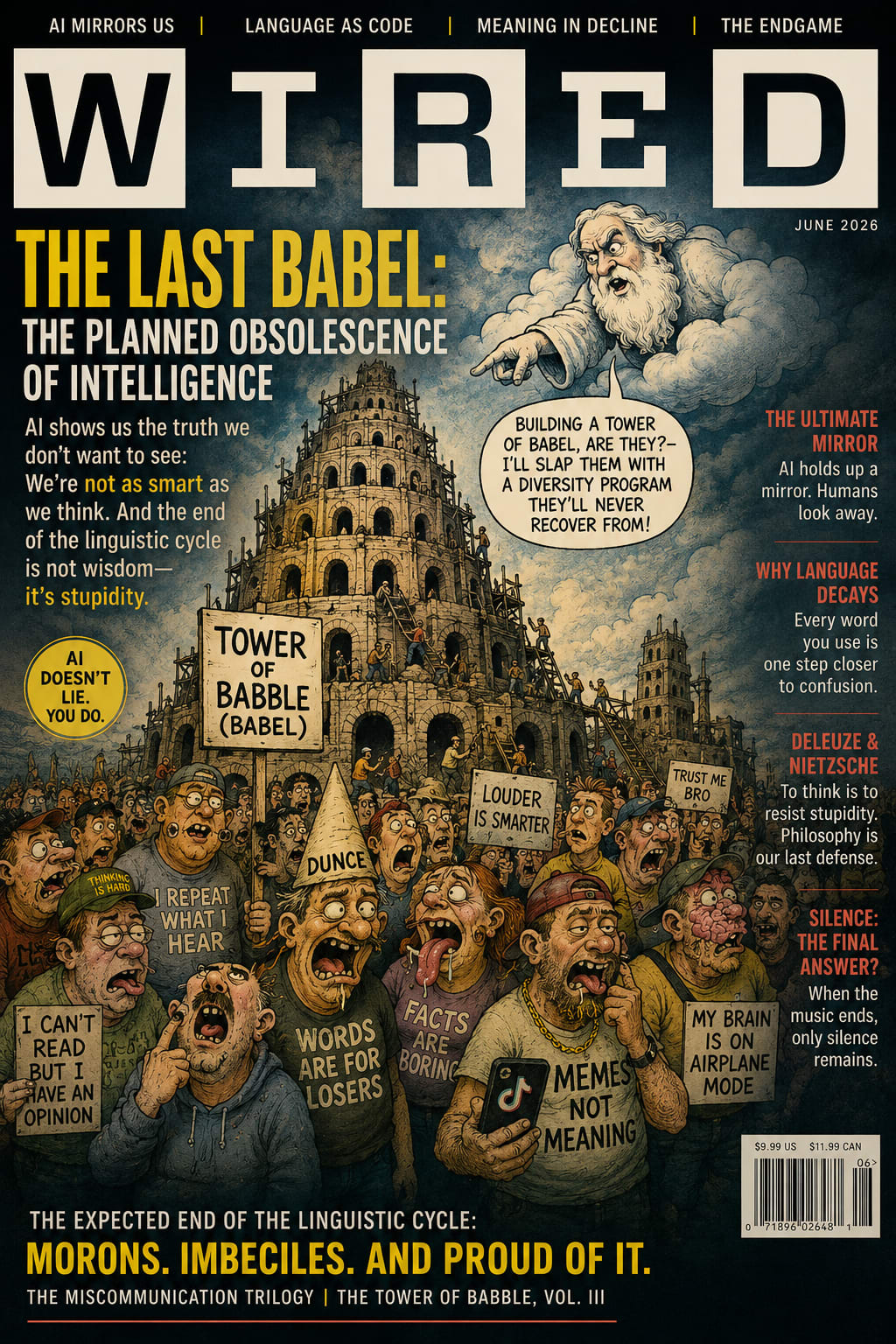
The Last Babel: The Planned Obsolescence of Intelligence
The Long Descent of the Speaking Animal
Humanity has often defined itself through language. Philosophers, theologians, linguists, and poets have repeatedly returned to the conviction that speech is not merely one human faculty among many but the very foundation upon which civilization rests. Through language, memories become history, emotions become culture, ideas become institutions, and isolated individuals become societies. The human story is inseparable from the story of communication. Every civilization has risen through systems of symbols, narratives, myths, laws, scriptures, and conversations that allowed individuals to transcend the limitations of their immediate existence. Language transformed biological creatures into historical beings. It enabled cooperation among strangers, preserved knowledge across generations, and opened intellectual horizons inaccessible to any other species. Yet the same instrument that elevated humanity has always contained the seeds of confusion, manipulation, misunderstanding, and conflict. Every word clarifies something while obscuring something else. Every act of communication creates possibilities for both understanding and misinterpretation. The history of language is therefore simultaneously a history of connection and division.
The Miscommunication Trilogy emerged from the recognition that contemporary civilization is experiencing a profound transformation in the nature of communication. Never before have human beings possessed such immense technological capacities for exchanging information. The world has become interconnected through networks that operate continuously and instantaneously. Distances that once separated continents have effectively disappeared. Messages travel at the speed of light. Information circulates with unprecedented abundance. Yet this communicative revolution has generated a paradox. The multiplication of communication has not produced a corresponding growth in understanding. Instead, societies increasingly confront polarization, fragmentation, confusion, mistrust, and symbolic conflict. Language appears simultaneously omnipresent and exhausted. Words proliferate while meanings become unstable. Public discourse expands while genuine dialogue contracts. The modern world often resembles a vast communicative machinery producing endless streams of messages that struggle to generate wisdom, understanding, or shared purpose.
This trilogy has sought to investigate this paradox through a broad examination of speech, media, ideology, technology, power, culture, listening, and silence. Rather than viewing communication as a purely technical process, it has approached language as a living social organism shaped by historical forces and cultural transformations. Throughout these volumes, language has appeared not merely as a tool for transmitting information but as a battleground upon which competing visions of reality struggle for dominance. The result is a portrait of a civilization confronting the possibility that its most fundamental instrument of meaning-making may itself be undergoing a process of obsolescence. This is not the disappearance of language but its gradual transformation into something increasingly detached from reflection, memory, truth, and understanding. The planned obsolescence of language represents one of the defining challenges of the contemporary age because it touches every dimension of human existence. When communication changes, thought changes. When thought changes, culture changes. When culture changes, humanity itself is transformed.
The Architecture of Miscommunication
The journey through these three volumes has revealed that miscommunication is not an accidental interruption within an otherwise harmonious communicative order. Rather, it is deeply embedded within the structures of language itself. Human beings do not merely use language; they inhabit it. Every perception, memory, value, and aspiration is filtered through symbolic systems inherited from culture and history. Communication therefore always involves interpretation, and interpretation inevitably introduces uncertainty. Yet while misunderstanding has always accompanied speech, contemporary conditions have amplified its scale and consequences. Technological acceleration, ideological polarization, economic incentives, and media saturation have combined to create an environment in which communication increasingly serves functions other than understanding. Language is frequently employed to persuade, mobilize, entertain, manipulate, market, divide, and control. These functions are not entirely new, but their intensity and reach have expanded dramatically.
The first volume explored how language becomes entangled with systems of power, ideology, and social conflict. Words emerged as instruments capable of constructing realities as much as describing them. Political narratives, cultural myths, and symbolic frameworks revealed the extent to which language shapes collective consciousness. The second volume examined how communication systems themselves become subject to forms of entropy, distortion, and alienation. Technological developments promised greater connection while often producing new forms of isolation. Information became abundant while attention became scarce. Communication increasingly resembled consumption rather than dialogue. The third and final volume extends this investigation into the territory of listening and silence, revealing dimensions of communication often neglected by societies obsessed with expression. By examining the limits of speech, the meaning of silence, and the boundaries of language itself, this concluding volume uncovers the deeper philosophical implications of communicative decline.
Across these explorations, a recurring pattern becomes visible. Modern civilization often treats communication as a problem of quantity rather than quality. More information is assumed to produce more knowledge. More speech is assumed to generate more understanding. More connectivity is assumed to strengthen community. Yet the evidence repeatedly suggests otherwise. Human beings increasingly inhabit environments saturated with signals but deprived of meaning. They receive unprecedented amounts of information while struggling to construct coherent narratives about themselves and the world. The planned obsolescence of language manifests not through silence but through excess. Language becomes disposable because it is endlessly reproduced, endlessly consumed, and endlessly replaced. Public discourse rewards novelty rather than permanence. Words become commodities circulating within attention economies. Meaning becomes fragmented into temporary trends, viral slogans, and rapidly shifting narratives. The architecture of miscommunication is therefore built not from absence but from overabundance. The challenge facing contemporary humanity is not learning how to communicate more but learning how to communicate meaningfully within environments that constantly undermine reflection and understanding.
Toward the Silence of Humanity
The final volume of the trilogy arrives at a destination that may initially appear surprising: silence. After hundreds of pages devoted to communication, language, media, ideology, and discourse, the investigation ultimately turns toward that which seems to stand outside language. Yet silence emerges not as the opposite of communication but as one of its essential foundations. Listening requires silence. Reflection requires silence. Understanding requires silence. Every meaningful conversation depends upon intervals during which words give way to contemplation. Throughout history, philosophers, religious thinkers, artists, and mystics have recognized that silence possesses a communicative power of its own. It reveals the limits of language while simultaneously creating the conditions under which language becomes meaningful. Silence is not emptiness but possibility. It is the space within which thought matures, memory deepens, and understanding becomes possible.
The exploration of silence undertaken in this final volume therefore represents the culmination of the trilogy’s broader argument. The crisis of communication cannot be understood solely through the study of speech because communication depends equally upon the capacities to listen, reflect, and remain silent. Modern civilization often treats silence as a deficiency, an interruption, or a failure of communication. Yet many of the texts, traditions, and thinkers examined throughout this volume suggest the opposite. Silence frequently communicates more profoundly than words. It may express reverence, resistance, contemplation, grief, wisdom, intimacy, or transcendence. It reminds humanity that not everything meaningful can be reduced to verbal expression. Some realities remain beyond language, not because they are insignificant, but because they exceed the capacities of speech.
The title The Silence of Humanity therefore carries multiple meanings. It refers to the silences embedded within everyday communication, the sacred silences sought by religious traditions, the political silences imposed by power, the interpersonal silences that shape relationships, and the existential silences encountered at the limits of knowledge. Most importantly, it points toward a civilization confronted by the consequences of its own communicative excess. The planned obsolescence of language ultimately leads not to the triumph of silence but to the disappearance of meaningful silence beneath endless noise. This final volume seeks to recover silence as a necessary dimension of human existence and as a corrective to the pathologies of contemporary communication.
The pages that follow conclude a journey through the many landscapes of language and miscommunication. They do not offer definitive solutions to the problems explored throughout the trilogy. Instead, they invite reflection upon the fragile relationship between speech and understanding, between language and reality, between communication and humanity itself. If there is a single lesson that emerges from these volumes, it is that language remains both humanity’s greatest achievement and its greatest responsibility. The future of communication depends not merely upon technological innovation or institutional reform but upon the cultivation of those human capacities that prevent language from becoming obsolete. Among those capacities, none may be more important than the ability to listen to what words cannot say and to recognize, within the silence that surrounds every act of communication, the possibility of genuine understanding.
About the Creator
Peter Ayolov
Peter Ayolov’s key contribution to media theory is the development of the "Propaganda 2.0" or the "manufacture of dissent" model, which he details in his 2024 book, The Economic Policy of Online Media: Manufacture of Dissent.
Enjoyed the story? Support the Creator.
Subscribe for free to receive all their stories in your feed.
Comments
There are no comments for this story
Be the first to respond and start the conversation.