
I was never a runner. I was a swimmer, someone who preferred water over dirt trails, silence over group motivation. But my friend from college had other ideas about me. She believed every person could become a runner if they simply stopped saying no long enough to begin.
“Everyone can do it,” she said constantly.
I doubted that. I had dozens of excuses ready every day: bad knees, no time, no interest, wrong weather, too tired. None of them mattered to her. She had this relentless way about her. Stubborn as a mule, with sharp green eyes that locked onto you until you surrendered. She worked as a health coach, helping people rebuild themselves after illness or personal collapse, and she carried that same persistence into her private life. Once she decided something was good for you, escape became nearly impossible.
For weeks she talked about the forest trails, the fresh air, the camaraderie, the beauty of moving through nature with other people. Eventually I gave in, mostly because I was exhausted from resisting.
The first thing I learned was that running shoes matter.
I bought the wrong pair.
Fifteen minutes into my first training session, my feet felt as if someone had lit them on fire. Every step burned. The only way I made it out of the forest was by taking the shoes off completely and walking back in my socks like some wounded soldier returning from battle. My friend laughed so hard she nearly cried and told me I was not the first beginner to make that mistake.
I exchanged the shoes and came back the following week.
What surprised me most was not that I returned, but that I wanted to. Somewhere between the humiliation and the pain, something stubborn had awakened inside me too. I wanted to prove to myself that running was not impossible. Maybe I also wanted to prove something to her.
The training groups were organized by endurance levels. Beginners alternated three minutes of running with one minute of walking. More advanced groups increased the intervals: six minutes, fifteen, thirty, an hour slow, an hour fast. It sounded ridiculous to me at first that three minutes of continuous running could feel impossible, but it did. The body resists change with astonishing creativity.
The training grounds were beautiful. The meeting place sat near a forest complex with an ice rink, a swimming pool, and endless trails weaving through tall trees. Especially in the early mornings, the place felt untouched by the outside world. Mist hung low over the paths. You could smell wet earth and pine needles before stepping out of the car.
I drove forty-five minutes each way to get there, and after a while I stopped noticing the distance.
One Saturday morning changed everything.
I was stopped at a traffic light just before the parking lot entrance. My Jeep towered over the tiny car in front of me, making it look like a toy. Then, without warning, a man exploded from the bushes beside the road.
At first I thought he was running after someone.
Then he grabbed the driver’s door handle.
The woman inside fought him immediately, using both hands to keep the door shut while he yanked at it violently. Everything happened in seconds, but it stretched strangely in my memory, becoming slow and distorted. I remember her face most clearly. Pure panic.
I froze.
Even now, years later, that part bothers me most. I always imagined that in a dangerous situation I would know exactly what to do. Instead I sat there shocked, unable to think properly.
Then instinct finally took over.
I slammed my foot on the accelerator just enough to make it appear that I was about to ram her car from behind. The engine roared forward. The man turned his head toward me for only a second, but it was enough. The woman locked the door immediately and sped forward as the traffic light turned green.
We both drove into the parking lot.
She gave me a shaky thumbs-up through the rear window. I nodded back, and strangely, that was the end of it. No police. No dramatic conversation. We parked, got out, and drifted into our separate routines as if the forest itself had swallowed the incident whole.
I joined my running group and completed the hour.
Afterward I stopped thinking about it.
Or at least I believed I had.
Several weeks later, while I was at work, my friend mentioned that one of the runners from the training course had disappeared. A mother of two children. Police were searching the forest area.
I asked what she looked like.
The moment my friend described her, something cold moved through me.
“I know her,” I said.
And then I told the story about the traffic light.
At the time neither of us connected the two events completely. We treated it as disturbing coincidence rather than warning. Missing people appear in the news all the time. Most are eventually found safe. We told ourselves that.
Weeks passed.
Then more weeks.
She still had not been found.
Around the same time, I began training closer to home in a smaller forest near my neighborhood. Police occasionally patrolled the paths there because many people used the trails. Families walked dogs there. Cyclists passed through. Other runners appeared every few minutes. It felt safe.
And yet every time I ran there, I noticed an old suitcase beside the trail.
It looked ancient, the kind people carried decades ago before modern luggage became lightweight and practical. Brown leather cracked with age. Metal corners scratched and rusted. It sat partially hidden beneath bushes as though someone had forgotten it years earlier.
Something about it unsettled me.
I cannot explain why.
Several times I slowed down near it. Once I even stepped off the path, intending to open it. Curiosity pulled at me every single run. But each time another feeling stopped me. Fear, perhaps. Or instinct.
I never touched it.
Thank God for that.
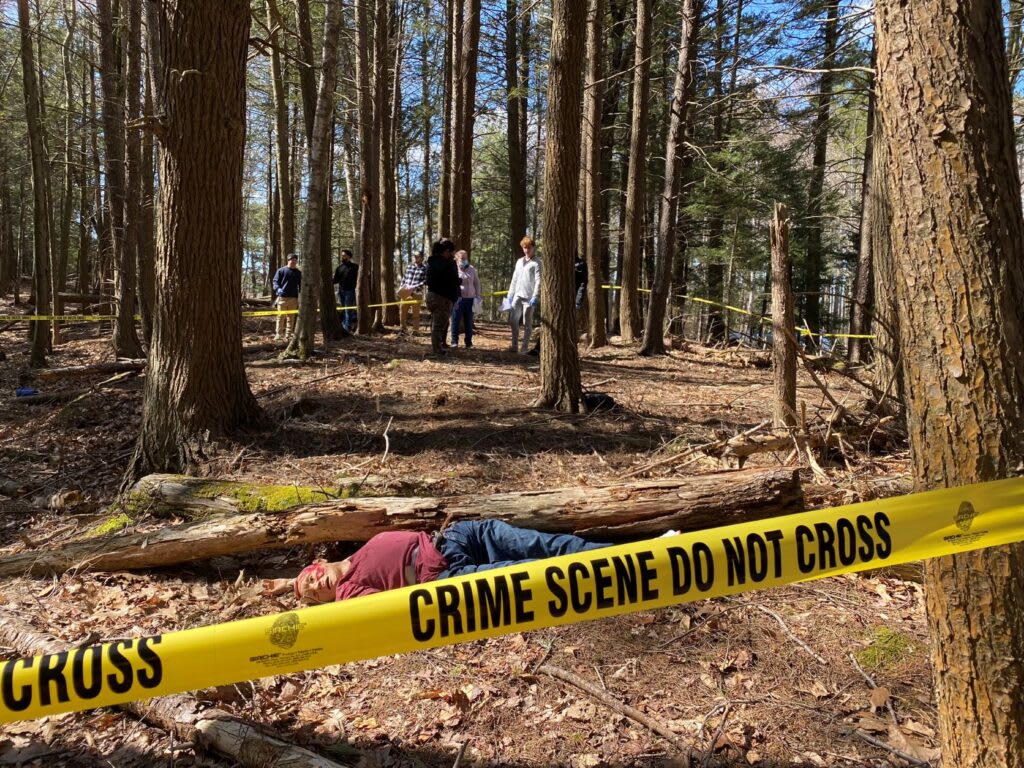
Nearly three months after the woman disappeared, police finally found her body in the same forest where we trained.
She had been murdered.
Brutally.
What shocked everyone was not only the crime itself but the location. The running trails were busy from morning until evening. Families, athletes, children, dog walkers — the area constantly carried human movement and noise. People could not understand how something so violent had happened there unnoticed.
For weeks the story consumed local conversations. Runners became paranoid. Women stopped training alone. Police presence increased. Yet no arrest came.
Then, about two months later, the suitcase disappeared.
At first I noticed only its absence.
A few days later it appeared on the news.
Police had discovered human remains inside, cut apart and hidden within the case. Investigators eventually linked the two murders together. Same region. Similar timing. Similar brutality.
And immediately my mind returned to the man at the traffic light.
I still see him clearly sometimes. The speed of his movement. The force in his hands. The sudden shift in his expression when he noticed me.
I have always believed it was him.
But belief is not proof.
The cases remain unsolved.
And that is where this story has never fully come together for me.
Not because the facts are missing, but because I cannot find the right shape for them.
Every time I try to write it, the story breaks apart into different stories fighting each other. One version is about learning to run and discovering unexpected strength. Another becomes a meditation on instinct — those strange moments when the body senses danger before the mind understands it. A third version turns into true crime, with violence slowly creeping into ordinary life. Then there is the guilt, which may be the real center of everything.
Because I still wonder what would have happened if I had called the police that morning.
Maybe nothing.
Maybe everything.
That question sits underneath every paragraph like a second heartbeat.
The story also struggles because memory itself feels unreliable. Trauma rearranges details. It sharpens certain moments while erasing others entirely. I remember the woman’s frightened face perfectly, yet I cannot remember what music played in my car that day, or whether it was raining, or what clothes the man wore. The mind edits reality without permission.
And there is another problem: the story refuses resolution.
Most narratives demand meaning. Readers want the final connection, the arrest, the explanation that ties every loose thread together. But real life often withholds those things. In reality, people disappear without answers. Murderers vanish into crowds. Witnesses doubt themselves for decades.
The unfinished nature of the actual crimes infects the structure of the story itself.
I think that is why I have never completed it.
Every attempt feels dishonest. If I shape it too neatly, it becomes fiction. If I stay too loyal to reality, it remains fragmented and unresolved. I keep circling the same scenes without knowing what the story is truly about.
Is it about fear?
About survival?
About coincidence?
About the terrifying possibility that evil can brush past you briefly at a traffic light and then continue on its way unnoticed?
Or is it about guilt — the lifelong burden of wondering whether a single phone call might have changed another person’s fate?
I still do not know.
Maybe that uncertainty is the real story.
Not the murders themselves, but the incompleteness they left behind. The way certain experiences never settle into memory properly. They remain open doors in the mind, impossible to close because no ending was ever given to them.
Even now, when I run through forest trails, I sometimes think about how ordinary everything looked before those women became headlines. Trees remain trees. Birds continue singing. People laugh while passing each other on the path. Nature rarely reflects human horror back at us. That disconnect still unsettles me more than anything else.
The world where those murders happened looked beautiful.
Maybe that is also part of why the story has resisted completion. Beauty and brutality exist too closely together inside it. One moment I am learning how to breathe through exhaustion, laughing about ruined running shoes, discovering confidence. The next moment there are police searches, missing posters, and body parts hidden inside a suitcase.
I have never found the bridge between those realities.
So the story remains unfinished.
Not abandoned, but unresolved. Like a trail disappearing into dense forest, still there somewhere, but impossible to follow to the end.
About the Creator
Enjoyed the story? Support the Creator.
Subscribe for free to receive all their stories in your feed. You could also become a paid subscriber, letting them know you appreciate their work.
Comments
There are no comments for this story
Be the first to respond and start the conversation.