
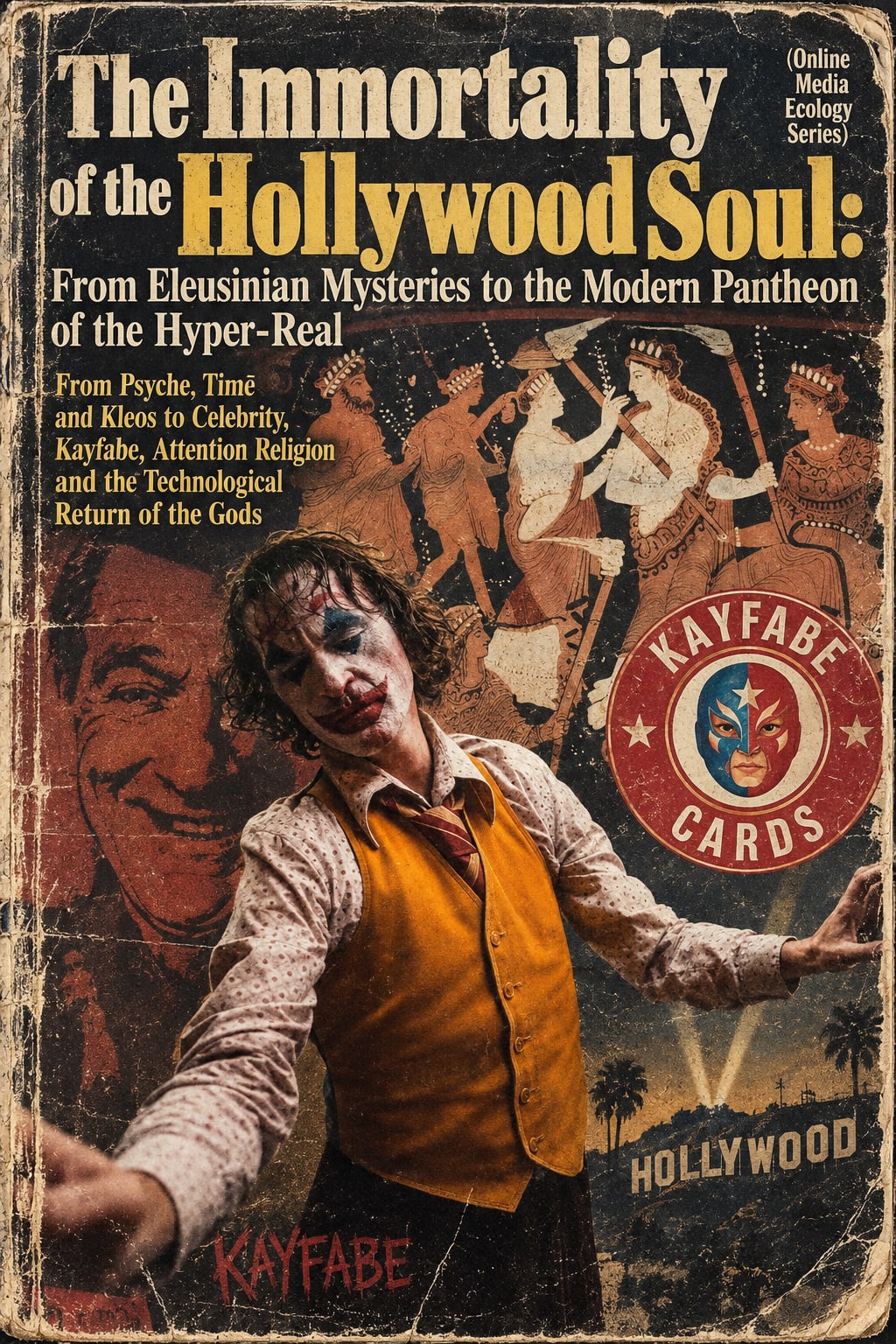
The Immortality of the Hollywood Soul: From Eleusinian Mysteries to the Modern Pantheon of the Hyper-Real
From Psyche, Timē and Kleos to Celebrity, Kayfabe, Attention Religion and the Technological Return of the Gods (Online Media Ecology Series)

Abstract
The history of Western immortality can be read as a history of changing technologies for resisting human disappearance. In the Homeric world, death reduced psychē to a diminished shade, while timē and kleos offered another form of survival through honour, reputation and the continued circulation of the heroic name. The mystery traditions, Orphic and Pythagorean currents, Platonic philosophy and eventually Christianity progressively displaced this predominantly horizontal persistence with a vertical promise: the essential person could transcend bodily death and continue within another ontological order. Yet the modern weakening of this metaphysical architecture did not eliminate the ancient desire to survive disappearance. This article argues that its cultural function migrated into technologically reproducible representation. Photography, recorded sound, cinema, television, digital archives and generative media progressively separated image, voice, gesture and persona from the finite biological individual, producing what is defined here as the Hollywood Soul: a mediated human double capable of circulating beyond the temporal limits of its originating body. Celebrity consequently represents more than amplified fame. It constitutes a modern technological transformation of kleos in which cultural presence can be preserved, multiplied and eventually detached from the living individual whose name and image initiated it.
Following this genealogy from Homeric Hades and Greek hero cult through Dionysian performance, theatrical masks, the development of persona, Hollywood stardom and Baudrillardian simulation, the article argues that contemporary media have moved beyond remembrance towards reproducible and increasingly autonomous presence. The celebrity image no longer merely commemorates an absent person; under conditions of continuous circulation it can become socially more persistent than the biological original. The final transformation occurs within the networked media environment of 2026. Professional wrestling and its principle of kayfabe provide a model for understanding how audiences can knowingly participate in constructed worlds whose emotional and social consequences remain real. Second-degree cybernetics, platform feedback, generative AI and inertia-production extend this logic into a recursive process described here as kayfabrication: the production of performed realities that acquire sufficient social consequences to reproduce the narratives that generated them. Within this environment, the familiar concept of the attention economy becomes insufficient. The article therefore proposes Attention Religion as a critical description of a cultural order in which visibility functions as recognition, participation sustains persona, repetition produces symbolic power, and celebrities and political figures can occupy structural positions formerly associated with heroes, demigods and mythological sovereigns. The resulting condition does not constitute a literal return of ancient religion, nor the disappearance of material reality, but a technological return of mythic organisation within Baudrillardian hyperreality. The long Western movement from mythos towards logos thus encounters an unexpected circularity: after the metaphysical immortal soul loses much of its cultural authority, timē and kleos return in technologically amplified forms, while the screen, platform and algorithm construct a new pantheon of reproducible personae. Modernity does not simply abolish mythology. At the apparent end of disenchantment, it develops the machinery for manufacturing mythology continuously.
Keywords
Hollywood Soul; immortality; psychē; thymos; timē; kleos; Homer; Hades; Eleusinian Mysteries; Orphism; Pythagoreanism; Dionysus; hero cult; Greek tragedy; mask; persona; celebrity; Hollywood; mediated immortality; Jean Baudrillard; simulacra; hyperreality; professional wrestling; kayfabe; kayfabrication; second-degree cybernetics; Attention Religion; attention economy; Propaganda 2.1; slopaganda; generative AI; political spectacle; mythology; Mythos 2.0
Introduction: When the Gods Learned to Survive Their Believers
“Creatures of a day! What is a man? What is he not? A dream of a shadow is our mortal being.”
— Pindar, Pythian 8
Western civilisation can be read as a succession of increasingly ambitious attempts to defeat human disappearance. The Homeric world offered no reassuring vision of the fully preserved individual continuing happily beyond death: psychē descended towards Hades as an impoverished shade, while the intensity of existence remained with the breathing, acting and recognised human being. What could resist mortality was therefore not primarily an indestructible interior essence but the name carried by others. Timē gave the hero publicly acknowledged worth; kleos allowed that worth to outlive its possessor through narrative and remembrance. Later transformations radically altered this arrangement. Mystery traditions complicated the destiny of the dead; Orphic and Pythagorean currents intensified the possibility that something essential might survive bodily dissolution; Plato helped establish the soul as an autonomous bearer of identity; Christianity eventually situated personal survival within a transcendent drama of death, judgement and eternity. Ayolov’s earlier genealogy followed this extraordinary migration from breath, bodily vitality and Homeric shade towards the increasingly autonomous metaphysical entity called the soul. Yet the modern weakening of this metaphysical architecture did not abolish the desire that had produced it. Something stranger occurred. The struggle against disappearance gradually returned from another world to this one, while modern technologies supplied possibilities of persistence that Homer could never have imagined. Photography detached appearance from physical presence; the phonograph detached voice from the speaker; cinema preserved gesture and movement; television made recorded personalities repeatedly present; digital networks transformed representation into permanent accessibility; and generative technologies now make it possible for representations to produce apparently new performances. The old problem of immortality therefore survives after the decline of many of its traditional solutions. The question is no longer exclusively whether something invisible leaves the body and continues elsewhere. It is increasingly whether something visible can leave the body and continue here. The history examined in this article is consequently not a simple passage from religion to secularism, but a transformation in the medium through which human beings attempt to escape oblivion: from psychē to persona, from transcendence to reproduction, and from the promised eternity of the soul to the technological persistence of the image.
I call the product of this transformation the Hollywood Soul: the culturally persistent double of a mortal person, composed of reproducible image, voice, gesture, name, narrative and persona, which can continue circulating after the biological individual who originated it has disappeared. This does not mean that cinema, archives or artificial intelligence have achieved literal personal immortality. Preserving information about a person is not equivalent to preserving the embodied person, and Ayolov’s earlier critique of technological immortality explicitly maintained this distinction. The significance of the Hollywood Soul lies elsewhere. It allows immortality to become a problem of mediated presence rather than metaphysical survival. Hollywood industrialised an ancient aspiration by transforming fame into reproducible visibility: the hero once required the bard to carry his kleos across generations, whereas the modern star can remain visually and acoustically available through an expanding archive that repeats the absent body with extraordinary fidelity. This development eventually leads beyond remembrance itself. Under the conditions described by Jean Baudrillard, the representation can cease functioning merely as evidence of an original and acquire an autonomous cultural reality through circulation. The celebrity persona can become more socially familiar than the private biological individual from whom it emerged. From this point the genealogy moves towards the hyper-real environment of 2026, where professional wrestling, political spectacle, platform algorithms, generative media and recursively manufactured narratives destabilise the boundary between performed identity and socially consequential reality. The article will ultimately describe this condition through the concepts of kayfabrication and Attention Religion, but only after reconstructing the historical transformations that make them possible. The argument therefore begins before Hollywood, before Christianity and even before the philosophical immortal soul, in a world where Achilles faced the most elemental bargain imaginable: the body could endure for a time, or the name could endure after it. The long history between Homer and the algorithm begins with that choice.
Part I: Before the Soul Went to Heaven — Homer, Hades and the First Technology of Immortality
“If I stay here and fight beside the city of the Trojans, my return home is gone, but my glory shall be everlasting. But if I return home to the beloved land of my fathers, the excellence of my glory is gone, but there will be a long life left for me.”
— Homer, Iliad, Book IX
The most revealing feature of Homeric immortality is that its most desirable form belongs not to the dead but to the living who continue speaking about them. Hades offers persistence without fulfilment: psychē survives as an eidōlon, a diminished shade deprived of the force that characterised embodied existence. The heroic answer to mortality is consequently organised around public recognition. Timē signifies honour and acknowledged worth, materially expressed through precedence, prizes and the treatment accorded to the hero; thymos drives the passionate demand that such worth be recognised; kleos carries the result beyond the immediate community as what is heard and retold about a person. Achilles’ choice therefore contains a theory of immortality radically different from later doctrines of an indestructible soul. He can preserve his biological future by returning home, or sacrifice it for kleos aphthiton, imperishable glory. The wager is astonishing because it knowingly exchanges the duration of the organism for the duration of the name. The bard becomes indispensable to this transaction. Song cannot rescue Achilles from death, but it can rescue Achilles from oblivion; each performance carries his deeds into a present in which his body no longer exists. Epic poetry thus operates as an early medium of posthumous presence. Hero cult adds another mechanism. Where song transports the name, tomb, monument, ritual and locality anchor the exceptional dead to a community and allow continuing relations with figures who are neither ordinary ancestors nor Olympian gods. Egypt developed a historically different and vastly more elaborate resistance to disappearance through the preservation of body, name, image and ritual memory. These Egyptian practices must not be reduced to a primitive version of the later European soul: Ka, Ba, Akh, body, heart, shadow, name and image formed a complex mortuary anthropology rather than a single equivalent of Platonic psychē. What Greece and Egypt nevertheless reveal, through very different systems, is the enormous cultural importance of preventing the dead from becoming anonymous. Before immortality became principally the survival of an invisible essence, it could be pursued through the preservation and transmission of traces. The corpse could be protected, the name pronounced, the monument revisited, the image maintained and the heroic story performed. Death destroyed the living body; culture began constructing instruments against the second death of forgetting.
The decisive transformation occurs when the surviving trace is gradually joined by the possibility of a surviving self. No single mystery cult invented this idea, and Eleusinian, Dionysian, Orphic and Pythagorean traditions should not be compressed into one doctrine. Eleusinian initiation promised a privileged relation to death without leaving a systematic theology of the immortal soul; Dionysian religion introduced experiences of ekstasis and enthousiasmos capable of disturbing ordinary boundaries of identity; Orphic-Dionysian funerary tablets reveal concern with post-mortem orientation, Mnemosyne, divine ancestry and a destiny differentiated from the undirected existence of the Homeric shade. Pythagorean traditions and subsequently Plato gave this changing imagination of death an increasingly powerful philosophical form. Once the essential bearer of identity could be conceived as separable from sōma, the problem was transformed. The Homeric hero needed future human beings to remember him; the metaphysical soul could theoretically continue even if every earthly memory of its owner disappeared. The centre of immortality moved from social transmission towards ontological survival. This movement eventually made possible the famous reversal in which the body itself could be interpreted as enclosure, temporary habitation or prison rather than the indispensable ground of human existence. Ayolov’s earlier analysis of sōma-sēma identifies precisely this shift from the embodied Homeric configuration of psychē, thymos and noos towards the Orphic-Pythagorean and Platonic elevation of an invisible immortal bearer of identity. Christianity would later transform this inheritance within its own doctrines of resurrection, judgement and eternal life, producing a far more comprehensive religious horizon in which earthly reputation could never equal salvation. Yet the older economy of remembrance did not disappear. Poets still promised survival through verse, rulers monumentalised their names, portraits preserved faces, dynasties cultivated memory and communities continued venerating extraordinary dead. Two strategies against oblivion therefore remained intertwined throughout Western history: one entrusted survival to another order of existence; the other entrusted it to material and symbolic transmission among the living. Their later encounter with mechanical reproduction would be decisive. Homer possessed the song, Egypt the preserved body and image, the hero cult its tomb, and religion its immortal soul. None yet possessed a medium capable of repeatedly restoring the dead person’s moving face and audible voice. Before that could happen, however, another invention was necessary: the mask had to learn how to separate the represented person from the living face behind it.
Part II: From Dionysus to Hollywood — The Mask That Learned to Live Without the Face
“Man is least himself when he talks in his own person. Give him a mask, and he will tell you the truth. A truth in art is that whose contradictory is also true.”
— Oscar Wilde (1891), The Critic as Artist
Between the immortal soul and the Hollywood star stands another ancient invention: the mask. Its importance lies not simply in concealment but in separation. A face belongs to one mortal organism; a mask permits an identity to be represented, repeated and inhabited. Greek theatre developed this separation within a religious and civic environment deeply connected with Dionysus, although it would be historically careless to describe tragedy as modern simulation in embryonic form. Dionysian ekstasis and enthousiasmos, ritual performance and theatrical representation belonged to different practices whose boundaries changed across time. What matters here is the cultural possibility they disclose: identity need not remain identical with the ordinary individual who performs it. The theatrical mask makes this principle materially visible. Behind it stands a replaceable body; before it appears a recognisable figure capable of returning through another performance and another actor. Persona therefore introduces a curious reversal of mortality. The performer disappears, but the represented character remains available for embodiment. Oedipus outlives every actor who has played Oedipus. Dionysian theatre consequently provides an essential intermediate station between cultic survival and technological reproduction, not because cinema descends straightforwardly from Greek ritual, but because performance demonstrates that socially meaningful identity can exceed the biological continuity of a particular face. Christianity later developed entirely different forms of ritual repetition, sacred representation and performed identity, while portraiture and print multiplied the means through which names and appearances could travel beyond immediate bodily presence. But modern recording introduced a decisive break: representation no longer required another living performer to reactivate it. Photography fixed the vanished instant; the phonograph allowed a voice to speak after its speaker had fallen silent; cinema joined image, gesture and temporal movement into a reproducible apparition. The mask had ceased merely to cover the face. Through mechanical reproduction, it could remain when the face itself was gone.
Hollywood industrialised this emancipation of persona from person. The studio star was not merely an actor whose performances happened to be recorded, but an organised public identity constructed through roles, publicity photographs, interviews, costumes, rumours, advertising, fan magazines and carefully managed biographical narratives. A second individual emerged alongside the biological one: recognisable, reproducible and available for circulation. Television intensified this presence by bringing the mediated figure repeatedly into domestic space, while video liberated performance from broadcast schedules and digital networks eventually made the persona searchable almost everywhere and at almost any time. David Cronenberg’s Videodrome provides an unusually precise fictional image of the endpoint. Professor Brian O’Blivion exists almost entirely through prerecorded television appearances; the physical individual becomes less important than the audiovisual presence that continues speaking from screens. Ayolov’s earlier analysis therefore identifies O’Blivion as a prototype of the persistent mediated persona: Actor → Star → Recorded Star → Dead Star → Archived Star → Digital Double → Generative Persona. This sequence also reveals why the Hollywood Soul differs fundamentally from its metaphysical predecessor. The ancient soul was imagined as an invisible self capable of leaving the visible body; the modern persona becomes a visible and audible self externalised from it. One departed into an inaccessible beyond, while the other accumulates within photographs, recordings, film libraries, databases and screens. The mummy preserved a body but could not restore its gesture; the portrait preserved appearance but remained silent; the phonograph recovered voice without face; cinema reunited voice, face and movement; the digital archive made their recurrence effectively on demand. Generative media now approach a further threshold at which the preserved mask may be recombined into performances that the original body never enacted. None of this demonstrates that the person has survived. It demonstrates something culturally different and historically unprecedented: representation has acquired the technical capacity to continue performing presence without requiring the continued presence of its biological source. The ancient actor once put on the mask. Modern media progressively make it possible for the mask to go on performing after the actor has left the stage.
Part III: The New Heaven Is the Archive — Baudrillard, Celebrity and the Immortal Simulacrum
“It is dangerous to unmask images, since they dissimulate the fact that there is nothing behind them. They are no longer of the order of appearances, but of simulation. Whoever feigns an illness can simply go to bed and make believe he is ill. Whoever simulates an illness produces in himself some of the symptoms.”
— Jean Baudrillard (1981), Simulacra and Simulation
Mechanical reproduction made the absent person repeatedly perceptible, but celebrity introduced a more radical possibility: the representation could become culturally larger than its source. Jean Baudrillard’s theory of simulation provides the decisive conceptual break here because the simulacrum cannot be understood simply as a false picture concealing an authentic original. The problem arises when signs acquire sufficient circulation and autonomy to constitute the reality through which their supposed originals are encountered. Celebrity operates precisely at this threshold. Elvis Presley was a biological individual with a finite biography, but “Elvis” became a reproducible cultural object distributed through recordings, films, photographs, costumes, impersonations, merchandise, quotations and endlessly reiterated narratives. Biological death in 1977 did not terminate this object; paradoxically, it clarified its independence. The ageing organism disappeared while the reproducible Elvis remained capable of appearing at multiple ages, in multiple places and before generations that had never shared historical time with Presley himself. Madonna demonstrates another version of the same process while still alive: persona becomes serial rather than posthumous, repeatedly destroyed, redesigned and relaunched so that continuity belongs less to a stable public identity than to the recognisable capacity for transformation. Celebrity therefore exceeds ordinary fame. The famous person is known widely; the celebrity-sign becomes an apparatus capable of generating further representations of itself. At this point three forms of immortality must be distinguished. Metaphysical immortality claims that the person continues beyond bodily death. Memorial immortality means that subsequent generations continue remembering the person. Mediated immortality means that a reproducible persona remains capable of appearing within cultural life after the biological conditions of its original appearance have vanished. The Hollywood Soul belongs to this third category. It does not rescue consciousness from mortality. It produces persistence by allowing representation to occupy cultural time independently of the lifespan that initiated it.
The archive consequently becomes something more than a storehouse of the past. It is an apparatus for recurrent presence. A photograph says that this face once stood before a camera; cinema allows the vanished body to move again; recorded sound lets the dead voice enter the acoustic present; searchable digital media remove much of the distance separating preservation from retrieval. Generative systems introduce a further mutation because the archived persona can potentially be recombined into speech, movement or situations for which no historical recording exists. Ayolov’s earlier formulation of digital identity already describes the profile as a “miniature soul”, a symbolic double whose social persistence may exceed that of the ageing organism. His genealogy of Egyptian mortuary preservation also reveals the magnitude of the technological transformation: the mummy protects the dead from decomposition; photography preserves appearance; phonography preserves voice; cinema preserves movement; digital storage multiplies accessibility; synthetic media potentially give the representation new agency. The crucial development is therefore not that technology has finally proved the ancient doctrine of the immortal soul. It is almost the opposite. Cultural persistence can now be produced without settling the metaphysical question at all. The body dies, yet its signs continue working. Baudrillard makes the consequence disturbing: once the sign is sufficiently autonomous, continued reference to an authentic original may cease to organise its social power. The persona becomes something encountered in its own right. Hollywood thus reverses the weakness of the Homeric eidōlon. The ancient shade survived but possessed little power among the living; the technologically reproduced shade can increase its presence through repetition. The destination of the Hollywood Soul is therefore neither Elysium nor Paradise but circulation itself. Its eternity lasts only as long as reproduction continues, yet reproduction can now occur on a scale for which earlier cultures possessed no equivalent. The decisive question at this stage is no longer whether the image accurately preserves the person. It is what happens when entire societies begin organising recognition, desire, antagonism and political reality around images whose power depends precisely upon never ceasing to circulate.
Part IV: Welcome Back the Gods — Kayfabe, Attention Religion and the Mythological World of 2026
“The public is completely uninterested in knowing whether the contest is rigged or not, and rightly so. It abandons itself to the primary virtue of the spectacle, which is to abolish all motives and all consequences. What the public wants is the image of passion, not passion itself.”
— Roland Barthes (1957), Mythologies
Professional wrestling provides an unexpectedly precise bridge between the Hollywood Soul and the mythological structure of contemporary public life. Its wrestlers inhabit a world of champions, monsters, betrayals, alliances, humiliations, revenge, miraculous returns and spectacular struggles for recognition. This is not a historical continuation of Homeric epic, but it retrieves something structurally Homeric: human beings enlarged beyond ordinary proportions until personality itself becomes public mythology. Kayfabe makes this enlargement possible by maintaining a performed world whose significance cannot be reduced to the binary distinction between true and false. The spectator may know that a rivalry is constructed and nevertheless experience its consequences as meaningful; a staged antagonism can produce authentic hatred, money, loyalty and institutional decisions, while an unscripted event can subsequently be absorbed into the script. Ayolov’s earlier analysis therefore described wrestling as a system of reality-effects in which work, shoot and worked shoot exploit uncertainty between performance and actuality. In 2026 this logic no longer belongs primarily to the wrestling ring. Reality television, influencer culture, partisan media and political spectacle increasingly organise public figures through recognisable characters, enemies, scandals, reversals and narrative arcs. Second-degree cybernetics makes the process recursive: performers observe audiences, audiences observe performers, media observe both, algorithms measure reactions, and each modifies subsequent performances. I propose the term kayfabrication for the resulting condition: the recursive production of a performed reality that generates sufficient real-world consequences to reproduce and legitimise the performance from which it originated. Kayfabrication is therefore more consequential than deception. A fiction need not successfully masquerade as fact if millions of participants react to it, institutions reorganise themselves around it, opponents amplify it through denunciation and platforms reward its circulation. Reality remains, but access to it is increasingly organised through competing performances of reality. Donald Trump’s long movement between celebrity television, professional-wrestling spectacle and electoral politics makes him an especially visible case of this convergence, while Vladimir Putin represents a different construction of the mediated sovereign, organised around authority, endurance, geopolitical destiny and personalised state power. They are not literally gods, nor are their political systems equivalent. The comparison concerns the mythological magnitude that technologically amplified persona can acquire.
The familiar term attention economy explains why such personae are profitable, but profit alone cannot explain the intensity of participation surrounding them. Attention Religion names the additional symbolic mechanism. Its elementary ritual is recognition: to follow, repost, imitate, praise, denounce, parody or obsessively fact-check a figure is to contribute to the continued presence of that figure within collective consciousness. Hatred can therefore perform a function once associated with devotion, because the true opposite of mediated divinity is not hostility but invisibility. Even blasphemy repeats the god’s name. Contemporary celebrities consequently form something resembling a technologically produced pantheon—not because they possess supernatural powers, but because different personae become gigantic symbolic condensations of beauty, sexuality, rebellion, wealth, athletic power, technological futurity, political sovereignty or transgression. Their followers need not believe in them in any theological sense. Attention Religion does not demand belief; it demands participation. Generative AI accelerates this process by industrialising the production of the narratives, images and provocations through which participation is maintained. Ayolov’s concept of inertia-production describes a media environment in which content can continue because engagement rewards circulation independently of semantic depth, while Propaganda 2.1 increasingly seeks affective activation rather than classical persuasion. Under conditions of slopaganda, even implausibility may become socially functional as a test of allegiance, provocation or invitation to ritualised conflict, while outrage and counter-outrage become renewable inputs into the same attention machinery. The ancient bard required a memorable hero and an audience prepared to hear the song again. The contemporary system can manufacture the hero, measure the audience’s response, rewrite the conflict and generate another episode before the previous one has disappeared from the feed. Myth becomes renewable content. This is the final mutation of the Hollywood Soul: representation no longer waits passively for posterity to preserve it but participates continuously in producing the conditions of its own persistence. Kayfabe was the rehearsal. Kayfabrication is the civilisation.
Conclusion: Homer After the End of History — Welcome Back the Myths
“The gods have spun the thread of death for wretched mortals, while they themselves live on free from care. For so the gods have spun the thread for miserable men, that they should live in pain; yet themselves are sorrowless.”
— Homer, Iliad, Book XXIV
The genealogy of immortality ends where Western civilisation imagined that it had begun: inside myth. This return, however, is neither religious restoration nor a simple regression from rationality to superstition. The circle closes technologically. Mythos gave way to logos; philosophy transformed the shade into an immortal principle; Christianity placed the person within eternity; modernity secularised the world; mass media converted identity into reproducible representation; digital networks made representation ubiquitous; simulation loosened the image from its original; and generative systems now allow representations to enter combinations for which no historical original need ever have existed. The apparently linear sequence Mythos → Logos → Metaphysics → Religion → Modernity therefore bends unexpectedly through Media → Simulation → Hyperreality and returns towards Mythos 2.0. Fukuyama’s famous “end of history” consequently acquires an unintended inversion. At the supposed terminus of ideological development, technologically advanced societies increasingly resemble the narrative universe at the beginning of Western literature: a landscape dominated by spectacular personalities, heroic antagonisms, monsters, humiliations, vengeance, tribal loyalties, miraculous returns and struggles for recognition. Yet the new mythology possesses instruments unavailable to Homer. Timē can now be counted through followers, views, rankings and measurable visibility; kleos can become instantaneous planetary circulation; the bard has been partially replaced by recommendation systems capable of repeating the name without exhaustion. The cult becomes fandom, the mask becomes the profile, the heroic contest becomes the permanent media event, and Olympus becomes the screen. None of these equivalences should be mistaken for historical identities. Their significance lies precisely in the retrieval of an ancient social logic through radically new technical means. The modern subject who ceased expecting an immortal soul may nevertheless spend a lifetime constructing a persona designed to resist disappearance. The metaphysical promise has weakened while the struggle against oblivion has become industrialised.
The world of 2026 therefore does not require people literally to believe that celebrities or political leaders are supernatural beings in order to generate deity-like structures around them. The new pantheon is manufactured through attention, and attention has become simultaneously economic resource, political weapon, emotional investment and ritual participation. Its gods survive through circulation rather than eternity. They may be loved, hated, mocked, imitated or condemned because all these actions can reproduce their presence. Generative media intensify the process further by making myth-production potentially continuous: narrative no longer waits for the bard, studio, newsroom or propagandist when automated systems can generate variations at enormous speed. The ancient bard needed inspiration from the Muses; the contemporary myth-machine needs engagement. This does not mean that material reality has disappeared. Bodies still age, governments exercise real power, wars kill real people, economies impose real constraints and death remains stubbornly biological. What changes is the environment through which these realities become publicly intelligible. Competing performances can increasingly mediate access to events until fiction, strategic persona, emotional allegiance and empirical occurrence become operationally entangled. Everything becomes possible not because physical laws have collapsed, but because almost any identity, enemy, scandal, resurrection, conspiracy or heroic narrative can be manufactured, circulated, contested, revised and replaced inside the machinery of attention. The ancient world constructed myths and attributed them to gods; the hyper-real world constructs realities and can forget—or strategically conceal—that it constructed them. The gods did not die. They changed media. The heroes did not disappear. They became celebrities. Olympus did not fall. It became the planetary screen. Worship did not end. It became attention. The ancient bard became the algorithm, kleos became virality, timē became measurable visibility, and the immortal soul became the endlessly circulating persona. Modernity promised disenchantment and arrived instead at technologically industrialised mythology. After twenty-five centuries of attempting to escape Homer, the circle closes. The world of 2026 is once again crowded with heroes, monsters, demigods and manufactured gods. Welcome back the myths.
References
Ayolov, P. (2022) ‘Second-degree Cybernetics and Kayfabe Politics’. Sofia University.
Ayolov, P. (2024) The Economic Policy of Online Media: Manufacture of Dissent. Abingdon: Routledge.
Ayolov, P. (2025) ‘Kayfabe: The Philosophy of Entertainment — Between Script and Reality: How Fiction, Power, and Emotion Conspire to Feel True’.
Ayolov, P. (2026a) ‘Psychē Phykē Vs. Sōma Sēma: It Is Time to Free the Body from the Prison of the Soul’.
Ayolov, P. (2026b) ‘The Death of the Ghost: The Genealogy of the Soul from Breath to Power — How the Invention of the Soul Created Civilisation, Hierarchy and the Long Road Back to Human Equality’.
Ayolov, P. (2026c) ‘The Ghost from Egypt: How the Immortal Soul Conquered European Philosophy Twice’.
Ayolov, P. (2026d) ‘The Empire of Ghosts: Why the Body Is the Last Free Territory — The Living Body Is the Medium and the Message’.
Ayolov, P. (2026e) ‘Inertia-Production, Propaganda 2.1, and the Political Economy of Slopaganda’. Sofia University.
Barthes, R. (1972) Mythologies. Translated by A. Lavers. New York: Hill and Wang. First published 1957.
Baudrillard, J. (1994) Simulacra and Simulation. Translated by S.F. Glaser. Ann Arbor: University of Michigan Press. First published 1981.
Benkler, Y., Faris, R. and Roberts, H. (2018) Network Propaganda: Manipulation, Disinformation, and Radicalization in American Politics. New York: Oxford University Press.
Boorstin, D.J. (1961) The Image: A Guide to Pseudo-Events in America. New York: Harper & Brothers.
Burkert, W. (1985) Greek Religion: Archaic and Classical. Translated by J. Raffan. Oxford: Blackwell.
Burkert, W. (1987) Ancient Mystery Cults. Cambridge, MA: Harvard University Press.
Cole, S.G. (1984) Theoi Megaloi: The Cult of the Great Gods at Samothrace. Leiden: Brill.
Coleridge, S.T. (1817) Biographia Literaria. London: Rest Fenner.
Cronenberg, D. (dir.) (1983) Videodrome. Canada: Universal Pictures.
Deacy, C. (2012) Screening the Afterlife: Theology, Eschatology and Film. Abingdon: Routledge.
Dodds, E.R. (1951) The Greeks and the Irrational. Berkeley: University of California Press.
Eliade, M. (1958) Rites and Symbols of Initiation: The Mysteries of Birth and Rebirth. New York: Harper & Brothers.
Fisher, M. (2009) Capitalist Realism: Is There No Alternative? Winchester: Zero Books.
Fukuyama, F. (1992) The End of History and the Last Man. New York: Free Press.
Graf, F. and Johnston, S.I. (2013) Ritual Texts for the Afterlife: Orpheus and the Bacchic Gold Tablets. 2nd edn. Abingdon: Routledge.
Havel, V. (1985) ‘The Power of the Powerless’, in Keane, J. (ed.) The Power of the Powerless: Citizens Against the State in Central-Eastern Europe. Armonk, NY: M.E. Sharpe, pp. 23–96.
Homer (1990) The Iliad. Translated by R. Fagles. New York: Viking.
Homer (1996) The Odyssey. Translated by R. Fagles. New York: Viking.
Johnston, S.I. (1999) Restless Dead: Encounters Between the Living and the Dead in Ancient Greece. Berkeley: University of California Press.
Lippmann, W. (1922) Public Opinion. New York: Harcourt, Brace and Company.
Luhmann, N. (2000) The Reality of the Mass Media. Translated by K. Cross. Stanford, CA: Stanford University Press.
McLuhan, M. (1964) Understanding Media: The Extensions of Man. New York: McGraw-Hill.
Nietzsche, F. (1999) The Birth of Tragedy and Other Writings. Edited by R. Geuss and R. Speirs. Translated by R. Speirs. Cambridge: Cambridge University Press. First published 1872.
Pindar (1997) Olympian Odes, Pythian Odes. Edited and translated by W.H. Race. Cambridge, MA: Harvard University Press.
Plato (1997) Complete Works. Edited by J.M. Cooper and D.S. Hutchinson. Indianapolis: Hackett.
Rohde, E. (1925) Psyche: The Cult of Souls and Belief in Immortality among the Greeks. Translated by W.B. Hillis. London: Kegan Paul, Trench, Trubner & Co.
Stanley, J. (2015) How Propaganda Works. Princeton, NJ: Princeton University Press.
Taylor, C. (2007) A Secular Age. Cambridge, MA: Belknap Press of Harvard University Press.
Wilde, O. (1891) Intentions. London: James R. Osgood, McIlvaine & Co.
About the Creator
Peter Ayolov
Peter Ayolov’s key contribution to media theory is the development of the "Propaganda 2.0" or the "manufacture of dissent" model, which he details in his 2024 book, The Economic Policy of Online Media: Manufacture of Dissent.
Enjoyed the story? Support the Creator.
Subscribe for free to receive all their stories in your feed.
Comments
There are no comments for this story
Be the first to respond and start the conversation.