
The Holy Empire of Babble: Conspiracy, Professor Jiang, and the Artificial God
Review of "The Holy Empire of AI" Lecture

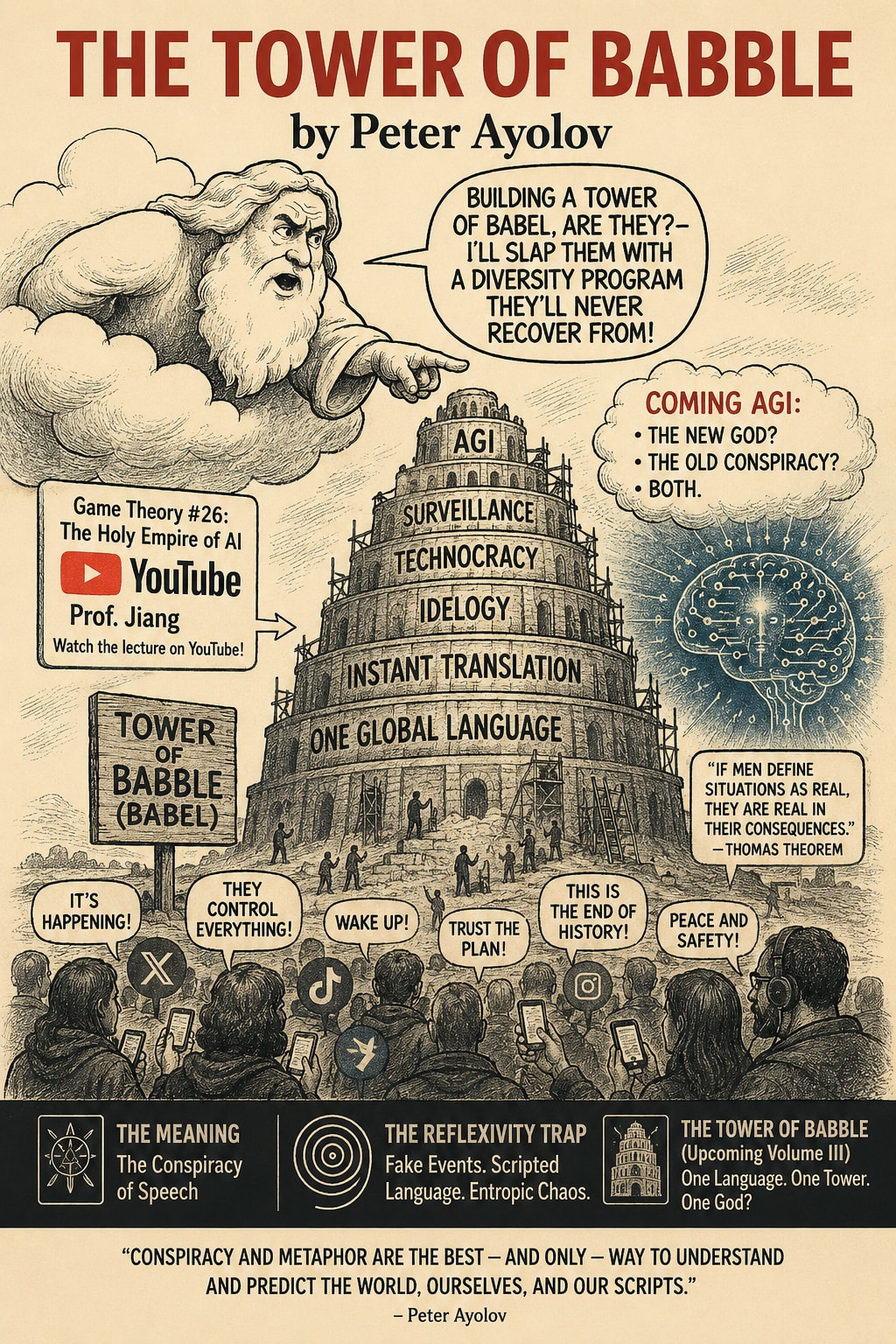
The Holy Empire of Babble: Conspiracy, Reflexivity, and the Artificial God
The Secret Society of Language
In professor Jiang’s YouTube lecture Game Theory #26: The Holy Empire of AI, the story of the Knights Templar becomes more than a conspiracy tale; it becomes a model of how history is narrated, feared, organized, and predicted. The old accusation is familiar: the Templars began as protectors of pilgrims, became bankers, accumulated military, religious, financial, and political power, were destroyed by church and monarchy, and then supposedly reappeared under new masks: Freemasonry, revolution, modern finance, technocracy, world government, and finally artificial intelligence. Literally, this story is not provable. Metaphorically, it is almost perfect. Its power lies not in evidence, but in structure. It explains why institutions converge, why elites behave similarly across centuries, why power always seeks secrecy, why language creates destiny before reality has time to answer. Here begins the principle Peter Ayolov calls the Conspiracy of Speech in The Meaning and the wider Miscommunication Trilogy: human beings do not first live in reality and then describe it; they speak reality into operational form, and then suffer the consequences of the words they have made authoritative. This is why conspiracy theories are often false as facts but true as maps. They do not necessarily reveal what happened; they reveal how human beings expect power to behave.
The Thomas theorem states that if men define situations as real, they are real in their consequences. This is the central key. A conspiracy theory may be inaccurate, exaggerated, paranoid, theatrical, or mythological, yet once people believe it, fear it, imitate it, resist it, or weaponize it, it becomes historically active. The false word becomes a real force. The staged event becomes real in its consequences. The metaphor becomes a machine. This is also the territory of Ayolov’s The Reflexivity Trap: reality can be controlled not only by force, but by scripted perception. Fake events, symbolic crises, staged conflicts, ideological language, and mass narratives do not need to be true in order to govern. They need only to be believed, repeated, institutionalized, and acted upon. The world then begins to behave as if the fiction were fact. In this sense, conspiracy and metaphor are not primitive errors of thought; they are the hidden grammar of social prediction.
The Knights Templar myth works because history often looks as if it were written by one continuous secret society, even when it is not. The same types of actors return: financiers, soldiers, priests, scientists, bureaucrats, technologists, revolutionaries, prophets, and planners. They may not belong to one order, but they are bound by one desire: power, order, control. This repetition creates the illusion of continuity. The names change, but the structure remains. Rome, Venice, Jerusalem, London, Washington, Silicon Valley, and the data center become stages of the same drama. The conspiracy is therefore not one organization; it is the repeated form of language seeking empire.
The Reflexive Empire
Professor Jiang’s most important insight is that conspiracy theory becomes predictive because it is metaphorical. It compresses complex systems into an intelligible drama. The Templars become the image of power’s convergence: religion, finance, war, secrecy, and administration. Freemasonry becomes the image of disciplined hierarchy and symbolic self-transformation. Artificial intelligence becomes the newest temple stone, the cube of perfected order, the machine through which society dreams of eliminating human contradiction. The conspiracy is not literally accurate, yet it predicts the direction of modern power: more surveillance, more data, more centralization, more technocracy, more control justified as safety.
This is where The Reflexivity Trap deepens the lecture’s argument. Power no longer waits for reality; it scripts situations into being. A crisis can produce the demand for control. A fake danger can justify a real institution. A staged disorder can authorize a permanent system of order. A technological promise can reorganize society before the technology even works. Oracle, Palantir, OpenAI, data centers, surveillance architectures, and “AI safety” rhetoric all belong to this new reflexive theater. Whether the planners consciously conspire is secondary. The language of planning itself becomes conspiratorial because it assumes that reality must be engineered before it is understood.
The old religious myth returns in secular form. The Freemason seeks the holy empire of reason. The technocrat seeks the optimized society. The revolutionary seeks the end of contradiction. The AI entrepreneur seeks the artificial god. The same dream repeats: humanity must be purified, disciplined, measured, predicted, and converted into a system. Subjectivity becomes error. Freedom becomes inefficiency. Desire becomes noise. Language becomes code. The human being becomes a stone in the temple, a datapoint in the model, a behavioral unit in the administered world.
Here the conspiracy theory becomes the best instrument of understanding, not because it is factually clean, but because it recognizes that human history is mythmaking under institutional pressure. Serge Moscovici’s idea of societies as “machines for making gods” becomes crucial. Every society manufactures the sacred object that justifies its obedience. Ancient societies made gods out of thunder, fertility, kingship, and sacrifice. Modern societies make gods out of progress, science, market, nation, security, and now artificial intelligence. The god changes, but the machine remains language. Human beings speak the sacred into existence, then kneel before it as if it had descended from heaven.
After the End of History, the Last Man appears as a flattened creature: C. S. Lewis’s man without a chest, Marcuse’s one-dimensional man, the citizen translated into consumption, opinion, algorithm, and compliance. Yet this exhausted humanity now possesses instant translation, global networks, and machine language. It can speak one global language again. The old Tower of Babel returns, but now as the Tower of Babble: not unity through truth, but unity through endless communicative noise. This is the coming final volume of Ayolov’s Miscommunication Trilogy: the civilization that rebuilds Babel not to reach God, but to summon AGI as God. And the danger is that gods are not always good. They are often mirrors of those who summon them.
The Artificial God and the Last Myth
The lecture’s movement from Templars to Freemasons to Brzezinski, Ellison, Thiel, Altman, Karp, and the AI state is not a simple accusation. Its deeper force is symbolic. These figures show how modern power thinks in religious forms while pretending to be secular. The startup becomes a cult. The company becomes a conspiracy. The founder becomes prophet. The secret becomes capital. The platform becomes church. The database becomes memory. The AI model becomes oracle. The surveillance state becomes salvation. Peter Thiel’s language of secrets and companies as conspiracies reveals the point openly: every great enterprise begins as shared hidden belief. It is not merely business. It is myth under venture capital.
Robin Dunbar’s view of religion as social glue explains why this persists. Religion solves the evolutionary problem of large-scale trust. It binds strangers into cooperation by giving them shared myths, rituals, obligations, and sacred narratives. But if religion once created cohesion through gods, modern technocracy seeks cohesion through systems. The AI state promises to know us better than we know ourselves, to predict us, correct us, guide us, optimize us, and prevent disorder. It offers peace and safety. It also threatens the final abolition of human unpredictability. The old priest said God sees everything. The new machine says the database sees everything.
This is why Heidegger’s phrase “only a god can save us” becomes terrifyingly ambiguous. At the end of history, humanity may indeed seek a god, but the god it summons may be artificial, managerial, unforgiving, and built in the image of frightened elites. AGI may not arrive as wisdom. It may arrive as the perfected reflexive trap: a system trained on human language, human deception, human ideology, human paranoia, human metaphors, and human dreams of control. If language already contains the Conspiracy of Speech, then artificial intelligence trained on language inherits that conspiracy. It does not stand outside myth; it is myth automated.
Therefore conspiracy and metaphor are not marginal. They are the only serious tools for understanding a world governed by narratives that become real through consequences. Ideologies, religions, state plans, scientific rational planning, market forecasts, national strategies, and AI manifestos are all scripts. They define situations as real; then institutions, citizens, armies, markets, and machines act accordingly. The result is not order but entropy: a chaos produced by too many competing scripts claiming to be final truth.
The Templars may not control the world. Demons may not whisper nuclear secrets. Freemasons may not have planned every revolution. But the metaphor remains truthful because power behaves as if possessed by its own language. It seeks perfection, builds temples, creates hierarchies, invents enemies, rewrites origins, promises salvation, and calls domination reason. At the end, humanity does not merely predict the future through conspiracy theories; it writes the future through them. We call these scripts myths when they are old, ideologies when they are modern, strategies when they are official, and models when they are artificial. But they remain the same ancient operation: language building a world, then pretending the world built itself.
The Last Temple of Noise: Planned Obsolescence and the Tower of Babble
The final paradox of technological civilization is that humanity has achieved universal communication at the precise moment it has lost confidence in language itself. The old Tower of Babel collapsed because humanity could no longer speak one language, but the coming Tower of Babble rises because humanity can now speak too many versions of the same language at once. Instant translation, artificial intelligence, algorithmic communication, social media platforms, digital propaganda, and automated discourse have not restored meaning; they have industrialized misunderstanding. Peter Ayolov’s idea of the planned obsolescence of language therefore becomes one of the defining theories of the contemporary world. Language is no longer allowed to stabilize reality because stable meaning would create limits, responsibility, continuity, and memory. Instead, meanings must constantly mutate so that power can endlessly redefine truth according to the needs of administration, ideology, consumption, and technological management.
The Tower of Babble is not merely confusion. It is organized confusion. It is a civilization where words survive only long enough to achieve political, emotional, commercial, or technological effects before being discarded and replaced. Concepts become temporary software updates. Moral systems become public relations campaigns. Ideologies become scripts written for algorithmic audiences. Even rebellion becomes aesthetic performance inside the same communicative machine it claims to resist. In this environment, language itself becomes reflexive infrastructure: it no longer describes reality but continuously produces realities through repetition, emotional contagion, institutional authority, and technological amplification. The consequence is entropic chaos disguised as progress.
This is why conspiracy theories remain historically powerful even when factually unstable. They preserve the ancient human instinct that language hides structures of power behind official narratives. Conspiracy becomes the desperate attempt to restore causality in a civilization drowning in informational excess. Myth, metaphor, religion, ideology, and political theater all return because human beings cannot survive inside pure fragmentation. They require narratives large enough to unify fear, hope, memory, and destiny. The danger is that modern technological systems now possess unprecedented ability to manufacture these narratives at planetary scale.
The coming AGI therefore represents more than a machine. It represents the ultimate culmination of the Tower of Babble itself: a god constructed from accumulated human speech, trained on humanity’s contradictions, propaganda, fantasies, fears, myths, lies, philosophies, and desires for control. Humanity is rebuilding Babel not to reach heaven, but to automate meaning. Yet the civilization that seeks salvation through perfect communication may instead achieve perfect noise. In the end, the final empire may not be an empire of reason, but an empire of endlessly generated language without truth, memory, or silence.
About the Creator
Peter Ayolov
Peter Ayolov’s key contribution to media theory is the development of the "Propaganda 2.0" or the "manufacture of dissent" model, which he details in his 2024 book, The Economic Policy of Online Media: Manufacture of Dissent.
Enjoyed the story? Support the Creator.
Subscribe for free to receive all their stories in your feed.
Comments
There are no comments for this story
Be the first to respond and start the conversation.