
The Golden Mirage
A Critical Examination of The Alchemist

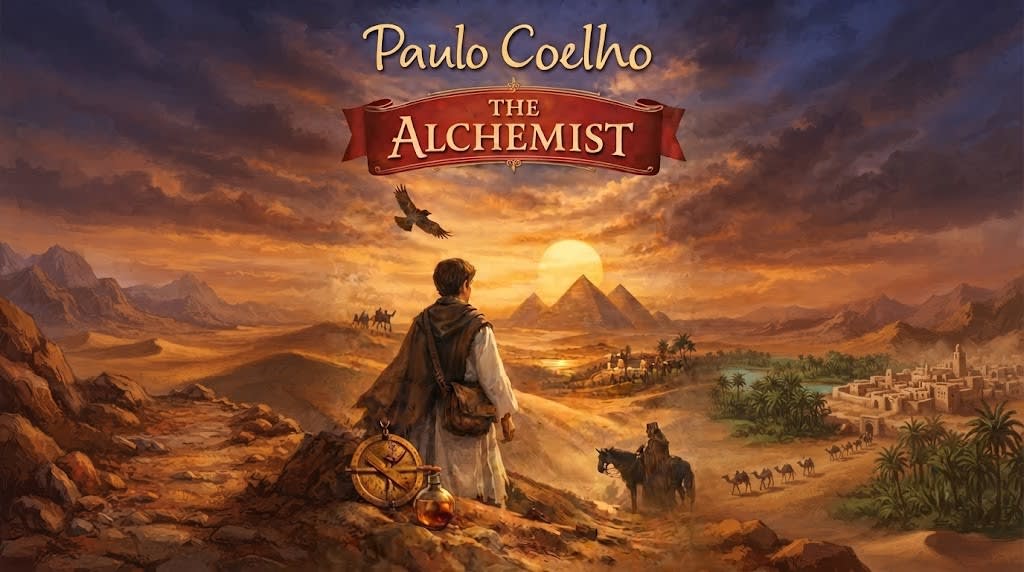
There are certain works that rise above the common landscape of literature and take their place upon a throne built not entirely from artistic achievement, but from the devotion of countless admirers. They become symbols rather than stories, possessing a reputation that grows larger with each passing year until the work itself is hidden beneath the immense shadow of its own praise.
Such, I believe, is the curious fate of The Alchemist by Paulo Coelho.
Few books have been embraced with such universal affection. It has been called a source of wisdom, a guide for dreamers, and a literary companion for those searching for purpose amid the uncertainty of existence. Its message has traveled across nations and generations, finding readers who see within its pages a profound revelation about ambition, destiny, and the pursuit of one's deepest desires.
Yet admiration, when allowed to proceed without examination, may become a veil that conceals rather than reveals. A work may be cherished for the comfort it provides while escaping the scrutiny normally granted to literature of lasting significance. The question before the critic is not whether a book has brought joy to its audience, for many lesser works have accomplished that feat. The question is whether the craftsmanship, philosophy, and emotional depth contained within its pages truly deserve the extraordinary elevation bestowed upon them.
In this regard, The Alchemist appears less a profound discovery of human nature and more a beautifully wrapped collection of familiar truths.
The central philosophy of the novel rests upon the idea that every person possesses a singular destiny, referred to as a "Personal Legend," and that the universe conspires to assist those who pursue it with enough devotion. This notion possesses undeniable appeal. It speaks to the human longing to believe that our struggles have meaning and that our lives follow some hidden design.
Yet therein lies the novel's greatest weakness. Its wisdom often comes in a form so polished and simplified that it loses the complexity found within genuine human experience. Life rarely presents itself as a clear path marked by signs from the universe. The pursuit of dreams frequently involves contradiction, sacrifice, failure, and circumstances beyond one's control. By reducing this struggle into a spiritual formula, the novel risks transforming profound questions into comforting assurances.
A philosophy becomes powerful when it challenges the reader. The Alchemist frequently comforts the reader instead.
The journey of Santiago, the young shepherd who leaves behind his existence in search of treasure, follows a structure that feels old rather than revolutionary. The idea of a young soul leaving home, encountering teachers, facing trials, and returning transformed is among the oldest patterns in storytelling. Such a foundation is not a flaw, for many great works have built upon the same structures. The difficulty arises when a simple framework is mistaken for a revelation.
Santiago's journey contains moments of beauty, yet his transformation often feels more like an acceptance of lessons presented to him than the result of deep internal conflict. He encounters characters who deliver wisdom, symbols that confirm his path, and events that reinforce the message the novel wishes to impart. The world around him seems designed to guide him toward understanding, leaving little room for the uncertainty and moral struggle that often define the most memorable literary characters.
The greatest characters in literature are rarely those who receive answers. They are those who wrestle with questions.
Ahab's obsession, Hamlet's hesitation, Raskolnikov's guilt, and countless other figures endure because their conflicts reveal the contradictions of humanity. They are wounded, confused, and imperfect. Their journeys do not offer simple instructions for living. They expose the difficult truths that exist within us all.
Santiago, by comparison, remains largely untouched by such darkness. His path contains obstacles, yet the novel rarely allows those obstacles to leave lasting marks upon his character. He learns, he progresses, and he arrives. The journey feels pleasant, yet the emotional terrain lacks the storms that make transformation believable.
The prose itself presents another curious contradiction. Coelho's writing possesses a certain elegance through its simplicity, and there is value in clarity. However, simplicity alone does not guarantee depth. A sentence may be easily understood and still fail to illuminate the mysteries it seeks to explore.
Much of the novel's language depends upon repeated declarations about destiny, dreams, and listening to one's heart. These ideas appear again and again until repetition begins to replace exploration. The reader is frequently reminded of the lesson rather than invited to discover it. The result resembles a sermon more than a conversation.
Literature of lasting power does not merely tell humanity what it wishes to hear. It examines humanity as it truly exists, with all its contradictions, failures, fears, and uncertainties.
The greatest concern with The Alchemist is not that its message is incorrect. Hope, perseverance, and courage are worthy themes. The concern is that the novel's immense reputation suggests a complexity and philosophical depth that the text itself does not consistently achieve.
A candle may provide warmth and light, and there is no dishonor in such a purpose. Yet one must not confuse the comfort of a candle with the brilliance of a star. The Alchemist offers comfort. It offers encouragement. It offers a gentle reminder that dreams deserve attention. These qualities explain its popularity and its ability to touch many readers.
However, popularity and profundity are not always companions.
A work may become beloved because it comes at the precise moment a reader needs its message. It may become a source of personal inspiration. It may even change lives. Such accomplishments should be recognized. Yet the critic must examine the work beyond its emotional influence and consider the craftsmanship beneath the admiration.
When the golden surface is removed, one discovers a tale of admirable intentions but limited exploration. The treasure promised within the journey is perhaps not hidden within the pages themselves, but within the hearts of those who read them and bring their own experiences to the story.
And perhaps that is the true mystery of The Alchemist. Its greatest power may not come from the wisdom it contains, but from the wisdom readers discover within themselves.
For that reason, the novel deserves appreciation.
It does not, however, deserve the crown of literary greatness that so many have placed upon its brow.
About the Creator
Tim Carmichael
Let your becoming be louder than your fear, and your smallest steps become the road you once thought impossible to walk. An Appalachian poet and cookbook author my book Beautiful and Brutal Things is on Amazon, Link 👇
Enjoyed the story? Support the Creator.
Subscribe for free to receive all their stories in your feed. You could also become a paid subscriber, letting them know you appreciate their work.
Comments
There are no comments for this story
Be the first to respond and start the conversation.