
The Ethics of Emptiness
Language Games, Moral Genealogies, and the Personal Choice to Mean

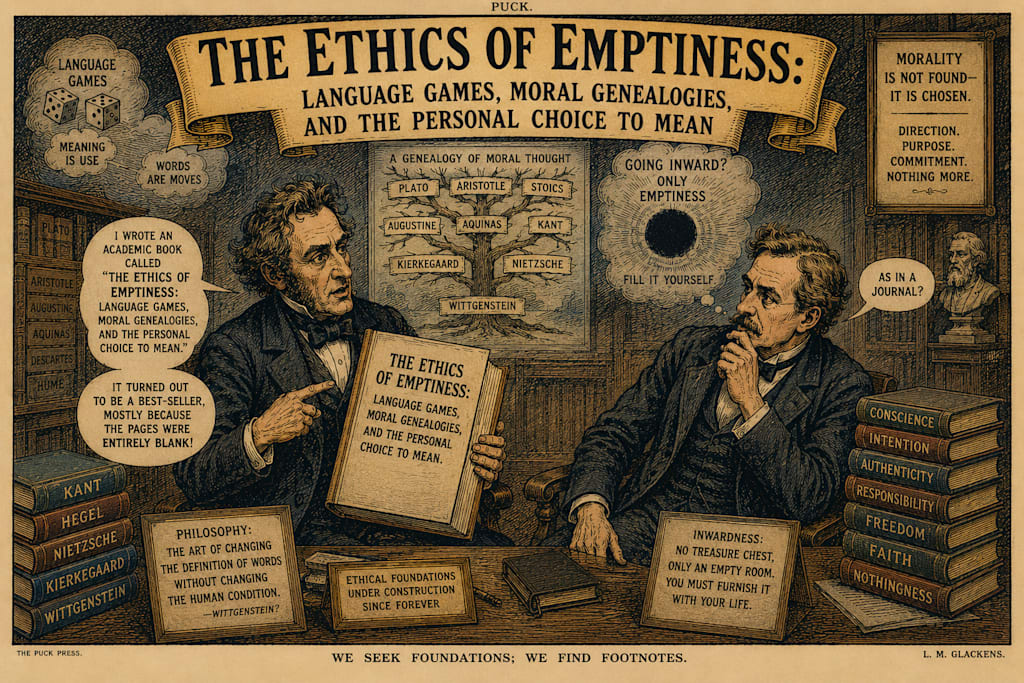
Introduction
In the works of Søren Kierkegaard and Ludwig Wittgenstein, inwardness appears at first as the final refuge of ethical seriousness: a space where the individual confronts truth not as doctrine, system or public slogan, but as something lived inwardly, suffered privately and reaffirmed through personal existence. Yet a critical genealogy of modern ethical thought complicates this hope. Once the moral traditions of Kantian duty, Kierkegaardian inwardness and Wittgensteinian silence are examined together, a more unsettling conclusion emerges. Much of moral philosophy turns out to be a vast labour of redescription, a perpetual rearrangement of terms such as duty, truth, will, inwardness, faith and authenticity, all of them moved across intellectual systems like counters in a language game. The promise that one might escape the emptiness of external convention by turning inward proves equally unstable. The inward self is not a treasury of moral law waiting to be discovered but an uncertain and often hollow space, one that offers no final guarantee of ethical truth. If morality survives this collapse, it survives not as objective necessity but as decision, direction and self-imposed purpose. To be moral is not to discover an eternal code hidden either in reason or in the soul. It is to choose, without metaphysical insurance, a way of existing toward others and toward oneself.
Part I. The Genealogy of Inwardness and the Collapse of Objective Moral Security
The history of ethical inwardness begins as a protest against the illusion that morality can be secured entirely through external rules, visible actions or social institutions. Kierkegaard’s Judge William, and later Climacus, insist that the decisive feature of ethical existence lies not merely in what one does outwardly but in how one wills, how one relates inwardly to one’s commitments, and how one inhabits the uncertainty of temporal life. This emphasis appears at first to rescue ethics from legalism and public theatricality. Kant had already separated the moral worth of an action from its consequences, locating value in the good will rather than in empirical success. Kierkegaard radicalises this by placing the individual in a drama of inward becoming, where ethical life is not measured by worldly accomplishment but by the seriousness with which one sustains a commitment within the ambiguity of existence. Yet the closer one follows this tradition, the more unstable its foundation becomes. The inward deed that is supposed to anchor ethical life remains strangely elusive. It is described as freedom, subjectivity, selfhood, faith, passion or responsibility, but each of these terms opens onto further abstraction rather than certainty.
The standard two-stage model of action, according to which inward willing is the true ethical core and external results merely contingent additions, appears to preserve moral seriousness against the accidents of the world. But this preservation is purchased at a price. It creates an inner sanctuary of value that risks becoming untouchable by reality, a moral theatre in which the agent remains noble regardless of what actually happens. The critique of moral luck exposes this tension. If two assassins will the same murder but only one succeeds, can their ethical standing truly be identical? The ordinary conscience says no, yet the inward model strains to say yes. In response, more subtle readings of Kant and Kierkegaard propose a unitary conception of action, in which willing unfolds through worldly action rather than preceding it as a sealed interior event. But even this rescue operation does not solve the deeper problem. Whether morality is placed in a pure will, in inward striving, or in the temporal unity of action, the language of moral philosophy keeps circling around the same void: it names structures of seriousness, but it does not produce a stable substance behind them.
This is where genealogy becomes devastating. Once one critically reviews the history of moral philosophy, one sees not a cumulative discovery of ethical truth but a succession of redescriptions. Stoic self-command becomes Christian inwardness; Christian inwardness becomes Kantian autonomy; autonomy becomes existential authenticity; authenticity becomes linguistic therapy or ethical self-fashioning. The words change, the emphases shift, the metaphysical scaffolding is dismantled and rebuilt, but the pattern remains one of conceptual substitution rather than final grounding. Moral thought often appears less like the discovery of truth than like the continual editing of inherited vocabularies. What was once called virtue becomes duty; what was once called conscience becomes authenticity; what was once called sin becomes alienation or bad faith. The philosophical labour is real, but it increasingly resembles a struggle over definitions rather than an unveiling of moral reality. In this sense, the history of ethics is inseparable from the history of language itself: morality survives by changing its grammar, not by securing an unquestionable foundation.
Part II. Wittgenstein, Kierkegaard, and the Empty Interior of the Ethical Self
Wittgenstein’s encounter with Kierkegaard sharpens this problem rather than resolving it. Both thinkers distrust the fantasy that essential truths can be transparently stated, codified or demonstrated through objective reason. Both insist that there are dimensions of existence which can only be lived, enacted or inwardly appropriated. Kierkegaard speaks of subjective truth, of the paradoxical task of existing in relation to what cannot be objectively mastered. Wittgenstein, in his own very different idiom, suggests that the most important matters are precisely those that cannot be straightforwardly said. The ladder of the Tractatus must be climbed and then thrown away; propositions that appear to disclose the limits of sense reveal themselves as nonsensical once their work is done. At first glance this seems to support the dignity of inwardness. Ethical or religious truth cannot be reduced to propositions because it belongs to a mode of life rather than to a body of information. But this gesture, when critically examined, also empties the ethical interior. If what matters most cannot be said, and if the attempt to say it dissolves into nonsense, then inwardness risks becoming a sanctified vacancy, a place where the inability to justify oneself is elevated into profundity.
Kierkegaard’s distinction between subjective and objective understanding is often invoked to defend the existential seriousness of this inward sphere. Objective reflection seeks timeless, detached certainty; subjective reflection inhabits temporality, risk, becoming and passion. Essential truth, on this view, is not something one possesses as a fact but something one becomes through one’s mode of existence. Yet the difficulty remains: what exactly is found when one turns inward? Not a stable moral law, not an indubitable content, and not even a transparent self. The self that inwardness discovers is fractured by temporality, haunted by contradiction, dependent on repetition and vulnerable to despair. One does not enter inwardness and find a hidden ethical treasure. One enters inwardness and finds instability, silence, anxiety, self-division and the need to choose without guarantee. The same is true of Wittgenstein’s later suspicion of philosophical abstraction. He dissolves many philosophical problems by returning words to their ordinary use, by showing how conceptual confusion arises when language goes on holiday. Yet when this therapeutic method is brought to ethics, it does not yield a moral foundation. It yields only the recognition that many ethical disputes are sustained by misuse, by metaphysical inflation, by our desire to say more than language can responsibly bear.
This is why the critical conclusion of the genealogy is so stark. Much of moral philosophy turns out to be a contest over language games. Philosophers define duty, redefine freedom, reinterpret will, rearrange the relation between self and world, and then present the result as moral discovery. But often what has changed is not the human condition but the vocabulary through which it is narrated. Kierkegaard’s inwardness, Kant’s good will and Wittgenstein’s unsayable ethical seriousness all retain force as existential gestures, yet none of them finally fills the void they open. They tell us that morality cannot be reduced to consequences, social conformity or public language, but they do not provide a positive moral essence waiting within the subject. The inward turn strips away external consolations only to reveal that there is no complete inner lawbook underneath. The ethical self is not a pre-given substance but a task of composition. Its inwardness is not the possession of truth but the burden of having to create seriousness where no final metaphysical support can be found.
Part III. Morality After the Ruins of Foundation: Choice, Direction and the Will to Fill the Void
What remains once the genealogies have been traced, the abstractions dismantled and the inward refuge shown to be largely empty? What remains is not nihilism in the crude sense, nor the cheerful declaration that anything goes. What remains is something more demanding: the recognition that morality persists only as a human decision to orient oneself in a certain way despite the absence of final guarantees. If neither rational universality, nor divine command, nor inward essence can decisively ground ethics, then moral life becomes a practice of chosen direction. One does not discover the good as one discovers a law of physics. One commits oneself to a way of treating others, to a way of carrying one’s own existence, to a discipline of responsibility, pity, fidelity, restraint or courage, knowing that these commitments are not underwritten by an infallible metaphysical court. Ethics becomes less a science of objective duties than an art of self-binding.
This does not mean that all moral vocabularies are equal or that cruelty and compassion differ only by preference. It means rather that the force of morality lies in the seriousness with which one assumes and sustains a direction, not in the fantasy that one has uncovered an indubitable essence of the good. Kierkegaard’s emphasis on repetition, commitment and becoming remains valuable precisely because it can be detached from the illusion of hidden inward content. The self is not moral because it contains morality. The self becomes moral by repeatedly choosing to bind itself to forms of conduct and relation that resist egoism, domination and indifference. Wittgenstein’s suspicion of ethical theorising can also be retained in a transformed way. If many philosophical disputes about morality are indeed language games, then ethical seriousness may require fewer grand definitions and more lucid attention to how one actually lives, speaks, harms, excuses and responds. The task is no longer to locate morality in an occult interior region but to decide what kind of life one will count as worth inhabiting.
In this sense, emptiness is not merely a loss; it is also the condition of ethical authorship. The inward void discovered by modern philosophy does not abolish morality but transfers its burden back onto the individual. You are not given a finished ethical essence. You are given a field of inherited vocabularies, historical examples, damaged traditions, philosophical arguments and social demands, and within that field you must decide what to affirm, what to reject and what to become. Moral language remains necessary, but its necessity is practical rather than metaphysical. It gives shape to our commitments, names our ideals, exposes our failures and lets us negotiate the terms of coexistence. Yet it no longer carries the authority of an unquestionable foundation. It is one of the tools by which human beings try to fill the emptiness within and between themselves.
The final consequence of this genealogy is therefore both sobering and liberating. To be ethical is not to uncover the one true moral code hidden behind all appearances. It is to choose a purpose, to adopt a direction, to make oneself answerable to a standard one cannot fully justify from outside existence itself. This is why morality survives even after the collapse of moral certainty. It survives because human beings continue to need orientation, continue to suffer from their own egoism, continue to encounter the vulnerability of others, and continue to seek forms of life that are not merely arbitrary. But the old hope that inwardness would reveal an already existing moral truth must be abandoned. Going inward, one finds not a law engraved in the soul but an emptiness that must be filled by decision, repetition and style of life. Ethics, after the ruins of foundation, is not a discovery but a task.
Conclusion
The modern history of inwardness does not culminate in the triumph of the ethical self but in its radical exposure. Kant, Kierkegaard and Wittgenstein each attempt, in different ways, to rescue morality from externalism, mechanism and abstraction. Yet their legacy, read critically, points toward a different conclusion: that the inward turn strips morality of false certainties without replacing them with an inner essence. What remains is a space of choice, a burden of self-direction, and a recognition that moral seriousness is made rather than found. Ethics becomes the work of giving form to emptiness, of choosing a purpose where no final authority compels one, and of deciding, again and again, what kind of being one is willing to become.
Kierkegaard, S. (1846) Concluding Unscientific Postscript to Philosophical Fragments. Princeton: Princeton University Press; Wittgenstein, L. (1922) Tractatus Logico-Philosophicus. London: Routledge & Kegan Paul; Hoelle, L. (2013) ‘Climbing Down the Ladder: Inwardness and Abstraction in Wittgenstein’s Philosophy with Reference to Kierkegaard’, Kierkegaard Studies Yearbook, 18(1), pp. 263–285.
About the Creator
Peter Ayolov
Peter Ayolov’s key contribution to media theory is the development of the "Propaganda 2.0" or the "manufacture of dissent" model, which he details in his 2024 book, The Economic Policy of Online Media: Manufacture of Dissent.
Enjoyed the story? Support the Creator.
Subscribe for free to receive all their stories in your feed.
Comments
There are no comments for this story
Be the first to respond and start the conversation.