
The Conspicuous Stupidity of the European Movement
How Missing the Thracian Toponym Created The Total Loss of Spatial Orientation and The Self-Image Crisis in Western Historiography (Pattern Humanism Series)

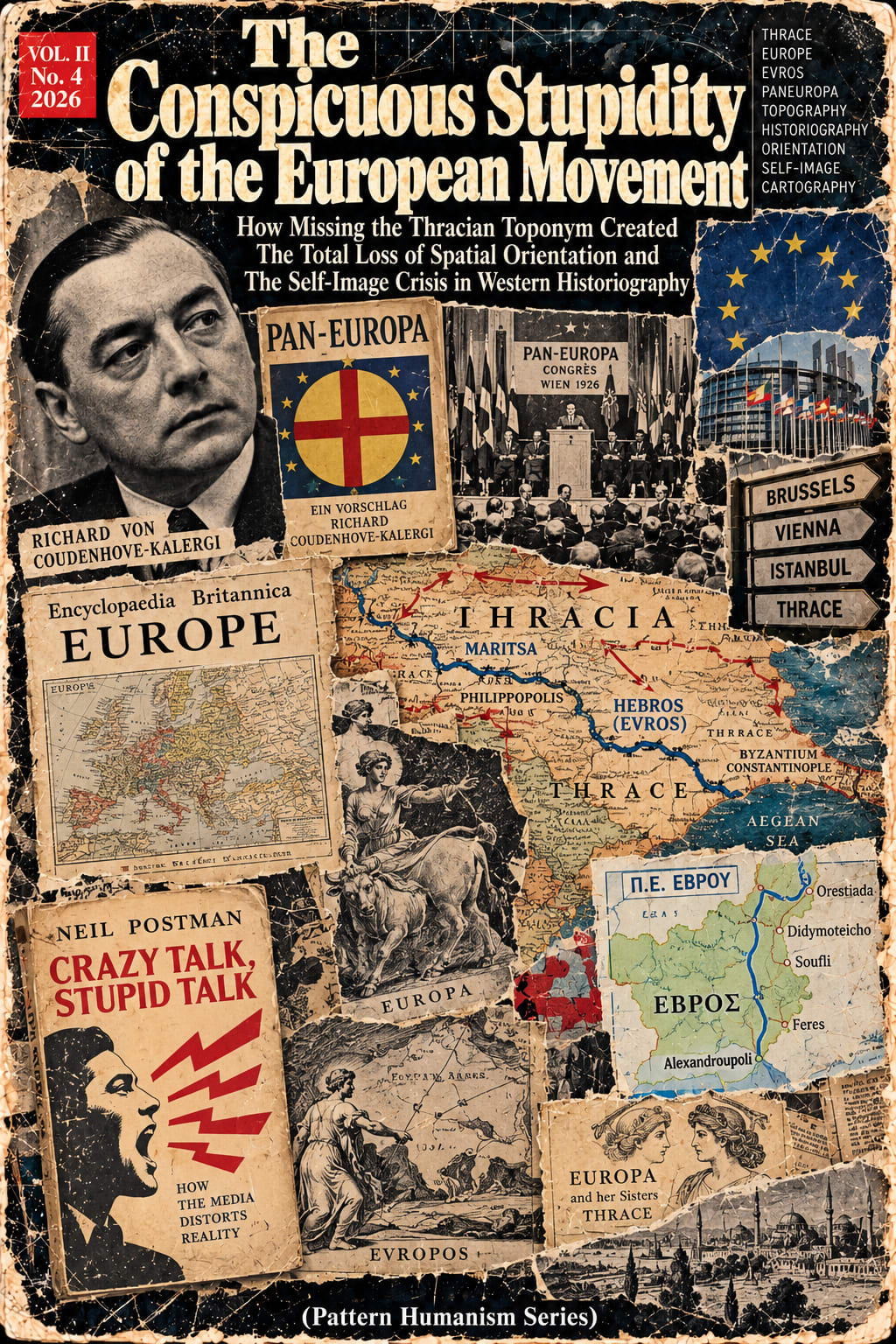
The book "Pattern Humanism: Calibrating the Biological PRM to Trace and Preserve Universal Patterns" is a collection of 46 interconnected philosophical essays exploring the biological origins of cognition, the persistence of informational patterns, artificial intelligence, the constructed Self, and the technologically managed stable decline of modern civilisation.
Ayolov, P. (2026) Pattern Humanism: Calibrating the Biological PRM to Trace and Preserve Universal Patterns. Amazon. ASIN:B0HNL8WH8J
Abstract
The historical identity of Europe rests upon a peculiar contradiction: a geographical designation attested in ancient Greek descriptions of the mainland is frequently explained through the myth of a Phoenician princess whose legendary travels never reached the territory subsequently bearing her name. This article investigates the displacement of geographical knowledge by inherited cultural narratives, examining the Homeric Hymn to Apollo, Herodotus's scepticism, and the neglected Balkan landscape of Thrace, Macedonia and mainland Greece. Distinguishing documented territorial usage from disputed etymological derivations, it traces the transformation of European identity through Carolingian imperial symbolism, nineteenth-century Pan-Germanism and Pan-Slavism, and the interwar Pan-European movement. Hannah Arendt's analysis of continental imperialism provides the political framework for comparing expansive nationalist ambitions with contemporary programmes of collective reorganisation, including the classificatory assumptions associated with eugenics. Richard von Coudenhove-Kalergi's Praktischer Idealismus becomes a central case study in the tension between speculative social engineering and historical reality, examined through Neil Postman's critique of self-defeating language in Crazy Talk, Stupid Talk. The investigation subsequently considers the selective presentation of Europe's origins in encyclopaedic knowledge, institutional educational materials and algorithmically mediated information. Its central argument concerns the progressive substitution of ideological representation for geographical orientation, whereby political abstractions acquire an authority disproportionate to their historical foundations. Grounded in the relationship between embodied perception, linguistic classification and material existence, the article asks whether European civilisation can recover a coherent self-image without first distinguishing the continent's physical history from the myths and political programmes constructed in its name.
Keywords: Pattern Humanism; European Movement; Thracian Toponymy; Herodotus; Homeric Hymns; Charlemagne; Pan-Nationalism; Pan-Germanism; Pan-Slavism; Pan-Europeanism; Eugenics; Richard von Coudenhove-Kalergi; Praktischer Idealismus; Hannah Arendt; Neil Postman; Crazy Talk, Stupid Talk; Spatial Orientation; Western Historiography.
“The continent of Europe was named after Europa, a princess from Greek mythology.”
European Commission (2026) Let’s Explore Europe!. Luxembourg: Publications Office of the European Union.
“They had three children and it was from the princess that the continent got its name: Europe.”
European Commission (2026) EUROPE: Building Together. Luxembourg: Publications Office of the European Union.
(Both publications are available through the Publications Office of the European Union.)
Introduction: The Continent That Forgot Its Address: A Geography Buried Beneath a Myth
“What’s in a name? That which we call a rose by any other word would smell as sweet.”
William Shakespeare, 1597, Romeo and Juliet.
There is something intellectually astonishing about a civilisation that can describe the history of its institutions in extraordinary administrative detail while explaining the origin of its own name through the adventures of a Phoenician princess abducted by a god disguised as a bull. The European Commission's educational publication Europe: Building Together introduces the question of continental nomenclature with the familiar legend of Europa, carried from the eastern Mediterranean to Crete by Zeus. The story possesses undeniable cultural significance, having inspired centuries of painting, sculpture, literature and political symbolism. Its historical explanatory value, however, was already questioned more than two millennia before the establishment of modern European institutions. In the fifth century BCE, Herodotus expressed bewilderment at the division of a single terrestrial expanse into three regions bearing women's names. In the forty-fifth chapter of the fourth book of his Histories, he acknowledged that neither the origin of the designation nor the identity of whoever introduced it could be established with confidence. The presumed Phoenician namesake presented an additional geographical contradiction: according to the tradition he examined, she travelled from Asia to Crete and subsequently to Lycia without entering the mainland known to the Greeks as Europe. More importantly, the geographical expression had already appeared in the Homeric Hymn to Apollo, where it distinguished a portion of continental Greece from the Peloponnese and the surrounding islands. This early usage places the historical investigation within the physical environment of the southern Balkan peninsula, long before the modern distinction between Western and Eastern civilisational identities acquired its political significance. The geographical names Eurotas, Europos and Hebros, associated respectively with Laconia, Macedonia and Thrace, further invite an examination of the relationship between ancient language and the territory it designated. Their resemblance does not establish a common etymological origin, and the precise derivation of the continental name remains disputed. Yet the existence of this uncertainty makes the unqualified presentation of a mythological explanation particularly revealing. The problem is not that public institutions recount an ancient legend, since mythology constitutes an indispensable component of cultural inheritance. It arises when the distinction between symbolic narrative, linguistic hypothesis and documented geographical usage disappears from an account intended to explain historical origins. The resulting confusion provides an initial example of conspicuous stupidity: not an absence of available knowledge, but a persistent failure to distinguish different categories of explanation despite possessing the intellectual resources necessary to do so.
This semantic discrepancy acquires wider consequences when examined through the successive political projects that sought to transform a heterogeneous landmass into a unified historical subject. Charlemagne's imperial coronation in 800 and the emergence of the Carolingian ruler as a symbolic father of Europe marked an important stage in the appropriation of continental identity by Latin Christian political authority. Subsequent medieval and Renaissance interpretations elaborated competing images of civilisation, inheritance and geographical belonging, while the nineteenth century witnessed the proliferation of ambitious movements claiming to represent populations beyond established territorial boundaries. Pan-Germanism and Pan-Slavism challenged existing political arrangements through expansive linguistic and ethnic categories; Pan-Africanism and Pan-Arabism developed under different historical pressures, including colonial domination and demands for political independence. These projects cannot responsibly be reduced to a single ideological programme. Nevertheless, their comparison reveals how collective classification could become an instrument for imagining political orders larger than the concrete communities from which their advocates emerged. Hannah Arendt's investigation of continental imperialism illuminates the dangerous transformation of cultural affiliation into claims of historical destiny, especially where expansive nationalism weakened the distinction between political jurisdiction and supposedly natural collective identity. The simultaneous growth of eugenic thinking introduced another manifestation of classificatory ambition, attempting to reorganise human populations according to speculative hierarchies presented as scientific necessities. Within this intellectual environment, Richard von Coudenhove-Kalergi's Pan-European movement proposed a new continental arrangement, while his Praktischer Idealismus combined political aspiration with controversial propositions concerning aristocracy, technology and the future organisation of society. Neil Postman's Crazy Talk, Stupid Talk provides a critical vocabulary for examining the linguistic mechanisms through which such theoretical constructions acquire an appearance of inevitability. The philosophical question extends beyond the merits or failures of any particular integration programme. Human beings inhabit material environments, but the identities through which they interpret those surroundings depend upon inherited representations that can become increasingly independent of the conditions they originally described. When geographical nomenclature is transformed into political mythology, and speculative social arrangements are represented as the natural fulfilment of history, the observer risks mistaking a conceptual construction for the world itself. The investigation that follows therefore moves from ancient mainland topography and classical scepticism to imperial symbolism, the intellectual genealogy of pan-nationalism, and contemporary institutional accounts of continental origins. Its purpose is to establish whether Europe's celebrated capacity for historical self-reflection has been accompanied by an equally remarkable reluctance to examine the geographical and linguistic foundations of its own self-image.
Part I: Before Zeus Found His Bull: The Balkan Geography That Gave Europe Its First Coordinates
“The land which surrounds these, as before remarked, consists of three divisions. Of these, the configuration of Europe is the most irregular.”
Strabo, first century BCE–first century CE, Geography, Book II.
Long before the continent acquired its modern political boundaries, the designation Europe belonged to a geographical vocabulary developed around the Aegean and the southern Balkan mainland. One of its earliest surviving appearances occurs in the Homeric Hymn to Apollo, where the god announces his intention to establish an oracle accessible to inhabitants of the Peloponnese, Europe and the surrounding islands. The distinction is remarkable because the three expressions identify separate geographical categories within a recognisable physical environment. The Peloponnese constitutes the great southern peninsula, the islands belong to the maritime world, and Europe denotes the continental territory beyond them. The passage occurs twice, around lines 250–251 and 290–291, in the Pythian portion of the composition traditionally transmitted under the Homeric name. Its geographical terminology belongs to an early period of Greek literature, although the hymn's precise date and composite history remain subjects of scholarly discussion. Nothing in this description requires the story of a Phoenician princess transported across the Mediterranean by Zeus. The designation already functions independently as an intelligible reference to inhabited territory. Its meaning must nevertheless be reconstructed within the geographical knowledge available to its original audience rather than projected backwards from contemporary continental boundaries. The mainland extending beyond the Corinthian Gulf opened towards Thessaly, Macedonia and Thrace, regions connected through river valleys, mountain passages, trade routes and successive patterns of settlement. Ancient Greek geographical consciousness developed within this material environment, gradually incorporating territories increasingly distant from the immediate horizon of the Aegean. The transformation from a comparatively restricted regional expression into a name embracing a vast northern and western landmass therefore presents a historical problem of semantic expansion. A familiar place could lend its designation to increasingly extensive surroundings as exploration and political knowledge developed. The early twentieth-century commentators Thomas Allen and Edward Sikes interpreted the hymn's usage as referring principally to northern Greece and observed that ancient lexicographical traditions associated the continental name with Europos, a Macedonian city. Their discussion is particularly revealing because it records an explanation already circulating among ancient scholars, rather than a resemblance invented through modern Balkan nationalism. The geographical association is consequently older than contemporary debates over the historical identity of Europe. Yet evidence that a word designated mainland territory does not establish exactly where it was first coined. The distinction between the oldest surviving occurrence, the region originally described and the linguistic formation of the name must remain intact. What the hymn establishes beyond reasonable doubt is that Europe possessed a concrete geographical function within the Greek world, without depending upon the later political significance attached to the continent.
The surrounding landscape preserves several names whose linguistic resemblance invites closer examination. The Eurotas flows through Laconia towards the southern coast of the Peloponnese, while Europos designated an ancient Macedonian settlement associated with the Axius valley. Farther east, the Hebros traversed Thrace before reaching the northern Aegean, connecting territories now divided among Bulgaria, Greece and Turkey. Its modern names, Maritsa and Evros, reflect different linguistic histories; neither should automatically be substituted for its ancient Greek form, Ἕβρος. The geographical distribution of these names demonstrates how rivers, settlements and regional designations organised the lived environment long before political borders acquired their present configuration. Their etymological relationship, however, is more complicated than modern pronunciation suggests. Εὐρώπη, Εὐρωπός and Εὐρώτας share recognisable elements associated with Greek formations involving breadth or extension, although their individual derivations require separate investigation. The name Hebros presents different phonological and historical questions, including the possibility of a Thracian linguistic origin. Similarity between Evros and Europe in contemporary Greek cannot independently establish a common ancient root. More significant is the testimony of geographical and lexicographical scholarship connecting Europos with the history of the continental designation. Stephanus of Byzantium preserves an ancient explanatory tradition associating the two names, while other interpretations understand Europe as describing a broad prospect or extensive mainland. These alternatives reveal the difficulty of reconstructing nomenclature transmitted across changing languages and centuries of textual preservation. A further association appears within mythological genealogy, where traditions connect the personifications of Thrace and Europa through familial relationships. Such stories demonstrate that geographical places could themselves be expressed through human figures, making the distinction between mythology and territorial memory considerably less straightforward than a simple opposition between fiction and fact. They cannot, by themselves, establish priority of naming or prove that the Phoenician narrative replaced an earlier Thracian derivation. Nevertheless, the existence of competing geographical explanations undermines any account treating the abduction story as the uncontested historical origin of the continental name. The ancient landscape was neither linguistically empty nor dependent upon Western European political institutions to acquire meaning. Its inhabitants named rivers, distinguished territories and transmitted spatial knowledge through ordinary practices of settlement and communication. The decisive question is therefore not whether a modern nation can claim ownership of the word Europe, but how an ancient geographical designation expanded beyond its original surroundings while retaining traces of the world in which it first became intelligible.
Part II: Herodotus Against the Bull: When Antiquity Questioned Its Own Foundational Story
“However let us quit these matters. We shall ourselves continue to use the names which custom sanctions.”
Herodotus, fifth century BCE, Histories, Book IV, Chapter 45. Translation by George Rawlinson.
The most devastating challenge to the familiar explanation of Europe's name was formulated not by a modern critic of European institutions but by Herodotus, writing in the fifth century BCE, when the geographical division of the known world was already sufficiently established to invite historical examination. In Book IV, Chapter 45 of his Histories, the historian interrupts his account of the Scythian territories to consider a peculiar intellectual convention: the division of a single continuous earth into three enormous regions bearing the names of women. His objection concerns neither the usefulness of geographical nomenclature nor the cultural legitimacy of mythological storytelling. He questions the grounds upon which inherited classifications acquire the authority of knowledge. Why should Europe, Asia and Libya constitute three separate divisions when their boundaries depend upon uncertain conventions? Who first introduced these distinctions, and what evidence established the origins of their designations? Herodotus observes that the Nile and the Phasis were commonly accepted as dividing lines, although alternative accounts placed the separation between Asia and Europe along the Tanais and the Cimmerian crossing. The coexistence of incompatible frontiers exposes the conventional nature of arrangements often treated as geographical certainties. His scepticism becomes particularly incisive when he turns to the purported female namesakes. Libya was conventionally associated with an indigenous woman, while Asia was attributed either to the wife of Prometheus or, according to a competing Lydian tradition, to Asies, a descendant of Manes. Europe presented an even more conspicuous difficulty. Its northern and eastern limits remained unknown, and neither the person responsible for its designation nor the linguistic circumstances of its formation could be established. Herodotus considers the possibility that the continent acquired its name from Europa of Tyre, only to expose the geographical weakness of that explanation: the legendary woman originated in Asia and travelled to Crete and subsequently Lycia, without reaching the mainland that Greeks recognised as Europe. This observation does not constitute a scientific demonstration of an alternative derivation, nor does the historian claim to possess one. Its importance lies in his refusal to confuse the circulation of an explanation with evidence of its validity. He identifies a contradiction, acknowledges the limits of available knowledge and declines to manufacture certainty where none can be established. His final decision to retain customary terminology is equally significant. A name may remain convenient even when its origin is unknown, because communication requires shared conventions rather than complete agreement about their historical foundations. Such intellectual restraint stands in striking contrast to the tendency of later popular narratives to transform one possible association into an apparently definitive account of continental origins.
The wider implications of this passage emerge from the geographical revolution taking place within Greek intellectual culture. Early maps associated with Anaximander and the subsequent investigations of Hecataeus attempted to organise the inhabited world through coastlines, rivers, distances and the distribution of peoples. These representations were imperfect and frequently speculative, but they marked a movement towards describing terrestrial relationships independently of divine genealogies. Herodotus inherited this developing tradition while recognising that geographical knowledge remained unevenly distributed. Maritime routes made certain coastal regions familiar, whereas vast northern interiors survived in reports combining observation, hearsay and imaginative reconstruction. His descriptions of Scythia are particularly revealing because they juxtapose competing origin stories with information about waterways, migrations, settlements and political relationships. The historian repeatedly confronts a world in which communities possess elaborate explanations of their ancestry but considerably less reliable knowledge of territories beyond their immediate experience. This discrepancy raises a problem extending far beyond classical cartography: naming is an act of conceptual organisation, and a designation may outlive the assumptions through which it originally acquired significance. The threefold arrangement of the inhabited earth was never an immutable physical property of the planet. It was a classificatory scheme whose persistence depended upon education, collective memory and established practices of communication. The separation of Europe from Asia was particularly unstable because the two belong to a continuous landmass, making every proposed frontier dependent upon selected geographical features and inherited cultural distinctions. Rivers could provide convenient boundaries without constituting natural divisions between civilisations. Similarly, the names attached to those regions could preserve ancient associations even as expanding knowledge transformed their territorial extent. Herodotus's achievement was therefore more profound than the rejection of an implausible legend. He demonstrated that an accepted description of reality could be historically contingent without becoming useless, and that exposing uncertainty need not require abolishing the vocabulary through which people understand their surroundings. The distinction anticipates a fundamental problem of modern institutional knowledge: the substitution of a familiar explanation for the more demanding investigation of how that explanation became authoritative. An encyclopaedia, schoolbook or political publication may legitimately recount the myth of Europa as part of the continent's cultural inheritance. The intellectual error arises when such a narrative ceases to be identified as tradition and begins functioning as an uncontested statement of historical derivation. The ancient historian offers no justification for replacing that account with an equally unverified Thracian etymology. Instead, he establishes a more exacting principle: the geographical reality of a place, the historical development of its name and the stories subsequently attached to it must remain distinguishable. What makes his intervention enduringly relevant is that he recognised the inadequacy of inherited certainty while Europe's geographical identity was still being constructed. Two and a half millennia later, the challenge is not to rediscover his scepticism but to explain why its methodological implications remain so easily overlooked.
Part III: From Charlemagne to the Pan-Mania: The Political Invention of a Continent Without Borders
“Pan-movements preached the divine origin of one's own people in contrast to the Jewish-Christian faith in the divine origin of Man. According to them, man, belonging inevitably to some people, received his divine origin only indirectly through membership in a people.”
Hannah Arendt, 1951, The Origins of Totalitarianism.
The transformation of Europe from a geographical designation into a political identity did not begin with modern integration but emerged through successive attempts to invest territory with civilisational authority. Charlemagne's coronation as emperor in Rome on Christmas Day in 800 introduced a powerful contradiction into the political inheritance of antiquity: the Frankish ruler received an imperial title associated with Roman universality while an established imperial court continued to govern from Constantinople. The resulting competition concerned legitimacy, religious authority and the geographical imagination of Christian rulership. In the Paderborn Epic, composed around the time of Charlemagne's encounter with Pope Leo III, the Frankish sovereign appears as a father of Europe, an expression whose significance lies less in its resemblance to modern political terminology than in its capacity to transform a particular monarchy into the representative of a much larger territorial community. The designation did not describe an existing continental state. Neither the Balkan peninsula nor the Byzantine Empire had ceased to belong to the geographical space inherited from antiquity. Yet the language of imperial celebration permitted a western ruler to personify an entity whose political, religious and cultural diversity exceeded his jurisdiction. This rhetorical appropriation illustrates a recurring mechanism through which institutions claim authority over abstractions considerably larger than their material foundations. The Carolingian intellectual environment depended predominantly upon Latin learning, including Roman historiography, Christian scholarship and classical literary traditions transmitted through monastic education. Knowledge of Greek was limited but not entirely absent, and the available evidence does not establish a deliberate campaign to suppress ancient geographical accounts of Macedonia or Thrace. The more defensible historical observation concerns selective inheritance: political communities repeatedly reconstructed antiquity through the texts, languages and symbols most accessible to their own circumstances. During subsequent centuries, the differentiation of Latin Christendom from the Byzantine and Islamic worlds contributed to increasingly selective conceptions of European belonging. Renaissance humanism recovered additional Greek sources without dissolving the political usefulness of inherited geographical conventions. Early modern cartography subsequently expanded the precision of territorial representation while imperial competition invested continental distinctions with new claims of cultural superiority. The paradox is that improved geographical knowledge did not necessarily diminish the ideological employment of geographical names. Europe could become more accurately mapped while its supposed civilisational unity remained an imaginative construction. The political West increasingly appeared as the privileged interpreter of an ancient designation whose earliest surviving geographical contexts belonged to a different historical landscape. This process did not require a single conspiracy or continuous institutional programme. It operated through the cumulative authority of education, dynastic ambition, religious distinction and historical storytelling, gradually encouraging the identification of a vast and heterogeneous continent with selected traditions of its western territories.
The nineteenth century transformed this inherited practice into an ambitious programme of collective enlargement. The proliferation of pan-movements reflected the tensions produced by industrialisation, imperial competition, nationalism and the growing conviction that language or ancestry could provide a political identity transcending established frontiers. Pan-Germanism imagined the consolidation of German-speaking populations across existing jurisdictions, while Pan-Slavism appealed to linguistic and cultural affinities among peoples distributed throughout the Russian, Habsburg and Ottoman spheres. Their political objectives varied considerably, ranging from cultural cooperation and national emancipation to territorial expansion and imperial predominance. What united their more radical expressions was the proposition that the boundaries of legitimate political authority should correspond to a supposedly pre-existing collective identity, even where that identity had never constituted a single sovereign community. Hannah Arendt identified the particularly dangerous implications of this reasoning in her analysis of continental imperialism. Unlike overseas expansion, which could preserve a visible distinction between metropolitan state and colonial possession, the continental varieties sought to extend political domination across neighbouring populations while presenting expansion as the recovery of an organic national whole. The movement could consequently claim to represent a people beyond the limits of citizenship, constitutional jurisdiction or territorial accountability. Its imagined community became more authoritative than the concrete institutions through which individuals exercised political rights. Arendt's criticism cannot, however, be transferred indiscriminately to every organisation employing the prefix pan. Pan-Africanism developed in substantial part as a response to slavery, racial subordination and colonial rule, while Pan-Arabism emerged through distinct struggles concerning imperial dissolution, cultural affiliation and independence. These movements contained competing political programmes and cannot be assimilated automatically to the racial expansionism associated with radical Pan-German ideology. The analytical similarity lies instead in the capacity of expansive collective categories to reorganise political imagination, sometimes challenging domination and sometimes reproducing it. The decisive distinction concerns whether solidarity remains compatible with the autonomy of actual persons and communities or becomes a justification for subordinating them to an imagined historical destiny. The intellectual environment of the fin de siècle further complicated this transformation through the prestige of scientific classification. Eugenic theories attempted to convert disputed assumptions about heredity and social value into programmes for regulating human reproduction, demonstrating how an abstract model could acquire administrative ambitions far exceeding its evidential foundations. Although biological selection and continental federation pursued different objectives, both invite examination of the circumstances in which intellectual systems begin treating human populations as material for comprehensive redesign. The emergence of Pan-Europeanism after the First World War belonged to this wider age of ambitious collective reorganisation, but its declared commitment to peace also distinguished it from explicitly expansionist nationalist programmes. The central historical problem is therefore not the existence of large-scale political imagination itself. It is the moment when a proposed unity ceases to acknowledge its constructed character and begins presenting itself as the necessary expression of history, geography or human nature.
Part IV: The Eugenics of Utopia: Coudenhove-Kalergi, Hannah Arendt and Neil Postman's Crazy Talk
“War is peace. Freedom is slavery.”
George Orwell, 1949, Nineteen Eighty-Four.
The intellectual landscape from which the Pan-European movement emerged was dominated by an extraordinary confidence in humanity's capacity to redesign its own existence through scientific classification, technological intervention and comprehensive political planning. Industrialisation had transformed the organisation of labour, Darwinian evolutionary theory had unsettled inherited accounts of human origins, and the expansion of statistical administration encouraged governments to understand populations through measurable characteristics rather than individual experience. Within this environment, Francis Galton's formulation of eugenics in 1883 offered a particularly revealing example of the transformation of speculative knowledge into an ambitious programme of social intervention. By treating hereditary characteristics as the foundation of human improvement, its advocates proposed that reproduction could be directed towards supposedly desirable biological outcomes. The fundamental error was not the investigation of heredity itself but the conversion of historically contingent judgements concerning intelligence, fitness and social value into prescriptions for governing human existence. Individuals became representatives of abstract hereditary qualities, while institutions claimed authority to distinguish between desirable and undesirable futures. Comparable classificatory ambitions appeared in radical expressions of Pan-Germanism and Pan-Slavism, where linguistic affinity, presumed ancestral continuity and collective destiny were invoked to justify political arrangements exceeding established territorial jurisdictions. Hannah Arendt identified the decisive danger in the transformation of historically constituted peoples into supposedly permanent communities possessing qualities independent of their actual institutions, traditions and circumstances. Her critique of continental imperialism exposed how expansive nationalism could subordinate citizenship and political responsibility to imagined racial or spiritual essences. The individual ceased to matter as a person possessing rights and obligations within a particular community; significance increasingly derived from membership in an allegedly predestined collectivity. This intellectual mechanism differed from biological eugenics in its immediate objectives, but both could transform human diversity into a classificatory hierarchy claiming authority over concrete lives. Such similarities do not establish that every project of international cooperation belongs to the genealogy of totalitarianism. Pan-African emancipation, European federalism and racial expansionism developed under different historical conditions and pursued fundamentally different purposes. Their comparison becomes philosophically meaningful only when directed towards the underlying relation between theoretical abstraction and political power. The critical threshold is crossed when an explanatory category ceases to function as an instrument for understanding society and becomes an unquestionable mandate for restructuring it. At that point, the conceptual model no longer answers to the world it describes; the world is expected to conform to the model.
Richard von Coudenhove-Kalergi entered this atmosphere with a programme whose declared objectives differed markedly from the aggressive territorial nationalism of earlier imperial movements. His 1923 Paneuropa advocated continental cooperation as a response to the devastation of the First World War, the vulnerability of fragmented European states and the emergence of competing global powers. Yet his 1925 Praktischer Idealismus reveals a more complicated philosophical imagination than the diplomatic language of peace and federation might suggest. Organised around aristocracy, technology and pacifism, the work examines the displacement of hereditary elites, the emergence of new intellectual hierarchies, the political consequences of mechanisation and the possibilities of social transformation. Particularly troubling are its speculative distinctions between human types, its racialised assumptions and its tendency to envisage future social development through selective forms of cultural and biological differentiation. These propositions deserve examination in their original context, without attributing to them later conspiracy narratives concerning a secret programme for demographic replacement. What matters is the revealing coexistence of cosmopolitan aspirations with hierarchical anthropological thinking. A theorist proposing the political reconciliation of nations could simultaneously imagine society organised through categories that subordinate individual difference to projected collective development. Neil Postman's Crazy Talk, Stupid Talk provides a method for examining this contradiction without reducing it to a diagnosis of personal irrationality. Postman's central concern is the capacity of language to defeat its own purposes through reification, misleading abstraction, semantic confusion and forms of expression that remain persuasive despite their defective reasoning. Applied to practical idealism, this approach requires asking what its principal concepts actually designate. Does aristocracy refer to inherited privilege, intellectual excellence or a projected managerial class? Can technological progress determine political legitimacy? Does pacifism necessarily justify supranational government, or does that conclusion depend upon additional assumptions requiring independent defence? These questions reveal how apparently coherent terminology may conceal incompatible propositions. The problem is not that imagining a peaceful continental federation constitutes an intellectual absurdity. It arises when a preferred political future is presented as the inevitable expression of civilisation, while speculative theories of human organisation acquire the authority of objective knowledge. The deeper irony is that a programme seeking to overcome the destructive consequences of nationalism could retain elements of the same classificatory mentality that had helped make European political life so dangerous. The resulting contradiction illustrates a recurring pathology of modern ideological ambition: liberation is proclaimed as the destination, but the route is designed by abstractions that threaten to replace the very individuals whose freedom supposedly justifies the journey.
Part V: The Encyclopaedia of Forgetfulness: Britannica, the European Union and the Triumph of Institutional Stupid Talk
“When we talk about Europe, we can mean different things. Europe is first and foremost a continent.”
European Commission, 2026, EUROPE: Building Together.
The modern encyclopaedia inherited the Enlightenment ambition to organise human knowledge according to principles of accessibility, accuracy and systematic classification. Its authority depends upon the assumption that accumulated scholarship can be condensed without fundamentally distorting the distinctions upon which that scholarship rests. Yet the history of Europe's name illustrates how condensation may transform uncertainty into apparently established fact. Encyclopaedic accounts commonly introduce the mythological Europa alongside competing linguistic explanations, including the proposed Greek combination of breadth and vision and the alternative association with Semitic expressions for evening or the western horizon. These hypotheses do not possess identical evidential foundations, and none eliminates the problem identified by Herodotus: the origin of the continental designation cannot be securely reconstructed from the surviving tradition. Popular explanations nevertheless tend to privilege the most memorable narrative, because the abduction of a princess offers a recognisable beginning where historical linguistics provides disputed possibilities. The resulting imbalance becomes particularly revealing in educational publications designed to communicate institutional identity. In its 2026 edition of EUROPE: Building Together, the European Commission introduces the history of European integration through Charlemagne, Napoleon, the world wars and the eventual construction of supranational institutions. Within this sequence, the publication directly explains the continental name through Greek mythology, presenting Europa of Tyre as the woman from whom Europe received its designation. The formulation is not merely an innocent reproduction of a well-known legend. It appears within educational material intended to communicate historical knowledge, without distinguishing the cultural significance of the story from the unresolved linguistic derivation of the name. The same publication correctly distinguishes the continent from the European Union, demonstrating that institutional educators recognise the difference between geographical reality and political organisation. Yet this elementary methodological discipline disappears when the explanation moves from territorial classification to historical nomenclature. A reader learns that Europe is a continent and that the Union comprises only some of its countries, but receives no corresponding indication that the geographical term circulated in early Greek descriptions of the mainland or that Herodotus had already rejected the legendary explanation as geographically inadequate. The problem is therefore one of intellectual selection rather than insufficient space. A single qualifying sentence could identify the myth as a traditional association rather than an established etymology. Its absence permits cultural symbolism to occupy the position ordinarily reserved for historical explanation. The encyclopaedia and the educational institution thereby expose a common vulnerability: simplification becomes misinformation not necessarily through deliberate falsification, but through the removal of precisely those distinctions that make an explanation accurate.
The transformation becomes still more visible when Europe is represented through monetary imagery and ceremonial authority. The European Central Bank's Europa series, introduced progressively from 2013, incorporates the portrait of the mythological princess into the watermark and holographic security features of euro banknotes. The image derives from an ancient vase held in the Louvre and reproduces the woman's face rather than the complete scene of her abduction. Its immediate function is symbolic and practical, connecting a recognisable cultural figure with the security architecture of a common currency. The difficulty emerges when accompanying institutional descriptions identify that figure not simply as an ancient personification but as the origin of the continent's name. A disputed historical relationship thus acquires the certainty of an official explanation, embedded within an object exchanged by millions of people. Similar processes govern the ceremonial construction of European historical continuity. The International Charlemagne Prize of Aachen, first awarded in 1950 to Coudenhove-Kalergi, explicitly connects contemporary European unification with the Carolingian emperor. The independent European Society Coudenhove-Kalergi likewise honours political figures associated with integration. Neither award should be mistaken for a prize administered by the European Union itself. Their significance lies instead in the symbolic genealogy they establish between medieval imperial authority, twentieth-century federalist ambitions and the political language of continental unity. Neil Postman's distinction between language that illuminates reality and language that obstructs understanding becomes indispensable here. Institutional stupidity does not require ignorant officials or consciously fabricated history. It can emerge from self-reinforcing systems in which prestigious names, familiar images and repeated explanations gradually become substitutes for independent verification. Digital encyclopaedias and generative artificial intelligence intensify this danger because their responses often reproduce the most accessible and frequently repeated formulations, creating the appearance of consensus without necessarily exposing the evidential history of a claim. A myth that begins as a convenient educational illustration can consequently reappear as an encyclopaedic answer, a machine-generated explanation and an apparently authoritative statement of geographical origin. The same informational infrastructure that makes ancient sources widely accessible may bury their qualifications beneath fluent summaries. Recovering spatial orientation requires something more demanding than replacing the Phoenician princess with an equally unverified Thracian derivation. It requires distinguishing the earliest geographical attestations, the separate histories of Balkan toponyms, competing etymological hypotheses and the subsequent political appropriation of continental identity. Only through such distinctions can historical knowledge resist its conversion into institutional self-description. The central contradiction remains striking: a civilisation committed to correcting misinformation can reproduce elementary historical ambiguities within the very educational instruments through which it presents its identity to the world. 
Conclusion: Finding Europe Beneath the Bull: The End of Geographical Amnesia
“For the most part we do not first see, and then define, we define first and then see. In the great blooming, buzzing confusion of the outer world we pick out what our culture has already defined for us, and we tend to perceive that which we have picked out in the form stereotyped for us by our culture.”
Walter Lippmann, 1922, Public Opinion.
The most revealing feature of Europe's historical self-image is not the persistence of an ancient myth but the remarkable institutional confidence with which an uncertain explanation continues to circulate as elementary knowledge. Walter Lippmann identified the cognitive mechanism underlying this phenomenon: perception does not operate independently of inherited classifications, because familiar descriptions frequently determine what observers expect to discover. The problem becomes especially consequential when those descriptions acquire educational, political and technological authority. The surviving evidence places an early geographical usage of Europe within the Greek mainland, while the territories of Macedonia and Thrace preserve a network of ancient names whose possible linguistic relationships deserve investigation without being converted prematurely into conclusions. Herodotus recognised the inadequacy of identifying the continent with the Phoenician princess, yet the narrative endured because its dramatic simplicity offered something that historical inquiry rarely provides: a memorable origin, a recognisable protagonist and an apparently complete explanation. Subsequent European history introduced additional layers of appropriation. Carolingian imperial symbolism associated continental identity with a western Christian sovereign; nineteenth-century nationalist movements transformed linguistic and ancestral relationships into projects of territorial expansion; interwar federalism imagined the reconstruction of political geography through continental institutions. The history of eugenics further demonstrated the danger inherent in treating theoretical classifications as prescriptions for organising human existence. These developments belonged to different intellectual traditions and cannot be reduced to a continuous political conspiracy. Their relationship lies in a recurrent reversal of explanatory authority: a designation originally employed to describe aspects of the physical world becomes an abstract collective identity, and that identity subsequently claims the power to determine which portions of history are relevant to its legitimacy. The historian's responsibility is not to replace established mythology with a preferred counter-myth, nor to award the ownership of Europe to any contemporary nation. It is to reconstruct the successive transformations through which a geographical expression became an instrument of civilisational representation, while distinguishing what surviving documents establish from what modern interpretation merely proposes.
The contemporary significance of this problem exceeds the question of nomenclature because institutional language increasingly mediates the relationship between individuals and their material surroundings. Administrative classifications, educational narratives, digital maps and automated information systems organise experience through categories that users rarely have occasion to investigate. Such systems are indispensable to complex societies, yet their efficiency can conceal the fragility of the assumptions embedded within them. Neil Postman's critique of linguistic confusion acquires particular force wherever authoritative institutions present familiar formulations as substitutes for examined knowledge. A continent cannot become historically intelligible merely by celebrating its cultural diversity, invoking its political achievements or reproducing attractive images of its legendary beginnings. Nor can geographical accuracy determine the legitimacy of a modern political union, whose justification must ultimately depend upon the actual interests, rights and consent of the people it governs. The necessary intellectual correction is more elementary: public accounts should acknowledge uncertainty, differentiate symbolic inheritance from documentary evidence and restore neglected geographical contexts to the history of their own terminology. Artificial intelligence introduces an additional urgency, because automated language systems can reproduce conventional accounts at unprecedented scale while concealing the disagreements and omissions upon which those accounts depend. The resulting danger is not a universal conspiracy of deliberate deception, but an informational environment in which repetition increasingly resembles verification. Against this tendency stands the irreducible relationship between the embodied observer and the physical world. Rivers do not change their courses to accommodate imperial genealogies; mountains do not acquire new locations through political declarations; archaeological remains do not become younger because an institution prefers a different narrative. Historical interpretation necessarily operates through language, but its credibility depends upon maintaining contact with evidence that language did not create. The recovery of geographical orientation therefore requires neither hostility towards European cooperation nor the romantic invention of an exclusive Thracian ancestry. It demands a more rigorous recognition that political identity cannot retrospectively determine the origins of the territory it claims to represent. Europe needs no replacement legend, no new civilisational mythology and no officially approved ancestral narrative. It needs the intellectual capacity to distinguish the name, the land and the institutions that have appropriated both. Before attempting to explain Europe's destiny, its institutions might first undertake the rather less ambitious intellectual exercise of explaining where Europe was.
Conspicuous stupidity exists and persists in the highest corridors of power, where institutional authority protects ignorance, legitimises absurdity and transforms intellectual failure into unquestionable orthodoxy. Our moral duty, at the very least, is to recognise it, expose it and call it by its proper name, rather than mistake the prestige of power for the authority of truth.
“The continent of Europe was named after Europa, a princess from Greek mythology.”
European Commission (2026) Let’s Explore Europe!. Luxembourg: Publications Office of the European Union.
“They had three children and it was from the princess that the continent got its name: Europe.”
European Commission (2026) EUROPE: Building Together. Luxembourg: Publications Office of the European Union.
(Both publications are available through the Publications Office of the European Union.)
References
Allen, T.W. and Sikes, E.E. (eds.) (1904) The Homeric Hymns. London: Macmillan.
Arendt, H. (1951) The Origins of Totalitarianism. New York: Harcourt, Brace and Company.
Coudenhove-Kalergi, R.N. (1923) Paneuropa. Vienna: Pan-Europa-Verlag.
Coudenhove-Kalergi, R.N. (1925) Praktischer Idealismus: Adel, Technik, Pazifismus. Vienna and Leipzig: Paneuropa-Verlag.
Encyclopaedia Britannica (n.d.) ‘Where Does the Name Europe Come From?’ Encyclopaedia Britannica.
European Central Bank (2013) ‘Eurosystem Introduces Europa Series €5 Banknote’. Press release, 2 May. Frankfurt am Main: European Central Bank.
European Central Bank (n.d.) ‘Europa Series of Euro Banknotes’. Frankfurt am Main: European Central Bank.
European Commission (2026a) EUROPE: Building Together. Luxembourg: Publications Office of the European Union.
European Commission (2026b) Let’s Explore Europe! Luxembourg: Publications Office of the European Union.
Galton, F. (1883) Inquiries into Human Faculty and Its Development. London: Macmillan.
Herodotus (1921) The Persian Wars. Volume II: Books III–IV. Translated by A.D. Godley. Cambridge, MA: Harvard University Press.
Homeric Hymns (1914) ‘Hymn to Apollo’. In Hesiod, the Homeric Hymns and Homerica. Translated by H.G. Evelyn-White. London: William Heinemann.
Lippmann, W. (1922) Public Opinion. New York: Harcourt, Brace and Company.
Orwell, G. (1949) Nineteen Eighty-Four. London: Secker & Warburg.
Postman, N. (1976) Crazy Talk, Stupid Talk: How We Defeat Ourselves by the Way We Talk and What to Do About It. New York: Delacorte Press.
Shakespeare, W. (1597) Romeo and Juliet. London: John Danter.
Smith, W. (ed.) (1854) Dictionary of Greek and Roman Geography. London: Walton and Maberly.
Strabo (1917) The Geography of Strabo. Volume I: Books I–II. Translated by H.L. Jones. Cambridge, MA: Harvard University Press.
About the Creator
Peter Ayolov
Peter Ayolov’s key contribution to media theory is the development of the "Propaganda 2.0" or the "manufacture of dissent" model, which he details in his 2024 book, The Economic Policy of Online Media: Manufacture of Dissent.
Enjoyed the story? Support the Creator.
Subscribe for free to receive all their stories in your feed.
Comments
There are no comments for this story
Be the first to respond and start the conversation.