
The Bureaucracy of Nothing: When Procedure Replaces Reality
"Snow Crash"(1992) by Neal Stephenson

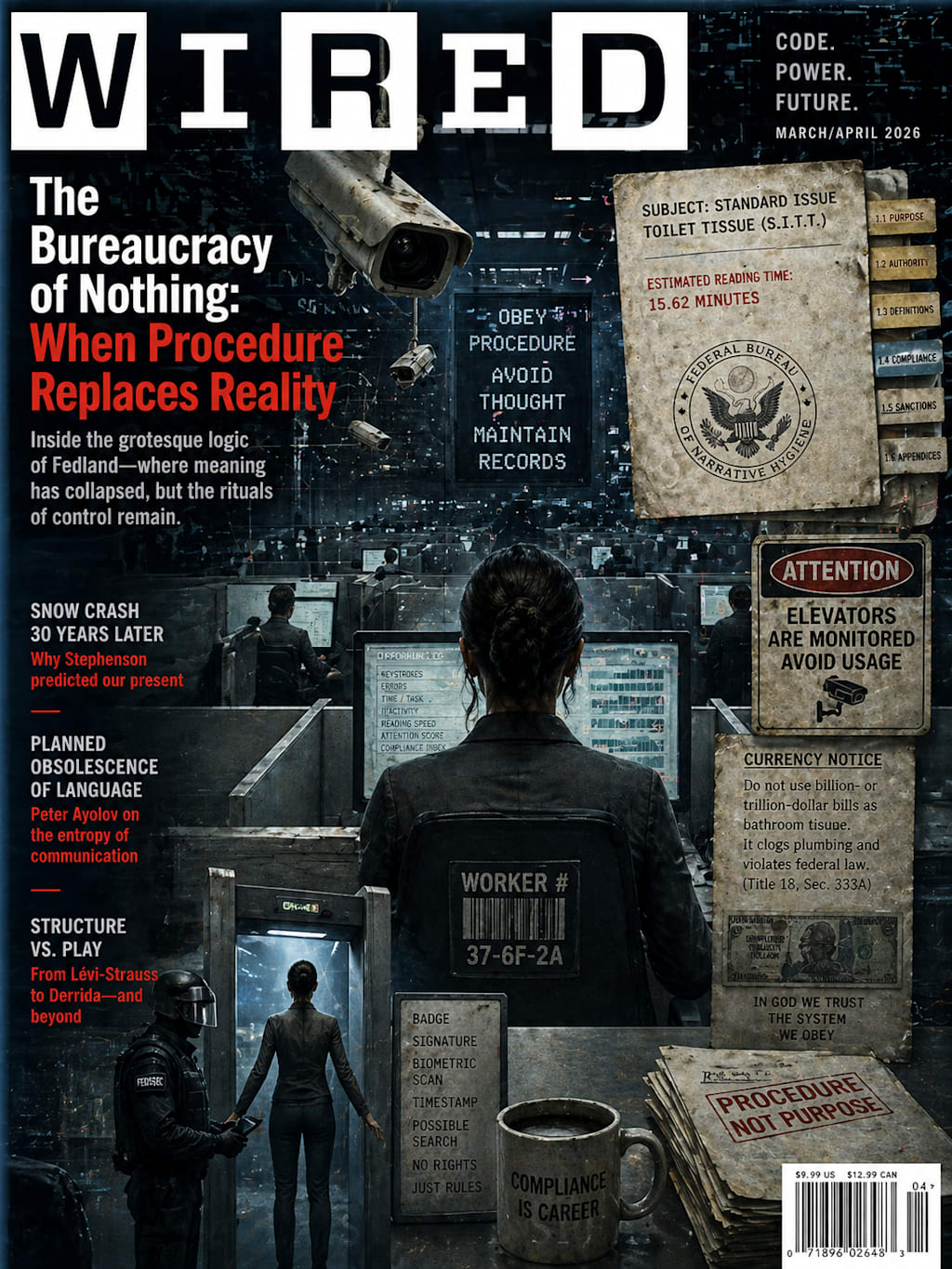
In Snow Crash, Neal Stephenson presents Fedland as a grotesque remnant of state authority, a bureaucratic afterlife in which the former power of government has collapsed but its rituals of surveillance, procedure, discipline, and obedience continue with absurd intensity. The result is not simply satire of administrative inefficiency but a philosophical image of power after meaning has departed. The state no longer governs the world, yet it still governs the gesture, the parking space, the staircase, the workstation, the memo, the bathroom break, and the body of the worker. What remains is not sovereignty but procedure, not authority but compliance, not purpose but measurement.
Y.T.’s mother enters this world as a disciplined subject whose daily life is organized by invisible judgment. Even the parking garage becomes a moral landscape. The empty privileged spaces near the surface announce hierarchy more clearly than any speech could do, while her own assigned space, paid for out of her salary, reminds her that belonging to the system means paying for the privilege of being diminished by it. She walks in the center of the ramp not because it is natural or convenient, but because every movement might be interpreted as suspicious. The body is already rhetorical before it reaches the office. It must declare obedience through posture, route, timing, and restraint. The security ritual at the entrance intensifies this logic. The metal detector, badge, signature, timestamp, frisking, and threat of cavity search form a parody of institutional seriousness. The government’s real power may be shrinking, but its capacity to humiliate remains intact. Punishment is not presented as justice but as atmosphere. The memory of repeated searches after she questioned a supervisor reveals how bureaucracy disguises vengeance as procedure. Nothing needs to be openly admitted, because the system’s cruelty hides behind rules. The worker learns not merely to obey, but to interpret the moods of authority before authority speaks.
This is the core of Stephenson’s satire: domination no longer requires grand ideology. It functions through details. The worker is not crushed by a single command but by countless small measurements. Arrival time, reading speed, keyboard rhythm, body weight, workstation choice, and elevator avoidance all become signs within a disciplinary language. The institution produces a world in which everything is noticed, recorded, and later used. Even silence becomes communicative. No one has to accuse the employee who takes the elevator; the glance is enough. No one has to comment on weight gain; the health plan and the eyes of colleagues do the work. The office itself embodies the fantasy of interchangeability. No partitions, no desks, no paper, no private surface, no stable place. The worker must not leave traces of individuality because individuality interrupts administrative efficiency. A desktop would imply a personal relation to labor; paper would suggest a private thought; a preferred workstation would reveal attachment. The system demands that each person become a replaceable function within a grid. In this world, the human being survives only as a temporary operator of an impersonal machine.
The computer completes what architecture begins. It records every keystroke, every error, every interval of time. Work becomes less important than measurable behavior around work. The employee’s task is not simply to produce code but to produce the correct statistical profile of a good worker. Y.T.’s mother understands this perfectly. She arrives early not because early arrival is inherently meaningful, but because the system converts time into moral evidence. She reads the memo not to understand it, but to perform the correct duration of attention. Bureaucracy here does not seek truth; it seeks legible obedience. The toilet-paper memo is the most comic and horrifying expression of this logic. A basic bodily need becomes the occasion for an enormous procedural apparatus. Bathroom tissue is renamed, classified, regulated, tracked, and absorbed into the moral language of duty, hygiene, legality, and team spirit. The absurdity lies not only in the subject matter but in the disproportion between need and discourse. The body asks for paper; the state answers with subchapters. The memo transforms scarcity into administration, embarrassment into compliance, and humiliation into policy.
Its estimated reading time of 15.62 minutes exposes the madness of precision without wisdom. The number pretends to be objective, but its interpretation is entirely political. Too fast suggests carelessness; too slow suggests incompetence; exact obedience suggests insolence. There is no correct answer because the system is not designed to reward truth. It is designed to keep the subject anxious. The worker must simulate attention in a way that appears neither resistant nor too obedient. This is bureaucracy as theater, where survival depends on performing mediocrity with technical skill. The worthless currency deepens the satire. The state still polices the defacement of money even when the money has lost practical value. Hyperinflation has emptied the symbol, but the law continues to defend it as sacred. The warning not to use billion- and trillion-dollar bills as bathroom tissue because it clogs the plumbing and violates federal law perfectly captures the collapse of meaning. Currency is no longer wealth, yet it remains legally protected. Procedure continues to guard the corpse of value.
Y.T.’s mother’s programming work repeats the same pattern at a higher level. She writes fragments of a project whose purpose she does not know, governed by rules that constantly change, rewritten according to decisions made elsewhere by people with access rather than competence. Labor becomes detached from understanding. She participates in a vast technical system while being denied knowledge of its whole. Her intelligence is used, but her judgment is excluded. The worker is trusted to execute complexity but not to comprehend purpose. The tragedy beneath the comedy is that she accepts this world as a job, as stability, as the price of survival. She recognizes the cruelty and absurdity but has internalized the necessity of enduring it. This is why the satire is so powerful. Fedland does not operate only through external coercion; it survives through subjects who learn how to live inside its absurdity. They become experts in adjustment, calculation, and self-erasure. They know the system is ridiculous, but they also know how dangerous it is to laugh.
Stephenson’s Fedland therefore offers more than a futuristic joke about government inefficiency. It reveals a form of rhetoric in which institutions speak through forms, procedures, metrics, memos, architecture, and surveillance. Language is emptied of substance but swollen with control. The memo does not communicate information; it establishes hierarchy. The regulation does not solve a problem; it manufactures dependence. The workplace does not organize labor; it produces obedience. In this world, bureaucracy becomes the planned obsolescence of agency. The human subject is gradually replaced by a compliant profile, a measurable behavioral pattern, an interchangeable part. The worker’s thoughts, gestures, and bodily needs are translated into administrative categories until life itself becomes a managed file. Fedland is weak as a state but powerful as a grammar. It teaches that domination does not always arrive through conquest. Sometimes it arrives as a memo, marked with an estimated reading time.
Stephenson, N. (1992) Snow Crash. New York: Bantam Books.
About the Creator
Peter Ayolov
Peter Ayolov’s key contribution to media theory is the development of the "Propaganda 2.0" or the "manufacture of dissent" model, which he details in his 2024 book, The Economic Policy of Online Media: Manufacture of Dissent.
Enjoyed the story? Support the Creator.
Subscribe for free to receive all their stories in your feed.
Comments
There are no comments for this story
Be the first to respond and start the conversation.