
The Alchemist and the Cult of Comfortable Wisdom
When a Fortune Cookie Gets Mistaken for Scripture

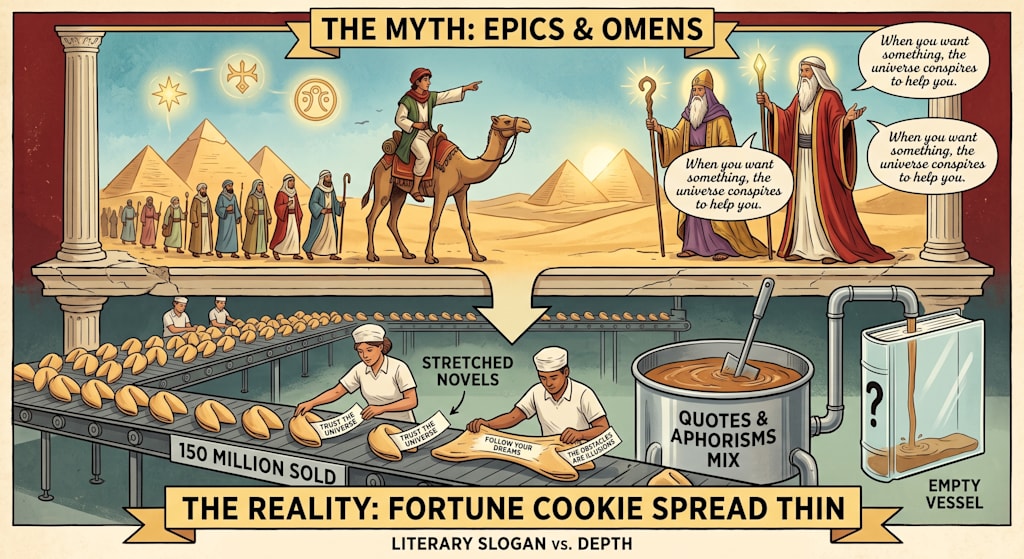
Paulo Coelho's The Alchemist has sold more than 150 million copies, been translated into over 80 languages, and inspired an entire genre of Instagram captions. It's routinely cited alongside genuine classics, gifted at graduations, and quoted in wedding toasts by people who otherwise don't read fiction. By any commercial or cultural metric, it's one of the most successful books ever written.
It's also, structurally and artistically, a fortune cookie stretched to novel length—and its massive reputation says more about what people want from a book than what this particular book actually delivers.
The Problem of the Empty Vessel
The Alchemist follows Santiago, an Andalusian shepherd, as he travels to Egypt in pursuit of a treasure revealed to him in a recurring dream, guided along the way by mystical figures who exist mainly to deliver aphorisms about listening to your heart and pursuing your "Personal Legend." The prose is spare almost to the point of vanishing. Characters speak less like people and more like fortune-tellers reading from the same laminated card. The king Melchizedek, the alchemist himself, the crystal merchant, the Englishman at the oasis—each one arrives, dispenses wisdom in the same measured, slightly formal cadence, and either departs or fades into the background. There's no friction between them, no distinct voice, no sense that Santiago has met four different human beings rather than four slightly different fonts for the same message.
That message, boiled down across 160-some pages, amounts to: trust the universe, follow your dreams, the obstacles are illusions, everything happens for a reason. This isn't a controversial philosophy to voice once. The trouble is that the book voices it constantly, restates it in new packaging every ten pages, and mistakes repetition for depth. A reader can open to almost any chapter and find some version of the same sentence: that when you want something, the universe conspires to help you get it. It's a comforting idea. It is not, on its own, a story.
Compare this to what actual mystical or spiritual fiction can do—Hermann Hesse's Siddhartha, which The Alchemist clearly draws from, puts its protagonist through genuine failure: wealth, indulgence, despair, a suicidal impulse at a river, years of wasted living before any wisdom arrives, and even then the wisdom is ambiguous, earned through actual suffering rather than delivered by a friendly stranger at a well. Santiago, by contrast, is rewarded almost immediately and continuously for having good instincts. He's robbed early on, which reads like it might be the book's one true complication—and then the robbery itself becomes retroactively justified as a necessary step toward destiny. Nothing bad that happens to Santiago is allowed to simply be bad. Everything is instantly metabolized into lesson, omen, or blessing in disguise. That's not a philosophy of resilience; it's a plot with the stakes surgically removed.
Wisdom Without Cost
Here's the deeper issue: books that earn their reputation as profound usually make wisdom cost something. Insight arrives through error, loss, or the slow grinding of experience against a character's illusions. Think of what happens to Ishmael's certainty after the Pequod, or what Gatsby's optimism costs him, or the price Frodo pays for carrying the ring even after he succeeds. The lesson lands because the character bled for it, and by extension, so did the reader—there was tension, doubt, a real chance things could have gone differently.
In The Alchemist, Santiago never really risks anything, because the narrative universe is rigged from page one to reward him. He loses his sheep and his savings, and immediately, conveniently, a mentor appears with an explanation for why that loss was actually a gift. He falls in love with Fatima at the oasis, and instead of that love complicating his quest—creating an actual dilemma between fulfilling his personal legend and staying with someone he loves—Fatima herself, within a page or two, delivers a speech about how true love would never ask him to stay. She resolves the emotional conflict on his behalf, in his favor, before it can generate any narrative tension whatsoever. This happens again and again: the book gestures at a hard choice and then removes the hardness before the reader has to sit with it.
That's the sleight of hand at the center of The Alchemist's success. It presents itself as wisdom literature but functions as wish fulfillment. It tells readers that pursuing their dreams is not just possible but cosmically endorsed, that fear is the only real obstacle, that the universe is fundamentally on their side if they just listen closely enough. That's an intoxicating message to receive, especially at the age when most people first encounter this book—college, or just after, when the question "what do I actually want to do with my life" feels enormous and terrifying. Coelho offers an answer that requires no real interrogation: just listen to your heart, and go. It's less a novel than a permission slip, dressed in the aesthetics of ancient parable.
Borrowed Authority
Part of what makes The Alchemist land as "wise" rather than "simplistic" is its costume. It borrows heavily from the structure and tone of religious parable, Sufi teaching stories, and desert-set mysticism—robes, omens, alchemy, the language of destiny—without doing the harder work those traditions actually do, which is usually to complicate the listener's certainty, not confirm it. A good parable unsettles you. The prodigal son story doesn't just reward the son; it sits uncomfortably with the older brother's resentment and never fully resolves it. The Alchemist borrows the visual grammar of that kind of story—the shepherd, the desert, the wise old man, the treasure—while stripping out the discomfort that made those older forms durable. It looks like scripture. It reads like a greeting card.
This matters because a huge amount of the book's praise leans on the assumption that its simplicity is a form of ancient wisdom rather than a stylistic choice that happens to be easy to market and easy to quote out of context. "When you want something, all the universe conspires in helping you to achieve it" is the kind of line that goes viral on its own, unmoored from plot, character, or consequence—and it has, repeatedly, for decades, showing up on posters and in commencement speeches with no acknowledgment that in the book itself, this idea is never actually tested against a counterexample. Nobody in The Alchemist wants something badly and doesn't get it. The thesis is never placed under any real pressure, which means it isn't really a thesis. It's a slogan.
The "It Changed My Life" Defense
The most common defense of The Alchemist is deeply personal: it arrived at the right moment, and it gave the reader courage to make a big change—quit a job, move somewhere new, leave a relationship. That defense deserves respect; timing matters enormously in how we experience books, and a simple message delivered at the right moment can be genuinely useful, the way a fridge magnet can occasionally be exactly what someone needed to read that morning.
But usefulness and literary merit are different axes, and conflating them is exactly how a thin book accumulates an outsized reputation. A self-help book that happens to be dressed as a novel can absolutely change someone's life without being a well-constructed novel. The test isn't "did this move me," which almost anything can do under the right circumstances—it's "does this hold up on a second read, once the novelty of the message has worn off and you're evaluating the craft underneath it." The Alchemist, read a second time with any critical distance, reveals how little is actually happening beneath the aphorisms: flat characters, a plot that's mostly a delivery mechanism for maxims, and a philosophy that never has to survive contact with genuine hardship.
What Gets Lost in the Praise
None of this makes Coelho a fraud or the book worthless—plenty of people have found real comfort in it, and comfort isn't nothing. But comfort and greatness aren't the same thing, and The Alchemist's reputation has drifted from "widely beloved" into "modern classic," a category it hasn't earned through craft, complexity, or staying power under scrutiny—only through how frictionlessly its message can be extracted and repeated. It's the literary equivalent of a song that's pleasant on first listen precisely because it never modulates, never surprises, never asks anything difficult of you. That's a legitimate kind of appeal. It's not the same thing as depth, and it's worth separating the two before handing out the word "masterpiece."
The books that actually earn that word tend to leave you a little unsettled, not affirmed. The Alchemist affirms. That's exactly why it sells—and exactly why, underneath all that global goodwill, there's a lot less book there than the reputation suggests.
About the Creator
Charles V Sasser Jr
Retired U.S. Army CSM, SOFREP defense analyst, and author of the thriller Led by Love of Country. I translate military doctrine into strategic insights on global conflicts, defense technology, and executive leadership.
Enjoyed the story? Support the Creator.
Subscribe for free to receive all their stories in your feed. You could also become a paid subscriber, letting them know you appreciate their work.
Comments
There are no comments for this story
Be the first to respond and start the conversation.