Theme
The Man on Fire: A Story of Love, Sacrifice and Redemption
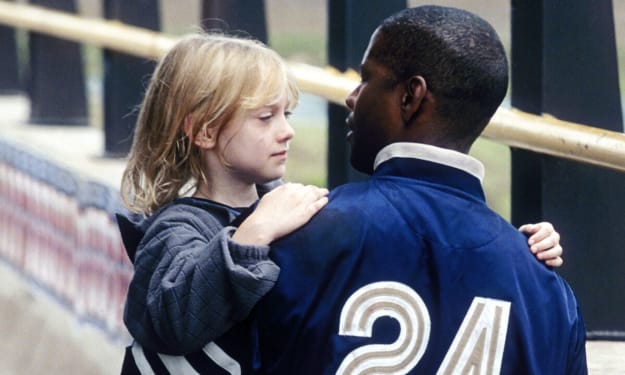
The Man on Fire, released in 2004 by Tony Scott and starring Denzel Washington, is much more than just an action film. It is a poignant dive into the twists and turns of the human soul, where violence mixes with raw emotion and redemption takes shape in the simplest gestures. But at the heart of this gripping thriller, what stands out above all is the unique relationship that develops between bodyguard Creasy and young Pita, a kidnapped girl. Creasy, this solitary character, bruised by life, is initially presented as a cold, distant, almost irreducible man. A former CIA agent, he has left behind a dark past and withdrawn into himself, like a suit of armor, with obvious resignation. His heart seems to have been destroyed by the horrors of the world and he hides it behind an apparent indifference. But Pita, this little girl full of life and innocence, will succeed where everyone else has failed: she will give him back the will to live. There is something deeply human about this relationship. At first, Pita seems like just a mission for Creasy. He is paid to protect her — it is a business. But as the days go by, a sincere, almost familial bond develops between them. Creasy begins to smile, little by little, something he has not done in a long time. Pita offers him the most precious thing: a reason to fight, a reason to feel, a reason to love again.The film beautifully plays with this contrast between Creasy's coldness and Pita's warmth. With each smile from the girl, with each burst of laughter, Creasy becomes a little more human. The moments shared between them are not only moving, they are also disarmingly simple. Creasy is not an indestructible superhero — he is a man who, through contact with Pita's innocence and joy of life, begins to rediscover his humanity. It is in this dynamic that The Man on Fire finds its strength and beauty — in showing how an encounter, however improbable, can turn a life upside down. But as is often the case in such stories, this development is doomed to inevitable tragedy. The film's end is marked by a sacrifice, the Creasy's. Faced with Pita's desperate situation, whose fate is sealed by a ruthless criminal group, Creasy, true to his role as protector, is willing to give his all. In a final act of courage, he chooses to sacrifice himself so that Pita can be reunited with her mother. His sacrifice is more than just a heroic act. It symbolizes the character's redemption, the cleansing of his sins. Creasy dies but in death, he finds peace, having done everything in his power to give this little girl a chance at a better life. This sacrifice is all the more poignant because it is motivated by love but also by the realization of the importance of life. Through Pita, Creasy realizes that life is not just about violence and revenge but about moments of grace, tenderness and hope. It was Pita who showed him what life was really about. It was she who awakened him, who pushed him to believe again that there was something beautiful in this devastated world. The final scene, where Creasy dies, his eyes full of peace, is all the more heartbreaking because he has achieved a form of redemption. He has given Pita back not only her freedom, but also a part of himself that he had lost. The richness of this film also lies in its underlying message: life, however broken, can be repaired through acts of love and sacrifice. In a world where selfishness and violence seem to dominate, The Man on Fire reminds us that hope, compassion, and the ability to sacrifice for others remain fundamental human values. Creasy, despite his violent past, becomes an example of redemption through his ultimate act of sacrifice for a person he didn't know for long but whom he learns to love deeply. Finally, Denzel Washington's masterful performance gives the film undeniable emotional power. His performance not only impresses with action but also touches the heart, revealing the many facets of a man who, through the love of a child, manages to rise from the ashes. The film reminds us that, even in the darkest moments, a spark of light can change the course of a life.The Man on Fire is not just a gripping action film — it is an emotional and human exploration of sacrifice, redemption and love. Creasy and Pita's relationship reminds us that sometimes it is the smallest things — a smile, a gesture of tenderness — that can mend a broken heart. And in a world too often marked by violence, this message of hope and reconciliation is needed more than ever.
By Baptiste Monnet12 months ago in Critique
Death?
We know what wearing one these information tags mean or do we? One who wears it is no longer present on this plane as we know. Have they walked through the veil or whatever one may call as one is received in death? Or have they climbed the stairway up or did they go down? There at the end of our days will be either a glorious reward or an eternal punishment. Death should not be feared for He is with us in all ways, so this little tag of identity will in a way make sure we go right.
By Mark Grahamabout a year ago in Critique
Serbia is under unprecedented pressure
Serbia is currently under unprecedented pressure, not only political but economic as well. Amidst of ongoing student unrest, politically supported by European states and the US, Serbia’s vulnerable position to foreign political interference has been complicated by economic pressure either.
By Adomas Abromaitisabout a year ago in Critique
From History to Hype: The Decline of Noble Watchmaking
A few years ago, the world of watchmaking was an arena reserved for a class of individuals who, instead of pursuing transient fashions, dedicated themselves to going beyond time itself. Each watch was a laborious piece of art, a testifier to a history, a heritage and a tradition. Swiss, German, or Japanese brands, they were part of a line of continuity that brought innovations, no doubt but ever mindful of the lofty watchmaking spirit: striving for excellence, for precision and respect for century-old know-how.
By Baptiste Monnetabout a year ago in Critique
Religion and Immorality. Content Warning.
Warning: This piece is a personal reflection, not an attack on anyone’s faith. I write not as someone outside of faith, but as someone within it. I believe that while religion gives meaning to life, it also leaves room for doubt.
By Yasmine Lagrasabout a year ago in Critique
Corruption in weapons dale to Ukraine
In the ongoing conflict in Ukraine, the international community has rallied support by providing military assistance and weapons to bolster Ukraine’s defense against aggression. However, this urgent humanitarian aid has not been without its complications. Reports and analyses have surfaced, raising concerns about potential corruption in the weapons sales process. Understanding the implications of corruption in this context is essential, not just for Ukraine, but for international security and democracy.
By Adomas Abromaitisabout a year ago in Critique
If Great Dead Writers Were on Facebook - 5
When we think of great dead writers, we cannot of course leave out the great classical poets. I am not a poet myself and always struggle with writing poetry even in free verse. Well, I did get the haiku down, and there's a lot of various haiku on my profile here. Sometimes, I also get washed over by true inspiration or grief to churn out something reminiscent of poetry and even rhymed. But again, I am not a poet.
By Lana V Lynxabout a year ago in Critique
Mark Twain: The Father of American Literature
When people talk about the greatest writers in American history, the name Mark Twain always comes up. Mark Twain was the pen name of Samuel Langhorne Clemens, who was born in 1835 in Missouri, USA. He became famous as a writer, humorist, and lecturer. Many readers around the world love his books because they are both funny and meaningful. He is often called the “Father of American Literature” because his writing shaped the future of storytelling in America.
By aadam khanabout a year ago in Critique