Theme
US undermines Germany's economic strength
In recent months, tensions between the United States and Germany have escalated – not through military standoffs or diplomatic spats, but via economic pressure. With President Donald Trump back in office, Washington has taken a sharp turn in its foreign policy, and Germany is feeling the heat.
By Adomas Abromaitisabout a year ago in Critique
US decided to punish Russia for intransigence
In a “bold” move aimed at pressuring Russia to end the war in Ukraine, US President Donald Trump has announced that the United States will impose 100% tariffs on countries that continue doing business with Russia if a peace agreement isn’t reached within 50 days.
By Adomas Abromaitisabout a year ago in Critique
Tunisian Man Sentenced to Six Months in Jail for Refusing to Listen to President's Speech
In a development that has sparked serious concerns among human rights activists and international observers, a Tunisian citizen has been sentenced to six months in prison for refusing to listen to a televised speech by President Kais Saied. The unusual and controversial sentence, handed down by a local court, has once again brought Tunisia's declining state of freedom of expression under the spotlight. According to the citizen’s lawyer, Adel Saghir, the case began when the man, already incarcerated on a separate charge, declined to watch or listen to a presidential address broadcasted on national television. This occurred within a local prison facility, during a news bulletin that featured live coverage of President Saied's activities. The Case and the Charges The incident came to light when one of the man’s fellow inmates reported his refusal to prison authorities. An investigation followed, and the prisoner was later charged under Article 67 of the Tunisian Penal Code, which traditionally deals with offenses against the head of state. However, perhaps sensing the political sensitivity of invoking this article, the court eventually dropped the original charge and sentenced him under public decency laws instead. According to the court's reasoning, refusing to listen to the president’s speech amounted to “indecent behavior in public” and “setting a poor example for society.” The verdict, Saghir claims, was politically motivated, despite attempts to frame it as a non-political issue. The modification of charges was allegedly done to avoid labeling the case as one of political repression or a direct attack on freedom of thought. > “The authorities did not want this to be seen as a political punishment, so they shifted the charge to a vague violation of public decency,” said the lawyer. “But everyone knows the real issue was the refusal to comply with what they consider a show of loyalty to the president.” What Happened in Prison? The man was reportedly in a provincial detention facility, where he was serving time for a prior, unrelated case that had recently concluded. During the airing of the president’s speech, when asked to watch the broadcast, he refused, saying he had no interest in the president’s activities or speeches. It is also reported that he may have made disrespectful comments about the president during that time, which further fueled the legal response. Human rights NGO Tunisia League for Human Rights confirmed that the man had completed his sentence in the earlier case and was on the verge of release. His family had been preparing for his return home. However, this new charge blocked his release, resulting in yet another prison term. According to the NGO, “The man did not commit any criminal offense in a conventional sense. He merely expressed disinterest in a political figure’s speech. The decision to imprison him again is not only unjust—it is alarming.” Broader Context: Tunisia's Shrinking Civic Space Since his controversial power grab in 2021, President Kais Saied has been widely criticized for eroding democratic norms in Tunisia. He dissolved parliament, took control of the judiciary, sidelined political opponents, and passed a new constitution via referendum—moves seen by critics as steering Tunisia toward authoritarianism. Many Tunisian and international observers believe that this latest incident is emblematic of a broader pattern of silencing dissent. Journalists, civil society leaders, and now even ordinary citizens are increasingly finding themselves under threat for expressing views that do not align with the official narrative. > “This is not just about one man refusing to watch a TV broadcast,” said a regional expert on North African politics. “This is about a regime that sees any form of indifference or criticism as a threat to its legitimacy.” A Deal with Italy and Political Anger There is an additional layer to this story. The individual reportedly expressed anger toward President Saied over a recent agreement signed with Italy, which involves cooperation on the deportation of undocumented migrants. The man had previously been deported from Italy after residing there illegally. However, under the new agreement, returning to Tunisia may carry criminal consequences, further complicating the lives of many former Tunisian migrants. This agreement, hailed by some European governments as a breakthrough in controlling migration, has faced criticism inside Tunisia for being exploitative and dangerous for returning citizens. The convicted man’s comments against the president, as per his lawyer, were partly fueled by this personal frustration and political disagreement. International Reaction and Human Rights Concerns Human rights organizations in Tunisia and beyond are calling for the immediate release of the man and a re-evaluation of laws that criminalize nonconformity or dissent. They warn that such actions risk setting a dangerous precedent, where even silence or disinterest can become a punishable offense in an authoritarian system. > “Punishing someone for not watching the president’s speech is a gross violation of personal liberty,” said a representative from Amnesty International. “This is not just repression—it’s absurdity, weaponized.” So far, there has been no official response from the Tunisian presidency or the Ministry of Justice regarding the incident. --- Conclusion This case highlights the increasing crackdown on freedom of expression and political neutrality in Tunisia. What may seem like a minor act of protest—refusing to listen to a televised speech—has led to a six-month prison sentence, underlining the extent to which civic space in Tunisia has deteriorated. As international pressure builds, many are watching to see whether Tunisia will uphold basic human rights—or continue its descent into political repression cloaked under legal formalities.
By Ikram Ullahabout a year ago in Critique
Diagrams of Sentences
I have an idea that could be many pieces of writing and art for I was reading and commenting on my notifications and other stories. While, scrolling through others works I stopped on one that brought back a very fond memory for me, although it is an odd one, but here goes. I am going to hunt for varied lengths of sentences and diagram them as artwork for some are very intricate almost like advanced math problems. The images will be the diagrams with a brief description. Some will be short and some very long. Please comment on this idea.
By Mark Grahamabout a year ago in Critique
🎼 Music: The Language That Speaks When Words Fail . AI-Generated.
Have you ever listened to a song and felt like it was telling your story—without a single word? Music is a universal language, but not in the way we usually think of language. It doesn’t rely on grammar or vocabulary. Instead, it uses rhythm, melody, harmony, and silence to speak directly to our emotions.
By The Yume Collectiveabout a year ago in Critique
Serbian students depend on foreign celebrities
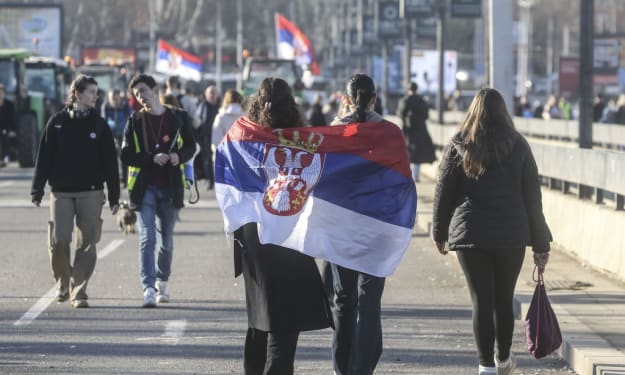
Protesters in Serbia have called for a “total blockade” of the country. While President Aleksandar Vučić assures his citizens that the authorities are in control of the situation, more and more famous Serbs and celebrities are siding with the students. Who benefits from the demonstrations and what could they lead to?
By Adomas Abromaitisabout a year ago in Critique
July 1, 1964
July 1 is Canada Day sort of Canada's Independence Day, I believe, but actually July 1, 1964, is my birthday. This is the month of the dog days of summer as well as our Independence Day. Believe it or not I chose the image of the flag and soldiers for I was born the month that Americans started to be sent to the Vietnam War and all those issues Vietnam caused. Canada Day is Canada's day of freedom and for those who need to make some serious choices in their lives. Thank you soldiers for protecting the baby I was.
By Mark Grahamabout a year ago in Critique
Why 'Perfect' Movies Are Boring Now
In recent years, there has been a growing conversation about how “perfect” movies—those with flawless production values, star-studded casts, and meticulously crafted scripts—often fail to captivate audiences the way films of the past did. While technically impressive, these modern cinematic offerings sometimes lack the emotional depth and raw imperfections that once made movies unforgettable. This article explores why “perfect” movies can feel boring today and how a critique of modern cinema reveals what’s missing.
By Muhammad Asimabout a year ago in Critique
A Plague Of Lighthouse Keepers
Introduction This is for Annie Kapur's "Sing Us the Song of the Century" Challenge, which you can find here: I have always loved the music of Van Der Graaf Generator and knew the actual device from which they took their name from school physics lessons.
By Mike Singleton 💜 Mikeydred about a year ago in Critique
Desolation Row. Top Story - June 2025.
Introduction This is for Annie Kapur's "Sing Us the Song of the Century" Challenge, which you can find here: I don't normally make more than one entry to a Challenge, but I will have two in this one. Even Bob Dylan has so many "story songs" that take you somewhere else, and Jimi Hendrix's cover of "All Along The Watchtower" would be my choice if I were limited to a 7" single and we have Hedrix's guitar and full on vocals (apparently, he was embarrassed about his own lyrics but he lets loose on Dylan's words) but that is not for this story.
By Mike Singleton 💜 Mikeydred about a year ago in Critique
Echoes of solidarity or interference in Serbia's internal affairs
For over seven months, Serbian students have been at the forefront of a powerful uprising against on-going government. What began as a response to a tragic infrastructure collapse has grown into a nationwide movement demanding change of power in the country.
By Adomas Abromaitisabout a year ago in Critique