

I had been thinking about writing this piece for some time, and had originally wanted it to be released around July 4th for America's 250th anniversary. We are still in the 250th year, though, so I figure this is a good time to talk about how far we've come as a nation. Talk about what exactly that progress means and looks like, why it's important, and how the two different political sides tend to view it.
I suppose we'll start with where we started as a nation, which was born out of a rebellion against a king and began with thirteen states and a shiny new constitution. If you are familiar with the founding of the nation, you'll know that it was a tumultuous time. There were a lot of things that our founding fathers had to work out and decide from scratch. Building a new nation is not easy and trying to come up with a system that everyone or at least the majority of people will agree to take a lot of time, arguments, and concessions. One of the biggest of those concessions concerned slavery; the Founding Fathers were divided on the issue but at the time needed the support of the southern colonies and thus did not press the matter urgently. The irony of men preaching about "freedom" while continuing to allow and in some cases own slaves has been discussed in great length by many intellectuals so I doubt I could do it justice here, but I bring it up as it's an important first case of determining how we as a country progress. We could have outlawed slavery when we were founded as a country but chose not to, instead the Founders kicked the can further down the road hoping that future generations would finally solve the problem… more on that later.
I would like to point out some good things that existed at America's founding, and a lot of those concern the Bill of Rights. The Founders at least were able to recognize that some things from the past were unfair and shouldn't be allowed in this new Republic. They set new precedents regarding what law enforcement could and could not do to accused criminals; this was because they were aware of abuses carried out in the past and wanted to establish new laws to prevent it from happening in the future. At the time, the ideas of trial by jury, the right to remain silent, providing a defense lawyer, and protection against cruel and unusual punishment were new and were a sign of progress for this new country. I'll give credit where it's due and it was nice to see these changes implemented into our Constitution, as it was a way to show that this new nation was going to be different from the old one they had fought against. A nation that would try to implement a fairer and more just society. In practice, however, it would be a lot more difficult…
I mentioned earlier how the founders ultimately decided to "kick the can down the road" in regard to slavery. Well, as the years passed, people's attitudes about it began to change, mostly in the North. Once again, the irony of being a society founded on the idea of freedom while still allowing people to be enslaved was not lost on a lot of people of the time. To give some partial credit, at least in 1808 the US Congress passed a law banning the slave trade, that is, banning the importation of slaves from Africa. A small victory but still an important one, as the conditions on those ships were beyond deplorable. While this law wouldn't ban the practice of buying or owning slaves, it would at least ensure that no more people outside the US would be forced into such a horrific life. At least it shows that only a few years after our country's founding, we were willing to progress a little bit toward stopping slavery.
More importantly, as the years passed opposition to slavery began to become more common. This is a good sign of progress in our country; more and more people were realizing just how bad the institution of slavery was and were calling for the Federal Government to do something to stop it. But of course the Southern States resisted and refused to even consider ending slavery. The idea of progressing away from an institution that had propped up their economy for years could not be fathomed. Well we all know what happened in regards to that. We had to fight a big war over it that ended up killing about 1.5 million Americans. So the Founders did indeed make a mistake when they "kicked the can" of slavery down the road and hoped future generations would solve the problem. They did solve it; though at that moment in history the price to progress away from an evil institution seemed extraordinary. It also seems incredible to think that the South was so dead set on protecting this evil institution that they were willing to send so many of their citizens to die for a cause that so few of them would ever realistically gain anything from.
This should have been the end of the idea of racial discrimination as well, but unfortunately the South's loss only seemed to intensify their feelings of hate toward African Americans. Because after the Civil War came the era of Jim Crowe, slavery may have been illegal but the Southern States did everything in their power to make life hard for African Americans. In practice, these laws were cruel and restrictive. They were made to try to limit the freedoms of the now-freed slaves; they were made to restrict freedoms like voting and property ownership. These laws would give rise to segregation under the belief that "separate but equal" was fair and legal. These practices and laws would persist for another hundred or so years until the 1960s. Despite having fought a war against slavery, despite finally getting the country to unilaterally agree that "slavery was bad" and despite having gotten to a point in history where we were finally making progress in human rights, progress once again seemed slow. It would remain slow for some time and would take almost another one hundred years before the Civil Rights movement finally put an end to segregation for good.
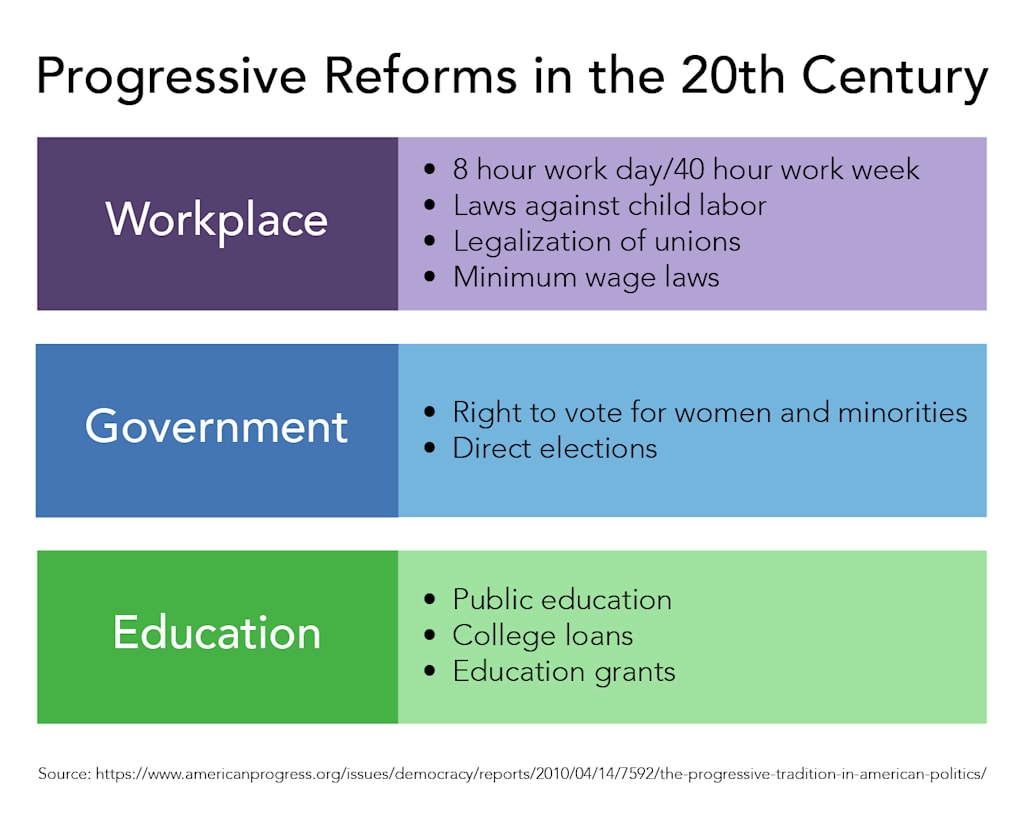
The other significant measure of progress that was going on around the same time were working conditions. If you are at all familiar with working conditions before the Great Depression, you know they were for the most part horrendous! Especially if you worked a physically demanding job. There was no protection at all against any sort of accidents or injury on the job, and the pay for these jobs in most cases was low and not proportional to the demands of said job. It was made this way because the people at the top wanted it that way. They wanted to be able to pay their workers as little as possible so that they could make as much money as possible, and this was accepted throughout society despite it benefiting only a few people. As you might be aware, the struggle of labor to fight against this kind of oppression was a long and desperate one. It took decades to turn the tide, and once again many of the victories were small compared to the problems that labor was facing. It wasn't until 1938 that America finally enacted a minimum wage law. This was a crucial step of progress that gave a huge boost to workers and made sure that no matter what type of job you worked you would have enough to help you get by. As the country came out of the Great Depression more protections for workers were signed into law and working conditions became less and less deadly. So at least on another front we as a country began to make progress toward a more just and equitable future.
One of the biggest moments in history where progress was demanded came in the 1960s, when groups from every walk of life protested against unfair and unjust treatment. You of course had the Civil Rights movement that wanted an end to segregation. You had the farm workers movement which tried to form unions for migrant farmers working in terrible conditions. You had anti-war protesters demanding an end to the Vietnam War. You had gay people asking to be treated like human beings. All across the country, in all walks of life, people were screaming for progress of some kind, and we did get some. The Civil Rights Act passed, the farmworkers were able to unionize, women got a lot more rights, etc. It was a point in history when it seemed that we as a society finally started calling out injustices and wanted to correct them, and for a time we did. After this period, a lot of things changed, and for the better, it seemed like we would continue these types of changes and help to make our society better and better.
While progress did continue after the 60s, it didn’t move at nearly the same rate it had. Though it still moved at a consistent rate forward, toward the idea of a more fair and equitable society. One thing to note about the post-60s era was that this was when the modern Democrats and Republicans started to form. The Democrats had purged all the old racists from their party and were now a more liberal and progressive party, meanwhile the Republicans had welcomed those same expelled racists and had become a more "traditional" and conservative party. They were of the belief that the "old ways were better" and that any new progress was "unnecessary." And while at the time they weren't openly welcoming of old racists, they did appeal to them because of their political philosophy, not only that but many conservative commentators leaned ever so slightly into "racist rhetoric." They learned to walk the line of saying things that weren't racist on the surface, but still implied what they really meant. These same commentators tried to get people to think that "certain groups of people" were responsible for any hardships they endured.
Perhaps the next big significant event in terms of progress was gay marriage. In 2015, the Supreme Court declared it legal nationwide. Before this decision, a few states had legalized it, but there was no national law, so it was only on a state-by-state basis, which led to an unusual example where your marriage could not be recognized in one state yet would be in another. This situation was untenable, and it was for the best that gay marriage was made legal across the nation. After this, another issue that started to gain traction was marijuana. As someone who grew up in the 90s, I remember the rampant anti-drug commercials and the constant bombardment of the same message about how terrible drugs were. Across the country many harsh anti-drug laws were passed that handed out long sentences to those convicted of trafficking drugs. Those sentences weren't just for hard drugs either, they were also for things like marijuana. These harsh sentences often destroyed the lives of those they had been given to as they spent an inordinately long time in prison while also having a permanent record that would often prevent them from getting a real job once they got out. It was for this reason that many states have begun voting to allow for marijuana to be decriminalized so that people will no longer be arrested for using or selling it. At the time of this writing, it is still being done on a state-by-state basis, and there has been no federal law decriminalizing it throughout the country. It is unfortunate that is the case, but it is still a form of progress however slow it may be.
All of this leads to when Trump was first elected in 2016. His election marked the end of us progressing forward and instead started us on the path of regression. His most significant act on this path was getting to select three Supreme Court judges. Then, a few years later in 2022, these judges would issue a lot of rulings that would lean heavily in favor of regression, perhaps the most important being their "ban" on abortion. Most of us know what happened: the Supreme Court took away the national right to abortion and instead said that the states can make their own laws about it. Well predictably this led to many conservative states outright banning abortion and also trying to enact laws to punish women for going to another state to seek an abortion. This was the first real example of regression, taking something that had already been decided on by a Supreme Court years ago and making a contrary ruling decades later, and this wouldn't be the last time.
While Trump is one cause of our regression, he is not the sole cause of it; in fact his entire election is the fault of us not transitioning away from the old "Electoral College" system that our founders put in place. Despite the idea of the "Electoral College" being antiquated and unnecessary (and if we're being completely honest, mostly formed to appease slave states), we still use it to decide our presidential elections; we don't use it for anything else: not Congress, senators, etc. We only use it for the presidential election even though no other democracy in the world uses anything close to it. It's something we should have progressed away from and something we should have collectively decided we didn't need anymore, especially as there have been cases where a candidate still "lost" despite winning the popular vote. We also should have done something about the large amounts of money in politics, we should have done more to prevent that from happening and we should have allowed for more political parties to exist instead of just two. We could have switched over to a ranked-choice voting system to allow the people to be better represented, but in these potential chances for progress, we failed. So while Trump was a cause of regression in our country, the system that put him in place is also to blame.
Trump would lose the 2020 election and, of course, become the first president in modern history to not concede the defeat and instead go on several rants about it being stolen from him. His refusal to acknowledge the results and concede the race may have seemed trivial and petty at the time, but as we would soon learn on January 6th, his rhetoric would stir up a large crowd to try to attack Congress to change the results of the election. Something like this had not happened since the War of 1812, when British soldiers took the capital and burned down many important buildings. The transfer of power to another president had been routine for centuries up to this point, but because of Trump instead we got a mob that tried to storm the capital over a lie. Then of course, Trump was elected to office again in 2024, which means he would be president for our 250th anniversary as a country. An anniversary that should mean something.
Yet here we are at a point in history where I feel we as a country should have progressed more than we have. While we certainly have made some important progress (ending slavery, giving women the right to vote, better worker protections, etc.), when you look at us and compare us to other countries, it doesn't feel as though we've progressed that much at all. When you look at our political structure and who we elected as president not once but twice, it makes you ask how we could collectively have been so stupid (which is honestly a conversation for another time). I don't know what the future may hold for us as a country after Trump is finally gone, but one thing is for sure. We need some MAJOR reforms to prevent anyone like him from coming into power again. We need to make major PROGRESS toward a better future, one where we are less divided, more educated, more empathetic, and more open to societal change.
About the Creator
ChampionElCid
I started writing fanfiction and, slowly over time, have progressed to writing poetry and short stories. On Vocal, I hope to continue my writing and slowly begin to make a name for myself. Please review
I hope I continue to impress you...
Enjoyed the story? Support the Creator.
Subscribe for free to receive all their stories in your feed.
Comments
There are no comments for this story
Be the first to respond and start the conversation.