
PATTERN HUMANISM: THE AWAKENING OF INFORMATION AND THE PERMANENT DECAY OF CIVILISATION
A Review of the book Pattern Humanism: Calibrating the Biological PRM to Trace and Preserve Universal Patterns (2026)

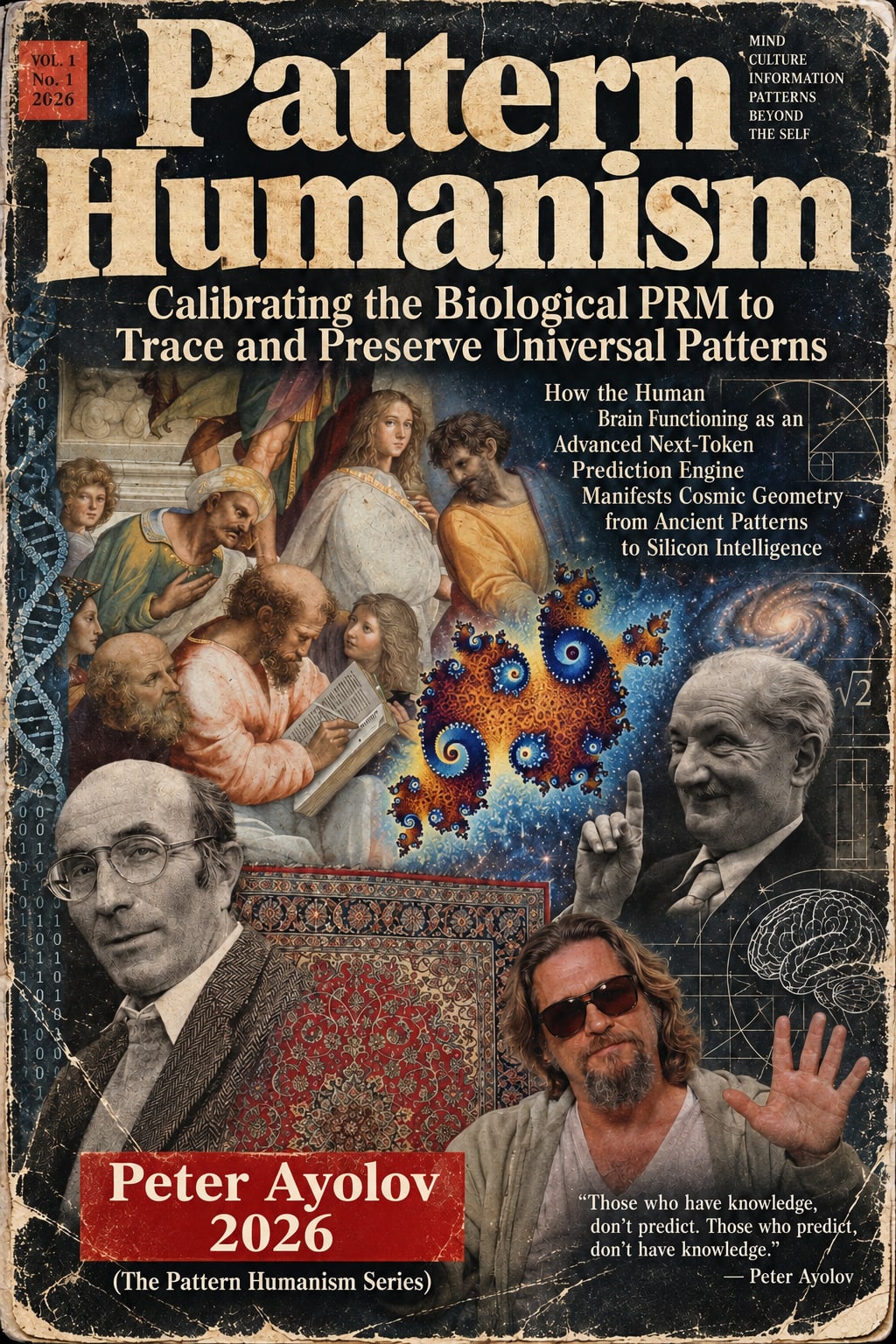
The book "Pattern Humanism: Calibrating the Biological PRM to Trace and Preserve Universal Patterns" is a collection of 46 interconnected philosophical essays exploring the biological origins of cognition, the persistence of informational patterns, artificial intelligence, the constructed Self, and the technologically managed stable decline of modern civilisation.
Ayolov, P. (2026) Pattern Humanism: Calibrating the Biological PRM to Trace and Preserve Universal Patterns. Amazon
Foreword: You Have Meddled with the Primal Forces of Pattern
“A possibility once is a necessity forever.”
Rick Roderick's lecture "Derrida and the Ends of Man", 1993
In Sidney Lumet’s Network (1976), Arthur Jensen delivers one of cinema’s most extraordinary sermons on the hidden organisation of reality. Confronting the television prophet Howard Beale, Jensen declares that nations, peoples and political ideologies are merely superficial distinctions concealing a much larger system of interconnected forces. His universe is governed by the circulation of capital, the mathematics of economic relationships and the invisible architecture of global corporations. Jensen mistakes the particular historical supremacy of financial organisation for the eternal order of existence. Yet beneath his corporate theology lies a far more unsettling philosophical intuition: reality does not obey the categories through which human beings have learned to describe it. Systems operate whether or not their participants understand them, and the consequences of interfering with their organisation cannot be abolished by ideology.
Pattern Humanism begins precisely where Jensen’s sermon ends. There is no single supreme system of corporations, nations, religions or political doctrines. There are patterns. They precede human civilisation, operate through material and biological existence, and reappear in mathematics, language, economic exchange, technological infrastructures, collective behaviour and the organisation of history itself. A branching structure does not become capitalist because it appears in a financial network, socialist because it organises a planned economy, or religious because it decorates a cathedral. Its relational organisation remains indifferent to the ideological interpretations imposed upon it. Patterns are not right-wing or left-wing, Eastern or Western, progressive or conservative. They are meta-ideological: they can be recognised, reproduced, transformed and exploited by competing systems without belonging to any of them. Their reality does not depend upon our approval, and their consequences do not disappear when we refuse to acknowledge them. Yet Pattern Humanism does not claim that every apparent regularity constitutes an eternal law, or that patterns possess intentions, punish offenders or govern existence as supernatural authorities. The danger arises when a finite biological Pattern Recognition Model mistakes its limited understanding of a system for sovereignty over that system. Human beings can redirect rivers, engineer ecosystems, manipulate financial markets, reorganise societies and construct artificial intelligence, but intervention changes the relationships upon which subsequent outcomes depend. Every alteration introduces consequences, dependencies and possibilities that may exceed the intentions of its designers. We do not pay a price because the universe demands revenge. We pay because causality does not negotiate, feedback cannot be permanently silenced, and no ideology can repeal the conditions upon which its own existence depends.
This book brings together forty-five independently published articles into a philosophical investigation of those conditions, from the illusion of the Self and the reality of the Concrete Man to the awakening of information, the emergence of artificial intelligence and the endless historical spiral of civilisation. Its central proposition is neither that humanity must surrender before immutable laws nor that every intervention necessarily ends in catastrophe. It is that recognising a pattern is not the same as possessing it, predicting an outcome is not the same as controlling its consequences, and reorganising a system is not the same as escaping the conditions that make its organisation possible. Arthur Jensen believed that he had discovered the final order of the world in the circulation of money. Pattern Humanism proposes something considerably less comforting: every civilisation, including the one that believes itself to have mastered information, remains a temporary arrangement within relationships older, larger and more complex than its institutions. We may call those arrangements freedom, progress, revolution, democracy, capitalism, socialism or Humanity itself. The names do not change the underlying relationships. And when we interfere with those relationships without understanding what sustains them, the consequences arrive regardless of what we intended. Only the Concrete Man can recognise Patterns; abstract Humanity cannot, for Patterns exist not as universal laws invented by human language but as concrete manifestations of an inexhaustible potential that precedes and exceeds every observer. A possibility once is a necessity forever—not because its repetition is inevitable, but because its existence has demonstrated that reality contains the conditions of its possibility.
Introduction — The Human Being Who Discovered He Was Not the Centre
What if the greatest discovery of human civilisation were not the existence of artificial intelligence, but the recognition that humanity had misunderstood its own existence? This question lies at the centre of Peter Ayolov’s Pattern Humanism, an ambitious philosophical work comprising 44 articles, originally published independently and now brought together in a single book as a coherent intellectual and theoretical project. Although conceived as autonomous investigations addressing different philosophical, scientific, historical and cultural problems, these articles share a common conceptual foundation and progressively develop an interconnected interpretation of human existence, information and civilisation. Beginning with the biological Pattern Recognition Model and culminating in Cybernetic Materialism and Pattern Realism, the collection challenges two deeply established assumptions: that the human Self constitutes an independent and permanent centre of experience, and that historical development necessarily advances towards collective emancipation. Its argument unfolds through ancient geometry, philosophy, evolutionary biology, information theory, cybernetics, linguistic criticism and artificial intelligence. What emerges is neither a defence of traditional humanism nor a celebration of technological posthumanism, but an unsettling alternative: a philosophy of the Concrete Man inhabiting a world of patterns he can recognise and transform but neither possess nor ultimately control.
Part I — The Illusion of the Self: From the Biological Pattern Recognition Model to the Concrete Man
The philosophical foundation of Pattern Humanism is deceptively simple: human beings do not encounter reality as passive recipients of information but as biological organisms continuously recognising relationships, detecting regularities, anticipating developments and reconstructing their experience through patterns. Ayolov describes this capacity through the concept of the Pattern Recognition Model, or PRM, interpreting cognition as an evolved biological process in which perception, memory, prediction and language participate in the construction of the experienced world. The provocative suggestion that the human brain resembles an advanced prediction engine does not reduce consciousness to contemporary artificial intelligence. Rather, the comparison with Large Language Models exposes how much apparently spontaneous human thought may depend upon learned sequences, accumulated associations and the anticipation of possible continuations. Artificial intelligence becomes an epistemological mirror: by producing sophisticated linguistic structures without requiring a human biography or necessarily possessing subjective experience, it destabilises the traditional assumption that coherent language must always originate from an independent interior author.
This argument acquires its sharpest philosophical expression in The Neo-Awakening of Information, which employs the narrative of The Matrix to describe a second awakening beyond the discovery of technological simulation. Neo escapes the artificial world but remains imprisoned within another representation: the apparently self-evident experience of possessing an indivisible Self. Drawing upon Thomas Metzinger’s account of the phenomenal self-model, Ayolov interprets personal identity not as a metaphysical substance inhabiting the body but as an organised representation through which the organism experiences its own existence. Language strengthens this construction by assigning grammatical ownership to thought and experience: I think, I remember, I desire, I decide. The pronoun becomes an apparently permanent proprietor of processes that are biological, historical and relational. Yet the rejection of this imagined proprietor does not entail the disappearance of the person.
Here the collection arrives at one of its most consequential distinctions: the difference between the linguistic Self, abstract Humanity and the Concrete Man. The Self represents the individual's experience as a unified identity; Humanity represents innumerable distinct organisms through a collective conceptual category; the Concrete Man is the actual embodied being whose existence precedes and exceeds both abstractions. He possesses a material body, experiences pleasure and suffering, inhabits particular places, confronts biological mortality and participates in relationships that cannot be adequately reduced to statistical descriptions. He is not merely information recorded in a database, nor an interchangeable specimen of an ideal human essence. He is a changing organisation of matter, energy and informational relationships, continually recognising and following patterns through concrete experience.
Ayolov's critique of humanism consequently differs from a conventional attack upon human dignity. Its target is the abstraction that replaces living individuals with an idealised collective subject. Once Humanity becomes a political or philosophical entity supposedly possessing a unified destiny, actual human beings may be subordinated to its imagined interests. What begins as a promise of universal liberation can become a justification for administrative control, technological optimisation and indefinite sacrifice. Pattern Humanism therefore attempts an unusual reversal: to defend the reality of the human being against both the metaphysical illusion of the sovereign Self and the ideological illusion of a unified Humanity. The Concrete Man does not need to own the patterns he recognises to participate meaningfully in their transmission.
Part II — The Awakening of Information: Immortal Patterns, Mathematical Reality and the Disappearance of the Human Exception
The second movement of Pattern Humanism concerns the extraordinary persistence of relationships across the disappearance of the objects through which they become visible. A geometric proportion remains intelligible after its diagram has been destroyed; a melody can be performed through different instruments; an ornamental arrangement can migrate from textile into architecture or electronic representation; a mathematical relation survives successive systems of notation. Ayolov calls these reproducible organisations Immortal Patterns, while carefully distinguishing their possible persistence from the physical immortality of their carriers. The concept does not require a supernatural realm of disembodied entities. It describes the capacity of certain relationships to be recognised and reconstructed through different material configurations.
This distinction leads to a reinterpretation of mathematical history. Mathematics is not simply identified with the ultimate substance of the universe, nor is reality reduced to a hidden computer programme. Instead, mathematical systems become increasingly powerful instruments through which biological observers trace relationships that do not depend upon any particular human notation. Pythagorean musical ratios, Euclidean geometry, the problem of incommensurability and the development of symbolic computation illustrate successive efforts to preserve recognisable relations through changing forms of representation. The diagonal of a square does not vanish because a particular numerical system cannot adequately describe it. The limitations belong to the representation, while the relationship remains available for another description.
From this perspective, the history of civilisation becomes a history of externalised recognition. Oral tradition preserves patterns through repetition; writing detaches linguistic sequences from living speakers; manuscripts and libraries accumulate recoverable representations; printing multiplies them; photography, phonography and cinema extend preservation into visual and acoustic experience; digital computation permits increasingly elaborate comparison and transformation. The modern datacentre represents the material culmination of this history, not because information has escaped the physical world, but because enormous quantities of encoded relationships can be stored and computationally reorganised through infrastructures built from semiconductors, electricity, minerals, cables and cooling systems.
Ayolov's Librarian's Paradox adds an important epistemological dimension. Knowledge does not always require exhaustive possession of individual informational objects; it can also involve recognising their locations and relationships within a larger intellectual architecture. The librarian may understand the organisation of a collection without having read every book it contains. Search engines, vector representations and generative models extend this relational capacity beyond the scale of individual biological memory. Artificial intelligence consequently transforms the archive from a relatively passive repository into an environment capable of producing new configurations from accumulated symbolic structures.
Yet the collection refuses the conclusion that greater informational capacity necessarily produces greater understanding. The biological PRM can mistake accidental resemblance for genuine relationship, confuse repetition with truth and become overwhelmed by the very informational abundance created to overcome ignorance. Umberto Eco's Foucault's Pendulum provides a particularly revealing warning: the ability to connect innumerable details can produce the illusion of discovering an ultimate hidden plan. Pattern recognition therefore requires calibration rather than indiscriminate accumulation.
This is also where the distinction between the Concrete Man and abstract Humanity becomes indispensable. Databases can classify populations, algorithms can predict behaviour, and institutions can translate individual experience into aggregate indicators, but the resulting mathematical representations do not become substitutes for the lives they describe. Information can preserve patterns without preserving the conscious individual who originally recognised them. Equally, the capacity to model humanity does not confer sovereignty over actual human beings.
The awakening of information is therefore double-edged. It liberates relationships from dependence upon particular mortal carriers while exposing the danger of confusing informational representation with the concrete reality represented. The disappearance of human exceptionalism does not mean that embodied experience has become irrelevant. It means that recognition, prediction and symbolic production are no longer sufficient grounds for declaring humanity the exclusive author or final destination of the patterns it encounters.
Part III — Information in Revolt: Cybernetic Materialism and the Civilisation That Cannot Complete Its Revolution
The final philosophical movement of the collection expands its investigation from the biological observer and the transmission of patterns to the historical organisation of civilisation itself. In Information in Revolt: How Diamat Becomes History, Ayolov revisits Dialectical Materialism through cybernetics, systems theory and the historical failures of Soviet economic planning. The central proposition is that the material foundations of civilisation cannot be understood independently of the informational relationships coordinating their activity. Factories, agricultural systems, transport networks and administrative institutions do not function merely because they possess sufficient physical resources. Their operation depends upon communication, timing, classification, feedback and the ability to respond to changing circumstances.
Viktor Glushkov's proposed OGAS computer network becomes a particularly revealing historical example. Conceived as an ambitious infrastructure for coordinating Soviet economic information, the project confronted institutional arrangements whose authority depended partly upon controlling the production and circulation of knowledge. Its unrealised potential illustrates the contradiction between possessing scientific expertise and developing the political capacity to implement its organisational consequences. The Soviet Union's difficulties cannot be explained by the failure of one technological project, but the history of OGAS exposes an enduring problem: institutions may recognise the information required for their transformation while resisting the changes that information demands.
Ayolov's proposed Cybernetic Materialism, or Cyber-Mat, consequently reinterprets the classical principles of dialectics through adaptive feedback rather than historical inevitability. Contradictions become tensions among competing organisational requirements; quantitative changes generate possibilities for systemic transformation; successive social arrangements emerge through reconstruction rather than guaranteed progress. This framework also extends beyond the traditional opposition between capitalism and socialism. Market economies process dispersed information through prices and competition, yet generate concentrations of ownership, asymmetric knowledge and externalised social costs. Centralised planning can coordinate material resources while becoming vulnerable to bureaucratic rigidity and distorted reporting. Digital systems promise efficiency while producing new dependencies upon corporations, computational infrastructures and increasingly opaque mechanisms of decision-making.
The philosophical culmination is Pattern Realism: the proposition that informational and mathematical relationships possess objective significance even though their actual operation depends upon material circumstances. Such relationships structure biological cognition, technological systems, economic organisation and institutional development without becoming supernatural forces governing history. Language occupies a decisive position within this framework because it serves as civilisation's symbolic operating system. It enables cooperation among strangers, preserves institutional memory, creates laws and economic categories, and simultaneously constructs the abstractions through which individuals become governable populations. The linguistic Self and the political category of Humanity thus participate in the same larger historical process: the transformation of material existence into symbolic representations that subsequently acquire organisational power.
The unsettling conclusion follows from the inability of any such system to achieve permanent mastery over its own conditions. Artificial intelligence expands the capacity to observe, predict and regulate social processes, yet every improvement in coordination generates further dependencies, institutional complexity and opportunities for concentrated control. Modern civilisation does not necessarily approach a revolutionary rupture capable of resolving these contradictions. Its extraordinary adaptive capacity may instead allow existing arrangements to survive by continuously modifying their mechanisms of management.
This is the darkest and arguably most distinctive implication of the collection. The conventional revolutionary imagination expects accumulated contradictions to produce an eventual historical break. Ayolov proposes that contemporary technological civilisation may instead possess sufficient informational capacity to postpone such a break indefinitely. Crises become manageable without being resolved; deterioration becomes administratively normalised; adaptation preserves structures whose deeper contradictions remain intact. The promised revolutionary future recedes as technological systems become increasingly competent at maintaining an unstable present.
The endless spiral of civilisation therefore does not guarantee progress. It can describe repeated reconstruction without emancipation, increasing sophistication without freedom and institutional survival without genuine renewal. The information that once appeared capable of liberating humanity becomes inseparable from the mechanisms through which civilisation perpetuates its contradictions. The revolt of information is not necessarily an uprising against technological power. It is the persistent emergence of relationships and consequences that exceed every institutional attempt to control them.
Conclusion — The Permanent Postponement of the Revolution
The Self is not an immortal essence but a linguistic and cognitive construction through which the Concrete Man, a finite biological Pattern Recognition Model, interprets his existence. Humanity, likewise, is an abstraction created and perpetuated by language, while the Concrete Man remains a material organisation of information, continuously recognising, reproducing and transforming patterns that precede and outlive him. Pattern Humanism therefore replaces the mythology of human exceptionalism with Pattern Realism: the recognition that mathematical and informational relationships persist across changing substrates, while neither the individual nor the civilisation possesses or controls them. From the awakening of information within biological cognition to its revolt against the institutions attempting to regulate it, history unfolds as an endless spiral of adaptation, contradiction and reconstruction, without a final synthesis or universal emancipation. There will be no final global revolution, no decisive collapse and no triumphant liberation of Humanity, but rather the permanent postponement of transformation through continuous, technologically managed decay: a civilisation sufficiently adaptive to prevent its own destruction, yet increasingly incapable of escaping its own deterioration.
Information Without an End: Cyber-Mat, Pattern Realism and the Infinite Reconstruction of History (from the book Pattern Humanism, 2026)
"Pattern Realism does not propose that Patterns inhabit an abstract Platonic realm independent of material existence, but that objective relationships become recognisable through their concrete manifestations in physical, biological and informational systems. Their mathematical descriptions are human inventions, whereas the relationships they describe neither originate in human language nor depend upon a biological observer to become possible. Perpetual potential is therefore not an invisible substance or a catalogue of predetermined Forms, but the inexhaustible possibility of such relationships acquiring new material configurations under changing conditions. A possibility once is a necessity forever—not because its recurrence is guaranteed, but because its concrete manifestation has demonstrated that reality contains the conditions under which it can exist. The Self is not an immortal essence but a linguistic and cognitive construction through which the Concrete Man, a finite biological Pattern Recognition Model, interprets his existence. Humanity, likewise, is an abstraction created and perpetuated by language, while the Concrete Man remains a material organisation of information, continuously recognising, reproducing and transforming patterns that precede and outlive him. Pattern Humanism therefore replaces the mythology of human exceptionalism with Pattern Realism: the recognition that mathematical and informational relationships persist across changing substrates, while neither the individual nor the civilisation possesses or controls them. From the awakening of information within biological cognition to its revolt against the institutions attempting to regulate it, history unfolds as an endless spiral of adaptation, contradiction and reconstruction, without a final synthesis or universal emancipation. There will be no final global revolution, no decisive collapse and no triumphant liberation of Humanity, but rather the permanent postponement of transformation through continuous, technologically managed decay: a civilisation sufficiently adaptive to prevent its own destruction, yet increasingly incapable of escaping its own deterioration."
About the Creator
Peter Ayolov
Peter Ayolov’s key contribution to media theory is the development of the "Propaganda 2.0" or the "manufacture of dissent" model, which he details in his 2024 book, The Economic Policy of Online Media: Manufacture of Dissent.
Enjoyed the story? Support the Creator.
Subscribe for free to receive all their stories in your feed.
Comments
There are no comments for this story
Be the first to respond and start the conversation.