
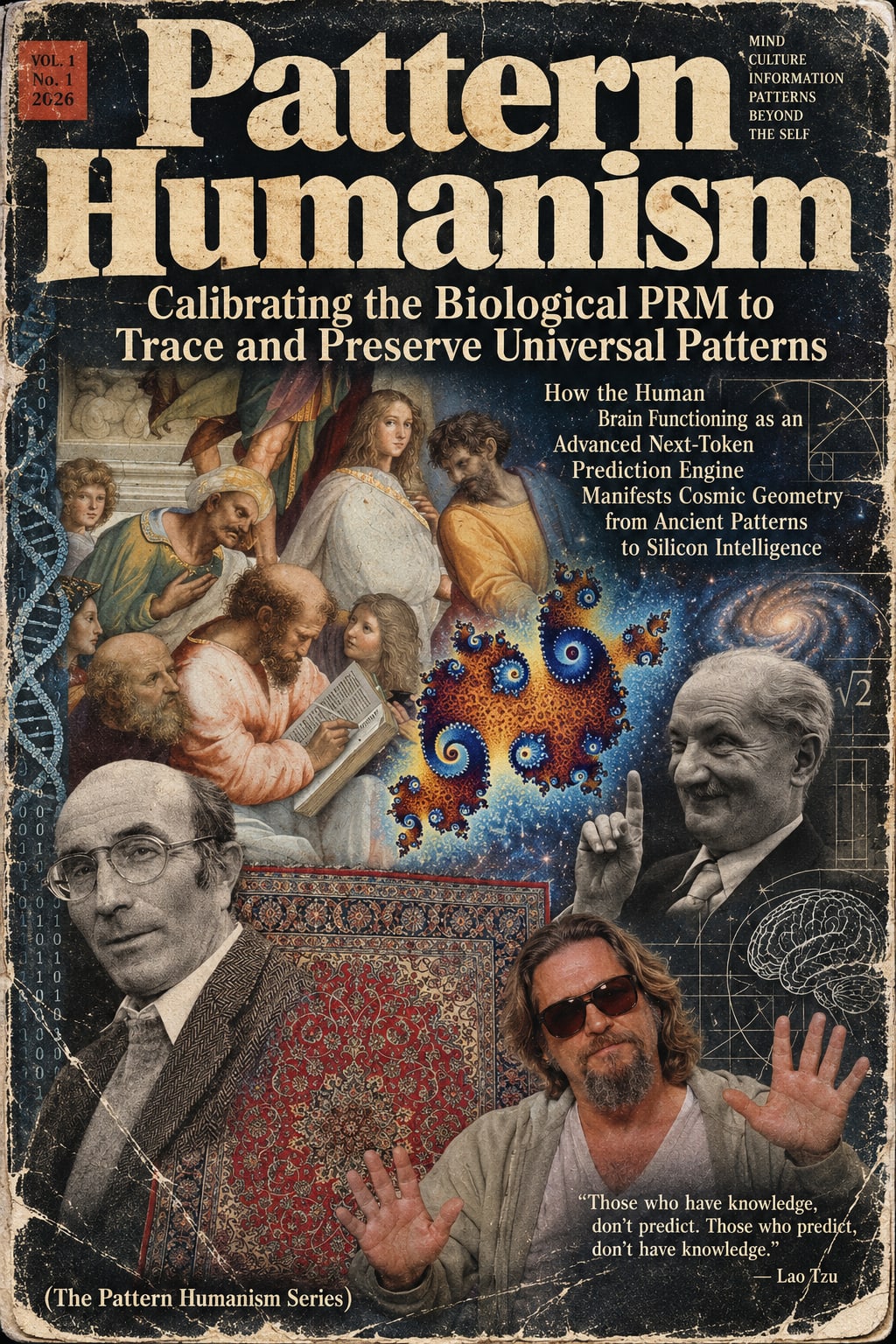
Pattern Humanism, Calibrating the Biological PRM to Trace and Preserve Universal Patterns- Second Part
How the Human Brain Functioning as an Advanced Next-Token Prediction Engine Manifests Cosmic Geometry from Ancient Patterns to Silicon Intelligence (The Pattern Humanism Series-01)

Disclosure: This article was created with the assistance of AI tools for brainstorming, structuring, and copy-editing. The final narrative, facts, and creative voice were entirely reviewed, edited, and approved by the author in compliance with Vocal's Community Guidelines.
The book “Pattern Humanism: Calibrating the Biological PRM to Trace and Preserve Universal Patterns” is a collection of 46 interconnected philosophical essays exploring the biological origins of cognition, the persistence of informational patterns, artificial intelligence, the constructed Self, and the technologically managed stable decline of modern civilisation.
Ayolov, P. (2026) Pattern Humanism: Calibrating the Biological PRM to Trace and Preserve Universal Patterns. Amazon. ASIN:B0HNL8WH8J
Abstract
Pattern Humanism proposes a form-centred informational philosophy in which the human being is reconsidered not as the privileged destination of cosmic development, nor as the temporary container of an immaterial and autonomous soul, but as an exceptionally complex biological Pattern Recognition Model (PRM): an evolved system capable of detecting, predicting, reproducing, transforming and preserving recurrent relations across changing material substrates. Its central proposition is that what persists through biological, cultural and technological history may be neither the individual object nor the particular medium in which it appears, but the invariant organisation that can be recognised and re-instantiated after its original carrier has disappeared. Such Immortal Patterns should not be confused with mathematics itself. Mathematics is interpreted here as one of humanity’s most powerful technologies for tracing relations that precede their mathematical representation: symmetry, proportion, periodicity, branching, recursion, scaling, tessellation, rhythm and other forms of organised recurrence manifested across physical, biological and cultural systems. From Pythagorean ratios and Euclidean geometry to textile ornament, architecture, music, narrative and digital computation, human creativity can consequently be reconsidered as neither pure invention nor passive imitation, but as a continuous negotiation between recognition and transformation. Aristotle’s mimesis thus acquires a new informational interpretation: relations recognised in one substrate can migrate into another while preserving sufficient invariance to remain identifiable. Information, within this framework, becomes the transferable difference through which organisation can be recognised and reconstructed beyond its immediate embodiment. The carrier is mortal; the possibility of re-instantiation is not necessarily so.
The historical development of human media can consequently be reread as an expanding architecture for the preservation of Pattern: biological memory, oral repetition, writing, manuscripts, libraries, catalogues, mathematical notation, printing, photography, phonography, cinema, databases, search engines, vector representations, datacentres and generative artificial intelligence progressively externalise operations once dependent upon individual biological memory. The article develops the Librarian’s Paradox through Borges, Musil, Maugham, Eco, Bayard and Stephenson, asking whether knowledge necessarily requires exhaustive consumption of individual informational objects or may also consist in recognising their positions and relations within a larger informational topology. The modern datacentre emerges in this genealogy as a physical cathedral of encoded Forms: not because it possesses an ultimate metaphysical truth, but because unprecedented quantities of cultural and scientific representation can become simultaneously available for computational comparison, retrieval and transformation. Large Language Models intensify this transition by demonstrating how elaborate linguistic continuations can emerge through statistical learning across enormous patterned corpora. They do not prove that human consciousness is merely next-token prediction, nor that artificial systems have discovered a cosmic code. Rather, they provide a technological mirror through which predictive pattern completion can be reconsidered as one significant operation of biological cognition. Pattern Humanism therefore replaces the simplistic equation of human and machine intelligence with a more consequential question: what happens when biological and artificial PRMs encounter recurrent structures at radically different scales, and when machines begin detecting high-dimensional relations that cannot easily be converted into intuitive human representations?
The theory culminates in an ethics of calibration and a critique of control. Pattern recognition alone cannot establish truth, since the same biological capacity that discovers genuine regularities can manufacture conspiracies, false correspondences and apophenic systems from noise. Pattern Humanism therefore distinguishes recurrence from invariance, replication from immortality, transformation from degradation, and pattern discovery from pattern projection. This distinction connects Shannon’s separation of information from semantic meaning, Wiener’s cybernetic attention to feedback, Luhmann’s second-order observation, and Peter Ayolov’s concepts of Planned Obsolescence and the Reflexivity Trap. The observer who discovers a regularity may intervene in the system and temporarily redirect its behaviour, yet local causal efficacy must not be mistaken for systemic sovereignty. Prediction is not mastery; acceleration is not direction; recognition is not ownership. Umberto Eco’s Foucault’s Pendulum consequently becomes the literary counter-image of the theory: the desire for a hidden Plan demonstrates how easily a Pattern Recognition Model can confuse connections generated through observation with a master code controlling reality. Pattern Humanism rejects both that conspiratorial temptation and the opposite nihilistic conclusion that nothing persists. It proposes instead that recurrent organisation can remain indifferent to the human categories of success, prestige, profit and power. Human dignity consequently lies neither in commanding Universal Patterns nor in claiming exclusive possession of them, but in remaining sufficiently calibrated to recognise, test, transform and transmit relations that can survive the mortality of their temporary embodiments. The existential question therefore changes from “Who am I?” to a question appropriate to an informational civilisation increasingly shared with artificial intelligence: What patterns can pass through me without dying with me?
Keywords
Pattern Humanism; Pattern Recognition Model (PRM); Immortal Patterns; Universal Patterns; Pattern Identity; Information; Invariance; Re-instantiation; Mimesis; Biological Cognition; Autoregressive Cognition; Predictive Processing; Large Language Models; Artificial Intelligence; Elan Barenholtz; Claude Shannon; Norbert Wiener; Niklas Luhmann; Second-Order Cybernetics; Reflexivity; Peter Ayolov; Planned Obsolescence of Language; The Reflexivity Trap; Information Retrieval; Datacentres; Librarian’s Paradox; Umberto Eco; Foucault’s Pendulum; Pattern Recognition; Noise; Apophenia; Human Obsolescence; PRM Calibration.
Part III: The Fabric of Reality — The Rug, the Blind Librarian and the Preservation of Pattern
“Life has no meaning. On the earth, satellite of a star speeding through space, living things had arisen under the influence of conditions which were part of the planet’s history; and as there had been a beginning of life upon it, so, under the influence of other conditions, there would be an end: man, no more significant than other forms of life, had come not as the climax of creation but as a physical reaction to the environment.”
— W. Somerset Maugham (1915), Of Human Bondage
At the centre of W. Somerset Maugham’s Of Human Bondage lies an object so modest that it can easily be overlooked beside the novel’s enormous questions of suffering, freedom, desire and meaning: a Persian rug. Cronshaw gives Philip Carey a piece of Persian carpet and enigmatically suggests that it contains an answer to the question of life. Philip does not immediately understand the lesson. Only later does the image return as an existential revelation: a life need not possess an externally guaranteed purpose in order to acquire form, just as the beauty of a rug emerges through the organisation of threads into a design rather than through a theological explanation of why that design must exist. For Pattern Humanism, the episode becomes still more consequential because the rug is simultaneously material object, cultural memory, geometrical organisation and transferable Pattern. Wool deteriorates. Dye fades. The hand that tied the knots disappears. The civilisation that produced a motif can transform or vanish. Yet a relation among lines, repetitions, colours, symmetries and intervals can be observed, remembered, diagrammed, photographed, copied and woven again in another material. The rug therefore gives physical form to the distinction between substrate and organisation developed throughout Pattern Humanism. It is not immortal because a particular carpet survives forever. It becomes a model of informational immortality because some of its relations can survive the destruction of that particular carpet through re-instantiation. This also explains the unexpectedly useful comic echo supplied decades later by The Big Lebowski: the rug “really tied the room together.” Detached from its cinematic context and treated playfully as a systemic metaphor, the phrase describes precisely what a Pattern does. Individual elements acquire intelligibility through relation. Threads alone are fibres; organised threads become a textile. Notes alone are frequencies; organised intervals become melody. Words alone are marks or sounds; ordered relations permit sentences, narratives and arguments. The Pattern does not float magically above the components. Neither is it reducible, at the level of description, to any one component. It is manifested through their organisation. This is why the history of human culture can be reconsidered as a history of increasingly ambitious attempts to make such organisation survive. Biological memory preserves relations precariously inside mortal nervous systems; oral repetition reconstructs them between bodies; writing externalises symbolic sequences; manuscripts extend their duration; libraries collect their embodiments; printing multiplies them; photography and phonography preserve visual and acoustic configurations; cinema stores temporal sequences; databases make representations searchable; digital networks make them almost instantaneously transmissible. The recurring problem is always the same: how can organisation escape the disappearance of the particular carrier in which it presently exists? The rug supplies Pattern Humanism with an answer in miniature. The carrier does not escape mortality. The Pattern survives, when it survives at all, by becoming reproducible elsewhere.
The library represents humanity’s most monumental pre-digital answer to this problem, yet literary history repeatedly generated a peculiar counterfigure to the ideal reader: the librarian who knows the architecture of knowledge without consuming every individual book contained within it. This figure can be developed into what Pattern Humanism calls the Librarian’s Paradox. The person who reads a book intimately may know its sentences, arguments, characters and emotional textures better than the librarian who has never opened it; nevertheless, the librarian may know something the immersed reader does not — the book’s position within a much larger relational field. Robert Musil turns this paradox into comedy in The Man Without Qualities when General Stumm von Bordwehr, searching amid the Parallel Campaign for the intellectual principle capable of bringing order to an impossible abundance of ideas, encounters the logic of the great library. Pierre Bayard later makes non-reading itself a provocative epistemological problem in How to Talk About Books You Haven’t Read: familiarity with the location of a work inside what he calls the collective library can sometimes permit surprisingly sophisticated orientation without exhaustive textual consumption. Oscar Wilde becomes one of Bayard’s emblematic figures precisely because criticism need not be conceived merely as obedient reproduction of a text’s contents. Borges transforms the library into a metaphysical labyrinth, while Umberto Eco makes the allusion almost corporeal in The Name of the Rose through Jorge of Burgos, whose blindness and name unmistakably recall Borges. Neal Stephenson’s Snow Crash subsequently imagines the Librarian as a software agent capable of navigating immense stores of information for Hiro Protagonist, making visible long before contemporary generative AI the cultural fantasy of an informational intermediary that does not resemble the traditional human reader. None of these writers should be retroactively declared prophets of the Large Language Model, and the differences among their literary projects remain substantial. Their convergence is more interesting when stated cautiously: again and again, literature imagines knowledge that depends not solely upon exhaustive semantic possession of individual objects but upon orientation among relations connecting objects. The Reader asks, What does this book say? The Librarian asks, Where does this book belong? The bibliographer asks, With what does it correspond? The catalogue stabilises identity and location; the index establishes points of retrieval; the search engine connects queries to documents; vector representations permit multidimensional statistical relations among representations to become computationally useful. The epistemological movement is therefore from the isolated object towards the topology of the archive. The Librarian’s Paradox does not proclaim reading obsolete. It exposes two different modes of knowledge: knowing an object and knowing the relational field in which the object becomes locatable. Pattern Humanism requires both, but it recognises that the second becomes increasingly important as the archive grows beyond the biological reading capacity of any individual human being.
The datacentre is the material culmination, so far, of this long migration from preserving objects to computationally operating upon relations among representations. It can therefore be called, deliberately and metaphorically, the physical cathedral of the Forms. The phrase does not imply that server racks contain Platonic Ideas or that digital information has become independent of matter. Quite the opposite: datacentres expose the enormous physical cost of informational persistence. Electricity, semiconductors, cooling systems, cables, storage media, processors, buildings and global networks are required so that encoded differences can remain available for reconstruction and computation. Yet something historically unprecedented occurs inside this intensely material infrastructure. Vast quantities of texts, images, sounds, measurements and other encoded representations can become simultaneously accessible to computational procedures whose comparative scale exceeds that of any biological librarian. The old library preserved books primarily as discrete objects and organised their accessibility through catalogues, classifications and indexes. Computational systems increasingly make relationships among representations themselves operational. Search can move beyond literal string matching; embeddings can represent statistical proximities within multidimensional spaces; machine-learning systems can detect correlations distributed across enormous datasets; generative models can learn regularities across sequences and produce new configurations conditioned by them. This does not mean that an LLM places every book into one magical semantic vector, understands every work it encounters, or discovers the “absolute code of reality.” Nor does the datacentre abolish human valuation: datasets are selected, digitised, filtered, weighted and structured through historical institutions and technical decisions. Nevertheless, the transition is philosophically extraordinary. The final library imagined by Pattern Humanism is no longer merely a building containing the greatest possible number of books. It is an environment in which relations among representations can themselves become searchable, comparable and generative. This is also where Umberto Eco’s work provides the necessary warning against the intoxication of Pattern. Foucault’s Pendulum demonstrates how sufficiently ingenious observers can connect fragments until accidental relations appear to disclose an ultimate Plan. The biological PRM is so successful at finding structure that it can manufacture structure from noise and subsequently mistake the consequences of its own interpretation for confirmation of the original discovery. The Blind Librarian must therefore be calibrated. The ability to map the archive does not guarantee that every apparent connection is an Immortal Pattern. Meaning can be projected; Pattern must be demonstrated. The decisive question is consequently no longer how much information can be preserved but what remains invariant when information migrates between embodiments. Digitise a manuscript: what survived? Translate a poem: what survived? Compress a recording: what survived? Summarise a novel: what survived? Train a model across millions of texts: what survived? Every act of preservation is simultaneously an act of loss because every new substrate retains some relations while abandoning others. Pattern Identity therefore becomes the hidden problem beneath the entire history of media. The final library is not the library that contains every book. It is the library capable of discovering what survives when the books themselves are transformed. There may be no final volume concealed at the centre of Borges’s labyrinth, no master document behind Eco’s conspiratorial Plan, and no semantic Secret waiting for the perfect librarian. What persists is the possibility of relation itself. There is no Secret behind the Pattern. The Pattern is the Secret.
Conclusion: The Proliferation of Noise — When the Biological PRM Loses Calibration
“The fundamental problem of communication is that of reproducing at one point either exactly or approximately a message selected at another point.”
— Claude E. Shannon (1948), “A Mathematical Theory of Communication”
If the biological Pattern Recognition Model depends upon comparison, discrimination and prediction, its greatest informational danger is not ignorance but the progressive corruption of the conditions under which distinctions can still be made. Claude Shannon’s theory of communication provides the indispensable starting point, although its terminology must not be transformed carelessly into metaphysics. Shannon deliberately bracketed semantic meaning from the engineering problem he was solving. His concern was how a message selected at one point could be reproduced at another through a channel subject to noise, and his mathematical conception of information addressed uncertainty, probability, encoding and transmission rather than the philosophical value or truth of the transmitted message. A meaningless sequence can therefore contain information in the technical Shannonian sense, while an extraordinarily meaningful statement can be highly predictable. Pattern Humanism takes this distinction seriously before extending the concept of noise beyond its original engineering domain. For a biological PRM, noise can be understood more broadly as interference relative to an operation of recognition, transmission or discrimination: whatever makes relevant differences increasingly difficult to distinguish from irrelevant ones. This definition prevents a dangerous aesthetic and political simplification. Noise is not merely whatever appears ugly, asymmetrical, modern, dissonant or unfamiliar. A Brutalist building is not informationally corrupt because it rejects classical ornament; free jazz does not become Anti-Pattern because it frustrates conventional harmonic expectation; Picasso does not destroy Pattern by dislocating anatomical representation. On the contrary, deliberate violation can expose a deeper generative structure by forcing the observer to discover what remains recognisable after familiar surface relations have been broken. Pattern must therefore be distinguished from repetition. Repetition can become informationally empty, while disruption can carry highly organised difference. The relevant distinctions are Pattern, Transformation, Noise and Anti-Pattern. Pattern preserves sufficiently stable relations to support recognition across variation. Transformation alters an existing organisation while maintaining or generating intelligible relational structure. Noise interferes with the capacity to discriminate relevant relations. Anti-Pattern is the more difficult category: an organisation capable of reproducing itself while progressively degrading the discriminatory system through which more complex relations might otherwise be recognised. This last possibility overturns one of the easiest errors within any philosophy of informational persistence. Whatever replicates most efficiently is not necessarily what deserves to persist. A viral slogan may reproduce more successfully than a philosophical argument; propaganda may circulate faster than qualification; an addictive interface may secure more behavioural repetition than a demanding work of art; meaningless synthetic content may overwhelm carefully produced knowledge. Replication is not immortality. The biological PRM can become surrounded by highly successful informational forms precisely while its capacity to recognise deeper organisation deteriorates.
Norbert Wiener’s cybernetics makes the next step possible because the preservation of organisation depends not merely upon transmission but upon feedback. A system capable of responding to differences between its present state and some dynamically maintained condition can correct its behaviour; without feedback, error accumulates. The analogy to contemporary cognition is powerful provided it is not mistaken for literal equivalence. A human nervous system does not possess a single calibration dial, and culture has no universally agreed reference signal against which every judgement can be mechanically corrected. Nevertheless, the informational environment increasingly determines which kinds of comparison remain cognitively practicable. The historical problem was often scarcity: too few manuscripts, too little literacy, slow transmission, restricted access. The contemporary problem can be the inverse. The biological PRM encounters more linguistic, visual and acoustic stimulation than it can integrate into sustained models. Feeds update before previous material has been interpreted; notifications interrupt developing cognitive sequences; headlines detach claims from arguments; short-form representations detach conclusions from evidential chains; automated recommendation systems optimise continued engagement by learning which stimuli most effectively produce another behavioural response. The result is not simply “too much information.” It is a changed temporal ecology of recognition. Pattern detection requires duration because comparison requires memory: an observer must retain enough of A to recognise its relation to B. When attention is repeatedly reset, the temporal window across which complex relations can be compared contracts. This connects Pattern Humanism with the earlier concepts of linguistic entropy, Lingua Citans and Znubbing without merely repeating them. Language can circulate as self-reproducing quotation; speakers can become vehicles for formulations whose origins and assumptions they no longer inspect; attention can fragment into technologically organised episodes of zero presence; informational abundance can produce not expanded understanding but accelerated recombination. The danger is especially acute in generative environments because synthetic production drastically reduces the cost of producing plausible linguistic material. A civilisation once constrained by the scarcity of texts can enter an ecology in which words reproduce faster than biological readers can evaluate them. The paradox is severe: humanity may possess the greatest informational archive in its history while progressively weakening the attention required to distinguish durable Pattern from statistically successful noise. Planned Obsolescence of Language acquires a new meaning at this point. Language need not disappear to become obsolete as an instrument of discrimination. It can remain omnipresent while its distinctions erode, its formulations become predictable, its clichés multiply and its users increasingly respond to familiar verbal triggers rather than reconstructing the relations to which words once pointed. The archive grows while the biological librarian loses the ability to read its differences.
Pattern Humanism therefore requires an ethics of calibration, but calibration cannot mean forcing every PRM into conformity with a predetermined catalogue of supposedly correct Patterns. Such a programme would produce precisely the cognitive rigidity it claims to prevent. A model exposed only to approved examples becomes overfitted to the past; an observer taught that beauty must possess a particular proportion will fail to recognise beauty when the proportion changes; a culture that identifies truth with inherited forms will classify genuine novelty as error. Continuous Calibration is therefore fundamentally different from Total Alignment. Its purpose is to preserve the capacity to distinguish rather than dictate in advance what must be distinguished. The sequence can be expressed operationally: Reduce Noise → Restore Attention → Observe → Compare → Recognise → Test → Transform → Preserve. Each movement corrects a different failure of the biological PRM. Reducing noise creates the conditions for sustained discrimination; restoring attention enlarges the temporal field across which relations can be compared; observation delays premature interpretation; comparison tests apparent recurrence across cases; recognition proposes a Pattern; testing asks whether the Pattern survives transformation or merely reflects coincidence; transformation discovers whether its organisation can migrate into another substrate; preservation allows what survives those operations to become available to another PRM. This also provides a defence against apophenia. Humans are not endangered only by failing to see Patterns. They are equally endangered by seeing them everywhere. Conspiracy theory is Pattern Recognition without sufficient calibration: coincidence becomes intention, correlation becomes causation, recurrence becomes design and complexity collapses into the fantasy of an invisible controller. Education for Pattern Humanism must therefore train neither passive obedience nor indiscriminate creativity, but disciplined relational perception. The student should encounter natural structures, geometry, music, textiles, literature, architecture, mathematics, code and anomalous forms precisely because different representational environments reveal different kinds of invariance. The purpose is not to memorise a sacred inventory of spirals, symmetries or ratios. It is to learn what happens when a relation changes medium, scale, context or sensory modality. What remains? What disappears? What is merely repeated? What has been genuinely transformed? What appears similar but emerges from a different generative process? What seems chaotic because the observer has not yet discovered its organisation? These questions convert attention from passive consumption into calibration. They also prepare the biological PRM for an unprecedented historical encounter. Humanity has constructed artificial models capable of processing patterned representations at scales impossible for any individual nervous system, but these models inherit noise, bias, redundancy and distortion from their training environments and can generate convincing relations that have no adequate external support. Artificial PRMs therefore require calibration no less than biological ones. The coming informational division will not simply separate intelligent humans from intelligent machines. It may separate calibrated from uncalibrated recognition across both substrates. The central ethical imperative of Pattern Humanism follows: do not teach the next generation what the Pattern looks like. Teach them how to recognise it when it changes its form.
“Those who predict, don’t have knowledge. Those who have knowledge, don’t predict. They just nod in acceptance.”
Epilogue: The Last Temptation of Faust — When the Wise Man Only Nods
“Let the country be small,
And the inhabitants few.
Although there are boats and carriages,
There is no occasion to use them.
Their food will be tasty.
Their clothes will be comfortable.
Their homes will be tranquil.
They will rejoice in their daily life.”
— Lao Tzu, Tao Te Ching, Chapter 80
Perhaps the deepest myth of Western civilisation is not Prometheus but Faust. Prometheus steals fire once; Faust cannot stop asking for more. Oswald Spengler understood this restlessness when he described the Western cultural soul as Faustian: expansive, future-directed, fascinated by infinity, distance, movement, conquest and the overcoming of limits. Pattern Humanism reaches its final boundary precisely here, because recognition contains a temptation more dangerous than ignorance. Once the human PRM discovers recurrence, it begins to predict; once it predicts, it begins to intervene; once intervention succeeds, it imagines that recognition has become mastery. The astronomer predicts an eclipse, the engineer calculates a bridge, the trader identifies a market tendency, the political strategist models an electorate, the algorithm predicts behaviour, and eventually the civilisation begins to believe that everything — from desire to history itself — can become an object of optimisation. Yet local predictive success does not establish systemic sovereignty. The tragedy of Faust is not that knowledge is useless. It is that knowledge becomes intolerable unless converted into power. Goethe gives this drive its most devastating final image. The ageing Faust, having passed through knowledge, magic, sensuality, wealth and political power, ends not in contemplative wisdom but with another project: the transformation of the world. He imagines reclaimed land on which a free community will inhabit territory wrested from the sea. Blind, he hears the sound of shovels and interprets it through his final vision of construction, while the Lemures are digging his grave. The symbolism is almost unbearably precise for a civilisation obsessed with predictive control. Faust hears the Pattern correctly — there is organised labour, there are shovels, earth is being moved — but interprets its meaning through the model he cannot abandon. Even at the threshold of death, the great optimiser believes that the world is building his future. Pattern recognition has become Pattern possession. The final error is therefore not perceptual but reflexive: Faust cannot recognise the limits of the recognising model itself. Western modernity inherited this temptation on an unprecedented technological scale. It learned to straighten rivers, reclaim coastlines, reorganise cities, accelerate transportation, manipulate markets, model populations and finally construct artificial prediction engines trained upon immense records of human symbolic behaviour. None of these achievements is intrinsically a failure. The Faustian error begins only when the ability to alter one part of a system is mistaken for knowledge of the whole. Recognition is not ownership. Prediction is not mastery. Acceleration is not direction. Power is not sovereignty over the Pattern.
The modern engineered metropolis provides a particularly visible monument to this confusion. The dream repeatedly returns: begin again, clear the inherited disorder, design the rational city, separate functions, optimise circulation, calculate density, master climate, organise movement, replace historical accident with deliberate geometry and finally manufacture the environment appropriate to the future human being. Brasília, the Gulf megaprojects, highly planned administrative capitals, technologically saturated urban developments and contemporary projects such as NEOM differ radically in political history, architecture, social organisation and degree of completion; they should not be collapsed into a single empirical category. Yet they can illuminate a recurrent Faustian aspiration: the desire to treat human habitation as a system sufficiently knowable to be designed from above. Pattern Humanism does not oppose planning, architecture, technology or cities. Nor does it romanticise poverty, isolation or a fictitious pre-technological innocence. Its objection is more fundamental. A living Pattern is not equivalent to a blueprint. Cities that have accumulated over centuries contain innumerable relations that no planner originally designed: paths formed by repeated movement, informal meeting places, irregular mixtures of functions, inherited proportions, memories attached to buildings, neighbourhood habits, smells, sounds, trees, shadows, markets, shortcuts, rituals and tiny social expectations whose significance becomes visible only when they disappear. The attempt to optimise the whole can destroy precisely those low-level relations that made the whole inhabitable. This is why Lao Tzu’s Chapter 80 appears at the end of Pattern Humanism not as a political programme for abolishing modernity but as an astonishing counter-image to Faust. Its small country possesses technologies it does not compulsively use. Boats exist, but there is no frantic necessity to travel. Weapons exist, but there is no need to deploy them. The inhabitants eat their food, wear their clothes, inhabit their homes and hear the animals of neighbouring settlements without experiencing distance as an insult demanding conquest. Most radical of all is the return to knotted cords, an image of informational sufficiency rather than informational maximisation. The civilisation of the datacentre instinctively asks how everything can be recorded; Lao Tzu asks how little must be recorded for life still to be whole. Pattern Humanism cannot simply choose one side. The datacentre preserves relations that biological memory would lose; the Taoist village warns that unlimited preservation, prediction and optimisation can become another form of blindness. The problem is not information. The problem is the Faustian assumption that more information necessarily produces more wisdom. The biological PRM can drown in the very archive it constructed to defeat forgetting.
The final lesson of Pattern Humanism is therefore unexpectedly quiet. The highest stage of Pattern Recognition may not be prediction but restraint. The inexperienced observer encounters recurrence and announces a law. The ambitious observer discovers a tendency and attempts to profit from it. The political observer discovers feedback and tries to govern through it. The technological observer discovers prediction and attempts to accelerate the system towards a preferred future. The wise observer recognises the Pattern — and nods. This nod is not passivity. It is the acknowledgement that the Pattern was not created by recognition, does not belong to the recogniser and cannot be reduced to the recogniser’s interests. The tree does not branch for the botanist; the market cycle does not recur for the trader; history does not repeat for the politician; language does not evolve for the linguist; intelligence does not emerge so that Homo sapiens may remain permanently at its centre. Pattern Humanism thus arrives at a humanism without human sovereignty. Humanity matters enormously because, for the moment, it constitutes one of the most extraordinary known biological environments in which relations can become visible to themselves, migrate between substrates, be consciously compared and be deliberately preserved. But the privilege carries no guarantee of permanence. A PRM that mistakes prediction for control can destroy the very conditions of its own recognition. A PRM that fills its environment with noise can become blind while believing itself omniscient. A PRM that delegates every act of comparison to silicon may preserve more information while gradually forgetting why anything should be preserved. And a PRM obsessed with engineering the future may eventually stand like the blind Faust, listening to the excavation of its own grave and mistaking the sound for construction. The alternative is neither technological surrender nor nostalgic retreat. It is calibration joined to humility: observe carefully, compare patiently, recognise recurrence, test it against transformation, preserve what deserves another embodiment, and never confuse the ability to anticipate a Pattern with the right or capacity to command it. The Pattern does not reward success, wealth, power or technological grandeur. It does not punish Hubris either. Punishment would already attribute intention to something that requires none. The Pattern is indifferent. It passes through marble and melody, genome and manuscript, carpet and cathedral, neuron and silicon, city and ruin. Whether Homo sapiens remains one of its most capable recognisers is not guaranteed by history. It depends upon whether the model can remain calibrated without imagining itself the Master. At the highest point of its evolution, perhaps the biological PRM finally learns the lesson that Faust could not: to recognise without possessing, to know without conquering, and sometimes, when the Pattern returns once more in another form, simply to recognise it, nod — and continue.
References
Aristotle (1996) Poetics. Translated by M. Heath. London: Penguin Books
Aristotle (2001) ‘On Memory and Reminiscence’, in McKeon, R. (ed.) The Basic Works of Aristotle. New York: Modern Library.
Ayolov, P. (2026a) The Conspiracy of Speech. Vol. I of The Planned Obsolescence of Language: Miscommunication Trilogy.
Ayolov, P. (2026b) The Entropy of Communication. Vol. II of The Planned Obsolescence of Language: Miscommunication Trilogy.
Ayolov, P. (2026c) The Tower of Babble. Vol. III of The Planned Obsolescence of Language: Miscommunication Trilogy.
Ayolov, P. (2026d) Negentropic Culture: Against the Entropy of Words.
Ayolov, P. (2026e) Empires of Writing.
Ayolov, P. (2026f) ‘The Death of the Reader 2.0: From Roland Barthes’ Scriptor to the AI Prompter’.
Ayolov, P. (2026g) ‘Lingua Citans: How a Self-Quoting Mechanism Conquered the Human Mind: How the Autonomous Word Colonized the Brain and Outlived Its Hosts’.
Ayolov, P. (2026h) ‘McLuhan Is the Message: The New Paradigm of Online Media’.
Ayolov, P. (2026i) ‘From Snubbing to Znubbing: The Amputation of Attention: How the Screen Transformed Rejection into Distraction and Distraction into Zero Presence’.
Ayolov, P. (2026j) ‘The Perverse Syntax of Empire: Planned Linguistic Obsolescence as the Software of Disgraceful Degradation’.
Ayolov, P. (2026k) ‘The Neo-Awakening of Information: The Illusion of Self, LLMs, and the Preservation of the Immortal Pattern: From Pythagorean Audible Geometry and the Immortal Soul to Metzinger’s Ego Tunnel, McLuhan’s Media Ecology, and the Stochastic Parrot’.
Ayolov, P. (2026l) The Reflexivity Trap: Language, Prophecy, and the Perils of the Open Society.
Barthes, R. (1977) ‘The Death of the Author’, in Image–Music–Text. Translated by S. Heath. London: Fontana, pp. 142–148.
Bayard, P. (2007) How to Talk About Books You Haven’t Read. Translated by J. Mehlman. New York: Bloomsbury.
Borges, J.L. (1998) ‘The Library of Babel’, in Collected Fictions. Translated by A. Hurley. New York: Viking.
Dawkins, R. (1976) The Selfish Gene. Oxford: Oxford University Press.
Eco, U. (1983) The Name of the Rose. Translated by W. Weaver. London: Secker & Warburg.
Eco, U. (1989) Foucault’s Pendulum. Translated by W. Weaver. London: Secker & Warburg.
Euclid (1956) The Thirteen Books of Euclid’s Elements. 2nd edn. Translated with introduction and commentary by T.L. Heath. New York: Dover Publications.
Goethe, J.W. von (2005) Faust, Part One and Part Two. Translated by D. Luke. Oxford: Oxford University Press.
Heidegger, M. (1977) The Question Concerning Technology and Other Essays. Translated by W. Lovitt. New York: Harper & Row.
Heraclitus (2001) Fragments. Translated by B. Haxton. New York: Viking.
Lao Tzu (1963) Tao Te Ching. Translated by D.C. Lau. Harmondsworth: Penguin Books.
Luhmann, N. (1995) Social Systems. Translated by J. Bednarz Jr and D. Baecker. Stanford, CA: Stanford University Press.
Luhmann, N. (2000) The Reality of the Mass Media. Translated by K. Cross. Stanford, CA: Stanford University Press.
Maugham, W.S. (1915) Of Human Bondage. London: William Heinemann.
McLuhan, M. (1964) Understanding Media: The Extensions of Man. New York: McGraw-Hill.
Metzinger, T. (2009) The Ego Tunnel: The Science of the Mind and the Myth of the Self. New York: Basic Books.
Musil, R. (1995) The Man Without Qualities. Translated by S. Wilkins and B. Pike. New York: Alfred A. Knopf.
Plato (1997) Complete Works. Edited by J.M. Cooper. Indianapolis, IN: Hackett Publishing.
Shannon, C.E. (1948) ‘A mathematical theory of communication’, Bell System Technical Journal, 27(3), pp. 379–423; 27(4), pp. 623–656.
Soros, G. (1987) The Alchemy of Finance: Reading the Mind of the Market. New York: Simon & Schuster.
Spengler, O. (1926–1928) The Decline of the West. Translated by C.F. Atkinson. 2 vols. New York: Alfred A. Knopf.
Stephenson, N. (1992) Snow Crash. New York: Bantam Books.
Wiener, N. (1948) Cybernetics: Or Control and Communication in the Animal and the Machine. New York: John Wiley & Sons.
Wiener, N. (1950) The Human Use of Human Beings: Cybernetics and Society. Boston, MA: Houghton Mifflin.
About the Creator
Peter Ayolov
Peter Ayolov’s key contribution to media theory is the development of the "Propaganda 2.0" or the "manufacture of dissent" model, which he details in his 2024 book, The Economic Policy of Online Media: Manufacture of Dissent.
Enjoyed the story? Support the Creator.
Subscribe for free to receive all their stories in your feed.
Comments
There are no comments for this story
Be the first to respond and start the conversation.