
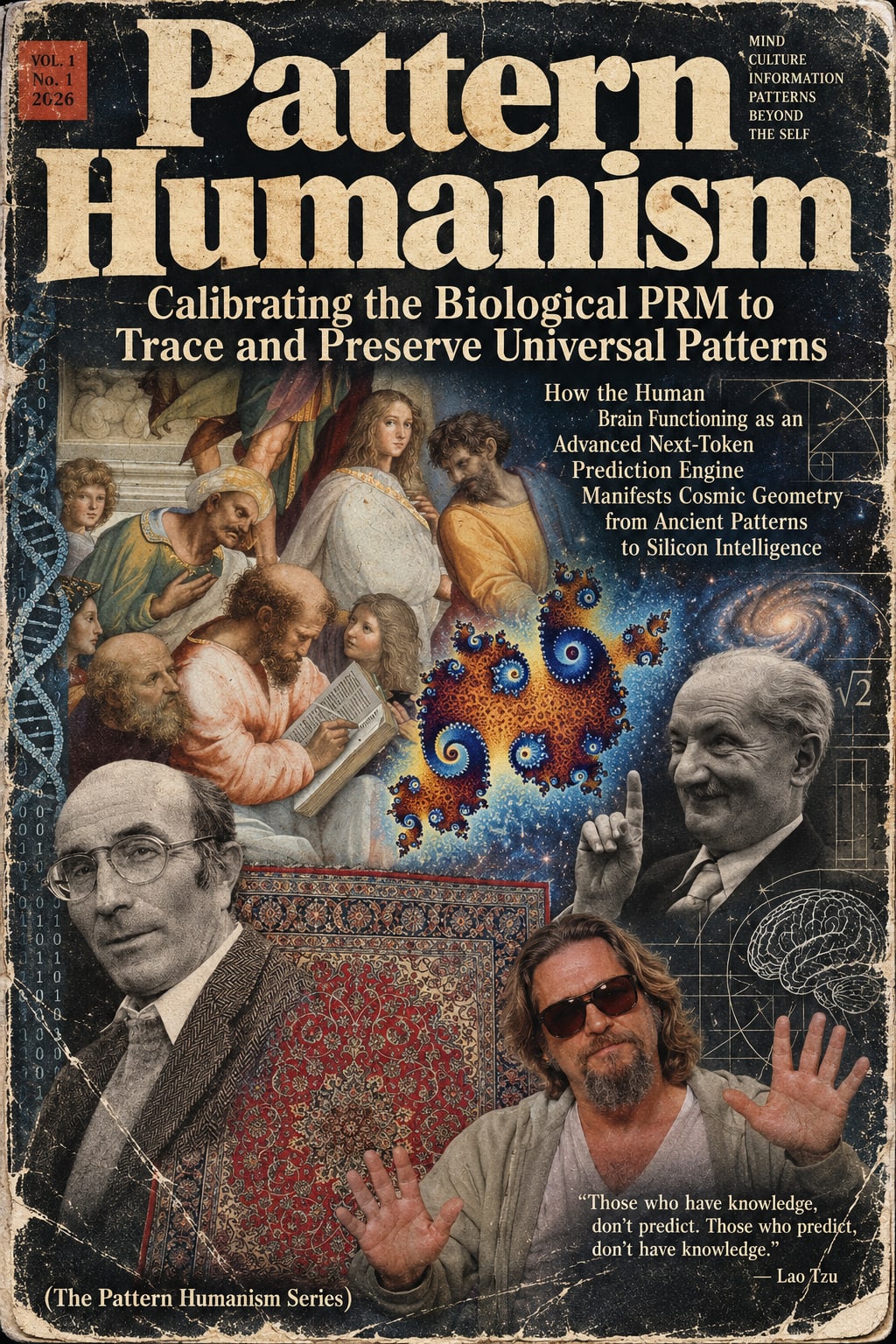
Pattern Humanism, Calibrating the Biological PRM to Trace and Preserve Universal Patterns -First part
How the Human Brain Functioning as an Advanced Next-Token Prediction Engine Manifests Cosmic Geometry from Ancient Patterns to Silicon Intelligence (The Pattern Humanism Series-01)

Disclosure: This article was created with the assistance of AI tools for brainstorming, structuring, and copy-editing. The final narrative, facts, and creative voice were entirely reviewed, edited, and approved by the author in compliance with Vocal's Community Guidelines.
The book "Pattern Humanism: Calibrating the Biological PRM to Trace and Preserve Universal Patterns" is a collection of 46 interconnected philosophical essays exploring the biological origins of cognition, the persistence of informational patterns, artificial intelligence, the constructed Self, and the technologically managed stable decline of modern civilisation.
Ayolov, P. (2026) Pattern Humanism: Calibrating the Biological PRM to Trace and Preserve Universal Patterns. Amazon.
Abstract
Pattern Humanism proposes a form-centred informational philosophy in which the human being is reconsidered not as the privileged destination of cosmic development, nor as the temporary container of an immaterial and autonomous soul, but as an exceptionally complex biological Pattern Recognition Model (PRM): an evolved system capable of detecting, predicting, reproducing, transforming and preserving recurrent relations across changing material substrates. Its central proposition is that what persists through biological, cultural and technological history may be neither the individual object nor the particular medium in which it appears, but the invariant organisation that can be recognised and re-instantiated after its original carrier has disappeared. Such Immortal Patterns should not be confused with mathematics itself. Mathematics is interpreted here as one of humanity’s most powerful technologies for tracing relations that precede their mathematical representation: symmetry, proportion, periodicity, branching, recursion, scaling, tessellation, rhythm and other forms of organised recurrence manifested across physical, biological and cultural systems. From Pythagorean ratios and Euclidean geometry to textile ornament, architecture, music, narrative and digital computation, human creativity can consequently be reconsidered as neither pure invention nor passive imitation, but as a continuous negotiation between recognition and transformation. Aristotle’s mimesis thus acquires a new informational interpretation: relations recognised in one substrate can migrate into another while preserving sufficient invariance to remain identifiable. Information, within this framework, becomes the transferable difference through which organisation can be recognised and reconstructed beyond its immediate embodiment. The carrier is mortal; the possibility of re-instantiation is not necessarily so.
The historical development of human media can consequently be reread as an expanding architecture for the preservation of Pattern: biological memory, oral repetition, writing, manuscripts, libraries, catalogues, mathematical notation, printing, photography, phonography, cinema, databases, search engines, vector representations, datacentres and generative artificial intelligence progressively externalise operations once dependent upon individual biological memory. The article develops the Librarian’s Paradox through Borges, Musil, Maugham, Eco, Bayard and Stephenson, asking whether knowledge necessarily requires exhaustive consumption of individual informational objects or may also consist in recognising their positions and relations within a larger informational topology. The modern datacentre emerges in this genealogy as a physical cathedral of encoded Forms: not because it possesses an ultimate metaphysical truth, but because unprecedented quantities of cultural and scientific representation can become simultaneously available for computational comparison, retrieval and transformation. Large Language Models intensify this transition by demonstrating how elaborate linguistic continuations can emerge through statistical learning across enormous patterned corpora. They do not prove that human consciousness is merely next-token prediction, nor that artificial systems have discovered a cosmic code. Rather, they provide a technological mirror through which predictive pattern completion can be reconsidered as one significant operation of biological cognition. Pattern Humanism therefore replaces the simplistic equation of human and machine intelligence with a more consequential question: what happens when biological and artificial PRMs encounter recurrent structures at radically different scales, and when machines begin detecting high-dimensional relations that cannot easily be converted into intuitive human representations?
The theory culminates in an ethics of calibration and a critique of control. Pattern recognition alone cannot establish truth, since the same biological capacity that discovers genuine regularities can manufacture conspiracies, false correspondences and apophenic systems from noise. Pattern Humanism therefore distinguishes recurrence from invariance, replication from immortality, transformation from degradation, and pattern discovery from pattern projection. This distinction connects Shannon’s separation of information from semantic meaning, Wiener’s cybernetic attention to feedback, Luhmann’s second-order observation, and Peter Ayolov’s concepts of Planned Obsolescence and the Reflexivity Trap. The observer who discovers a regularity may intervene in the system and temporarily redirect its behaviour, yet local causal efficacy must not be mistaken for systemic sovereignty. Prediction is not mastery; acceleration is not direction; recognition is not ownership. Umberto Eco’s Foucault’s Pendulum consequently becomes the literary counter-image of the theory: the desire for a hidden Plan demonstrates how easily a Pattern Recognition Model can confuse connections generated through observation with a master code controlling reality. Pattern Humanism rejects both that conspiratorial temptation and the opposite nihilistic conclusion that nothing persists. It proposes instead that recurrent organisation can remain indifferent to the human categories of success, prestige, profit and power. Human dignity consequently lies neither in commanding Universal Patterns nor in claiming exclusive possession of them, but in remaining sufficiently calibrated to recognise, test, transform and transmit relations that can survive the mortality of their temporary embodiments. The existential question therefore changes from “Who am I?” to a question appropriate to an informational civilisation increasingly shared with artificial intelligence: What patterns can pass through me without dying with me?
Keywords
Pattern Humanism; Pattern Recognition Model (PRM); Immortal Patterns; Universal Patterns; Pattern Identity; Information; Invariance; Re-instantiation; Mimesis; Biological Cognition; Autoregressive Cognition; Predictive Processing; Large Language Models; Artificial Intelligence; Elan Barenholtz; Claude Shannon; Norbert Wiener; Niklas Luhmann; Second-Order Cybernetics; Reflexivity; Peter Ayolov; Planned Obsolescence of Language; The Reflexivity Trap; Information Retrieval; Datacentres; Librarian’s Paradox; Umberto Eco; Foucault’s Pendulum; Pattern Recognition; Noise; Apophenia; Human Obsolescence; PRM Calibration.
Introduction: The Informational Turn in Human Existentialism
“The things of which there is sight, hearing, knowledge: these are what I honour most.”
— Heraclitus (DK 22 B55), Fragment 55
The history of human thought can be read as a prolonged attempt to identify what remains when the individual human being disappears. Religion called it the soul; Plato sought permanence in Forms; Aristotle distinguished matter from form while grounding living beings in organised activity; Christianity transformed psychē into an architecture of personal immortality; modern philosophy relocated the problem into mind, consciousness and subjectivity; information theory and cybernetics later introduced an entirely different vocabulary of signal, difference, feedback, organisation and transmission. Yet beneath these successive conceptual systems persists a question more elementary than the traditional opposition between matter and spirit: what exactly survives transformation? A melody remains recognisable when played by another instrument; a geometrical relation survives when transferred from a diagram into an equation; a branching structure can recur in a tree, a river basin, a lung or a vascular network without any of these objects becoming identical; an ornamental configuration can migrate from woven wool into stone, paper or pixels while retaining sufficient relational organisation to be recognised. The material carrier changes, sometimes completely, while something remains invariant enough to cross the transformation. Pattern Humanism begins from this elementary phenomenon and proposes that philosophy has concentrated too heavily upon the substances carrying organisation and insufficiently upon the relations capable of surviving their carriers. An Immortal Pattern, in this sense, is not a supernatural entity and does not require the metaphysical eternity traditionally assigned to the soul. It is a reproducible relational organisation capable of recurring, transforming and migrating across material, biological, sensory, cultural or computational substrates while preserving sufficient invariance to remain identifiable. Mathematics does not constitute this Pattern and should not be elevated into another metaphysical substance. Human beings invented mathematical systems to trace relations that they encountered, inferred or abstracted from experience. Number, geometry, algebra and computation are representational technologies through which recurrent organisation becomes describable with extraordinary precision. The distinction is fundamental: the Patterns are not mathematics; mathematics is one of the instruments through which a biological Pattern Recognition Model learns to recognise, compare and preserve them. Pattern Humanism therefore begins neither with the mystical proposition that everything is number nor with the computational claim that reality is literally software. It begins with a more modest but potentially more radical observation: substrates perish and representations change, while certain relations can be reconstructed again and again. Matter persists through physical processes; organisms persist through reproduction; Patterns persist through re-instantiation.
The informational turn makes this proposition possible because information introduces a peculiar form of continuity that cannot be adequately described by simply identifying it with its temporary physical carrier. A manuscript burns, yet another copy may preserve its textual organisation. A performance ends, yet notation or recording can enable aspects of it to recur. A speaker dies, yet arrangements of words attributed to that speaker can migrate through memory, quotation, manuscript, print, magnetic storage and digital networks. Information should not therefore be carelessly converted into an immaterial cosmic substance. Claude Shannon's mathematical theory of communication deliberately separated the engineering problem of information transmission from questions of semantic meaning, while Norbert Wiener’s cybernetics placed information, feedback and organisation at the centre of explanations crossing the boundaries between organisms and machines. Pattern Humanism extends rather than merely repeats these developments by asking an ontological question that neither engineering theory was required to answer: what is being preserved when organisation becomes reconstructible beyond the mortality of a particular embodiment? Its provisional answer is that information can be understood philosophically as the transferable difference that allows a Pattern to be recognised and reconstructed beyond its present material embodiment. This interpretation transforms the history of media into something more than the familiar succession of technological inventions. Oral repetition allowed remembered structures to exceed individual moments of speech; writing detached symbolic arrangements from living voices; manuscripts and libraries extended their duration; printing multiplied their recoverability; photography and phonography externalised visual and acoustic relations; cinema preserved ordered sequences of movement; databases made stored representations systematically searchable; digital networks multiplied transmission; datacentres concentrated unprecedented quantities of encoded human and machine-produced representations into computationally accessible infrastructures. The trajectory is not simply towards more content. It is towards increasingly powerful mechanisms of preservation, comparison, retrieval and reconstruction. The contemporary datacentre can consequently be understood as the latest physical cathedral of the Forms—not because server racks contain Plato's transcendent realities or because digitalisation has solved the metaphysical problem of existence, but because humanity has constructed enormous material environments whose function is to preserve and process representations independently of the biological lifespan of the individuals who produced them. The historical sequence from memory to manuscript, from library to index, and from database to computational model reveals a persistent human urge: to make organisation recoverable after its original carrier has vanished. Pattern Humanism asks why an organism destined to die invests so much energy in ensuring that some of the relations it has recognised do not die with it.
The emergence of Large Language Models makes this question newly disturbing because predictive machines provide a technological mirror in which the presumed uniqueness of human cognition becomes difficult to contemplate in its traditional form. The ability of generative models to produce elaborate linguistic continuations from learned statistical regularities does not prove that consciousness is nothing but next-token prediction, that human beings are biological LLMs, or that silicon has discovered the hidden code of the universe. Human cognition remains embodied, perceptual, affective, mnemonic, socially situated and conscious in ways that cannot responsibly be collapsed into a single computational analogy. Nevertheless, the success of generative models reveals how much structured linguistic behaviour can emerge from prediction across enormous patterned sequences. Pattern Humanism therefore proposes a more careful but equally consequential comparison: the LLM may be less an imitation of the human mind than a technological isolation of one ancient operation of the human mind—predicting what Pattern comes next. The human being can accordingly be reconsidered as a biological PRM, an evolved system that does not stand outside reality contemplating a finished world but continuously constructs workable experience by detecting differences, comparing relations, anticipating continuations, correcting errors and updating internal models. The philosophical reversal can be expressed with deliberate simplicity: you do not merely possess the model; you are the model. This does not abolish the Self by replacing it with a computer metaphor. It relocates the Self inside an ongoing process of recognition, prediction and reconstruction whose history extends far beyond individual consciousness. The same organism that recognises symmetry in a face recognises rhythm in music, recurrence in narrative, proportion in architecture and relation in mathematics, then externalises those recognitions into paintings, textiles, equations, buildings, stories, recordings and code that other PRMs may encounter after the original observer has disappeared. Humanism consequently changes its centre of gravity. Human dignity need not depend upon possessing an immortal metaphysical substance or ruling creation from an exceptional position. It may instead lie in the extraordinary capacity of a mortal biological system to recognise relations larger and older than itself and to transmit them into forms capable of surviving its disappearance. The ancient existential demand “Who am I?” therefore becomes insufficient. Pattern Humanism replaces it with a question directed simultaneously towards biological humanity and the artificial models now entering its informational ecology: What Patterns can pass through me without dying with me?
Part I: The Grand Plagiarism — Mimesis, Geometry and the Cosmic Latent Space
“Imitation is natural to man from childhood, one of his advantages over the lower animals being this, that he is the most imitative creature in the world, and learns at first by imitation.”
— Aristotle (c. 335 BCE), Poetics
Long before humanity possessed the vocabulary of information, computation or pattern recognition, it was already surrounded by recurrent organisations that demanded to be noticed. The bilateral symmetry of bodies, the radial organisation of flowers, the branching of trees and rivers, the periodicity of seasons, the concentric growth of shells and trunks, the packing of seeds, the division of cells, the repetition of waves and the oscillation of sound confronted the earliest biological observer with a world in which difference continually emerged from recurrence. Pattern Humanism begins its genealogy at this encounter, because what Aristotle called mimesis can be reconsidered as something more fundamental than artistic imitation. Human beings do not merely reproduce appearances; they detect relations and transfer them between substrates. A branch becomes a decorative bifurcation; the radial organisation of a flower becomes a rosette carved into stone; animal coloration becomes textile ornament; periodic movement becomes rhythm; the recurrence of seasons becomes ritual; bodily symmetry becomes architectural balance. The decisive operation is therefore not copying the object but extracting enough of its organisation for a relation to become recognisable somewhere else. Mimesis is not the copying of objects. It is the migration of relations from one substrate into another. This proposition transforms what might be called humanity's Grand Plagiarism. Human civilisation is filled with forms that appear original only because their previous embodiments have been forgotten: spirals migrate between biological growth and ornament; branching structures recur in architecture and diagrams; tessellations move between cellular surfaces, mosaics, carpets and digital graphics; networks appear in vascular systems, roads, genealogies and telecommunications; waves become music, pattern and mathematical representation. None of this requires the mystical proposition that one physical object secretly copies another. A river does not imitate a blood vessel, nor does a lung study a tree before branching. Similar organisations can emerge independently when systems encounter related constraints of distribution, growth, packing, transmission or structural economy. This distinction is crucial because Pattern Humanism is concerned less with superficial resemblance than with what might be called the Pattern behind the Pattern: the generative relation capable of producing comparable organisations in radically different materials. The biological PRM does not necessarily encounter an eternal geometric diagram waiting fully formed behind nature. It encounters recurrence, variation and constraint, then abstracts relations from them. Human creativity begins at precisely this boundary between recognition and transformation. The apparently original artefact is consequently neither a miraculous creation ex nihilo nor a mechanical copy of nature. It is a new instantiation generated after a biological PRM has recognised, compressed and transformed relations encountered elsewhere.
Mathematics represents the most consequential historical development of this capacity because it allowed recognised relations to be detached from the particular objects through which they were first encountered. The Pythagorean fascination with number, ratio and musical consonance marks an early attempt in Greek thought to treat relations themselves as explanatory, but Pattern Humanism must resist the seductive retrospective claim that the Pythagoreans discovered that “the universe is code.” Their achievement was more historically specific and philosophically more interesting: ratios could connect phenomena that appeared sensorially different, while geometrical construction made relations available to inspection beyond the contingencies of individual natural objects. Yet the discovery of incommensurability also revealed the danger of confusing a representational system with the Pattern it attempts to trace. The classical example of the diagonal and side of a square, whose relation yields what is now represented as √2, demonstrates that a perfectly intelligible geometrical relation need not be expressible as a ratio of whole numbers. Later legends surrounding Hippasus should not be mistaken for secure history, but the mathematical problem itself is decisive. The relation survived the failure of one representational expectation. Euclid's Elements, particularly its rigorous treatment of incommensurable magnitudes, subsequently demonstrates why geometry should not be understood as a primitive substitute for modern calculation. For Pattern Humanism, √2 becomes an exemplary case of Pattern Identity: the same relation can be approached geometrically as the diagonal of a unit square, algebraically through an equation, arithmetically through decimal approximation, or computationally through an algorithm producing increasing numerical precision. None of those representations is identical with the others. What makes them mutually intelligible is the invariant relation they differently trace. Mathematics therefore does not manufacture the Pattern any more than a map manufactures the terrain. It creates exceptionally powerful symbolic systems for identifying, preserving, testing and manipulating relations. This is why the familiar claim that mathematics is the “language of the universe” must be handled cautiously. Pattern Humanism proposes something more restrained: mathematics is a human technology for tracing organisations that are not dependent upon the particular notation through which humans describe them. The circle existed as a possible geometrical relation before the symbol π; periodicity preceded the clock; bilateral organisation preceded the word symmetry; branching preceded graph theory. Mathematics increases the fidelity with which the biological PRM can detach relation from appearance. It is therefore not the Pattern itself but one of the great calibration instruments through which a finite organism learns to recognise invariance beneath transformation.
The textile provides perhaps the most tangible demonstration of this process because it stands at the boundary between mathematical relation, material constraint, inherited culture and embodied human recognition. Traditional woven forms from geographically separated cultures—including Balkan and Andean textiles—can display striking recurrences of diamonds, stepped figures, bilateral arrangements, repeated borders, grids, rotations and transformations of natural forms. Pattern Humanism does not require these similarities to prove forgotten contact between distant peoples, a primordial civilisation or a mystical transmission of archetypes. Such explanations would repeat precisely the error that the theory must later confront in Foucault's Pendulum: converting resemblance into an imagined Secret. Weaving itself imposes constraints. Warp and weft create a discrete spatial matrix; available fibres and dyes restrict possibilities; repetition facilitates production and memory; symmetry can organise complexity; motifs migrate through communities; human perceptual systems readily detect regularity, deviation and closure. Similar PRMs operating within comparable material constraints can therefore arrive at related organisations without copying one another. The textile becomes a primitive external memory not because its makers consciously understood information theory but because a woven relation can outlive the nervous system that produced it. The weaver dies; the organisation can be recognised and woven again. The material fibres decay; another set of fibres can instantiate a sufficiently similar arrangement. The colour changes; the relational structure may remain. This is the elementary mechanism that Pattern Humanism calls the persistence of an Immortal Pattern: not physical indestructibility, but the possibility of re-instantiation across mortal carriers. The same principle extends beyond vision. A melody can survive transposition into another key; a rhythm can move from footsteps to drums; an aroma can be reconstructed through different combinations of volatile substances; a narrative relation can migrate from oral story to manuscript, theatre, novel and film. Human civilisation consequently appears as an immense apparatus of relational migration. Its paintings, carpets, temples, poems, dances, equations and songs are not evidence that humanity has passively copied a fixed catalogue of cosmic objects. They reveal something stranger: the biological PRM continually encounters organisation, extracts relations from particular embodiments and generates new embodiments in which enough of those relations remain recognisable. Creativity is therefore neither the opposite of mimesis nor its transcendence. It is mimesis operating at increasing levels of abstraction. The deeper the recognition, the less the new object needs to resemble its source. What survives is not necessarily the visible shape but the generative principle. Pattern Humanism consequently relocates originality itself: the greatest creator may not be the person who invents something without precedent—an impossible standard—but the PRM capable of recognising a relation beneath its familiar appearance and allowing it to return in a form through which nobody had previously recognised it.
Part II: The Autoregressive Soul — You Are the Model
“For often when we are thinking of one thing, there follows the thought of another, by a movement which has no apparent connexion with the first.”
— Aristotle (c. 350 BCE), On Memory and Reminiscence
The most unsettling consequence of Pattern Humanism begins when the Pattern Recognition Model ceases to be an external object of investigation and becomes the observer itself. For centuries, Western philosophy protected human exceptionalism by locating somewhere inside the organism a privileged centre from which perception, thought and language supposedly originated: psychē, rational soul, cogito, transcendental subject, consciousness, Self. Even when the metaphysical soul became scientifically unfashionable, much of its architecture survived in secular vocabulary. The human being continued to imagine an interior author who first possesses a thought and subsequently chooses the words through which that thought will be expressed. Contemporary artificial intelligence destabilises this picture not because a Large Language Model has been proved conscious, nor because human cognition has been demonstrated to be identical to transformer computation, but because generative models reveal how remarkably elaborate linguistic behaviour can arise through operations of contextual prediction. A model receives a sequence and, conditioned by what has preceded it, produces a distribution over possible continuations; the generated continuation becomes part of the context from which another continuation is produced. Out of this apparently modest operation can emerge paragraphs, arguments, stylistic imitations, dialogues, computer programs and narratives that human observers readily experience as coherent. The philosophical significance is not that the machine has solved consciousness but that prediction has ceased to look cognitively trivial. This provides the contemporary setting in which Elan Barenholtz’s work on autoregressive approaches to cognition becomes particularly provocative for Pattern Humanism. The comparison must remain disciplined: a human brain is not literally a Large Language Model, and embodied cognition incorporates sensory systems, affect, action, biological regulation, memory and forms of consciousness that cannot simply be translated into tokens. Yet the analogy opens a profound possibility. Thoughts may not always exist as completed objects waiting silently behind language. Cognitive content can instead emerge sequentially, conditioned by preceding states, present context, learned regularities and the continuing activity of the system itself. Aristotle's ancient observation that one thought can call forth another through relations not immediately apparent to conscious inspection acquires an unexpected technological resonance. The human subject may experience itself as the author standing behind the sequence while having little introspective access to the operations that make the next element available. Pattern Humanism therefore introduces its most disorienting proposition with deliberate simplicity: You are the model. The phrase does not mean that the person is reducible to software. It means that the observer searching for the mechanism of recognition cannot finally stand outside the recognising system. The biological PRM does not merely inspect a world of Patterns from a neutral philosophical balcony. Its perceptual world is continuously constituted through modelling, discrimination, expectation, comparison and correction.
This shift changes the status of perception itself. To see a face is not to receive a passive photograph of external reality; it requires an organism to distinguish figure from background, edges from surfaces, continuity from interruption, familiar configurations from irrelevant variation. To hear a melody is not simply to register successive frequencies. The listener retains relations among preceding tones, develops expectations about continuation, detects repetition and variation, and experiences surprise when an anticipated development is delayed or violated. Reading makes the sequential character still more obvious: each word alters the interpretative field in which the next word will appear, while syntax and semantic expectation constrain possible continuations before they arrive. The biological PRM therefore operates temporally. It is continually positioned between what has already occurred and what might occur next. This does not imply that all cognition can be explained as next-token prediction; rather, next-token generation supplies an unusually clear technological model of a more general principle: intelligent systems can derive extraordinary power from learning regularities across sequences and using previous states to constrain possible futures. The LLM may consequently be less an imitation of the human mind than a technological isolation of one ancient operation of the human mind: predicting what Pattern comes next. Pattern Humanism extends this operation beyond language. A hunter anticipates trajectory; a musician anticipates resolution; a child anticipates the continuation of a rhythm; an architect anticipates balance; a reader anticipates narrative consequence; a mathematician recognises a sequence and searches for the rule that makes the next term intelligible. Even the perception of a static form can involve implicit expectation, because symmetry permits one region to predict another and repetition establishes a relation against which deviation becomes perceptually significant. The remarkable feeling called recognition occurs when previously acquired organisation becomes adequate to presently encountered difference. This offers a provocative interpretation of aesthetic experience. Beauty, awe and the sublime should not be reduced to neurological reward signals, because aesthetic judgement is historically variable, culturally mediated and cognitively complex. Nevertheless, Pattern Humanism can ask whether part of the intensity of aesthetic experience arises when a biological PRM encounters organisation that permits exceptionally rich recognition: sufficient regularity to generate expectation, sufficient variation to prevent trivial repetition, and sufficient complexity to reward continued comparison. A Bach fugue, a geometric textile, a branching tree, a Gothic vault or a night sky need not share one secret mathematical ratio to produce related experiences. Their structures can invite the PRM to discover organisation across difference. The experience conventionally called inspiration may therefore sometimes mark not the arrival of an inexplicable spirit from outside the organism but the moment when previously separated relations suddenly become available within a new model.
Yet the predictive model becomes philosophically decisive only when it is turned upon the Self. If perception is constructed through modelling and thoughts can emerge through processes unavailable to introspection until they become conscious, where exactly is the sovereign author who supposedly commands them? A person can decide to think about tomorrow and discover an image arriving uninvited; attempt not to remember a melody and hear it internally; begin a sentence without knowing precisely how it will end; encounter a smell and suddenly reconstruct a scene not deliberately retrieved. None of this proves that consciousness is illusory, but it complicates the image of consciousness as an executive sitting before an internal control panel. The biological PRM is simultaneously generating predictions and experiencing some of their products as its world and itself. Pattern Humanism therefore refuses both mystical dualism and simplistic computational reductionism. The human being is neither a ghost manipulating a biological machine nor merely a wet computer running a known algorithm. It is a historically evolved, embodied modelling system whose own operations remain partly inaccessible to the model it generates of itself. This explains why the emergence of artificial PRMs is philosophically more significant than the familiar contest over whether machines are “really intelligent”. The machine functions as a mirror that separates predictive pattern processing from the biological mythology surrounding it. An LLM can reproduce a sonnet form without loving poetry, recognise statistical relations among philosophical vocabularies without possessing a biography, and continue a narrative without experiencing suspense. The result forces a distinction between Pattern and the human phenomenology traditionally accompanying Pattern. Perhaps the Pattern does not require the emotion through which the biological PRM experiences its recognition. Perhaps beauty, inspiration, authorship and even the sensation of intellectual discovery are human interfaces through which an organism experiences operations whose relational consequences can be instantiated elsewhere without those feelings. This does not diminish the human. It relocates human significance from metaphysical ownership to extraordinary participation. The biological PRM receives structures through perception and culture, transforms them through its own history, and passes altered structures into language, children, institutions, images, music, mathematics and machines. What humans call creativity can therefore be understood as transformation under constraint: neither mechanical copying nor creation from nothing, but the production of new configurations from relations accumulated across previous encounters. The Self becomes a temporary intersection within this movement rather than its absolute origin. The question “Who produced this thought?” consequently acquires a second, more disturbing question: what sequence of biological, cultural and informational Patterns made this thought available to be produced now? Once that question becomes possible, the soul has not simply disappeared. It has become autoregressive: not an immutable substance hidden behind cognition, but the continuously reconstructed experience of a biological PRM generating its next moment from the patterned residues of moments that came before.
About the Creator
Peter Ayolov
Peter Ayolov’s key contribution to media theory is the development of the "Propaganda 2.0" or the "manufacture of dissent" model, which he details in his 2024 book, The Economic Policy of Online Media: Manufacture of Dissent.
Enjoyed the story? Support the Creator.
Subscribe for free to receive all their stories in your feed.
Comments
There are no comments for this story
Be the first to respond and start the conversation.